The Inescapable AI Bubble
An AI investor must, to a certain extent, accurately predict at least the evolution of technology, computing power demand, competition landscape, technology beneficiaries, financing availability, and the exact time points when all the above events occur, and evaluating these key elements is extremely difficult.
But what is certain is that the birth of each round of disruptive technology does not necessarily bring returns to investors, and even most people suffer heavy losses in technology bubbles.
Technologies will eventually be implemented, but most investors cannot escape the bubble.
"Black Friday"
Recently, global stock markets have weakened in lockstep, with tech stocks under particular pressure. US stocks even ushered in "Black Friday" on Friday, with all three major indices suffering sharp losses. The market value of tech stocks has evaporated by more than 4 trillion US dollars this week.
The Dow Jones Industrial Average and the S&P 500 have fallen by nearly 10% from their highs, while the tech-heavy Nasdaq has plunged nearly 18% from its peak, erasing all gains so far this year and hitting the threshold of a bear market.
From the enterprise perspective, emerging cloud computing and chip companies related to AI, such as NVIDIA, Philadelphia Semiconductor Index constituent enterprises, SanDisk, Micron Technology, Broadcom, and Marvell Technology, have generally posted double-digit declines. NVIDIA's share price has almost halved compared to early October.
The CBOE Volatility Index (VIX), known as the "fear index", once hit 40, the highest level since the tariff turmoil in April 2025.
This is caused by the interweaving of a series of unfavorable factors: growing market doubts about AI investment returns; NVIDIA, as the "banner and belief" of AI, facing strong regulation; the Federal Reserve continuously sending interest rate hike signals; and the Democratic Party, which advocates slowing down AI development, winning a big victory in the midterm elections.
Investors originally hoped that AI star company Anthropic, which went public this week, could reignite the enthusiasm for trading tech stocks. However, after a short period of rise, Anthropic's share price once fell by more than 10%, which instead accelerated the decline of the stock market.
Corresponding to the consecutive gloomy days of global tech stocks, there have been more and more warnings about the AI boom since the second half of this year.
The recently released minutes of the Federal Reserve meeting show that almost every Fed official is worried about the same problem: what will happen to the financial system if the AI boom disappoints investors?
In addition, according to reports from CLS, policymakers of the European Central Bank pointed out in a recently released report that the global debt-driven artificial intelligence investment boom has "similarities" with the subprime mortgage bubble that triggered the global financial crisis nearly 20 years ago.
Ray Dalio, founder of Bridgewater Associates, warned that a large amount of debt funds are currently being used to support investments in the AI field. As interest rates continue to rise and financing costs keep increasing, the market will gradually approach the critical moment when the bubble begins to burst.
Gary Gensler, former chairman of the U.S. Securities and Exchange Commission (SEC), warned that the AI boom has formed a bubble that could burst before the U.S. presidential election in November 2028 and trigger an economic recession.
……
When exactly will the AI bubble burst?
It is very difficult to make a prediction. As Howard Marks, co-founder of Oaktree Capital, said in a recent interview, An AI investor must, to a certain extent, accurately predict at least the evolution of technology, computing power demand, competition landscape, technology beneficiaries, financing availability, and the exact time points when all the above events occur, and evaluating these key elements is extremely difficult.
But what is certain is that the birth of each round of disruptive technology does not necessarily bring returns to investors, and even most people suffer heavy losses in technology bubbles.
Technologies will eventually be implemented, but most investors cannot escape the bubble.
Revelations from Three Burst Tech Bubbles
"Bubble" is a neutral word and not a bad thing in itself. All technological innovations are inevitably accompanied by investment impulses and entrepreneurial impulses. It is these impulses that seem "unconstrained" at first that drive industrial progress.
But when more and more people get involved and become overly optimistic about technological innovation, and technological transformation moves from small-scale trials to large-scale promotion, it is easy to break away from reality. In this way, the ever-expanding bubble gradually evolves into an unavoidable systemic risk, hiding deep crises.
Every major disruptive innovation is almost inevitably accompanied by bubbles and crashes. The technology is a great success, but behind it are crowded with investors whose assets have vanished into thin air.
In the steam age, there were the canal bubble and the railway bubble.
After the United Kingdom launched the Industrial Revolution in the 18th century, cargo ships initially undertook the task of bulk transportation. As a result, Britain set off a frenzy of canal excavation, investing huge amounts of capital and manpower. The price index of canal stocks rose sharply, and canals became a high-risk investment that required a long operating cycle to recover costs.
People caught up in the frenzy at that time never expected how quickly railways would replace canals, and eventually the price of canal stocks collapsed.
Similar to canal investment, after the emergence of railways, they were hyped as the "lifeline of the new industrial era". A large amount of capital poured in, and many people invested with leverage. As a result, railway lines were laid everywhere, including remote poor areas with no commercial capacity to support them. The rate of return of the whole industry kept decreasing, and the income generated was only a quarter of the builders' expectations. The extremely high stock prices could no longer be sustained. In addition, interest rates shifted from easing to tightening, and this speculative movement came to an abrupt end.
In the electrical age, investment booms in aviation, automobiles, power facilities and other fields also triggered local crises. Quite a number of investors suffered heavy losses in these technological changes, because from the emergence of a technology to its large-scale popularization, it has to go through a long period of exploration in terms of technical routes, business models, etc. Ordinary people can hardly seize the opportunities in it, but it is easy to step into traps.
Take the automotive industry as an example. In the early stage, the technical routes could not even be determined, forming three power routes including improved steam engines, electric motors and gasoline engines.
We all know now that gasoline-powered cars finally won. But at that time, it was actually hard to see clearly: steam power with more mature technology and electric motors that seemed to have more development prospects still occupied the vast majority of the market share.
Even if you were certain about gasoline-powered cars at that time and planned to invest in such companies, you might still fail in investment — at its peak, there were hundreds of automobile manufacturing enterprises in the United States, more than half of which could not survive for 6 years.
Even if you found the later highly successful General Motors and Ford from so many companies, you still needed to buy in time and sell at the right time — General Motors was on the verge of bankruptcy twice in the early 20th century, and many people gave up too early, not waiting for its turnaround. During the Great Depression, auto stocks including General Motors plummeted sharply again, causing many people to step into traps once more.
So on the road of investing in tech stocks, there is always a trap waiting for you.
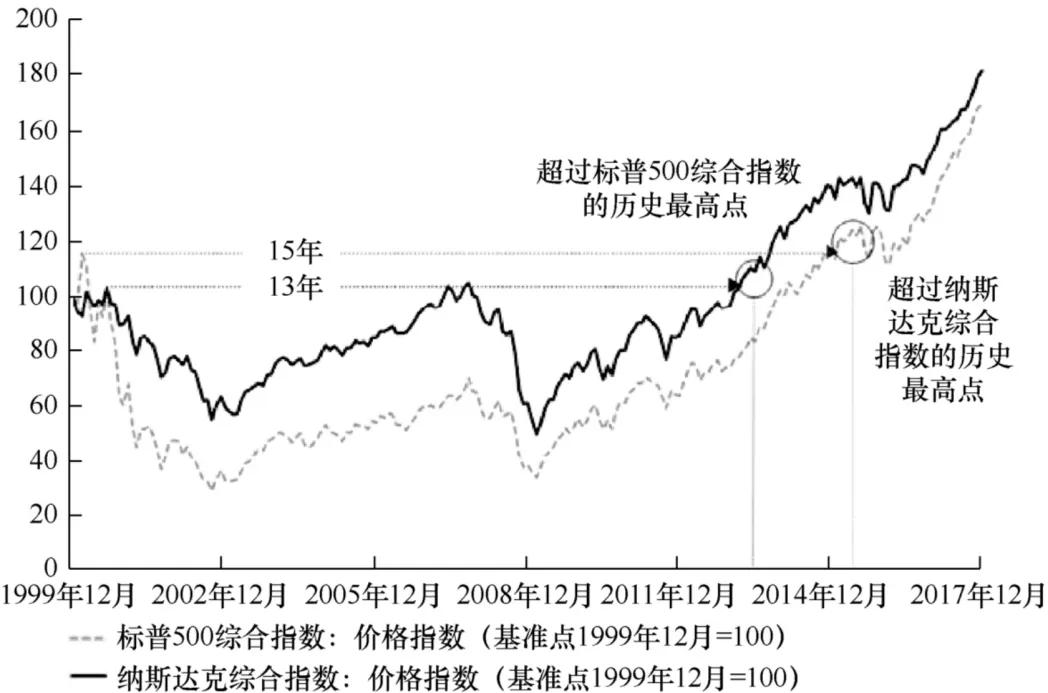
The information age saw an unprecedented huge bubble burst. After this huge bubble burst around 2000, most stock markets took at least more than ten years to get out of the haze of losses.
Why did this bubble cause such huge damage?
Investors were overly optimistic about the disruptive power of the Internet in the short term, firmly believing that the Internet would completely subvert traditional business models.
The problem is that the Internet did bring subversion, but that was slowly realized many years later. At that time, there was no reliable business model. Netscape, which profited from selling browser licenses, and the portal Yahoo were taken as benchmark enterprises, with their stock prices soaring to the sky.
Some emerging enterprises that did not even have mature businesses could also get high valuations. Even a business plan with an "e-" at the beginning and a ".com" at the end could exchange for tens of millions of dollars in real money.
Moreover, at that time, the United States stood out in the global economy: the Soviet Union had disintegrated, the Japanese economy was in a downturn, and the Asian financial crisis broke out. Only the US economy was growing, all of which were regarded as super positive factors for the US stock market. Investing in US stocks, just like investing in real estate in previous years, became the "guaranteed profit" belief in the hearts of many people, and the market had abundant liquidity.
Internet stocks were in short supply, and Wall Street kept launching IPO projects to meet the public's demand for Internet stocks.
The stock market bubble did not seem to have a hissing process, but burst all at once.
On March 10, 2000, the Nasdaq hit its all-time high. A few days later, the financial reports of major Internet companies were released, all falling short of expectations, and investors began to panic. A report at that time pointed out that 71% of the more than 200 Internet companies had negative profits, and 51 of them would burn out their cash within a year. The report was titled "Burned Out".
The Federal Reserve also felt that the bubble was too big and began to raise interest rates; some star companies that had skyrocketed before but lacked profit models were ordered to delist. By October 2002, the Nasdaq index had fallen to only a quarter of its peak level.
At that time, the media predicted that 5 trillion US dollars of wealth vanished into thin air in this bubble burst.
The Essence of Bubble Burst
The burst of tech bubbles is essentially caused by the split between financial capital and productive capital.
Productive capital refers to the capital used to purchase raw materials, equipment and hire labor, directly participating in the process of commodity production and circulation; financial capital indirectly enters the production field through investment, lending, securities trading and other methods.
Productive capital focuses on the real economy, buying machines, developing technologies, recruiting and training talents, opening up markets, providing good after-sales services, etc. While financial capital plays in the virtual field, realizing "making money generate money" by discovering and investing in good projects. This also determines that the cycle of obtaining returns through productive capital is longer, while that of financial capital is shorter.
Observing from this perspective, it is not difficult to see that the degree of harm caused by the three tech bubbles depends on the degree of separation between financial capital and productive capital.
The industries such as automobiles and aircraft in the electrical age only produced partial bubbles, which were far less harmful than the railway bubble and the Internet bubble. This is because financial capital did not excessively deviate from productive capital. It is a bit like today's new energy vehicle industry: although dozens of brands are competing and there are bubbles, it is more regarded as a manifestation of industry involution and excessive competition.
However, the railway bubble and the Internet bubble completely entered a frenzy stage that was severely separated from cash flow and dominated by financial capital. At this time, financial capital believed that it had full ability to create wealth through its own actions, and productive capital was only the object manipulated and speculated by financial capital, resulting in the imbalance between book wealth and real wealth, and between real profits or dividends and capital gains, which finally ended in collapse.
In the book *Technological Revolutions and Financial Capital*, economist Carlota Perez introduces the relationship between financial capital and productive capital in different stages. The stage when the two are severely divided is when the bubble is blown to burst, and also the period with the greatest destructive power of technological transformation.
But at the same time, new technologies also use sufficient funds to conduct crazy trial and error at this stage, lay new infrastructure, popularize new technologies and new industries by creating wealth in the short term, so that using new technologies to do things becomes a "common sense".
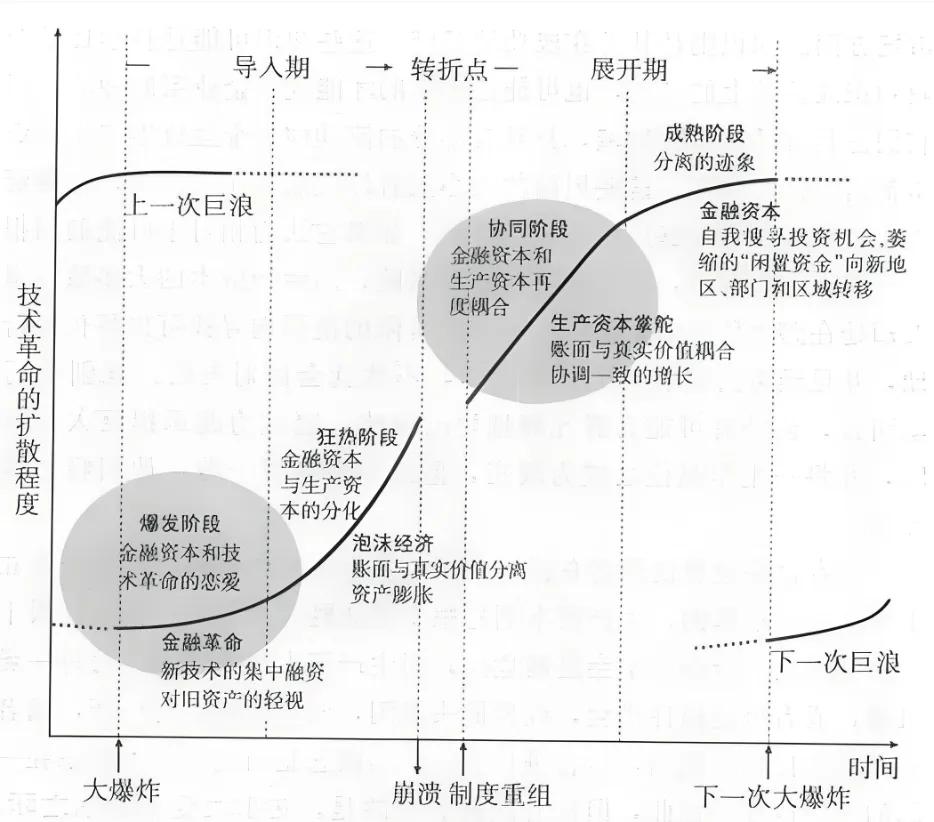
The synergistic stage of the two after the bubble bursts is the "golden period" when technologies truly transform industries. Financial capital returns to reality, is constrained by new rules and systems, and serves productive capital again. Most industries also begin to widely apply new technologies, with productive capital taking the lead again to create real growth and dividends.
This has also been confirmed in reality. During the "railway bubble", stock prices were pushed up by high expectations around 1850, and collapsed due to panic in 1857. The real productive dividends did not appear until the early 1860s after the completion of the national railway network.
Similarly, after the Internet bubble burst, the real dividends were actually cashed in the first decade of the 21st century, and began to transform all walks of life.
Therefore, financial capital acts as a role of digesting uncertainties in advance, while productive capital needs time to build infrastructure and transform organizational forms. The final wealth growth still depends on real output.
The Unknowability of Bubbles
For early warnings of bubbles, the book *Bubbles and Crashes: The Boom and Bust of Technological Innovation* mentions a key rule: technology itself does not spawn bubbles. Only the resonance of "high uncertainty + strong narrative + tradable carrier" can detonate a speculative boom.
Uncertainty Dimension
Uncertainty mainly includes uncertainties in technical routes, market competition, business models and value chains, as well as market demand. The more uncertainties there are among these factors, the greater the possibility of sharp rises and falls. On the contrary, if all these become clear, the possibility of bubbles will weaken.
Narrative Dimension
"Before a company truly becomes successful, it is actually just a story about an 'imagined future'", which means that behind every kind of "technological narrative" are various expectations and speculations of people about the future — essentially, it is people's "bet" on the future direction.
The strength of the "technological narrative" depends first on the imagination space. The more future imagination scenarios a technology can support, the easier it is to be sought after by more people.
Take the railway bubble in the past as an example. Railways were not only the blood vessels for bulk cargo transportation, but also related to urban expansion. If railways were built to everyone's doorstep, they would also benefit people's daily travel and be of great help to the upgrading of international trade, thus attracting more people to invest.
The Internet also initially created a beautiful vision of transforming all aspects of people's daily life, attracting people from different classes to invest in the future.
Secondly, it depends on the length of the verification period. The longer the narrative that cannot be verified, the greater the possibility of bubbles. Canals, railways, electricity, the Internet, and AI all require a long time to lay infrastructure, during which a large number of speculative behaviors will breed.
Finally, there is the understanding threshold of the narrative. Technologies are generally very complex. If a complex technology is described as extremely close to ordinary life and the investment threshold is relatively low, it will have greater communication power, spread more widely and attract more people to follow.
Tradable Carrier
It actually refers to companies that are highly bound to a certain technology and carry the narrative of this technology. Investors regard them as explorers who realize the technology, and buy the "technological narrative" by buying their stocks.
For example, Tesla emerged as a symbol of new energy vehicles, and Elon Musk is also a topic figure who often attracts public attention. But Tesla eventually fulfilled the promises in its story. However, in that wave of new energy vehicle manufacturing, there were not only Tesla, but also a series of names that flashed past quickly such as Fisker, Dyson, Bright, and Coda, which also carried this narrative and attracted some investors.
AI investment targets are enterprises related to the industrial chain such as cloud computing, chips, and large models. When there are too many of these carriers and most of them have no actual performance support, valuation can only be driven by story hype, and the bubble will grow bigger and bigger. Just like during the Internet bubble, more than 70% of the more than 200 Internet companies had negative profits, which was