FDE has gone viral, check its master data first.
Three sets of growth rate calibers are mutually exclusive, and there are two competing etymologies for the word Delta. A popular buzzword still has no unified master data of its own.
In October 2026, a line appeared in the official document Gong Xin Ting Ke Han [2026] No. 414: "Encourage service providers to build Frontline Deployment Engineer (FDE) teams, take root at user sites, and ensure scenario implementation". An English abbreviation being included in a national-level document is rarely seen in China's industrial policies.
In the same month, I spread all the domestic and international materials about FDE on the table, trying to make the most basic form for it — what it is, where it comes from, and how much it has grown. But I got stuck at the very first step: the mismatched contents outnumber the matched ones.
This should have been an awkward situation. But for people engaged in data governance, it is a very familiar scenario: a popular buzzword, a pile of conflicting figures, and a batch of second-hand accounts with unknown sources. Isn't that exactly what we deal with in enterprises every day?
So this article will not discuss "how popular FDE is", nor will it evaluate whether it is a type of outsourcing. It only does one thing: use the skills of data governance to break down the FDE story, and see what usable things it can leave for data practitioners.
I. First Conduct Fact Verification: Three Mismatched Tables
Let's look at the timeline first. I arranged all publicly available statements I can find by year, and directly marked out all the divergences.
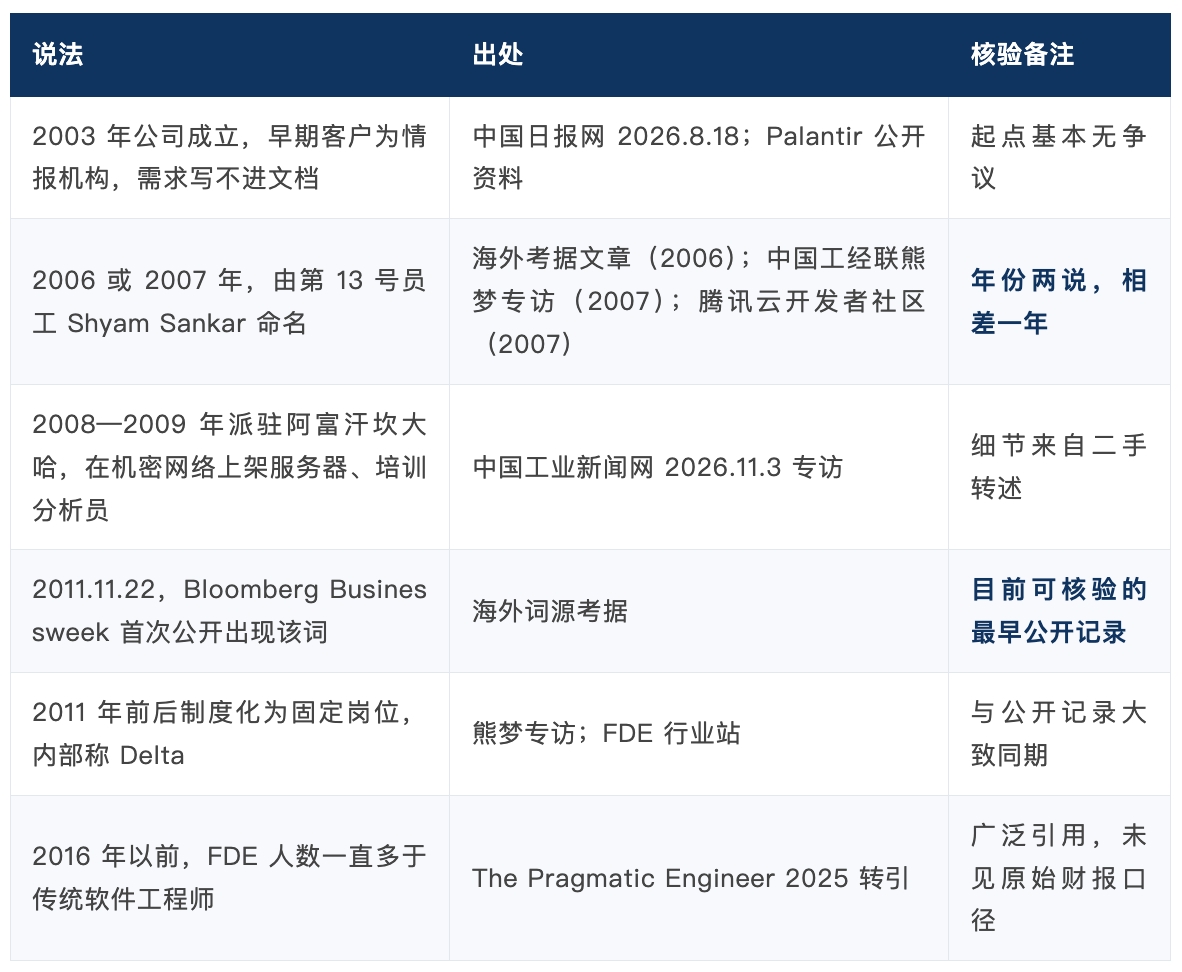
Then look at the growth data, which is the most cited and the most chaotic set of figures.
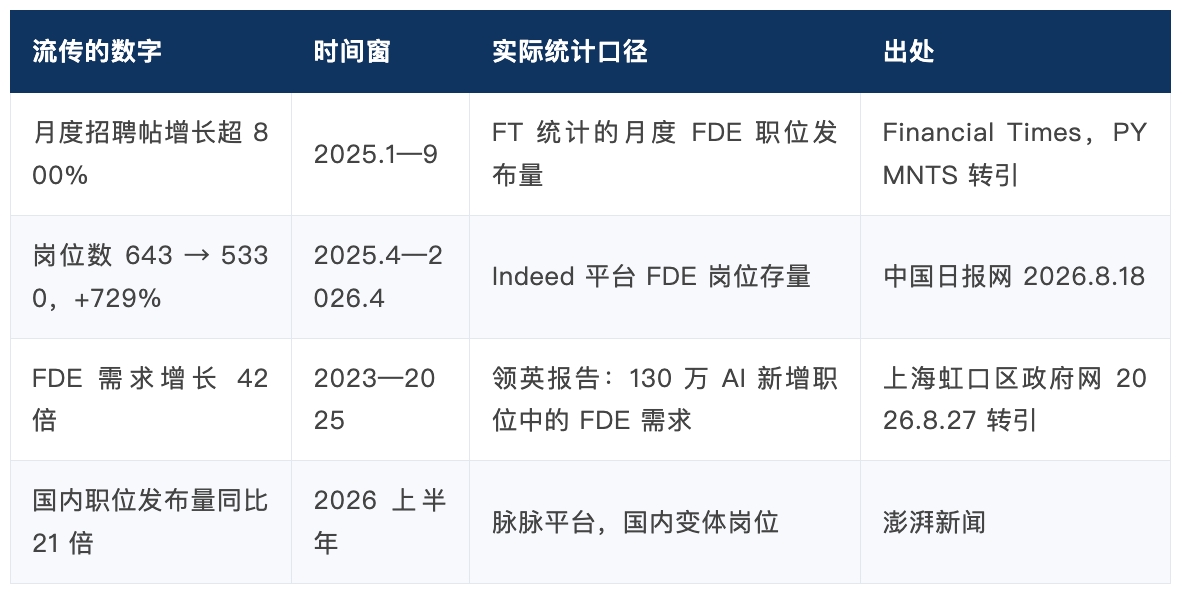
Four figures, four different denominators: monthly new posts, stock of positions on platforms, multiple of demand, year-on-year growth on domestic platforms. The time windows range from 9 months to 2 years. What's more troublesome is that the statistical objects themselves are inconsistent — the article on China Daily clearly states that domestic variant positions such as "solution architect", "industry delivery specialist" and "customer success engineer" are all increasing sharply, "although the names are different, the work they do is highly similar". So are these positions counted as FDE? The four statistical parties most likely gave four different answers.
The conclusion is very simple: These four figures cannot be added, cannot be interchanged, and cannot be drawn into the same trend chart. But they are mixed and used on the Internet, with a sentence of "FDE positions skyrocketed by 800%" followed by a sentence of "year-on-year growth of 42 times". Readers may think they confirm each other, but in fact they come from two different tables.
There are two more "facts" that are more thought-provoking.
The first is the etymology of the internal code name Delta. In an exclusive interview with Xiong Meng, the explanation is that "the metaphor of Delta Force was deliberately borrowed to emphasize that they are on-site operation personnel". However, Palantir publicly explained in 2019 that in the early stage, each business development team was named according to the NATO phonetic alphabet: Delta was assigned to frontline deployment engineering, and Echo was assigned to Deployment Strategist. The two statements are mutually exclusive, and the latter is the caliber of the party concerned.
The second is the article "The Rise of the Forward Deployed Engineer" that has been repeatedly attributed to Shyam Sankar. Overseas etymological research points out that Sankar has never written an article with this title. The title of the later author was mistakenly attributed to him in retrospect. Interestingly, when I sorted out popular articles last month, I also attributed this article to others according to the common statement — this is a living sample of how fast second-hand citations spread.
Authoritative institutions have actually made their positions clear. In its June 2026 report *The Role of Forward Deployed Engineers in Enterprise Intelligence Services* (#US54332126), IDC wrote that the FDE label "has outrun a single working definition". It also splits FDE into three "non-interchangeable" forms: vendor-owned FDE, GSI (large system integrator) FDE, and independent deployment company FDE, and records a term coined by two enterprises in the interview: "FDE washing", which refers to labeling positions that do not affect product development and do not produce measurable results as FDE.
Law 1|Buzzword Caliber Convergence Law: The speed at which a concept changes from a technical term to a market label is always faster than the speed at which its definition is fixed. Before the authoritative definition converges, all figures related to it are only external data, which can be cited but cannot be included in formal accounts.
Mechanism: Decentralized naming rights → All parties label according to their own recruitment and statistical calibers → Denominator drift → Figures seem to confirm each other, but are actually not comparable.
Inference: When you receive any report task of "something has grown N times", the first deliverable for data practitioners is not a chart, but a caliber ruling table: who conducted the statistics, what the statistical object is, the time window, which position variants are included, what is excluded, and whether it can be compared with the previous figure.
Golden Quote: Unify the master data before talking about trends. Otherwise, the curve you draw is not a single trend, but three different tables stacked together.
II. The Policy Stipulates "Taking Root at the Site", But the Sticking Point Is "Inaccessible Data"
Looking at the full text of Document No. 414, you will find it is quite restrained. Its goal is to have the service provider resource pool exceed 2000 by the end of 2026, and no less than 3000 by the end of 2027; the third task requires "opening a batch of real scenarios", "encapsulating and building modular and standardized solution product packages, and forming a batch of "small, fast, lightweight and accurate" AI product services"; the fourth task is the sentence "encourage service providers to build Frontline Deployment Engineer (FDE) teams, take root at user sites, and ensure scenario implementation".
Make sure there are accessible real scenarios before sending personnel to the site. The order cannot be reversed.
The interview published by China Industrial News on November 17, 2026 listed the difficulties more straightforwardly. Among the six major problems sorted out by experts, the second one is that data is "inaccessible, unusable due to concerns, and cannot be used properly"; the fifth one is that "delivery is highly non-standard, acceptance standards and effect evaluation are missing, and large-scale promotion is difficult". Xia Jiansong, a front-line observer, judged that nearly half of the "AI+" application scenarios are stuck in the pilot stage. Lu Feng from Beijing Frontier Future Technology Industry Development Research Institute said that the scarcest resource is "delivery-type service providers that can effectively connect multi-models, multi-data sources with customers' business KPIs". Among the six types of gaps listed by Wang Xiang from China Green Supply Chain Alliance, the second type is "data service providers that provide data governance, high-quality data sets, and trusted data spaces".
Overseas calibers surprisingly match. In its June 2026 report, IDC stated that only 15% of organizations reported that more than 75% of their AI projects have produced measurable results; in the benchmark assessment of about 1900 institutions in May 2026, 50% are still at the Opportunistic maturity level. IDC's most critical judgment is: the constraint on FDE value is the client's own operation model readiness, not provider capability.
This sentence is worth posting on the wall of every data center. It is equivalent to saying that spending a lot of money to invite external personnel cannot solve the problem that your own "ground" has not been leveled.
Sankar's sentence that has been cited for 18 years means the same thing: "if a problem could be solved through a requirements document, it would have been solved already". The site is not for collecting requirements, but for generating requirements: the caliber is only determined the moment a real document is generated, and all previous definitions are just guesses.
Front-line domestic statements are even more unreserved. In a September 2026 report from Lei Feng Network, the commercial director of Data Agent from a BI manufacturer said directly: "We will not take on projects with very poor data foundation, and let the client do data governance first". The same report also pointed out the old problem of semantic layer: Huawei internally calls PPT "film", this kind of corporate jargon, as well as different names for the same concept in different businesses, require manual semantic alignment one by one, which cannot be solved only by large models. The August 2026 article on China Daily wrote more specifically: A large amount of key knowledge in China's manufacturing industry exists in the experience of veteran technicians and paper SOPs, rather than structured data. After FDE personnel enter the site, they often have to spend a lot of time doing the "dirty and tiring work" of data governance and knowledge sorting, and the efficiency is far lower than that of overseas clients with higher informatization maturity.
That is to say, a considerable part of the high salary for FDE is used to make up for the historical arrears of data governance for enterprises.
Law 2|Connection Cost Preposition Law: The part with the highest failure probability in AI projects is not the model, but the segment that "connects the model to real data". This cost almost all falls into the account of data governance, but rarely appears in the AI project initiation budget.
Mechanism: Model capabilities are general → All differences lie in the objects, calibers, permissions and processes on the enterprise side → These contents will not appear in PoC demonstrations → The demonstration passes, but the connection gets stuck → The project stops at the last kilometer.
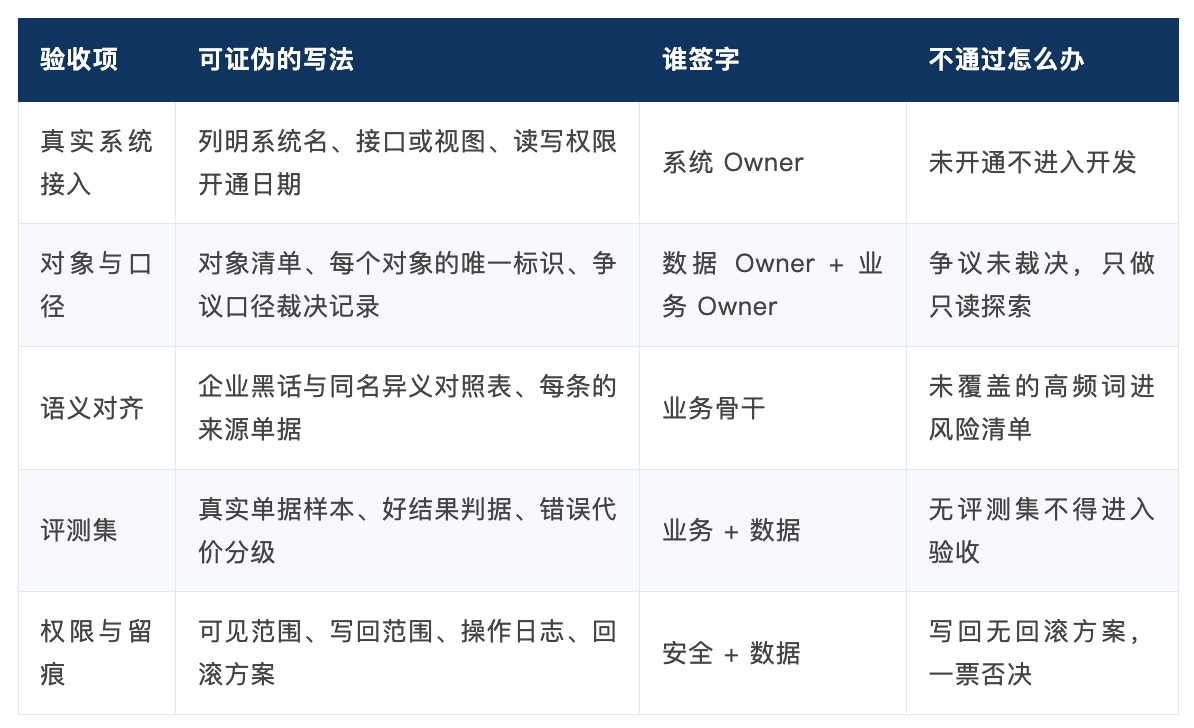
Inference: Rewrite "connection" from implicit workload to verifiable acceptance items, and include it in project initiation and acceptance, instead of only keeping it in weekly meeting minutes.
The table below can be directly added to the solution. Note that every item needs to be "falsifiable" — clearly state what degree counts as unaccomplished.
Golden Quote: It's not that AI cannot be implemented, but that the "ground" has not been leveled. Leveling the ground has always been the work of data governance, but it has never been listed as a separate budget item.
III. After Three Months of On-site Work, Who Has Learned the Skills
There is a sentence in an overseas industry dictionary that made me pause for a long time after reading it: "When an FDE spends three months in your warehouse, the vendor learns… In both cases the party that learns least by default is you, unless you insist on it." The FDE stays in your warehouse for three months, and the vendor learns the most; by default, you learn the least, unless you take the initiative to ask for knowledge transfer.
This is not a moral issue, but a business model. In its article *Trading Margin for Moat* (June 2025), a16z calculated the accounts clearly: services are sold at cost, and gross profit is earned from software subscriptions. For example, ServiceNow had a gross profit margin of 63.2% when it went public, which rose to 79% by 2024; Workday's gross profit margin rose from 54.1% to 75%. So vendors are willing to subsidize personnel deployment — the pitfalls encountered on site will be turned into connectors, default configurations, and lower deployment costs for the next client. The essential difference between the three FDE forms defined by IDC is only "who the on-site experience flows back to": vendor FDE flows back directly to their own products, GSI FDE needs to be filtered through the system integrator's own delivery methodology, and independent deployment company FDE must deliberately route feedback back to the laboratory.
The domestic industry has made this point even clearer. The China Daily article pointed out that "after the project is completed and the personnel leave, the capabilities are taken away too, and the next factory still has to start from scratch". A widely spread technical critical article is even more unsparing: people only copied the easiest part — on-site deployment, but removed the mature platform, real data, business leaders, front-line users, write-back permissions, and product feedback mechanism, "in the end, there is only an engineer sitting in the client's office, with the title of FDE". The capability list from Tencent Cloud Developer Community supplemented the most critical one among the four domestic constraints: there is a deep tradition of on-site deployment, but the product flywheel is missing — traditional on-site deployment follows the logic of manpower outsourcing, and nothing is left after the personnel leave; it also reminds that "acceptance standards are not only quality documents, but also the basis for payment collection".
Local variants have already emerged: "FDE + Productization" precipitates high-frequency scenarios into standard modules, and "FDE + Training" cultivates the client's internal operation personnel at the same time of delivery. Hongkou District of Shanghai held an "FDE Enterprise AI Implementation Class" on August 26, 2026, where 20 large-scale enterprises brought real business problems and connected with 20 FDE experts one-on-one, following the mode of "enterprise problem diagnosis — expert matching — on-site solution co-creation". The direction is correct, but note that its output on that day was marked as "the first version of the implementation plan" — a solution does not equal retained assets.
Law 3|Learning Ownership Law: In an on-site project, the party that precipitates reusable assets is the actual beneficiary. The client's benefit does not depend on whether the personnel are on site, but on whether the "retained assets" are written into the exit conditions.
Mechanism: On-site experience is attached to the personnel by default → The personnel belong to the second party (vendor) → Experience flows back to the vendor's product → The client only gets a one-time system → The client needs to pay again for the next phase or the next project.
Inference: Do not write uncheckable wording like "knowledge transfer" in the contract, but include the following four sets of contents in the acceptance list one by one.
I wrote before that the knowledge precipitation rate determines whether FDE is just high-end outsourcing — that is from the perspective of the vendor's business model. From another perspective, for the client's data lead, the same thing is called "retained assets".
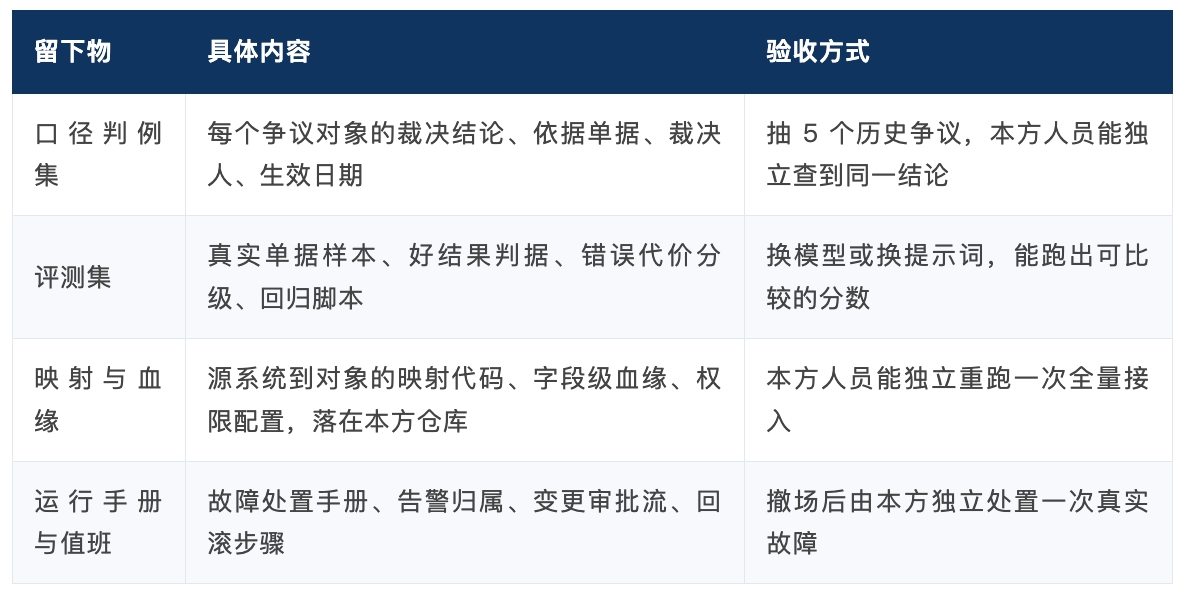
Golden Quote: The system remaining after the personnel leave does not count as capability transfer; it counts as capability transfer only when the caliber, evaluation, mapping, and on-duty mechanism can all be modified by your own personnel.
IV. Reversal: Palantir Has Turned FDE Into an Agent
We could have finished writing at this point. But there is something in Palantir