Up to a 238% surge: Are Japanese cosmetics brands bouncing back driven by the Asia-Pacific market?
Most Japanese cosmetics companies saw revenue growth in the first three quarters, with divergence intensifying on the profitability side.
In recent years, the performance of Japanese cosmetics companies has been under continuous pressure. Has their development improved in the first three quarters of 2026?
With Shiseido, Kose, Kao, POLA ORBIS and I-ne, the five Japanese cosmetics companies, having successively released their 2026 third-quarter reports, the performance landscape for the first three quarters has gradually become clear.
It is worth noting that as the third-quarter performance results are released, most Japanese cosmetics companies have generally maintained a growth trend in their China-related businesses, and the recovery signals of some enterprises in duty-free and offline channels have further strengthened, according to the collation by Jumeili.
Further breaking down the 2026 first-three-quarter reports of the five Japanese cosmetics companies, the following information is also worth noting:
1. Performance has fully rebounded, with all five companies achieving year-on-year growth in sales revenue, among which I-ne recorded the largest increase of 24.6%; however, the profitability performance of each company varies significantly.
2. The Chinese market and travel retail are recovering. With the rebound in demand on Hainan Island and the restart of business of duty-free enterprises, companies such as Shiseido and Kose have returned to the growth track in Asia-Pacific and China-related markets.
3. The differentiation among major enterprise brands is obvious. Drunk Elephant and Anessa under Shiseido declined by 16% and 11% year-on-year respectively, while Clé de Peau Beauté and NARS achieved growth; Tarte, Puri and DECORTE under Kose achieved double-digit growth; the core POLA brand recorded a slight drop of 0.6%, while ORBIS saw a 5.0% increase;
Profit Divergence Among the Five Japanese Cosmetics Companies
In the first three quarters of 2026, the five Japanese cosmetics companies all achieved year-on-year growth in total sales revenue, but their profitability trends varied.
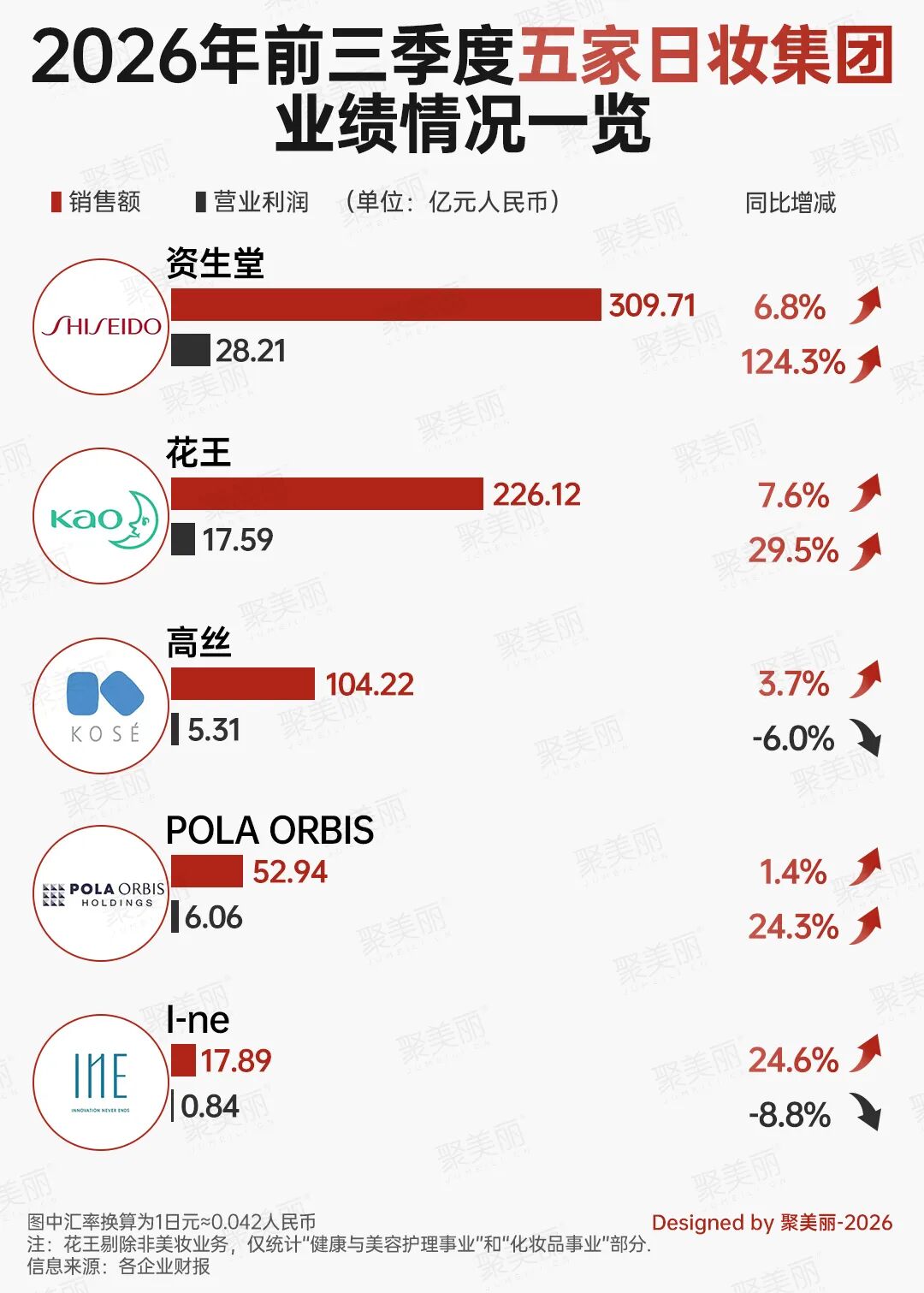
In terms of sales scale, if the business caliber is uniformly defined as beauty and personal care related, Shiseido still ranks first.
In the first three quarters of 2026, Shiseido ranked first among the five Japanese cosmetics companies with sales of 741.1 billion yen (about 30.971 billion RMB), up 6.8% year-on-year, with a real growth of 0.7%.
Excluding the home care and chemical business of Kao, only counting the "Health and Beauty Care Business" and "Cosmetics Business", the total sales reached 541.1 billion yen (about 22.612 billion RMB), of which health and beauty care increased by 6.2% year-on-year, and the cosmetics business increased by 10.1% year-on-year.
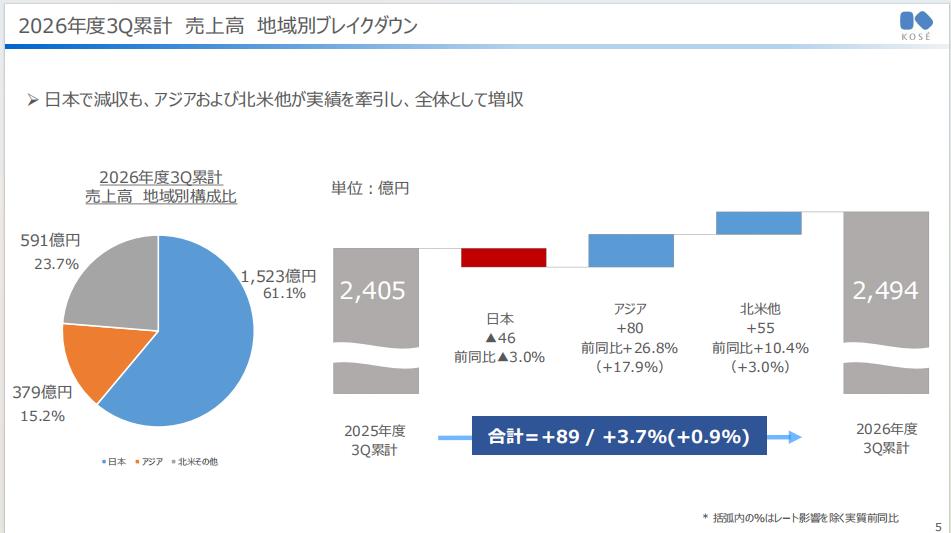
Kose achieved sales of 249.4 billion yen (about 10.422 billion RMB), a slight year-on-year increase of 3.7%; POLA ORBIS and I-ne are smaller in size, recording 126.67 billion yen (about 5.294 billion RMB) and 42.814 billion yen (about 1.789 billion RMB) respectively. Kose's sales increased by 1.3% year-on-year, while I-ne is the company with the highest sales growth rate among the five, surging 24.6% year-on-year.
However, in terms of profitability, the performance of each company is quite different.
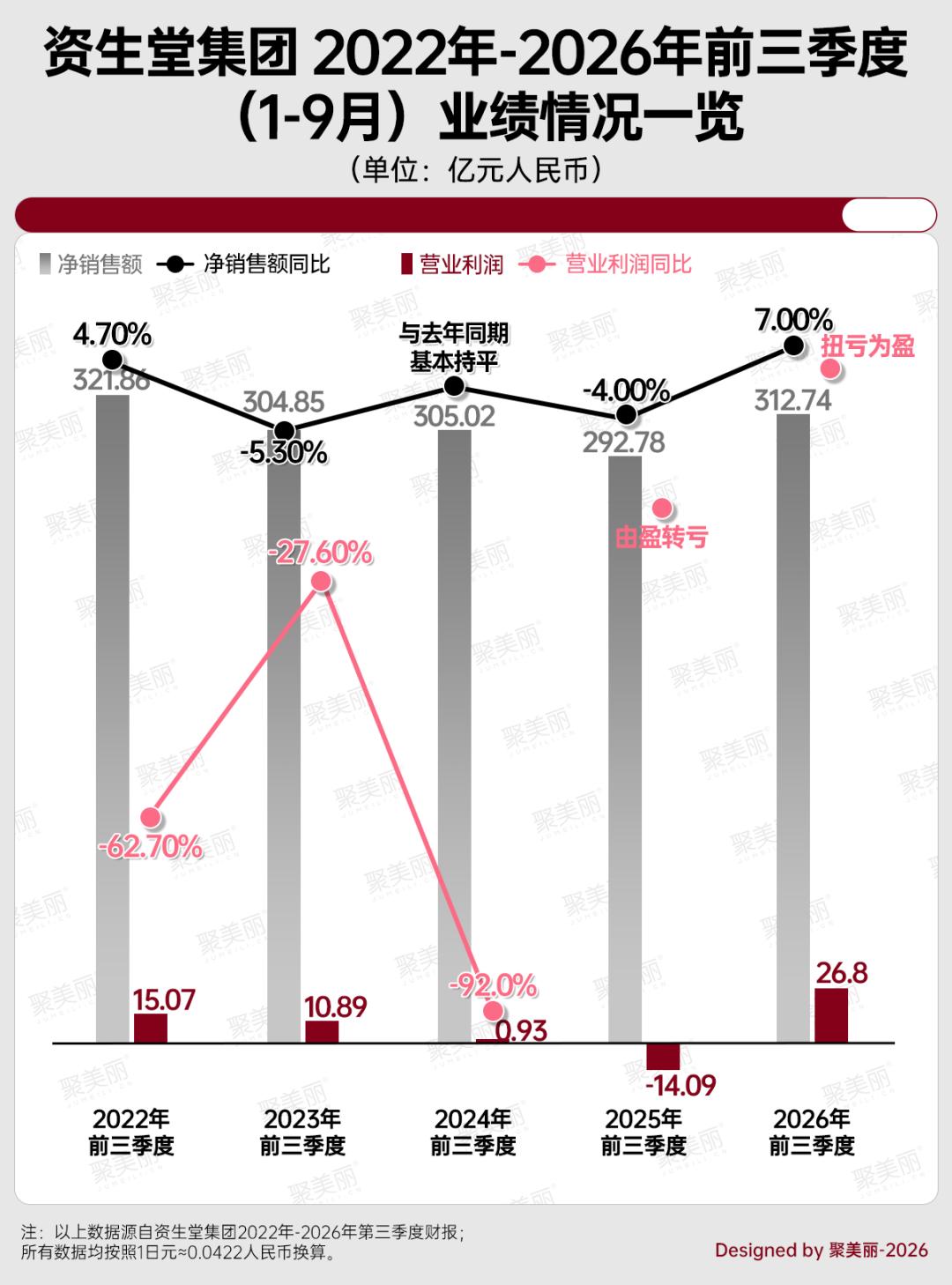
Shiseido has become the company with the most significant profit rebound. In the first three quarters, its core operating profit reached 67.5 billion yen (about 2.821 billion RMB), a year-on-year surge of 124.3%; the operating profit turned from a loss of 33.4 billion yen (about 1.396 billion RMB) in the same period of last year to 63.5 billion yen (about 2.654 billion RMB); the attributable net profit also reached 44.4 billion yen (about 1.855 billion RMB).
The financial report points out that this is mainly due to the advancement of the "Action Plan 2025-2026", which has achieved a total cost reduction of 72 billion yen (about 3.009 billion RMB) from 2024 to 2026; at the same time, non-recurring items such as the goodwill impairment of the American business accrued in the same period of last year have been greatly reduced this year.
Looking at the performance of the first three quarters in the past five years, this is the first time that Shiseido has recorded double growth in net sales and operating profit in the past five years.
Kao also delivered a report card of simultaneous growth in revenue and profit when only counting the two core businesses of "Health and Beauty Care" and "Cosmetics". The total operating profit of these two businesses reached 42.1 billion yen (about 1.759 billion RMB), an increase of 29.5% year-on-year. Among them, the cosmetics business directly related to the beauty sector performed the most impressively, with operating profit rising from 2.9 billion yen (about 121 million RMB) in the same period last year to 9.8 billion yen (about 410 million RMB), a year-on-year surge of about 238%, making it the company with the highest profit growth in the cosmetics business among the five.
In contrast, Kose and I-ne are facing the challenge of declining profits.
In the first three quarters of 2026, although Kose's sales increased slightly by 3.7%, its operating profit fell by 6.0% year-on-year to 12.7 billion yen (about 531 million RMB), and the attributable net profit plummeted by 25.6% to 6.9 billion yen (about 288 million RMB), the largest drop in attributable net profit among the five.
In response, Kose explained that the negative contributions from the ALBION business and KOSÉ Cosmeport business offset the growth of DECORTE and Tarte;
At the same time, the decline in net profit was also affected by the 2.4 billion yen (about 100 million RMB) special severance payment generated by the implementation of the voluntary retirement plan "Special Life Challenge".
Focusing on the situation of I-ne, in the first three quarters of 2026, its sales surged 24.6% year-on-year to 42.814 billion yen (about 1.789 billion RMB), but operating profit fell 8.8% to 2.013 billion yen (about 84 million RMB), and attributable net profit dropped 15.7% to 932 million yen (about 39 million RMB). The financial report points out that this is mainly affected by the amortization expenses of goodwill and intangible assets brought by the acquisitions of Tout Vert, Artemis and other companies in 2024.
POLA ORBIS's performance is relatively stable, delivering a report card of simultaneous growth in revenue and profit, with operating profit rising 21.3% to 145.0 billion yen (about 606 million RMB), and attributable net profit rising 20.0% to 918 million yen (about 384 million RMB).
Performance Divergence Among Major Brands
Focusing on the overall performance of the brands under the five Japanese cosmetics companies in the first three quarters of 2026, it can be found that high-end beauty products and best-selling items play a significant driving role, but the polarization between brands still exists.
As the largest Japanese cosmetics group, Shiseido saw the performance of its brands in the first three quarters of 2026 continue the "two extremes" pattern of the first half of the year. Among Shiseido's global core brands, half achieved growth and half recorded decline.
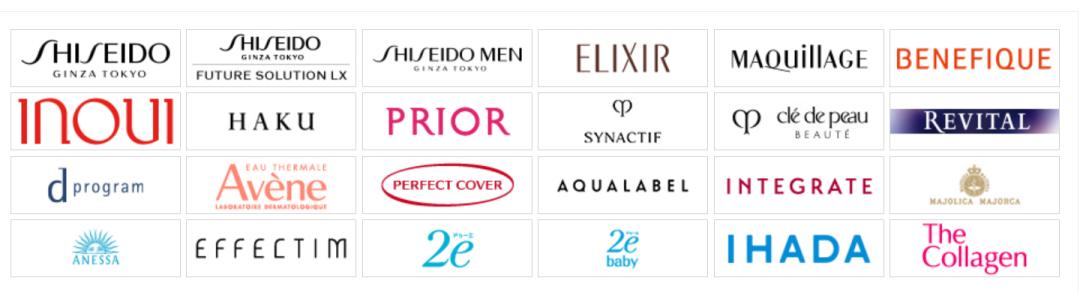
Source: Screenshot from Shiseido official website
The financial report shows that core brands are accelerating their recovery. Among them, Clé de Peau Beauté (abbreviated as CPB), NARS, and Elixir all achieved year-on-year growth of around 3%, while the perfume business and BAUM grew by 4% year-on-year.
In contrast, 5 brands under Shiseido recorded declines: Drunk Elephant fell by 16% year-on-year, Anessa by 11%, IPSA by 6%, Dr. Dennis Gross Skincare by 10%, and the core SHISEIDO brand recorded a slight drop of 1% year-on-year.
Among them, the double-digit decline of Drunk Elephant and Anessa continued the trend of the first half of the year, and they are the main "drag factors" in Shiseido's brand matrix.
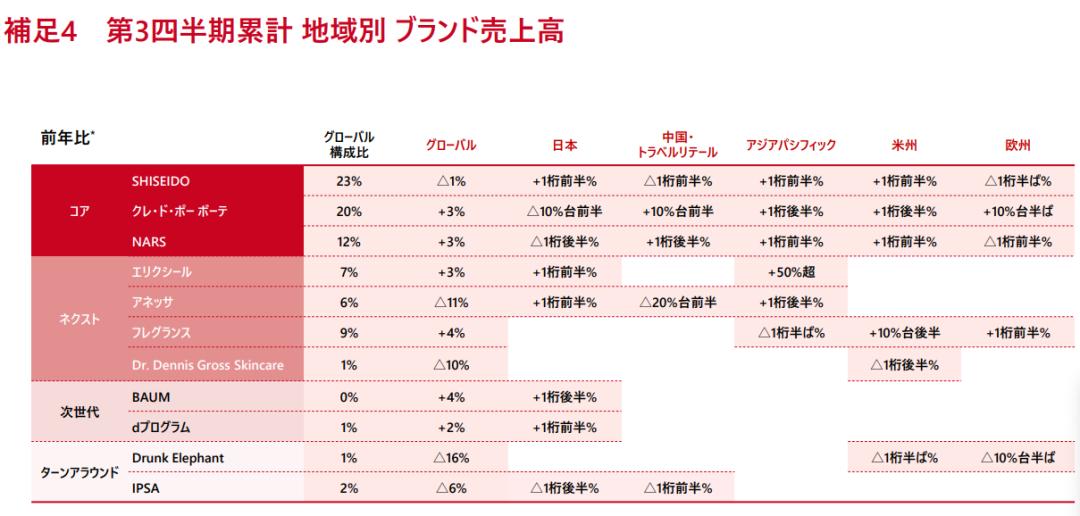
Source: Shiseido 2026 Q3 Financial Report
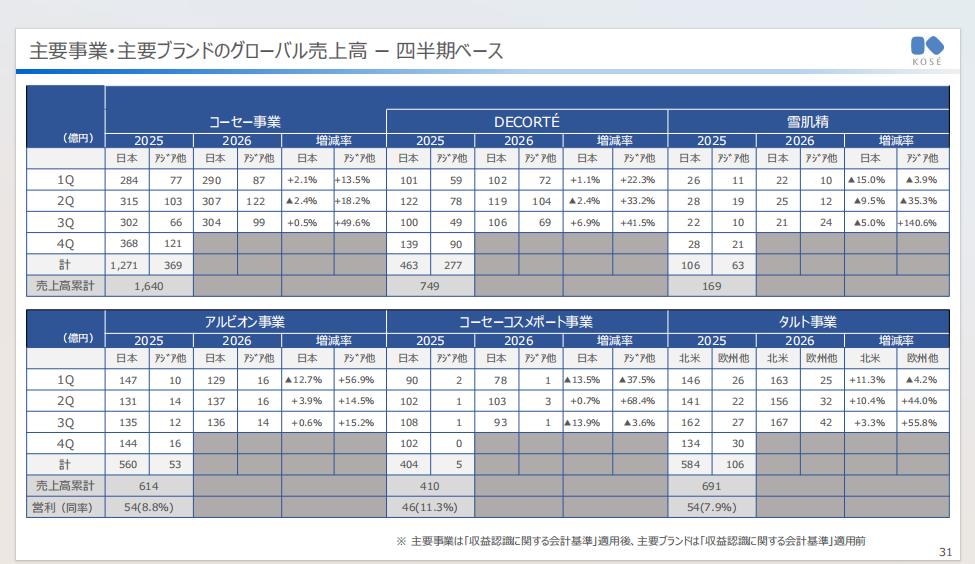
For Kose, the brand performance in the first three quarters of 2026 shows obvious polarization.
According to the financial report, the growth camp performed impressively. Driven by the core best-selling Shape Tape Concealer in the Sephora channel and the strong momentum of TikTok e-commerce, Tarte's store turnover and shipment volume both hit record highs; Puri's global sales increased by 39.2% year-on-year, and by 27.5% in local currency terms, mainly benefiting from strong local sales in Thailand and contributions from new stores; DECORTÉ maintained overall double-digit growth, with its high-end AQ series performing strongly in the Chinese market.
In sharp contrast, the cosmetics business where KOSÉ Cosmeport is located declined by 5.0% year-on-year, among which Clear Turn declined significantly due to intensified market competition; ALBION recorded a slight drop of 0.2% year-on-year, mainly dragged down by the sluggish duty-free channels in Japan.
Source: Kose 2026 Q3 Financial Report
The differentiation of brands under POLA ORBIS is also significant.
In the first three quarters of 2026, the core POLA brand recorded sales of 65.607 billion yen (about 2.742 billion RMB), a slight year-on-year drop of 0.6%, but operating profit surged 15.7% under cost reduction and efficiency improvement; by channel, domestic sales in Japan fell by 4.0% year-on-year; overseas business surged 20.8% year-on-year, mainly driven by the B.A series in the Chinese market.
The ORBIS brand recorded sales of 39.374 billion yen (about 1.645 billion RMB) in the first three quarters, up 5.0% year-on-year; operating profit reached 7.92 billion yen (about 331 million RMB), up 15.3% year-on-year. Among them, domestic direct sales channels increased by 1.6% year-on-year, and external channels (drugstores, multi-brand stores, etc.) surged 23.4% year-on-year; however, overseas business fell by 37.9% affected by the liquidation of its Beijing subsidiary.
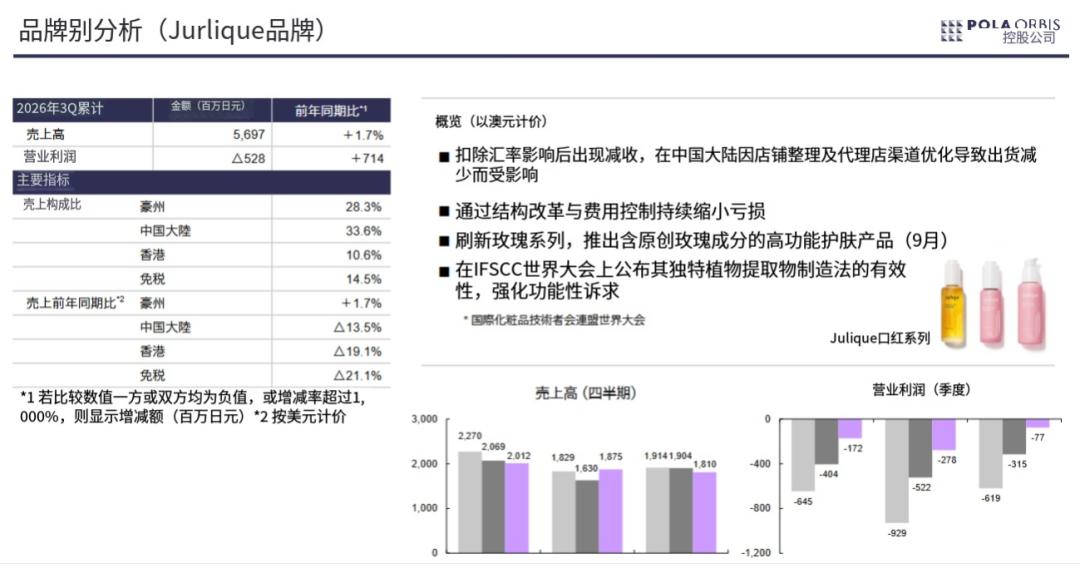
The Jurlique brand recorded sales of 5.697 billion yen (about 238 million RMB) in the first three quarters, up 1.7% year-on-year; operating loss reached 528 million yen (about 22 million RMB), which was significantly narrowed compared with the loss of 1.242 billion yen (about 520 million RMB) in the same period of last year.
Source: POLA ORBIS 2026 Q3 Financial Report
Performance in China Continues to Rebound
As an important fundamental market for Japanese cosmetics companies, the performance of China and Asia-Pacific markets has attracted much attention. From the perspective of the first three quarters of 2026, Japanese cosmetics brands show obvious recovery momentum in the Asia-Pacific region.
Kose's performance in the Asian market is particularly impressive. In the first three quarters of 2026, sales in this region surged 26.8% year-on-year to 37.9 billion yen (about 1.584 billion RMB), the fastest growth rate among the five companies.
The financial report states that this is mainly due to the recovery of China's duty-free channels and the expansion of business in Southeast Asia (such as Puri in Thailand).
In addition, according to the channel data released in the financial report, in the first 9 months of 2026, the net sales of China's travel retail (TR) channels rebounded sharply, up 61.5% year-on-year, and up 53.1% year-on-year in local currency terms; the net sales of China's e-commerce (EC) channels also achieved 25.3% year-on-year growth. The dual recovery of China's online and duty-free channels has also driven its overall performance in Asia.
Source: Kose 2026 Q3 Financial Report
Shiseido's