The 4-Trillion-Yuan Semiconductor Opportunity: Who Will Benefit
Following the traditional growth logic of the semiconductor industry, the expansion of market scale usually means an increase in chip shipments, wafer starts, and more end products entering the market. However, the advent of AI has overturned this set of logic.
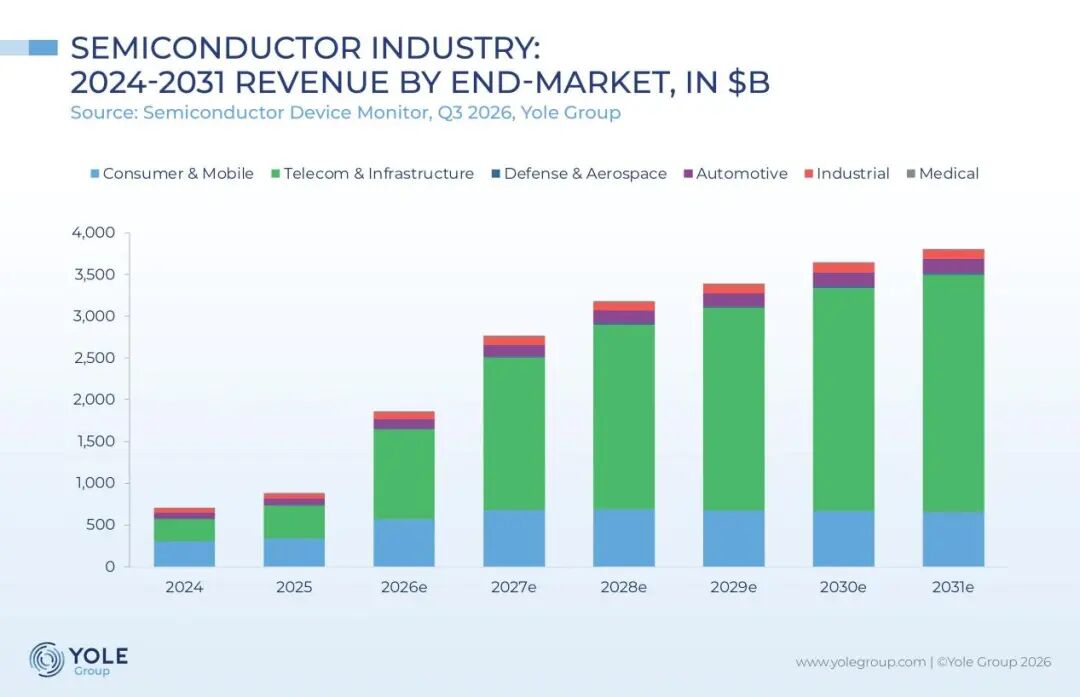
According to the latest forecast from well-known analysis institution Yole Group, the global semiconductor device market is expected to grow from about 707 billion US dollars in 2024 to nearly 4 trillion US dollars in 2031. What is particularly noteworthy is that during this period, semiconductor device revenue will surge by more than 400% compared with 2024, while shipments will "only" increase by about 50%. This set of data shows that the semiconductor industry is going through a growth cycle different from any previous ones.
At a recent exchange meeting, Gary Huang, Corporate Vice President of Yole Group and Chief Customer Strategy Consultant for Asia, also shared his views on this change.
A distinct chip cycle, with storage emerging as the big winner
Readers familiar with the semiconductor industry know that semiconductors are a highly cyclical industry. In recent years, driven by AI, semiconductor demand that had been depressed for several years has ushered in explosive growth. According to Gary Huang, this round of semiconductor growth is mainly supported by three major driving forces:
First, AI infrastructure investment: Hyperscale cloud vendors, emerging cloud service providers (neocloud) and sovereign AI projects continue to increase capital expenditures (for example, Google Cloud alone has an order backlog of 460 billion US dollars); second, storage content: the HBM equipped on each AI accelerator has increased significantly, and the DRAM market is expected to reach 1.3 trillion US dollars by 2031, of which HBM accounts for about 56%; third, customized chips: the data center logic chip market is expected to reach 12.63 trillion US dollars by 2031, covering GPU, AI ASIC, CPU and DPU.
In terms of specific applications, the telecommunications and infrastructure sector of data centers has contributed most of the increments in this cycle. Statistics from Yole Group show that the revenue contribution of this sector will grow from about 264 billion US dollars in 2024 to about 2.85 trillion US dollars in 2031, and surpass the consumer electronics and mobile sector as early as 2026; followed by the consumer electronics and mobile sector, which will double in size to about 651 billion US dollars during this period thanks to the increase in storage content; in addition, although the contribution is relatively small, the automotive (about 170 billion US dollars) and industrial (about 108 billion US dollars) sectors are growing steadily.
"In the past, the growth of the semiconductor market was mainly driven by shipments. From PCs to smartphones, every expansion of end-user demand would drive the growth of chip shipments and wafer starts. AI is changing this growth model, and the market is shifting from pure quantity growth to dual-wheel drive of both quantity and value," said Gary Huang.
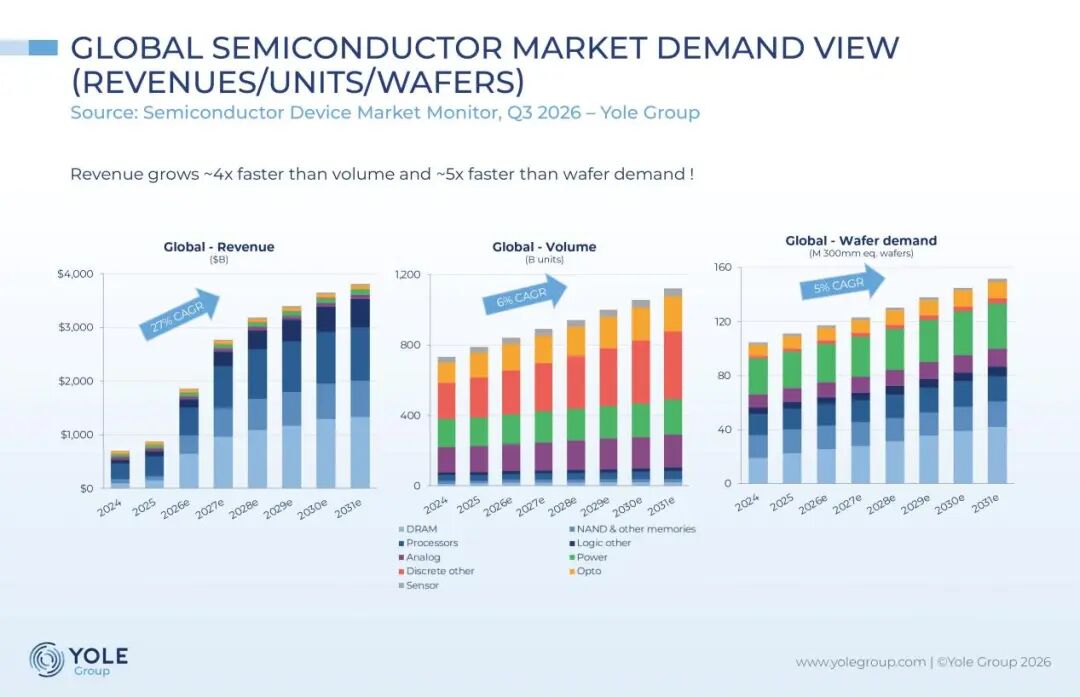
Citing data from Yole Group, he further pointed out that the industry's compound annual growth rate will reach as high as 27% between 2024 and 2031. However, the annual growth rates of shipments and wafer demand in the same period are only about 6% and 5%. In Gary Huang's view, the gap between the two mainly comes from the value enhancement of products such as HBM, advanced process processors and high-end NAND. At the same time, technological innovations such as EUV, 3D architecture and advanced packaging are also creating new market demand.
In addition, Gary Huang also admitted that this round of growth will not maintain the current pace forever. Driven by rising memory prices, the market growth rate is expected to be relatively fast from 2024 to 2027, and then gradually slow down, but the overall will still maintain expansion. But Gary Huang also said bluntly that in the semiconductor growth brought by AI, storage is undoubtedly one of the most benefited sectors.
Forecast data from Yole Group shows that the global memory market will reach 982 billion US dollars in 2026, four times that of 2025, and will be on a par with the logic and processor market in this year. After that, storage is expected to become the largest semiconductor sub-segment in the world and maintain this position until 2031. Between 2026 and 2031, the compound annual growth rate of storage will reach 43.2%. For comparison, the growth rate of the logic and processor market, which also has strong growth, is +22.7%, and the long-term growth rate of dedicated and discrete devices remains at around 6%.
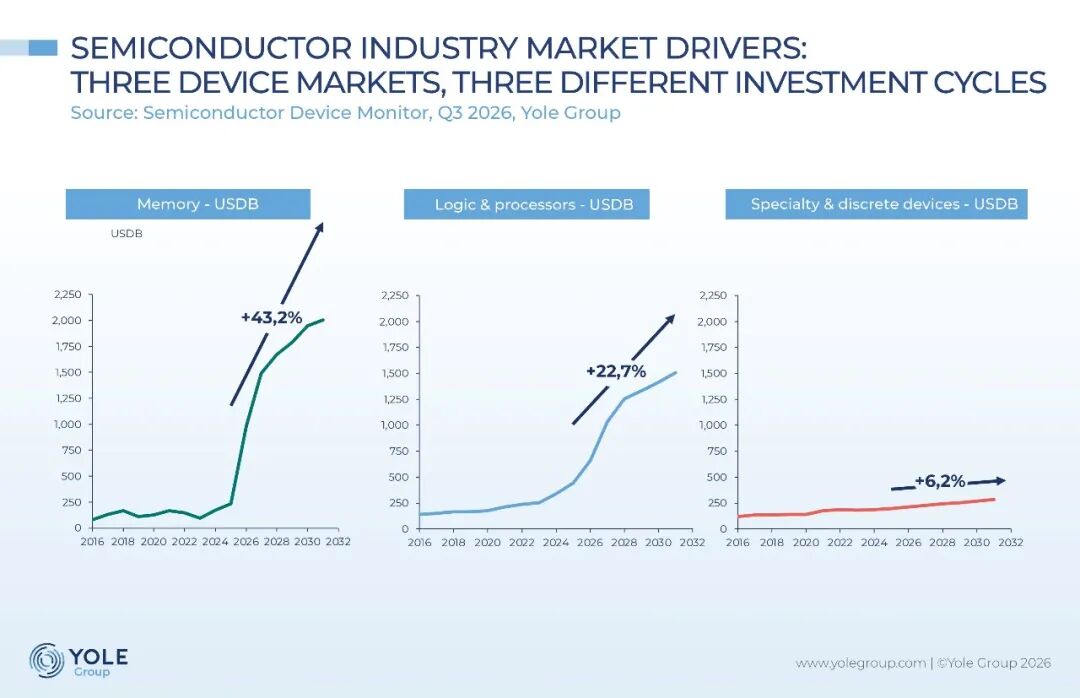
The reason for this change, according to Gary Huang, is that HBM plays an important role in it. As the performance of AI accelerators continues to improve, the requirements for storage bandwidth and capacity are also increasing synchronously. HBM is no longer just a supporting device next to the GPU, but an important part that directly affects AI computing power. The memory market is gradually shifting from the past model that focused more on shipment scale to a value market that pays more attention to product performance, bandwidth and technical content.
However, with the emergence of HBM 4, customization has gradually become the mainstream of storage, which has triggered another discussion, that is, whether storage has got rid of the cycle. In this regard, Gary Huang said that storage has not completely eliminated the cycle, but the form of the storage cycle has changed:
First, HBM has shifted from a scale market to a value market. It is expected that by 2031, HBM will account for about 56% of DRAM revenue, but its share of bit shipments will only be about 17%; second, the supply model has changed, and long-term strategic agreements of 3 to 5 years are gradually increasing, which improves suppliers' control over future orders and prices through quantity commitments, price floors and financial guarantees; third, the demand structure is more stable. It is expected that by 2031, data centers will account for about 70% of DRAM bit demand, reducing the dependence of the memory market on the consumer electronics cycle.
Based on the above observations, Gary Huang predicts that DRAM prices will peak around 2027, and then return to normal as new production capacity ramps up; DRAM capital expenditure will reach a peak of about 112 billion US dollars around 2028.
"The cyclical nature of memory is weakening and its strategic nature is strengthening, but it is not without cycles," Gary Huang reiterated.
The biggest bottleneck of AI may no longer be chips
If storage is the visible growth opportunity in the AI semiconductor industry, then electricity may be the most noteworthy infrastructure bottleneck in the coming years.
In Gary Huang's view, in the next 3 to 5 years, the key factor limiting the expansion of AI data centers may not be chips, but electricity. The reason is not complicated. Chip manufacturers can increase the production capacity of chips and advanced packaging in a relatively short time by adding equipment and adjusting production capacity. However, the construction of power plants, substations, grid connection and related approvals requires a much longer construction cycle.
As the scale of AI data centers expands, cabinet power is moving towards the megawatt level. Even if the production capacity of GPU, HBM and advanced packaging can continue to increase, if the data center cannot obtain sufficient power, the newly added computing power will hardly be put into actual use.
During the sharing, Gary Huang summed up this difference in one sentence: "Chip production capacity can be increased by quarter, but the power grid cannot." This judgment also means that the investment focus of AI infrastructure is changing.
In the past, the market paid more attention to GPU performance, computing power scale and chip supply capacity. In the future, the importance of power supply efficiency, power distribution architecture and heat dissipation capacity will be further improved. Technologies such as 800V DC power supply, SiC/GaN power devices and liquid cooling may all obtain new market opportunities from the upgrading of data center infrastructure. It is particularly worth noting that the growth in power demand will not only drive a small number of high-end power devices. Grid connection, substation construction, power management and power distribution system upgrading all require a large number of semiconductor devices to participate.
For the Chinese and Asian supply chains, this means that the opportunities brought by AI are spreading beyond traditional computing chips. Fields such as power semiconductors, power modules, power management and thermal management are also expected to become new growth directions.
In addition to electricity, Gary Huang believes that interconnection is also an unavoidable problem in the process of AI infrastructure expansion.
As the scale of AI clusters continues to expand, the amount of data that needs to be transmitted between chips, servers and cabinets continues to increase. Although traditional copper interconnection still has advantages in cost, supply and power consumption, its transmission distance and bandwidth capabilities are gradually facing physical limitations.
At present, copper cables are still an important solution for short-distance connections inside AI cabinets, and pluggable optical modules are mainly used between cabinets. As AI systems continue to develop towards higher density, the importance of optical interconnection will be further enhanced. Yole Group believes that co-packaged optics (CPO) will become an important technical direction in this change.
According to the data shared by Gary Huang at the exchange meeting, the revenue of CPO optical engines is expected to grow from about 600 million US dollars in 2026 to about 112 billion US dollars in 2031, of which about 94% of the market comes from Scale-up, that is, the vertical expansion scenarios inside cabinets and between computing systems.
However, CPO will not fully replace pluggable optical modules immediately. Because CPO is still facing problems such as fiber coupling accuracy, packaging yield, thermal management, reliability of external lasers and later maintenance. Due to the higher integration of optical engines and chips, once a failure occurs, maintenance and replacement are more complicated than traditional pluggable modules.
To this end, Yole Group expects that the adoption of CPO in the Scale-out scenario will still be selective from 2027 to 2028. The real noteworthy market inflection point lies in the Scale-up field, especially after the traditional copper cable connection begins to be limited by transmission distance. What is more noteworthy than the growth of market size is the industrial chain value transfer that CPO may bring.
As optical engines are further integrated with switching chips and computing processors, the importance of packaging, optoelectronic integration and testing will continue to rise. Some standardized assembly links in the traditional pluggable optical module industrial chain, as well as device suppliers such as DSP and Retimer, may face the pressure of value compression.
Facing Chinese manufacturers, Gary Huang mentioned several noteworthy directions, including fiber array unit (FAU), fiber coupling, assembly and test automation, InP lasers, external light sources, and advanced packaging and integration. This also means that the competition in the optical interconnection industry in the future may no longer be just the competition between optical module manufacturers, but extend to a wider range of industrial chain links such as optical engines, packaging, integration and testing.
Where are the opportunities for Chinese semiconductor enterprises?
As mentioned above, we can be sure that AI is driving this round of industrial value redistribution. As key players in this industry, in which fields can Chinese semiconductor enterprises get opportunities? In this regard, Gary Huang gave a relatively clear judgment in the exchange: storage is a relatively direct opportunity. As the demand of AI data centers for HBM, server DRAM and NAND increases, the value of the storage market is rising.
In addition, equipment and materials are another long-term opportunity they are optimistic about. Yole Group predicts that the localization rate of Chinese semiconductor equipment is expected to increase from the current about 18% to about 60% by 2031; advanced packaging is another noteworthy direction. As the complexity of AI chips increases, industrial bottlenecks are extending from simple transistor performance to packaging and system integration, and the importance of 2.5D packaging, 3D stacking and photonic packaging continues to rise; as for the power infrastructure and CPO mentioned earlier, they certainly also provide new entry opportunities for the Chinese supply chain.
"In contrast, affected by factors such as export controls, cutting-edge computing chips are still a relatively difficult field for Chinese enterprises," said Gary Huang. Citing data from Yole Group, he predicts that by 2031, China's share in the global semiconductor market is expected to rise from the current 10% to 12% to about 19%.
All in all, driven by AI, a brand-new semiconductor order is being re-formed. Whoever can master key technologies, break through core bottlenecks and occupy a favorable position in the new industrial division of labor in this transformation will be more likely to become the real winner of the next cycle.
This article is from the WeChat Official Account "Semiconductor Industry Watch" (ID: icbank), written by Li Shoupeng, authorized for release by 36Kr.