Will vehicles be essentially fully electrified by 2035? The internal combustion engine just refuses to die out.
"By 2035, domestic automobiles will basically realize electrification and pure electric drive."
When Academician Sun Fengchun said this at the 2026 China Automotive Charging and Battery Swap Ecosystem Conference, someone in the audience probably already had the headline ready: "Academician draws a full stop for fuel vehicles and internal combustion engines!"
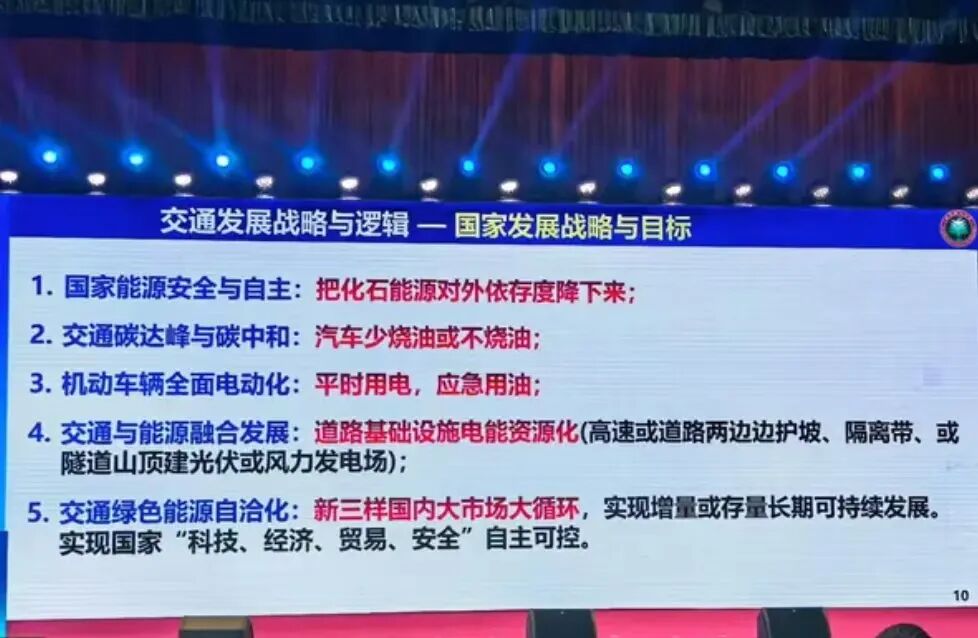
However, on the same day, the same person also put forward another view: motor vehicles can adopt the mode of "using electricity in daily scenarios and using oil in emergency scenarios" in the future.
It is precisely this latter statement that has stalled the countdown to "the extinction of internal combustion engines in 2035".
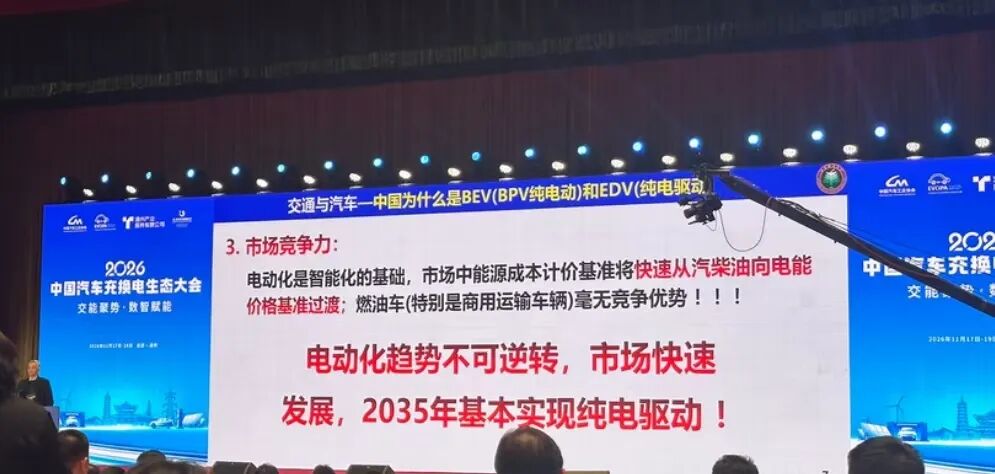
An academician who is the most staunch promoter of electrification personally left a back door for fuel in the narrative of "pure electric drive". This back door is not wide, but it is enough to turn the fact that "internal combustion engines will not be eliminated" from an emotional judgment into an engineering reality.
Pure electricity is the general trend, while hybrid power and internal combustion engines serve as the safety net. This is exactly the panorama of the automotive industry in 2035.
Pure Electricity: Start with Engineering Calculations
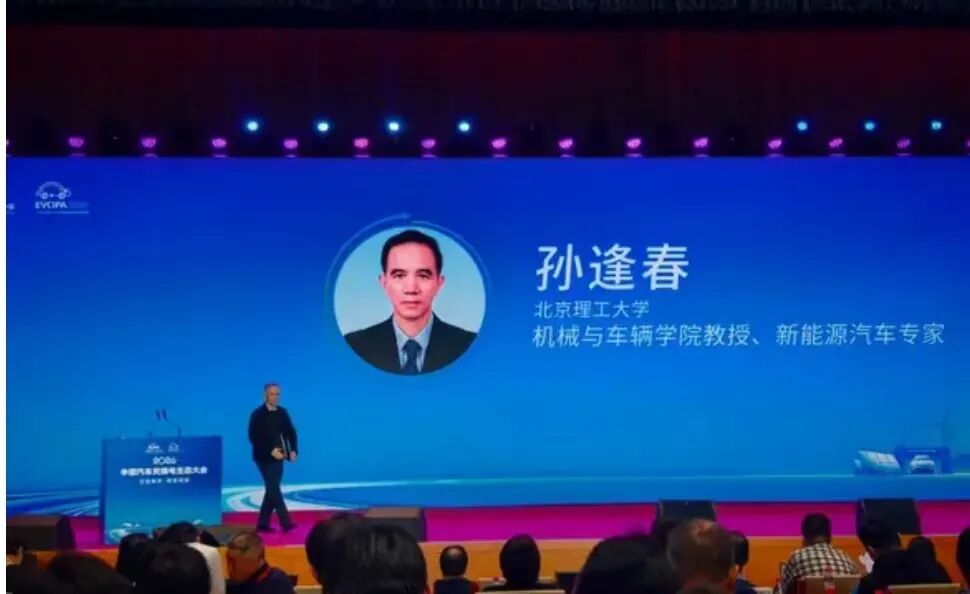
Before elaborating on the prospects of pure electric and internal combustion engine technology routes, let's first introduce who Sun Fengchun is.
He is an academician of the Chinese Academy of Engineering, a professor at Beijing Institute of Technology, and one of the main pioneers of electric vehicle engineering technology. He is also the earliest expert who used regulatory data to refute the claim that "electric vehicles are more dangerous than fuel vehicles": the fire accident rate of fuel vehicles ranges from 1 in 10,000 to 2 in 10,000, while that of new energy vehicles is below 1 in 10,000.
As someone who has defended the safety of electric vehicles for many years, there is no reason for him to be suddenly ambiguous on the 2035 timetable. So the back door he left is worth analyzing in depth.
Sun Fengchun's stance on electrification is more thorough than most practitioners in the industry.
In his view, the world has experienced four energy and industrial revolutions, while most people only recognize three, arguing that the first one should not be counted.
The first energy and industrial revolution: biomass energy, human and animal power, and slash-and-burn cultivation gave birth to the prosperity of the 5,000-year-old civilization of the Chinese nation.
The second energy and industrial revolution: with coal as energy and steam as power, it created the glory of the British Empire on which the sun never set.
The third energy and industrial revolution: with coal and oil as energy, internal combustion engines and electricity as power, it made the United States the only superpower in the current world.
The fourth energy and industrial revolution: green low-carbon energy, diversified intelligent power and electricity, will support the powerful country strategy of the great rejuvenation of the Chinese nation.
Without the development of electric vehicles, there is no feasible solution to carbon neutrality in the transportation sector. China's external dependence on crude oil is 75.6%, far exceeding the warning red line of 40%; vehicle carbon emissions account for 85% of total transportation emissions, and 70% of total oil consumption.
Faced with this set of data, the warm narrative of "fuel vehicles can hold on a little longer" cannot stand scrutiny.
But he is not a blind advocate of electric vehicles, because he understands better than any "electric vehicle detractor" where the shortcomings of pure electric vehicles lie.
He never promotes electrification by empty slogans. He made a more detailed calculation: new energy vehicles consumed 143 billion kWh of electricity in 2025, and the total charging volume will reach 2 trillion kWh by 2035, accounting for about 15% of the total social electricity consumption, corresponding to around 400 million vehicles.
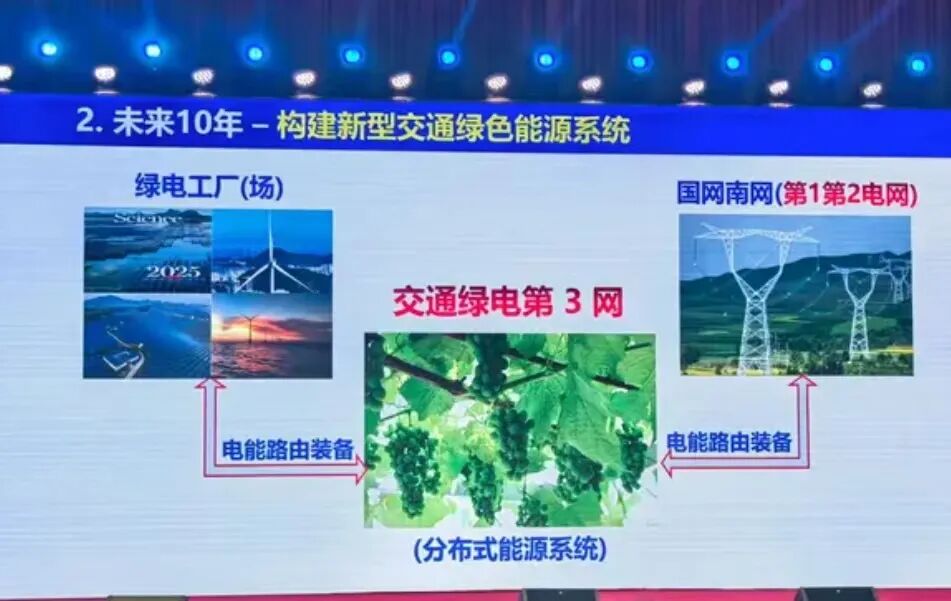
Where does the electricity come from? His answer is the "road" -- the "2211" vision: two networks consisting of the high-speed rail network and the expressway network, two energy corridors of the Yangtze River and the Yellow River, one coastline, and the vast western desert area, which together form a "third network" of transportation green power independent of State Grid and China Southern Power Grid.
It is the loss calculation that truly turns "pure electric drive" from a vision into an engineering constraint. Fast charging and energy storage will lose 10% of electricity after one charge-discharge cycle. If 60% of the 2 trillion kWh of electricity is used for fast charging of commercial vehicles, the loss of this single item will exceed 100 billion kWh, equivalent to the annual power generation of one and a half Three Gorges Hydropower Stations.
Coupled with another premise he put forward -- 70% of private cars in big cities do not have fixed parking spaces -- fast charging and home charging cannot form an inclusive solution in physical space.
That is why at this charging and battery swap conference, experts including Sun Fengchun analyzed from an objective perspective and agreed that battery swap is also one of the important components of new energy vehicle energy replenishment system.
Only new energy vehicles that make up for their shortcomings are truly competitive new energy vehicles.
Emergency Oil Use is a Necessary Redundancy
It is precisely in the conditional gap that the mode of "using electricity in daily scenarios and using oil in emergency scenarios" comes into being.
If this sentence is said by someone else, it can be regarded as a polite remark. But when it comes from Sun Fengchun, it carries far more weight. He knows better than anyone that the system of 400 million electric vehicles and 2 trillion kWh of electricity cannot reach a fully stable state at the same time on the day of 2035.
Extreme weather, power grid fluctuations, long-distance heavy loads, and remote scenarios are variables that cannot be completely eliminated simply by increasing the density of charging piles.
"Emergency oil use" is not to extend the service life of fuel vehicles, but to equip a highly electrified transportation system with necessary redundancy. The role of the internal combustion engine has changed: it is no longer the core protagonist, but an indispensable substitute that cannot be absent.
The industry and policy making departments are actually conveying the same core message in different expressions.
In December 2025, the European Commission withdrew the original plan to completely ban the sale of new fuel vehicles in 2035, adjusted the "zero emission" target to "90% emission reduction compared with 2021", so plug-in hybrid, range-extended, mild hybrid and internal combustion engine vehicles all obtained legal living space after 2035.
This is not a unilateral concession of a single country, but a structural compromise made by Europe in the face of the reality that the market share of pure electric vehicles is only 16.4%.
Domestic policies revealed this trend even earlier. The "Energy-saving and New Energy Vehicle Technology Roadmap 3.0" does not set a "deadline for fuel vehicles", but clearly states that by 2035, traditional energy passenger vehicles will achieve full hybridization; by 2040, passenger vehicles equipped with internal combustion engines will still account for about one third of new car sales. The internal combustion engine is not listed as an object to be eliminated, but as one of the "important power sources".
Sun Fengchun's "emergency oil use", the EU's "90% emission reduction" target, and the Roadmap 3.0's "full hybridization" all point to the same direction: electricity is the main development path, but internal combustion engines will not be completely phased out.
The End of Pure Fuel Vehicles ≠ The End of Internal Combustion Engines
Then what about the actual usage experience for consumers?
The most easily overlooked figure in Sun Fengchun's speech is that "70% of private cars in big cities do not have fixed parking spaces". This figure determines the fate of "pure fuel vehicles" more directly than the 2 trillion kWh total charging volume.
As of October 2026, the total number of charging infrastructure in China has reached 25.39 million, and the overall vehicle-to-pile ratio is about 2:1, which seems to be at a good level. However, private charging piles account for 79% of the total. After excluding private piles, the actual vehicle-to-pile ratio in the public service sector is close to 9.3:1.
The more troublesome problem is the operation quality: the average power of a single gun of public charging piles has dropped to 51.37 kW, and more than 40% of fast charging piles cannot operate at full power. The total number of piles is rising, but the effective energy replenishment capacity has not kept pace proportionally.
For users who have fixed parking spaces and can install private charging piles, the daily experience of pure electric vehicles is already good enough. But for people living in old communities, renting houses, and without underground garages, using pure electric vehicles is still a problem that requires careful planning. In addition, the battery swap service strongly promoted by NIO, CATL and Geely can make up for some gaps, but it cannot completely ensure that pure electric energy replenishment can cover every corner.
Therefore, what will really disappear in 2035 is not the broad category of "fuel vehicles", but "pure fuel vehicles" as a mainstream new vehicle category. Vehicles with fuel tanks will not disappear, they will remain in the form of hybrid, range-extended, and emergency fuel modules.
The internal combustion engine will not be eliminated, but it will change from "the only power source" to "a functional module in the power system".
Sun Fengchun said "basically" pure electric drive, the technology roadmap puts forward "full hybridization", and the EU sets the target of "90% emission reduction". The three statements all point to a 2035 where the internal combustion engine is downgraded from the main drive to a redundancy, not a 2035 where the internal combustion engine is completely banned.
Auto Commune believes that the choice of technical routes must always be dialectical and neutral. Neither the radical geek-style idea of "subvert tradition and abandon internal combustion engines" nor the die-hard conservative attitude of "driving fuel vehicles instead of electric vehicles" can resist the rolling forward of the wheel of history.
The internal combustion engine will not be eliminated, not because it is extremely powerful, but because pure electric technology is not mature enough to do without its safety net.
This article is from the WeChat Official Account "Auto Commune" (ID: iAUTO2010), written by Shi Jie, and published with authorization from 36Kr.