Free giveaway spree, delisting warnings, CEO resignation: The end of the road for video streaming platform membership services.
The number of users claiming Bilibili's free premium membership is almost catching up with the total number of all paid members on the platform.
Previously, BLG Esports Club, which was founded nine years ago, won the championship of the 2026 League of Legends World Championship (S16). As the owner behind the team, Bilibili immediately launched a welfare campaign giving out 7-day free premium membership to users across the entire internet.
By the end of the campaign at 12:00 noon on November 16, a total of 22.8 million netizens across the internet had claimed the free premium membership within just 24 hours. In comparison, the total number of existing paid premium members disclosed in Bilibili's latest financial report is only 25.71 million.

* Source from the Internet
Although this wave of free user acquisition has achieved remarkable results, it also highlights an awkward phenomenon that video platforms are increasingly unable to avoid: in the past two years, users have increasingly preferred to spend their time on Red Fruit, which positions itself as a free content platform, while for platforms that charge membership fees, users often only claim a discounted membership worth a small amount of money and watch popular short-term content before leaving.
The membership model of video platforms that have been painstakingly operated for more than a decade has reached a crossroads. What should these platforms do next?
01 "A 'Free Carnival' Reflects the Ceiling of Video Membership Growth"
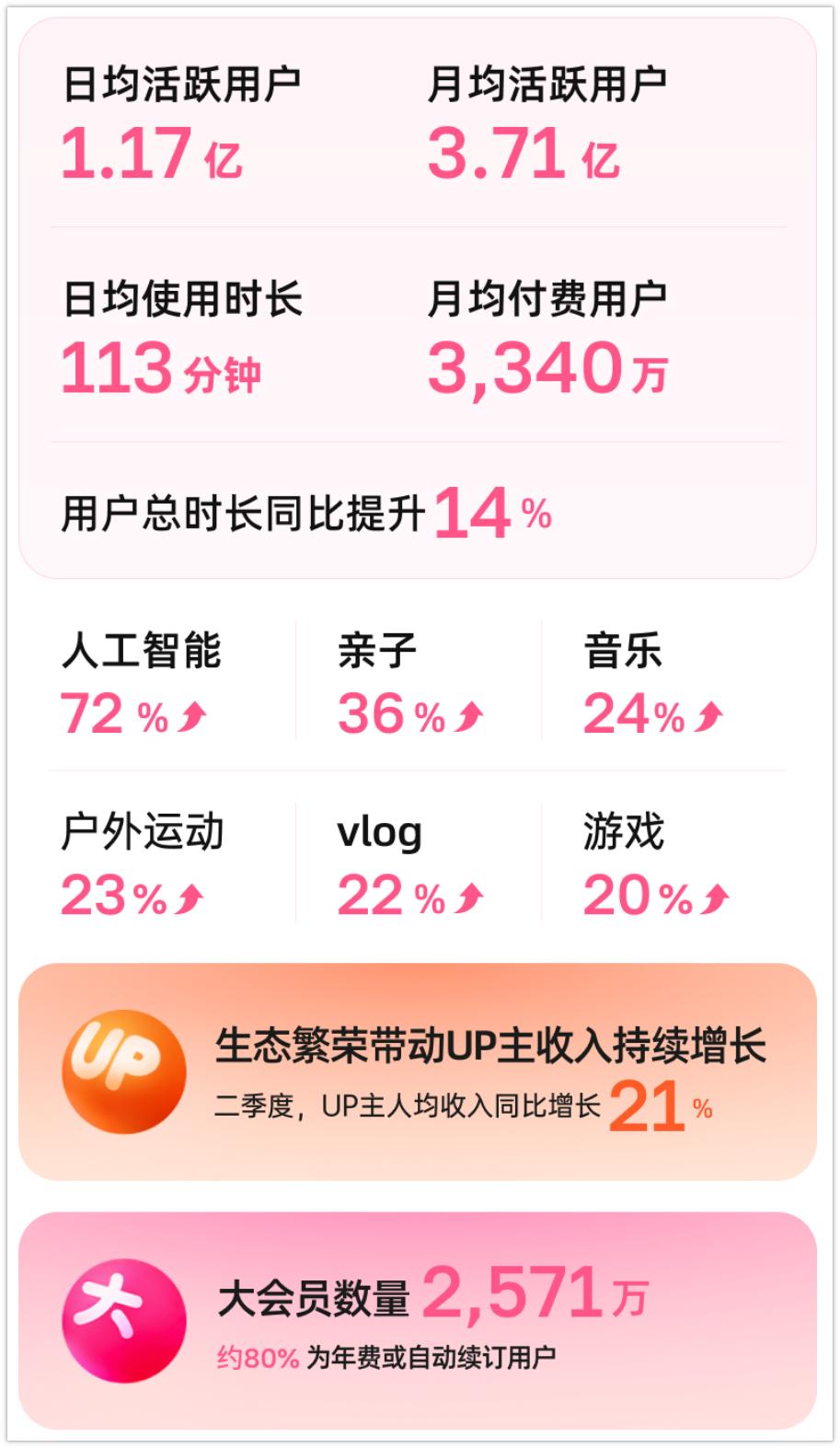
Membership subscription used to be the most attractive cash cow model in the video industry. Users who are willing to renew their subscriptions automatically on a monthly or annual basis just like paying utility bills can bring stable cash flow to enterprises. Bilibili specifically disclosed in its Q2 financial report that about 80% of its premium members are annual subscribers or users with automatic renewal enabled.
* Source from Bilibili
Therefore, it is reasonable to carry out such a marketing campaign. However, the huge sensation caused by this free premium membership giveaway has further confirmed to the outside world that the era for domestic video platforms to expand the scale of paid members relying on natural growth has come to an end.
Looking back at Bilibili's own commercialization process, its premium membership business has always been in a delicate position.
As a community centered on PUGV (Professional User Generated Video), Bilibili's most appealing content for young people, including medium and long videos, game live streams, and popular science content, is naturally free. The main reasons why users are willing to pay for premium membership are twofold: first, exclusive broadcast of anime, domestic animations and documentaries, and second, high-bitrate 4K image quality.
However, according to data from Tianyancha and Bilibili's Q2 financial report, its average daily active users have reached 117 million, and the total user duration has increased by 14% year-on-year, putting the community activity at a historically high level. In the same period, the year-on-year growth rate of value-added service revenue is only 7%. This means that more than 80% of active users on the platform are accustomed to watching videos for free, and conventional promotions cannot persuade them to pay.
Even with this free user acquisition campaign paired with promotions, many users have clearly stated that they only want to claim the lowest-cost benefits.

* Source from Xiaohongshu
Looking at the overall situation beyond Bilibili, the posture of racking their brains to activate incremental users is the true portrayal of long video platforms in 2026.
On the very day when Bilibili's membership campaign ended on November 16, iQiyi released its 2026 Q3 performance report: total revenue in the quarter was 6.01 billion yuan, down 10% year-on-year, of which membership service revenue was 3.97 billion yuan, a decline compared with the same period last year.
Looking further back, the 2026 Q3 financial report released by Mango Super Media on October 27 shows that its total operating revenue in the first three quarters of this year was 9.351 billion yuan, and the net profit attributable to owners of the parent company plummeted 79.01% year-on-year to 213 million yuan; combined with the details disclosed in its semi-annual report, affected by the year-on-year decline in membership revenue in the early stage and the rigid cost of head content, the platform is currently in an adjustment period.
Even for Tencent Video, which is backed by the huge social traffic of WeChat and QQ, the number of its paid members has remained stagnant for a long time. In addition, Tencent's newly released financial report shows that the revenue of the social network sector in the third quarter fell by 2% month-on-month, and the official explicitly mentioned that the revenue from long video subscriptions decreased.

* Source from Tencent Financial Report
Why have video platforms collectively hit this growth ceiling?
First, the total number of users who are willing to watch videos among all groups is always limited. Even Netflix has stopped disclosing the number of subscribers quarter by quarter since 2025; second, users have limited time, and once their entertainment needs are met elsewhere, they are unwilling to pay for platform membership to "bind" their consumption.
Over the past decade, major platforms have expanded their user base through copyright wars and exclusive broadcast dramas, and have repeatedly converted this group of core users. However, users have finally grown tired of the platforms' constant tactics to extract value from existing users.
02 "Hit Content Supply Cannot Support Regular Subscriptions"
If you make money from a group of people, you have to bear their anger. Open any social platform, and complaints about the membership experience of video platforms pop up from time to time. The first and foremost complaint is that users have paid for membership but still cannot avoid advertisements.
Many users pay for VIP according to the platform's rules, only to find that they have to watch a pre-video advertisement in the name of "member exclusive recommendation" before the main content, pop-up ads when pausing the video, and floating window promotions on some platforms.
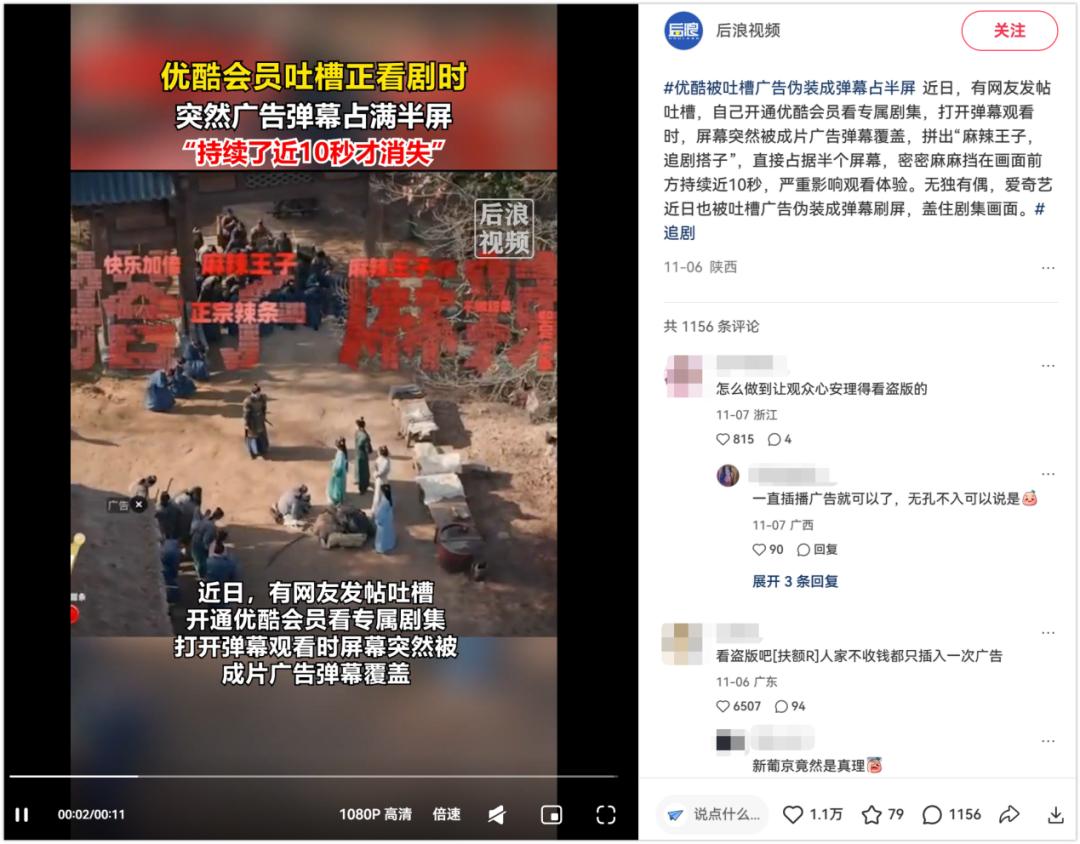
The most absurd part is that in the past two months, more than one platform has launched so-called "creative advertisements", packaging advertisements in the form of scrolling bullet comments for members to watch. This move has prompted many users to respond: "Let's watch pirated content instead!"

* Source from Xiaohongshu
In addition to pervasive advertisements, the continuous addition of membership tiers is also eroding users' patience.
SVIP is added on top of basic VIP, and TV VIP is further stacked on top of SVIP. Screen casting on mobile devices and the number of accessible devices are restricted, and all kinds of most popular content are set with separate paid "packages". After a series of tedious rules, many users can only mock themselves that "paying for membership makes me feel like a subordinate, and not paying makes me feel like a total stranger".

* Source from Xiaohongshu
The more popular the content is, the more it becomes a cash cow for the platform. If we simply attribute these phenomena to the "ugly eating behavior" of video platforms, product managers will also feel wronged — no product manager at any large internet company is unaware that pop-up advertisements and tiered charging will harm user experience. The reason why platforms choose to take this risky path is rooted in the fact that the long video industry has never been able to solve its own deadlock:
The expensive, highly risky hit content supply on the front end cannot support the stable regular subscription on the back end at all.
On the one hand, long videos, especially TV series, are a typical heavy-asset, long-cycle, high-risk business. The cost is extremely high, but it is very common for film and television works to flop quietly after being released. For example, last year Tencent's big production *The Lychee of Chang'an* ended up with mediocre results due to controversies including actor scandals and bloated plots.

* Source from WeChat Official Account
This leads to the situation that platforms must get enough returns from one hit work to offset the costs of other projects.
On the other hand, domestic video users also suffer from the fragmented content distribution of major platforms. Platforms such as iQiyi, Tencent Video, Youku, and Mango TV each hold their own exclusive content, and no one can deliver high-quality hit works seamlessly 365 days a year. Users have to pay for membership on Mango TV to watch *Later Friendship Period*, and on iQiyi to watch *Old Stories of Yu Hong*. In this case, why bother paying for an annual membership on one single platform?
It is worth mentioning that even if platforms try to get users to pay only for content they like based on user preferences, this problem still cannot be solved. Bilibili's paid charging video feature for UP owners is an example — charging means a threshold, and once there is a threshold, users will be more critical of the content itself. At this time, payment may even amplify the conflict between users and content creators.

* Source from Xiaohongshu
With all kinds of dilemmas superimposed, platforms can only maximize their monetization methods within the short dozens of days of the hit broadcast window, and try their best to acquire new users. Every time consumers feel they are being "calculated" on the front end, it is actually the platform paying for the high sunk costs and extremely high user churn rate.
03 "Dimensionality Reduction Strike from the Free Model: Where Is the Way Out for Long Video Platforms?"
If in the past few years long video platforms could still maintain a fragile balance in the cycle of "raising prices - losing users - pulling back users with hit content" behind closed doors, then the explosive growth of ByteDance's Red Fruit Free Short Drama since last year has almost shattered the "paid" business model that used to support the industry.
According to the QuestMobile report, as of July 2026, the monthly active users of Red Fruit Free Short Drama have exceeded 236 million, and the daily active users have soared to 168 million, a year-on-year surge of 107%, with the average daily usage duration per person as high as 125 minutes.
The daily active user scale of Red Fruit alone has surpassed the sum of the daily active users of the four long video platform apps including iQiyi, Tencent Video, Youku, and Mango TV, and the situation of long video platforms is getting even worse:
iQiyi's stock price has been below 1 USD for nearly 30 consecutive days. According to the listing rules, it will trigger the Nasdaq delisting warning as early as this week, followed by a 180-day rectification period. Just a few days ago, Fan Luyuan, CEO of Alibaba Orca Culture & Entertainment, resigned, and Youku is exactly one of its three core businesses.
In the final analysis, the business model of this batch of long video platforms has been hit by Red Fruit's dimensionality reduction strike.
On the content side, Red Fruit is backed by Tomato Free Novel, which also belongs to the ByteDance ecosystem. It mass-adapts hit web novels that have been verified by hundreds of millions of readers into short dramas, eliminating the high cost of IP procurement; on the monetization side, Red Fruit implements the "watch dramas for free + unlock content by watching ads / revenue sharing" model, which meets the needs of the vast majority of users and production studios.
Li Juncheng, founder of the short drama studio Jinwu Wuliang, said in an interview with 36Kr: "We have experienced the entire growth process of Tomato Novel from 0 to 1. All the breakout IPs have been verified by information flow advertisements. If a novel becomes popular, its short drama adaptation will definitely be a hit."
36Kr also disclosed an incredible practice of Red Fruit: it adds a huge number of ads, and then uses the revenue to acquire new users, which turns out to be the most efficient approach. For countless users from lower-tier markets and office workers with fragmented time, on Red Fruit, users not only do not need to spend a penny, but also get plot conflicts within the first