Anthropic: There is no escaping "brainpower deflation", and its endgame will eventually turn out to be the "AI version" of Google or AT&T?
In the previous article "Anthropic: Ditching the Money-Burning Burden and Becoming a Mortgage Payer", Dolphin calculated that nearly 1 trillion US dollars in computing power contracts are pressed onto the balance sheet, and the revenue needs to rise 4-5 times more to afford this. After the calculation, two more fundamental questions emerged:
First, why can this business maintain its "intelligence premium"? The price of tokens has dropped by 70% in one year, and open-source models are catching up rapidly. Can Anthropic's "intelligence premium" be sustained?
Second, what is the ceiling of revenue? The primary market gave a valuation of 965 billion US dollars in May, and IPO expectations once rose to 1.5 trillion — what kind of 2028 can this price buy?
This article by Dolphin focuses on solving Anthropic's value judgment, and further discusses Anthropic as well as AI's growth prospects, competitive barriers, etc. in combination with the above issues. The full text is divided into four parts:
1. What is the core difference in market disputes over Anthropic's value measurement?
2. How big is the total addressable market (TAM) for AI large model applications, and how to view the impact of intellectual deflation?
3. Will large models become commodities? How long can Anthropic maintain its barriers?
4. How to conduct value measurement?
Detailed Analysis is as Follows
I. Disputes over Value Measurement: What are the Core Differences?
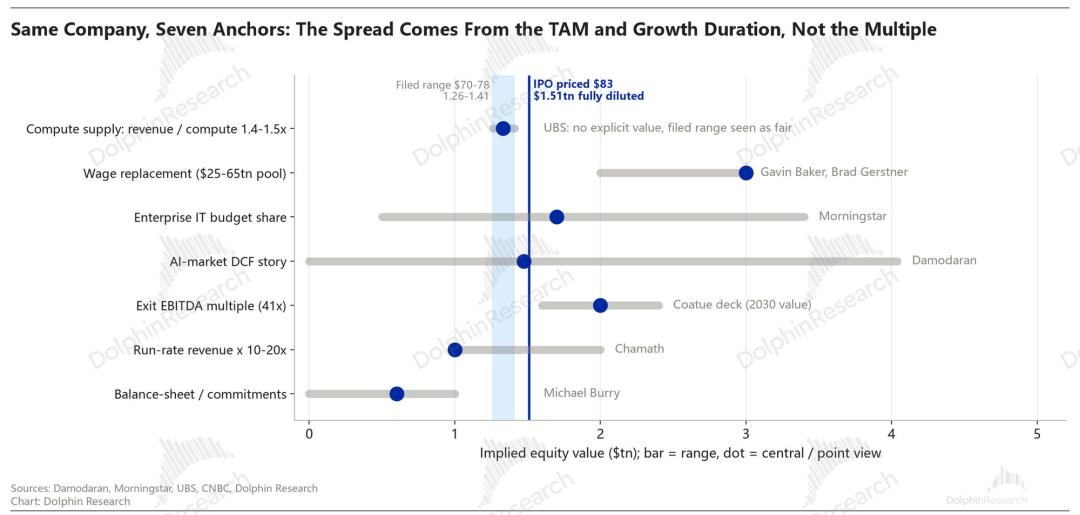
The fully diluted valuation corresponding to Anthropic's IPO range is 1.26–1.41 trillion US dollars, which is about 16–17 times the ARR (81 billion US dollars) in October. According to information from Barclays' small meeting last week, calculated based on the annualized revenue of 77 billion US dollars in Q4, the multiple even reaches 18 times.
Combined with the month-on-month declining trend, 18 times P/ARR is by no means cheap. The decline is mainly attributed by the company to seasonal fluctuations caused by holidays. This explanation is not unreasonable, but for a leading AI laboratory that claims to have a market space of trillions in revenue growth, it is really weird to talk about seasonal fluctuations at this time. How can investors rest assured to give it a high-growth valuation?
However, in the roadshow before listing, investors' subscription enthusiasm does not seem to be as cold and cautious as expected, and the subscription amount exceeds the financing demand by 6 times. For a while, Anthropic has almost become the most typical case where both long and short sides call each other fools.
Dolphin collected value measurement judgments from some primary and secondary institutions and found that the main dispute leading to the two opposite optimistic and pessimistic judgments lies in how to view Anthropic's definition of TAM:
a. Optimistic expectation: TAM is anchored at a salary of 40 trillion US dollars
Well-known investors such as Gavin Baker and Brad Gerstner have a definition of TAM similar to that in Anthropic's IPO prospectus, which takes the artificial salary of global knowledge workers as the total reachable market space.
At present, global labor income accounts for about 52% of GDP, with a total size of about 60 trillion US dollars. Anthropic has defined the job attributes of knowledge workers (from coding to general mental work), and believes that the 40 trillion US dollars of salary for such positions is a market that can be penetrated by AI and bring transformation.
Therefore, from this perspective, the revenue scale of hundreds of billions is still very low in the 40 trillion reachable TAM.
b. Pessimistic expectation: TAM is anchored at 6 trillion US dollars of enterprise IT budget
Bearish institutions link Anthropic's target market to enterprise IT budgets. Under the pessimistic expectation, Anthropic will only get 3% of the total IT budget scale five years later, that is, 180 billion US dollars in revenue.
However, the future evolution of AI is too uncertain, and the long-term anchor varies from person to person, which is equivalent to no anchor at all. At present, most people only give a neutral range of 1-1.5 trillion US dollars based on the revenue scale that Anthropic can achieve in the short and medium term and the not very high valuation multiple, which is also the range where the IPO pricing belongs. According to the latest IPO pricing calculation, the fully diluted valuation has reached the upper edge of the range.
II. TAM: Using the Current Market Size for Analogy Has a Fatal "Distortion"
Although the US government has recently imposed strict restrictions and supervision on remote computing power, China's open-source models will slow down iteration due to the lack of high-end computing power, which will improve the competitiveness of closed-source models such as Anthropic, and the pressure of token price reduction will ease for a while.
However, from the perspective of future marginal changes in the gap between computing power supply and demand, Dolphin believes that the continuous price reduction trend of AI large models in the future is certain. Not only driven by competition, but also the internal technology promotes it in the same direction:
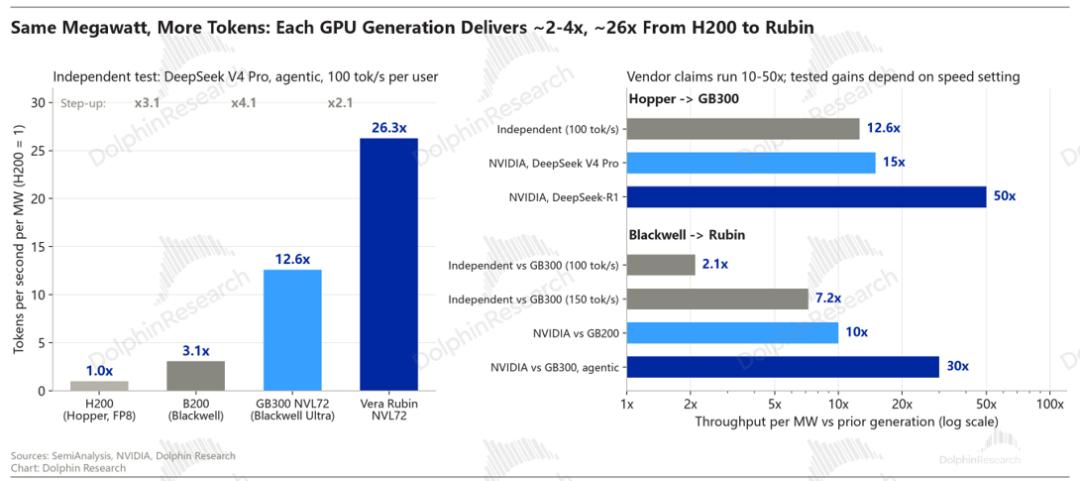
a. Each generation of chips doubles in performance. With the same 1GW of electricity, the new generation of chips can output more tokens;
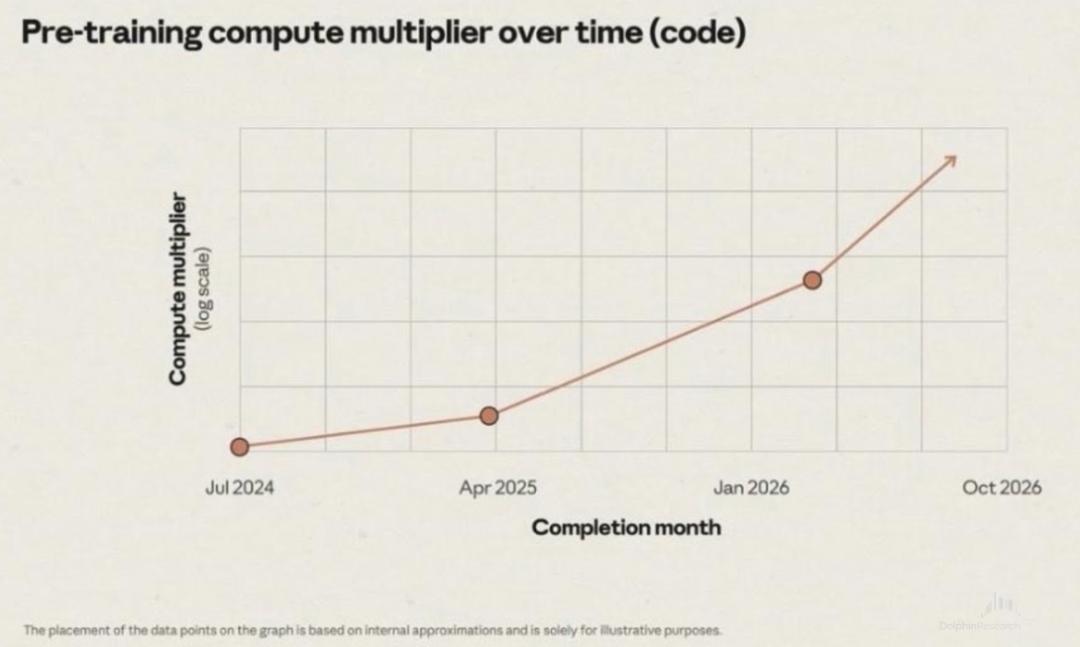
b. Model algorithms are also improving efficiency. Anthropic's prospectus mentions that improvements in algorithms and methods during training and inference can allow the same amount of computing power to produce more effective results.
This means that the training of each new model now involves the participation of the previous generation of models. The stronger the model, the stronger the model it can train, and the cheaper the services it can provide. This recursive self-improvement (RSI) rule will make the gap (performance, cost-effectiveness) between cutting-edge models larger and larger.
<a-b> represent the two-way iterative improvement of the computing power supply side and the demand side respectively. The final result is that the token price of cutting-edge models drops by 45–55% every year (implying an average quarterly month-on-month decline of 10-15%). In the past year, the input price of Opus has dropped from 15 US dollars per million tokens to 5 US dollars, then to 4 US dollars, a drop of about 73%;
The third-party transaction price index shows that Anthropic's actual transaction price has halved from 1.70 US dollars to 0.83 US dollars within one month. However, the latest computing power restriction order may effectively slow down the price reduction during the strong implementation period, for example, the comprehensive average quarterly month-on-month decline will be compressed to less than 10%.
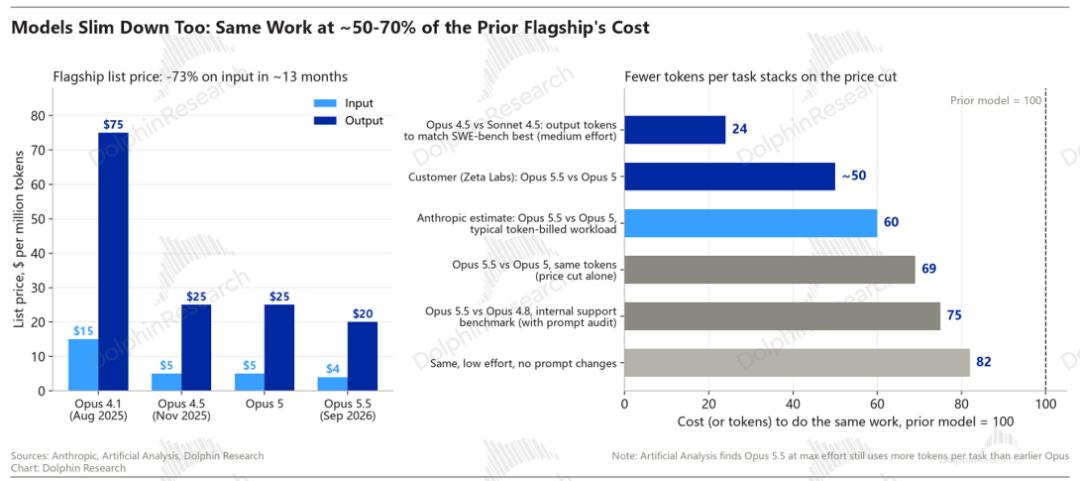
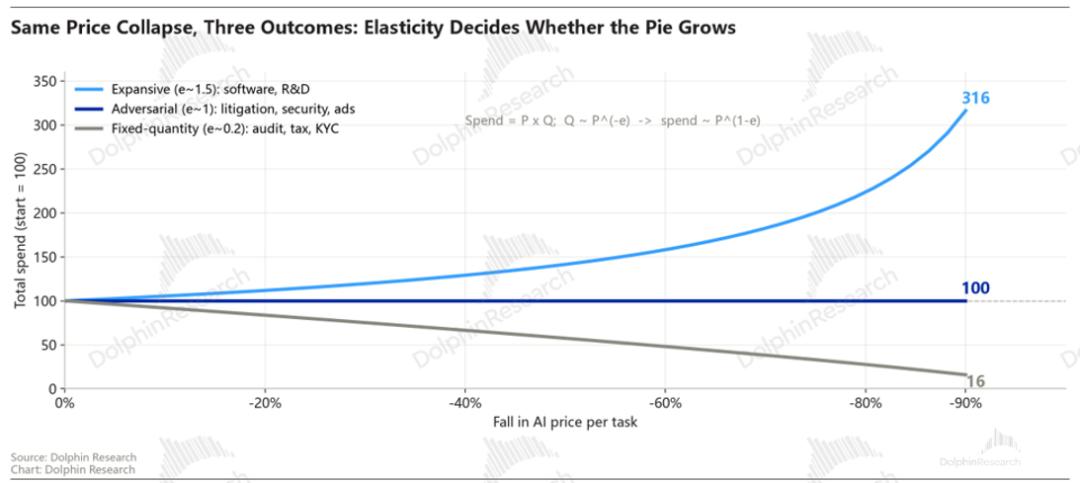
Whether revenue growth can be maintained depends on whether price reduction can stimulate additional computing power increment to more than compensate for the loss caused by price reduction. In the early stage of industry development, price reduction means lowering the threshold, which will enable new technologies to penetrate rapidly and generate more demand. This is also the "Jevons Paradox" that bulls often use to refute when AI is questioned for growth after every model iteration and sharp token price reduction in the past year.
However, Dolphin believes that this needs to be discussed by scenarios/industries to compare the different demand elasticity:
(1) Expansion type (elasticity greater than 1): The cheaper it is, the more it is used, and the total expenditure increases instead
This is most typical in the coding field. In the past, if a company wanted to make an internal tool, it had to schedule for two months and assign two programmers, and most demands were put on hold. Now an Agent can write it in one afternoon, so all the demands that were "not worth doing" before have emerged: rewriting old code, making every process into a tool, and full code audit. This kind of demand was originally suppressed by cost, and once the price drops, the usage will naturally multiply.
Following the logic that coding's penetration rate increases due to price reduction, thereby increasing the industry budget, in addition to accelerating the IT transformation of traditional industries, the development and innovation of the entire cutting-edge science and financial investment also belong to this category.
(2) Confrontation type (elasticity approximately equal to 1): The budget trend follows competitors and the industry.
For example, in fields such as litigation, cybersecurity, and marketing. This is a temporary demand expansion driven by industry competition, but in the medium and long term, it will disappear as the economic ROI of input decreases and industry monopoly increases.
In the corresponding scenarios mentioned above, for example, if the opposing lawyer uses AI to produce ten documents a day, you have to keep up; if hackers use AI to find vulnerabilities in batches, your defense must also be AI-enabled. In these fields, how much money an enterprise spends is not determined by the unit price, but by "how much the opponent spends and how much this matter is worth".
Price reduction will allow the same budget to buy more services, and will also allow more companies that did not have the ability before to participate in competition, compressing industry profits. But in the process of declining industry profits, this kind of demand generated by "involution" will also decrease.
(3) Deflation type (elasticity less than 1): The demand is fixed, and price reduction will only make customers spend less money.
This scenario refers to auditing, tax filing, compliance, payroll accounting, etc. A listed company only conducts annual report audit once a year, and quarterly tax filing will not be done several more times just because it is cheaper, and KYC is done for each new customer. AI reduces the cost of reviewing a contract by 90%, and enterprises will not sign ten times more contracts because of this. The money saved here directly goes into the enterprise's profit statement, or is invested in other places.
Therefore, based on Anthropic's main growth logic, that is, when AI penetrates to replace knowledge workers, there are still two problems that "question growth":
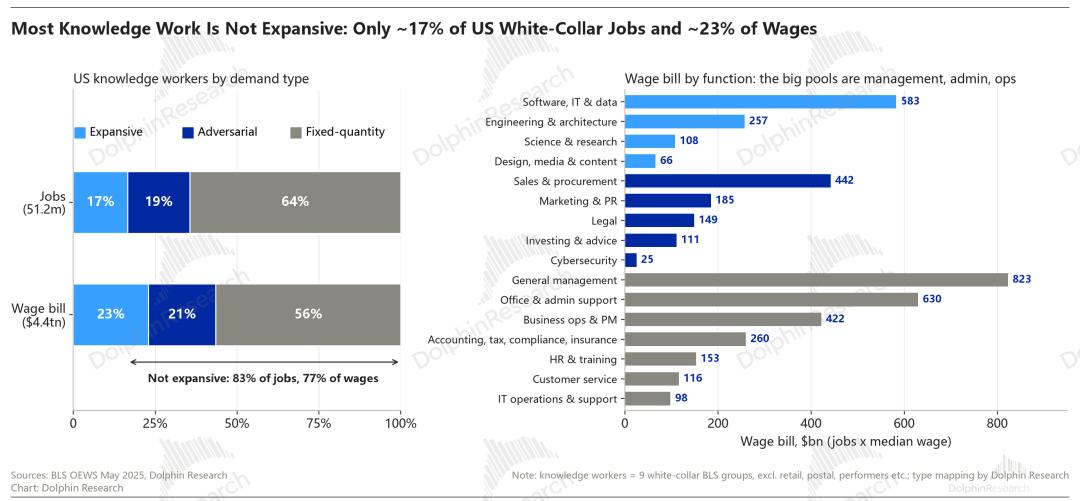
a. Most positions do not belong to the expansion type
In the 40 trillion US dollar knowledge worker market, scenarios that truly belong to the expansion type do not account for the majority.
Taking the United States as an example, from the distribution of the number of white-collar employees and the budget distribution of different departments of the company, about 64% of the employee scale and 56% of the salary scale come from non-expansion fields such as non-IT and cutting-edge science.
b. Under the overwhelming advantage of intelligence, the short and medium-term expansion scenarios will also turn into deflation scenarios faster
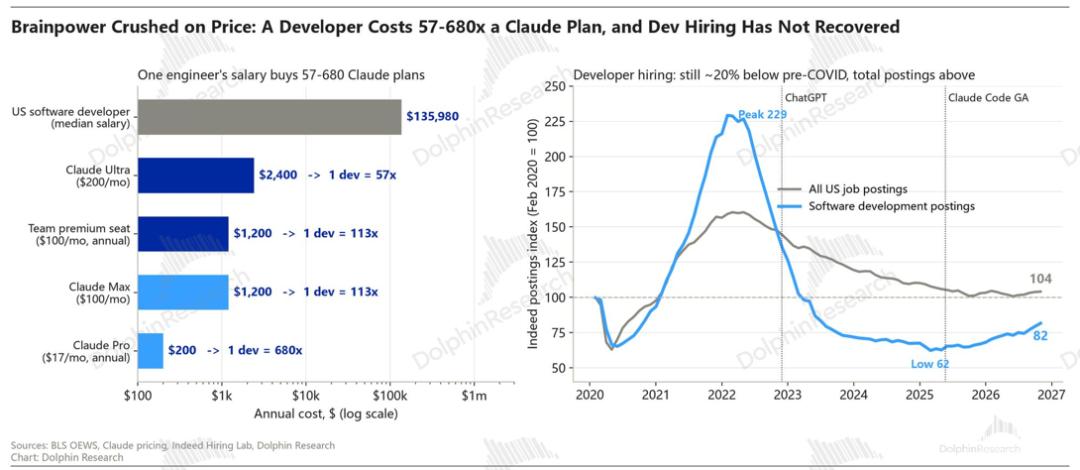
The reason why coding can become the current demand expansion scenario is that it has room for penetration improvement in traditional enterprises, which is essentially the natural increase of IT budget. But AI has dozens of times of overwhelming advantage over human intelligence. At present, the salary of one IT developer is equivalent to 113 sets of advanced seat packages of Claude Team.
In terms of output comparison, although it cannot completely replace real people, it has significantly improved in time saving for general tasks and the time cycle of long tasks:
A year ago, the programming tasks that AI could complete independently were only equivalent to the work that a programmer could finish in two hours; now it has reached two working days, roughly doubling every four months. One out of every five new merge requests in the public code base comes from Claude Code.
Dolphin makes a simple rough calculation: one AI can replace 113*1/5=22.6 real people, which saves nearly 20 times of IT salary cost for enterprises. Therefore, under the value deflation brought by this overwhelming intelligence advantage, the short and medium-term market size can maintain expansion due to the increase of penetration rate, but from a long-term perspective, the so-called 40 trillion intelligence market will automatically shrink before the penetration rate is fully completed.
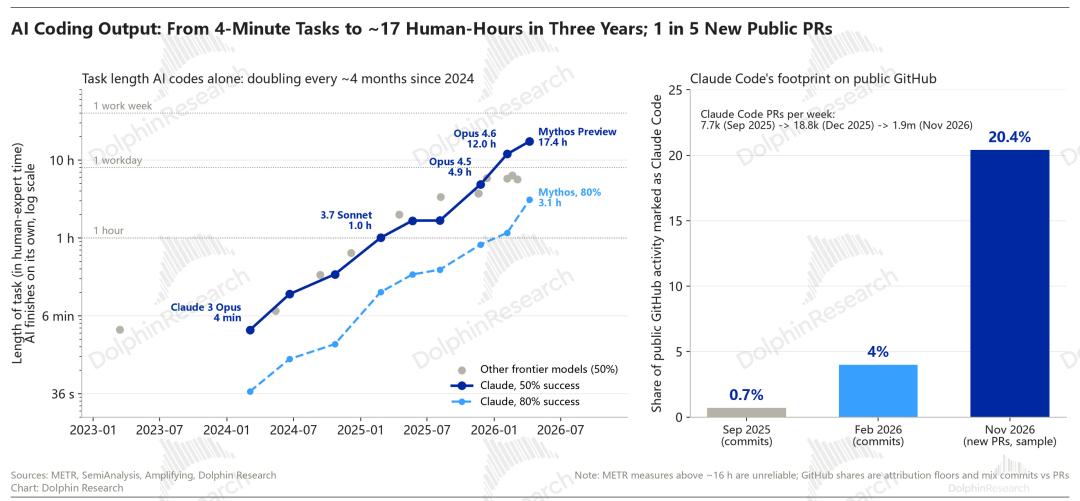
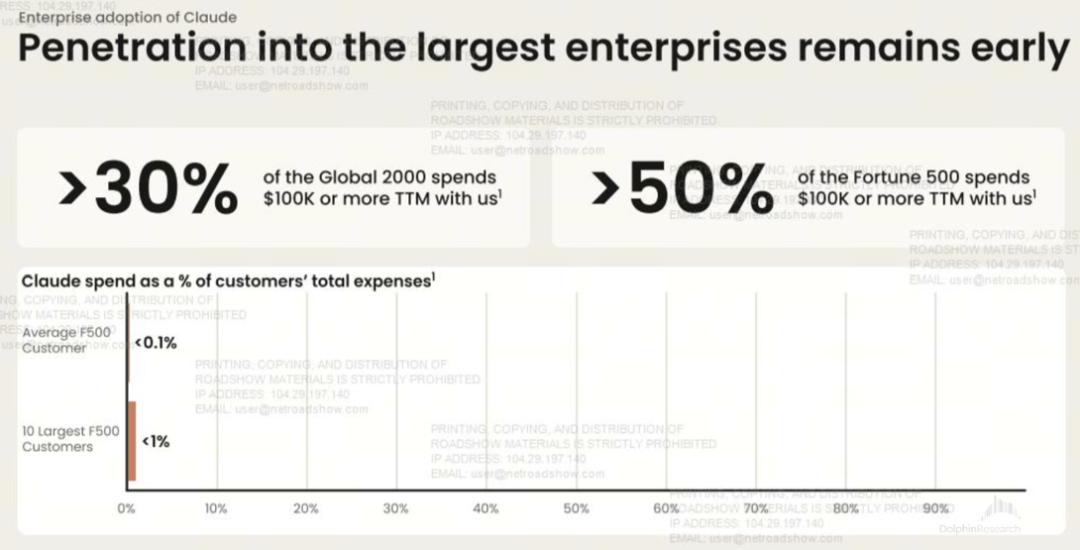
Therefore, Anthropic's interpretation of future growth logic in its prospectus, whether starting from the "existing" 40 trillion salary scale of knowledge workers or from the fact that Fortune 500 companies' IT budget accounts for less than 1%, has made a fatal bug that ignores the fact that in the process of AI replacing human intelligence, the "long-term" value of existing human intelligence will be greatly deflated.