Gaussian sputtering will replace ordinary photos and become the main data asset of human beings.
If photos and videos are the core data assets of current smartphones, what about smart glasses?
Some people say that AI glasses still capture photos and videos, so images and videos remain the main data assets?
The answer is no. The core data assets are Gaussian Splatting assets.
If you place your glasses on a spatial computing device, you will find that the main data assets of MR glasses are 3DGS and 4DGS, both of which are data based on Gaussian Splatting, one static and the other dynamic.
Gaussian Splatting (3D Gaussian Splatting) is a technology that represents real scenes with a large number of optimizable 3D Gaussian ellipsoids. It can quickly reconstruct a highly realistic 3D space that supports real-time rendering and free roaming from ordinary photos or videos.
1. All terminals running Gaussian Splatting and world models are currently on the wrong track, forced to be dimensionally reduced to mobile phone screens
Thanks to its brand-new assets and browsing effects, Gaussian Splatting, the current 3DGS, is gradually gaining popularity. But it is still limited to a small circle, and ordinary people cannot use it at all.
The main reason is that the carrier for running Gaussian Splatting and 3DGS assets is no longer on mobile phones or PCs, and there is no dedicated shooting device. There are very few shooting devices for Gaussian Splatting at present, which require LiDAR configuration and support for binocular cameras, meaning almost all such devices on the market are flagship models.
However, these configurations are almost standard on MR glasses, as MR glasses are all equipped with 6DOF spatial positioning and binocular cameras. But the price of spatial computing devices is not low enough at present, which is still close to 10,000 yuan.
In 2027, the price of spatial computing devices will still be on the high side, and there is no large shipment volume or even no official delivery, resulting in almost no users using Gaussian Splatting assets or even 3DGS.
2. Currently, people are forced to watch videos on ordinary flat-screen computers or mobile phones
With the popularization of MR glasses, this type of asset will gradually become as popular as current photos and videos. In the future, live streaming and even short videos shot with Gaussian Splatting and 3DGS will become mainstream.
This is not only because of the immersive experience, but also because users can feel and even integrate into the environment.
In fact, 3DGS refers to Gaussian Splatting, and the dynamic version is called 4DGS. Both of them have environmental depth and depth of field effects, which are almost impossible to browse on flat-screen mobile phones, or the operation has extremely high thresholds.
For example, the following is the browsing effect of 3DGS
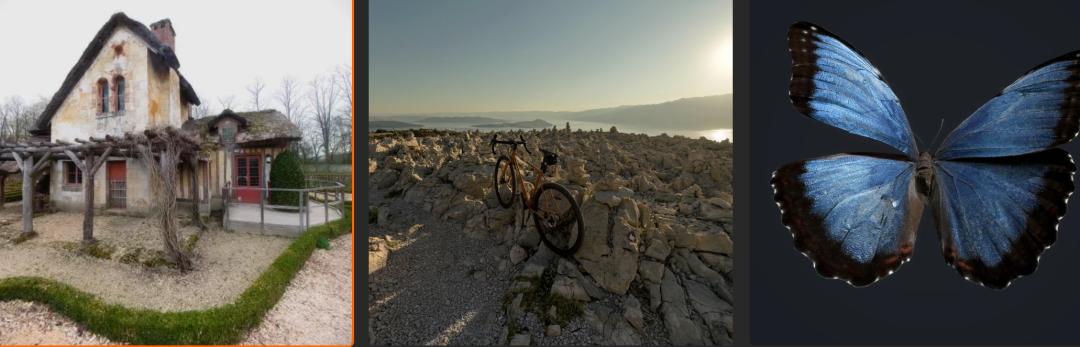
It is almost as troublesome as viewing houses on Shell, which requires repeated position adjustment and in-depth checking. On mobile phones, you have to keep dragging, swiping and long-pressing to complete the operation.
The interactive operation of viewing Gaussian Splatting on mobile phones is extremely complex on flat screens. But in spatial computing, users only need to zoom with both hands or rotate with one hand to complete the operation, and then they can "walk in" to get an immersive experience. The value and information depth of this experience are not at the same level at all.
It is just like trying to describe an image with text, which is very difficult in practice, because one-dimensional data can hardly describe two-dimensional world data, while Gaussian Splatting is three-dimensional.
3. Consumers need to understand the concept of MR devices and spatial computing, and know how to use them
Now if you tell an ordinary person about spatial computing MR glasses, he will think it is just a pair of glasses with a camera, rather than a brand-new operating device. At the same time, he does not know how to complete operations with gestures. For example, a few days ago I saw ROKID launch interactive training for ring-based interaction. You will find that adding gesture operations requires a certain learning threshold. At present, only vision OS and AndroidXR have unified specifications in the gesture interaction industry, while the self-developed specifications of these AI glass manufacturers have almost no unified standards.
I really hope everyone can follow Apple's set of interactive design specifications, especially for spatial computing gesture operations, so that everyone can focus on the development of spatial computing later, and no resources need to be invested in popularizing these basic gesture operations.
4. It will take another 1-2 years for spatial computing gesture specifications to be popularized
It will take another 1-2 years to popularize spatial gesture operations. However, with the help of AI, the application developer ecosystem of spatial computing will be greatly accelerated. Around the needs of users, many spatial computing applications such as food ordering, ride-hailing, and tourism will be born.
Whether the terminal evolves from computers to mobile phones, to current glasses, or to future brain-computer interfaces, users still need to meet their daily needs for basic necessities of life.
The most basic human social behaviors, food ordering, and ride-hailing demands will not change, but the change of terminals can transform the interaction form, and even bring a completely brand-new interaction and information transmission method.
The following is the rendering of ride-hailing in spatial computing
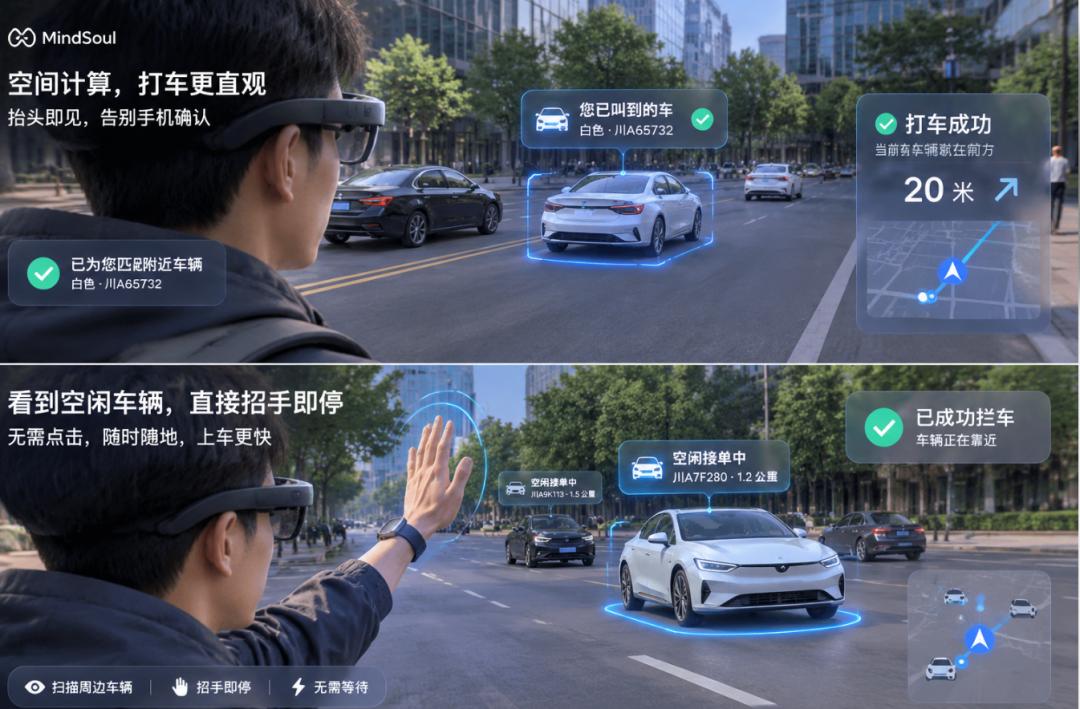
For example, in spatial computing, when you take a ride-hailing, you can directly see the cars on the street to confirm which one is your booked car, instead of checking the car color and license plate in the mobile app.
With MR glasses, you can scan to see which cars nearby have no orders, and users can hail a car with a wave to stop it, instead of clicking the ride-hailing button and waiting for the platform to dispatch orders. This returns to the real scenario of user ride-hailing, truly speeds up the order processing speed of the ride-hailing platform, and users do not need to wait for the car to arrive, realizing real hailing a car to stop immediately.
Improving the efficiency of ride-hailing can generate faster economic value. These very subtle innovations that bring revolutionary efficiency gains will bring brand-new opportunities.
It may even become the next ride-hailing platform, or the next WeChat.
All these will bring a brand-new society after the popularization of MR device terminals, and there will be a large number of digital twins and world models, rather than the current LLM.
5. Behind spatial computing and AI are robots, and humans will be treated like cats and dogs
In fact, a spatial computing glass is a robot, just without limbs. Such a society is both scary and happy. Humans can almost get care from robots and AI just like cats and dogs, without relying on partners to meet their needs for hot water supply, emotional companionship, and AI medical consultation.
Because everything can be replaced by AI. This AI is the world model-based AI, not the current LLM.
Therefore, with the emergence of Gaussian Splatting, a large number of spatial cameras that support binocular shooting will be spawned. Users can not only browse ordinary flat photos, but even "walk into" the moment when the photo was taken, record that moment, and restore past memories. For example, there are already editors for Gaussian Splatting that can edit related positions.
In the future, people will no longer edit images, but edit Gaussian Splatting related files, export relevant models through Gaussian Splatting, and then connect them with real-world physical hardware and process design.
Everything is waiting quietly for the popularization of MR glasses. Gaussian Splatting will then begin to spread widely and become the main data asset of mankind, instead of images.
This article is from the WeChat Official Account "Kevin's Bits That Change the World" (ID: Kevingbsjddd), written by Kevin's Stories, published with authorization from 36Kr.