The closer we get to the physical AI moment, the greater China's chances of winning?
The further AI penetrates into the physical world, the more significant the role of China's manufacturing industry becomes in this competition. Enabling a machine to understand a single instruction is only part of the product; getting it to complete tasks at a cost acceptable to customers and operate stably for a long time across different on-site scenarios will draw the entire supply chain, engineering teams and service networks into the competition. The accumulated capabilities China has built in these links have the potential to become the resources required for the next stage of AI popularization.
This means that the entry points for Chinese enterprises to participate in AI competition are increasing. Some supply components and complete machines, some embed intelligent capabilities into existing products, and others participate in model R&D with the support of real business scenarios. A question worth exploring is how much value Chinese enterprises can capture from this process: equipment orders are only the starting point. Whether they can further participate in product definition, retain customers, and convert on-site experience into technologies determines how far this competitive advantage can go.
The supply chain is starting to integrate into the AI R&D process
In the past, when talking about the advantages of China's manufacturing, people usually focused on the mass production stage after technology matures. Physical AI is bringing this advantage forward: to train an action, researchers first need equipment that can collect data, execute actions, and support repeated tests. How many problems can be solved by off-the-shelf hardware directly determines how much energy a team can allocate to model development.
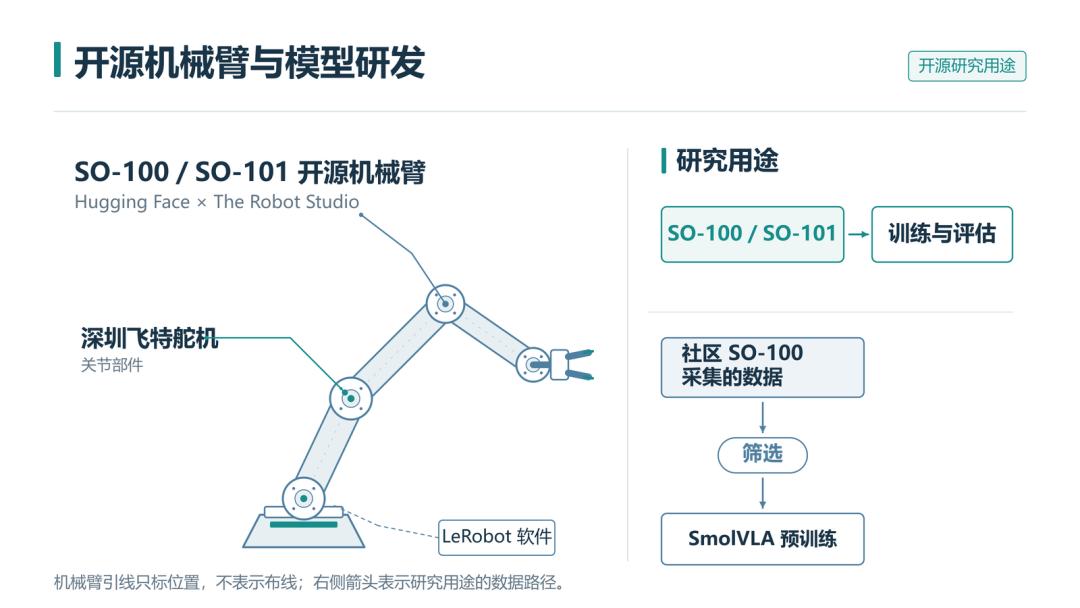
The open-source robotic arms SO-100 and SO-101 developed by Hugging Face in partnership with The Robot Studio serve as a specific example. Developers can purchase components according to the public bill of materials, print structural parts, and connect to the LeRobot software. The robotic arms use servos produced by Shenzhen Feite; the SO-101 also simplifies wiring and assembly, and adjusts the main arm motor to make it easier for manual operation.
These choices have already been embedded into model development. When Hugging Face released SmolVLA in 2025, it explicitly positioned low-cost open-source hardware as part of the efforts to lower the research threshold, and used SO-100 and SO-101 for training and evaluation. The team also screened and organized data collected by the community using SO-100 for model pre-training.
From purchasing components and assembling machines to collecting action data and training models, this path connects suppliers, hardware designers, the open-source community and model teams together. Chinese component enterprises do not need to become model companies first to have already participated in the hardware supply that AI research relies on. Development teams can also reuse existing execution components and assembly solutions to push their work forward to tasks and models. This is one of the ways manufacturing capabilities gain new value: it begins to influence who is qualified to conduct R&D and how R&D is organized.
This shift also takes place in complete machine manufacturing. Lens Technology disclosed in its semi-annual report this year that products related to robotic dexterous hands, joint modules and complete machine assembly have achieved mass delivery, relying on the precision manufacturing and system integration capabilities accumulated from long-term service for consumer electronics and smart vehicles. New products can leverage existing teams, processes and production systems, so entrants do not have to build every manufacturing capability from scratch.
China's comparative advantage is emerging right here: the more diverse the products that AI needs to enter, the more dispersed the required experience in materials, components, processing and assembly. An industrial system that can serve multiple types of products at the same time can provide more ready-made combinations. Model R&D still requires investment, but when an equipment company starts to try new intelligent functions, its existing products and supply chain will give it a much more advanced starting point.
To enter the physical world, you can also start from existing businesses
If people only focus on humanoid robots, it is easy to underestimate the value of this kind of starting point. A large number of physical devices already have clear tasks and paying customers. AI capabilities can be gradually integrated along specific practical problems, and commercialization does not need to wait for a universal machine that can do everything.
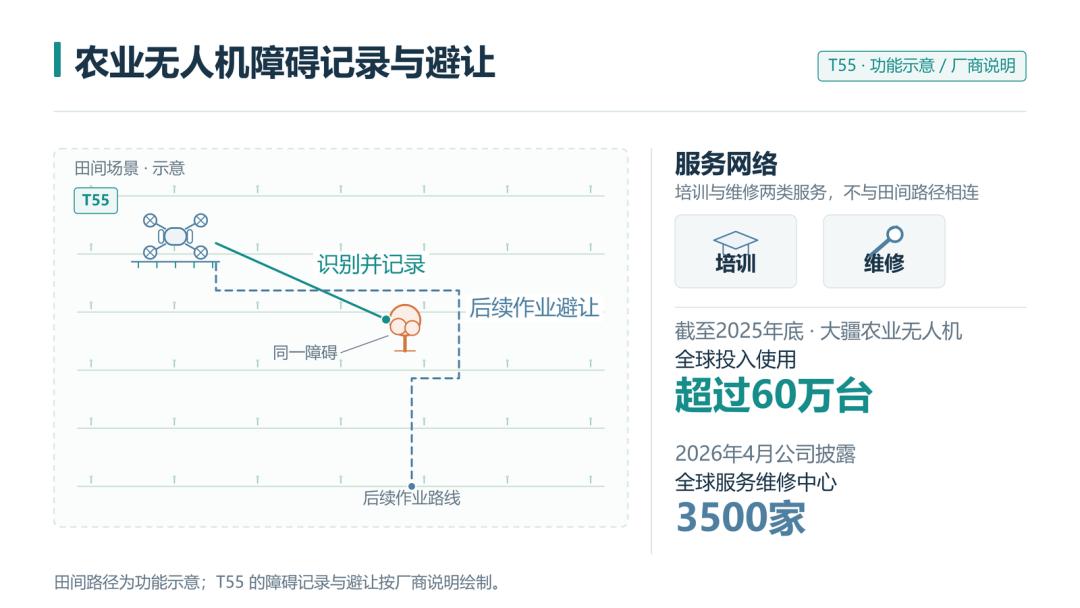
Agricultural drones have already gone through the process from equipment delivery to expanded usage. According to the report released by DJI in April this year, by the end of 2025, more than 600,000 DJI agricultural drones were put into use worldwide; the report also disclosed that its global service and maintenance centers have reached 3,500. Along with the machines, operator training and local service capabilities have also been formed.
The value of this business foundation lies in that new functions have ready-made usage entry points. The T55 launched in July this year integrates radar, vision and algorithms. According to DJI's product description, obstacles identified can be recorded to support avoidance in subsequent operations. R&D is targeted at specific field problems, and customers can accordingly judge whether intelligentization reduces the operation burden. The existing sales and service relationships enable enterprises to continue to deliver upgrades and handle faults, instead of rebuilding a whole set of customer networks for every new capability.
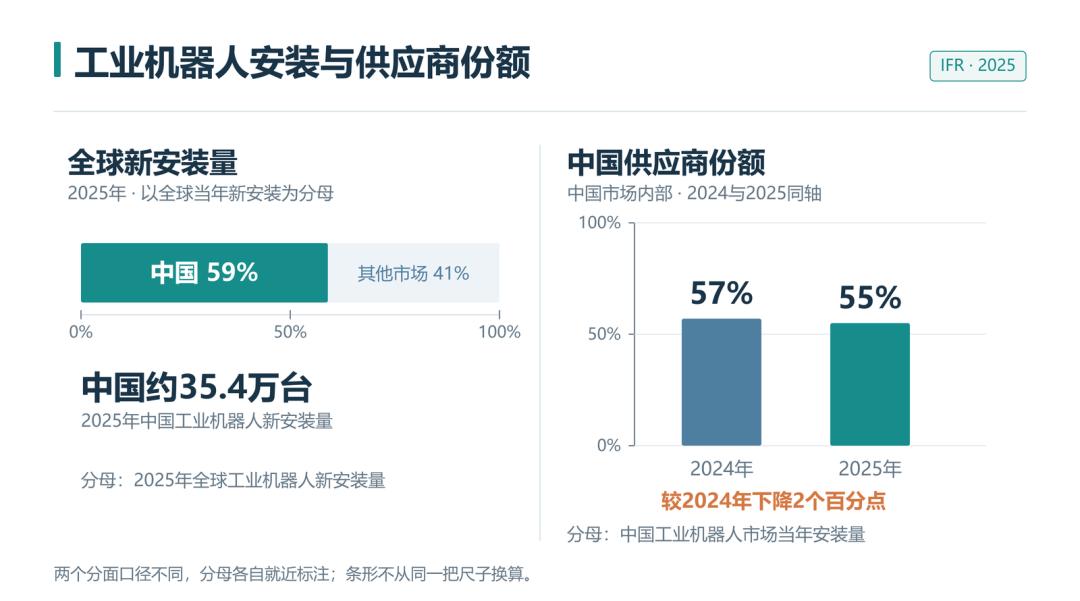
Industrial sites provide another type of starting point. Statistics from the International Federation of Robotics show that in 2025, about 354,000 new industrial robots were installed in China, accounting for 59% of the global total installation volume. Such a large usage scale means that a large number of enterprises already need to handle the coordination between robots, working procedures, personnel and incoming materials. When new AI capabilities enter factories, they can find tasks from these ready-made problems.
However, moving from production experience to model capabilities still requires someone to organize the problems into work that can be trained and verified. When Google DeepMind released Gemini Robotics 2.5 in November, it introduced the proof of concept carried out with Apptronik and Mercedes-Benz: the Apollo 2 robot sorts auto parts and matches them to containers used in production. DeepMind announced that the success rate of this specific task is 96%. This is still a pilot, but it has already demonstrated how deep the cooperation needs to go: the model team, equipment supplier and factory need to jointly define the actions and acceptance criteria.
China has a wide range of on-site foundations, and the next opportunity lies in this kind of cooperation. People familiar with production can put forward valuable tasks, equipment enterprises are responsible for adaptation, and model teams participate in improvement. The original number of machines in the factory will not directly translate into the amount of trainable data; converting experience into reusable capabilities requires continuous investment. Only enterprises that can organize this work and integrate improvements back into products can gain more long-term advantages from customer sites.
Beyond orders, who can retain more value
Hardware entering global AI R&D has formed a clearer cooperation pattern. The humanoid robot reference design announced by NVIDIA in May this year uses the Unitree body, paired with Sharpa dexterous hands and NVIDIA's computing and software platform, providing researchers with conditions for data collection, training and deployment. The plan announced at that time was to start delivery by the end of the year. Chinese robot body manufacturers thus participate in the supply of an international R&D platform.
This cooperation also draws a clear important boundary: NVIDIA's announcement explicitly states that researchers retain control over robot data, training data, telemetry and logs. Who manufactures the machine and who can use the subsequent data are two separate matters that need to be arranged respectively. High equipment sales volume first brings revenue from the supply business; whether the manufacturer can participate in subsequent R&D also depends on how it cooperates with customers.
Unitree is also expanding its own capabilities. In September this year, it released UnifoLM-WLA-1.0-Base and fine-tuning code, and its official open-source page also provides a data collection, training and real machine deployment framework adapted to its own robots and robotic arms. Robot body companies are starting to provide models and tools, which allows them to participate more deeply in how developers use hardware and what adjustments need to be made to the next generation of hardware.
Along this path, the value that Chinese enterprises strive for will change. If they only undertake manufacturing, they mainly compete for orders through delivery performance and cost; if they can continuously participate in task development and product improvement, they will have more opportunities to influence customer selection and obtain subsequent service and upgrade businesses. What is really worth observing is whether these enterprises can move from "others give the design, and I make it" to jointly deciding with customers what the machine should do and how to do it.
The huge domestic market will also attract competitors. According to the same IFR statistics, the market share of Chinese suppliers in the local industrial robot market in 2025 was 55%, down from 57% in 2024. The continuous expansion of the market did not make every new demand go to local suppliers. The manufacturing foundation provides the entry ticket, but customers will ultimately choose products that can solve their problems.
Therefore, the reason why China has greater odds of success as we get closer to the physical AI era is that the industrial capabilities that AI needs to mobilize are increasing, and China's existing accumulation can play a role in more links. The next more significant achievement should be that Chinese enterprises, relying on these accumulations, participate in defining new products, manage long-term customers, and continuously integrate manufacturing experience into their own R&D. At that time, the supply chain will not only take a round of new orders, but also secure a position in the next generation of industrial division of labor.
This article is from the WeChat Official Account "Feng Wei Feng Dabai", written by Feng Dabai, and authorized for release by 36Kr.