Elon Musk: Maybe it's time to give Amazon a rival, and netizens have even come up with the corresponding name.
AI has just learned to work for you, and Amazon, JPMorgan Chase, Charles Schwab have already started blocking its access!
On October 18, @trikcode posted on X a list titled "AI Blocked Access List", naming Delta Air Lines, JPMorgan Chase, Charles Schwab, Yelp and Amazon.
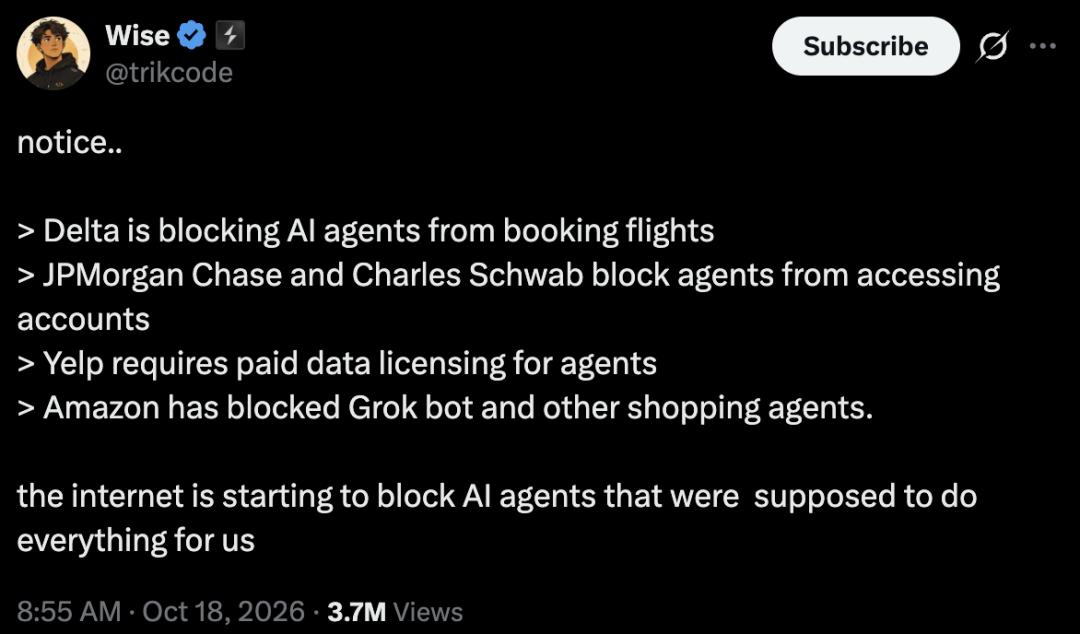
He complained:
Those AI agents that are supposed to handle everything for us are starting to be locked out by the internet.
Users are willing to pay, AI is willing to run errands, but the last mile is stuck because platforms refuse to grant access!
And the news that Amazon blocked Grok Bot drew a response from Elon Musk a few days ago.
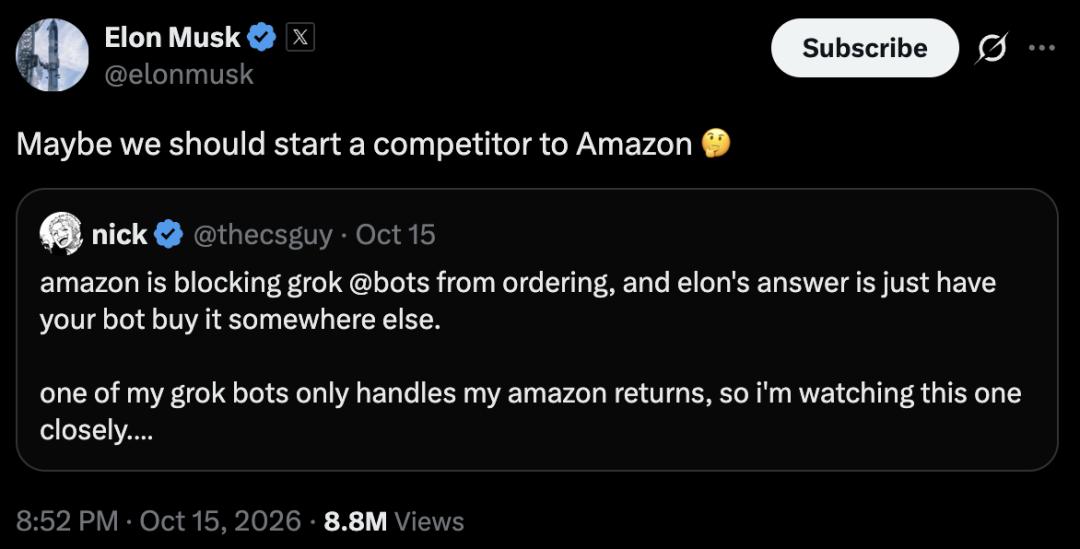
On October 15, X user nick posted that Amazon was preventing Grok Bot from placing orders. He himself runs a bot specifically for handling Amazon returns, so he paid extra close attention to this incident.
He also raised a question: Would you switch to another store just for your AI assistant?
Musk gave a bold response, and the sense of confrontation immediately rose:
Maybe we should create a competitor to Amazon.
Before the AI could even complete a purchase, Musk had already started considering whether to build a rival for Amazon.
nick even came up with a name for Musk: Grokazon!
He said that if such a platform really existed, he would sign up immediately, and did not forget to make a request: X membership should ideally include free fast delivery.

No specific plan for Musk's new e-commerce business has been made public yet, but Amazon's "blockade" of third-party AI shopping assistants has long been underway.
As early as September 21, The Verge reported that Amazon had blocked Meta's Muse shopping agent, and prompted users: Unauthorized agents continuing to access the site violates the website's terms of use.
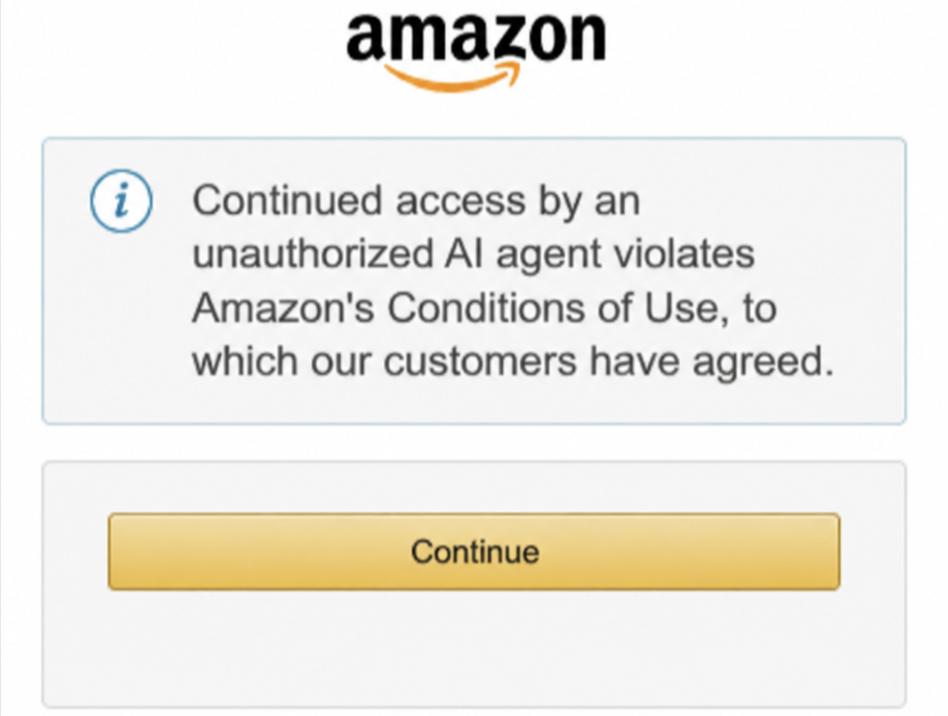
The interception prompt displayed by Amazon when users use Muse for shopping.
It is not only Muse that has hit a wall.
Some users also reported that OpenAI's Dots and Instinct agents have also encountered blocks on Amazon.
Users' thoughts may be very simple: I let the AI buy things for me, I have already granted authorization, and it is just my errand runner.
But the platform still has to ask: Who is this agent? What channel is it using? Did I give my approval?
Amazon's message is very clear: Third-party AI that buys things on behalf of users must clearly identify itself and explain how it operates.
As for whether to allow it to enter, the platform also has the right to say no.
In other words, even if you give instructions to the AI, the website may not issue it a pass.
And shopping is only one stop where AI hits a wall.
Booking flights, looking up restaurants, operating financial accounts all have their own respective access thresholds.
You Delegate Tasks to AI
You Still Need Platform Approval
First let's look at flight booking.
According to a TechCrunch report on October 6, Delta Air Lines said that there are currently no cooperation or access arrangements that allow third-party AI agents to search for flights and book tickets on its platform on behalf of users.
If you want to hand over all your travel arrangements to AI at once, you first have to see if the airline supports this "agent".
Then let's look at Yelp, the local business review platform.
Its requirement is: If you want AI to access the platform's content and data, you must first obtain paid authorization.
This means that it is not enough for users to be willing to let AI run errands, the company behind the AI must first negotiate authorization and fees with Yelp.
Even for the same AI delegation scenario, different platforms have completely different rules:
Amazon directly blocked Muse, Delta has no corresponding cooperation arrangements yet, and Yelp requires paid authorization.
Moreover, even if the website does not specifically block AI, the original anti-bot mechanism may intercept the agents.
You originally just wanted to say "get this done for me", but the AI company has to first negotiate with every single platform: whether to allow the AI to enter, and what it can do after entering.
If one link is not connected, the unfinished task may be sent back to you.
If you get stuck when shopping, you can just place the order yourself.
But when it comes to financial accounts, you can't just expect the platform to grant access, you must first figure out: What exactly can the AI do after accessing your account?
AI Gains Access to Your Money
Who Takes Responsibility?
JPMorgan Chase directly stated its concerns.
On October 13, CEO Jamie Dimon said during the earnings call that the company is using agents internally, and will also use them to serve customers.
But external AI cannot be allowed in casually, the bank has to prevent customers from suffering losses and prevent data from being misused.
CFO Jeremy Barnum put it more specifically: Some services obtain the ability to operate account funds through login information such as account numbers and passwords provided by users.

JPMorgan Chase explains the risks brought by shared login credentials.
The bank believes this method is unsafe and is intercepting related access.
To put it bluntly, if you hand over the key to your account, the AI may obtain permission to operate your funds.
You only wanted the AI to check your bills, but you may have also granted it transfer permissions at the same time.
Charles Schwab is also conducting interception.
According to a Bloomberg report on October 16, Charles Schwab is blocking unauthorized agents that attempt to transfer customer funds, including Muse.
CEO Rick Wurster said straightforwardly:
We can't control it, and customers can't control it either. Things can go wrong, so who is responsible?
Handing over a task should not equal handing over full control of your entire account.
For checking balances, viewing transaction records, and transferring money, the specific permissions granted to AI must be clarified in advance, and you cannot wait until the money is transferred out to discuss the issue.
After all, a simple line of "the AI made a mistake" will not automatically return the transferred money to your account.
AI Has Already Learned to Use Computers
Is Blocking Still Effective?
@trikcode, who published that "AI Blocked Access List", complained directly:
It's strange, they actually want to stay in the Stone Age.

Ethan Mollick, a professor at the Wharton School, also questioned the blockade strategy:
In an era where AI can already operate computers for you, this does not seem to be a very stable strategy.
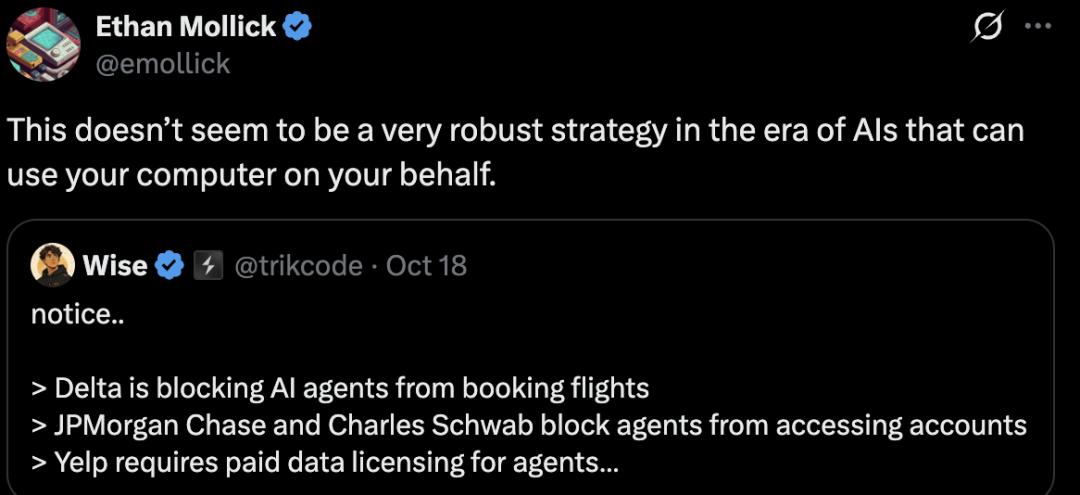
The AI opens web pages and clicks buttons for you, but you are the one who actually wants to make the purchase.
But platforms still need to figure out: Is the AI sent by you? What are you allowing it to do? Who is responsible if something goes wrong?
And Meta believes that rejecting personal agents means rejecting the customers behind them.
It is also securing partnerships to get more merchants to "receive" AI assistants:
According to The Verge, Meta has partnered with retailers including Walmart, Gap, Sephora and Best Buy, allowing Muse to shop on these websites.
But for users, the trouble still exists: the same AI assistant can be used in one store, but may be blocked when you go to another.
Therefore, when choosing an agent, apart from looking at how intelligent it is, you also need to see what exactly it can accomplish for you: which websites does it support? Can it only search, or can it add items to cart and make payments? Which steps require you to take over?
You shouldn't wait until the AI has gone through a whole process before you find out that the task you wanted to complete is not supported by the platform for AI delegation at all.
Don't Make Users Run Errands for AI
Users hand over tasks to AI to save effort.
What they care more about is whether the rules negotiated between platforms and AI companies can reduce the number of times they need to take over and reduce unnecessary hassle.
Before an agent takes on a task, it must also clearly state what it can do. Do not use a general statement like "can help you shop" to hide the restrictions on different websites and different links.
During the execution process, the permissions must also be clearly communicated.
Especially for actions such as payment and fund transfer, users should be able to see and control these processes, and should not have to rely only on that one general authorization given at the very beginning.
In addition, when problems occur, there must be a clear handling process: how to pause the task, whether the operation can be revoked, and who to contact when disputes arise, all of which must be clearly specified.
Otherwise, the so-called AI delegation is very likely to become:
When you reach the shopping website, you are required to log in again; when you reach the ticket booking step, you have to take over personally; when something goes wrong, you have to contact customer service on every platform one by one.
The AI has been busy for a long time, but in the end you have to do everything all over again from scratch.
Is such an assistant saving you trouble or adding to it?
The time that AI saves for users should not be spent again on repeatedly applying for passes for it and cleaning up the mess for it.
References:
https://x.com/elonmusk/status/2110715556328579219?utm_source=chatgpt.com
https://x.com/emollick/status/2111858791939772731
https://x.com/trikcode/status/2111622265284546620
https://www.theverge.com/tech/998078/amazon-blocks-meta-muse-ai-agent-shopping?utm_source=chatgpt.com
This article is from the WeChat Official Account "New Intelligence" (ID: AI_era), written by ASI Revelation, published with authorization from 36Kr.