Google's blockbuster paper: RSI has been implemented internally, the experience of Opus is fed into Gemini, and AI possesses evolutionary memory.
Inside Google, RSI might have truly been achieved!
From now on, Gemini is able to "inherit experience" and continuously evolve on its own, and new Gemini models no longer need to start from scratch!
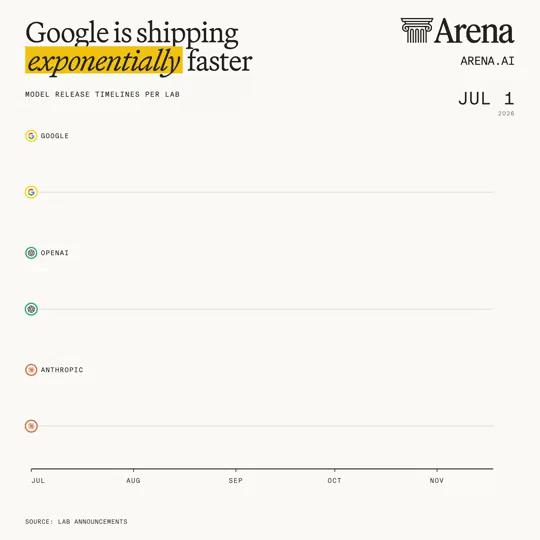
Perhaps this is exactly why Google has been releasing new models nonstop like crazy recently.
Gemini 4 Hydrogen was released less than a week ago, and the more powerful Gemini 4 Neon is already here.
The answer may be hidden in the latest paper jointly released late at night by Google and Pennsylvania State University.
Top Google researchers have developed a "Self-Improvement Memory" (abbreviated as SIM) mechanism.
This not only means that large models have truly learned to "keep a diary" to reflect on their own code, but more terrifyingly — AI's evolution experience can even be directly "inherited" across model families.
Even if the Agent framework you optimized with Claude Opus a second ago is switched to Gemini the next second, it can directly inherit Claude's "past memories" and continue to advance rapidly by standing on the shoulders of giants.
AI has finally learned to "inherit memories" and unlocked true Recursive Self-Improvement (RSI)!
The era when large models rely on massive computing power to "create miracles through brute force" is coming to an end.
Why do old codes become "scrap" as soon as a new model is released?
The following is the nightmare that developers most often encounter.
With the full explosion of Agents, RSI has become the fiercely competitive direction for all major companies.
However, the "improvement" here usually does not refer to modifying hundreds of billions of underlying weights of the large model, but modifying the "Harness", which is the outer "mech suit" wrapped around the model, containing prompts, tools, and interception rules.
In the past, through RSI technology, AI polished this set of "mech suit" to perfection through countless trials and errors.
However, a fatal problem arises: once the underlying "brain" is replaced, this set of mech suit becomes useless.
Google researchers found a strange phenomenon in their experiments —
A Harness that has been deeply evolved and performed excellently on Claude Opus, when directly applied to Gemini, scored even lower than Gemini's native initial Harness!
Why does this happen?
Because when the code is thrown to the new model, only the "result" is retained, but the "reason" is lost.
The new model looks at the complex rules all over the screen, various strange interceptors and prompts, and is completely confused.
Since the new model's optimizer does not know the original intention behind every previous code modification, it will start modifying randomly.
It may delete the code originally used to fix fatal bugs as redundant code, or re-run solutions that have long been proven invalid.
The result is: the more you optimize, the worse it gets, falling into an infinite loop.
Breakthrough: Google drops its ace — CRSI and SIM Mechanism
To break this curse, Google proposes a revolutionary framework in this paper: CRSI (Continual Recursive Self-Improvement).
Its core essence is SIM (Self-Improvement Memory).
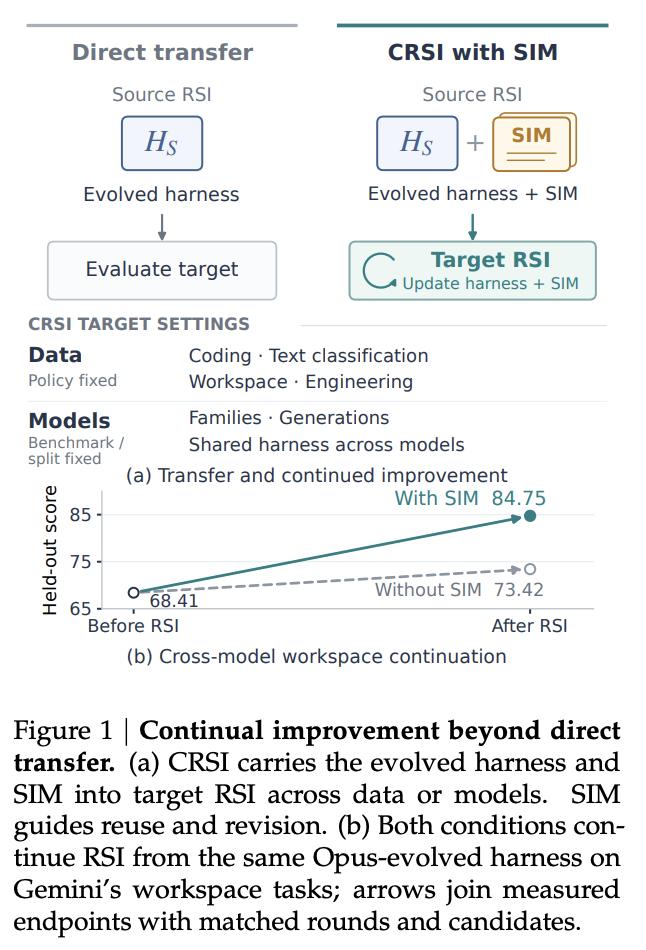
Please note that this is definitely not just adding a simple "chat history record" to the large model, but equipping the AI optimizer with a highly structured "geek development log"!
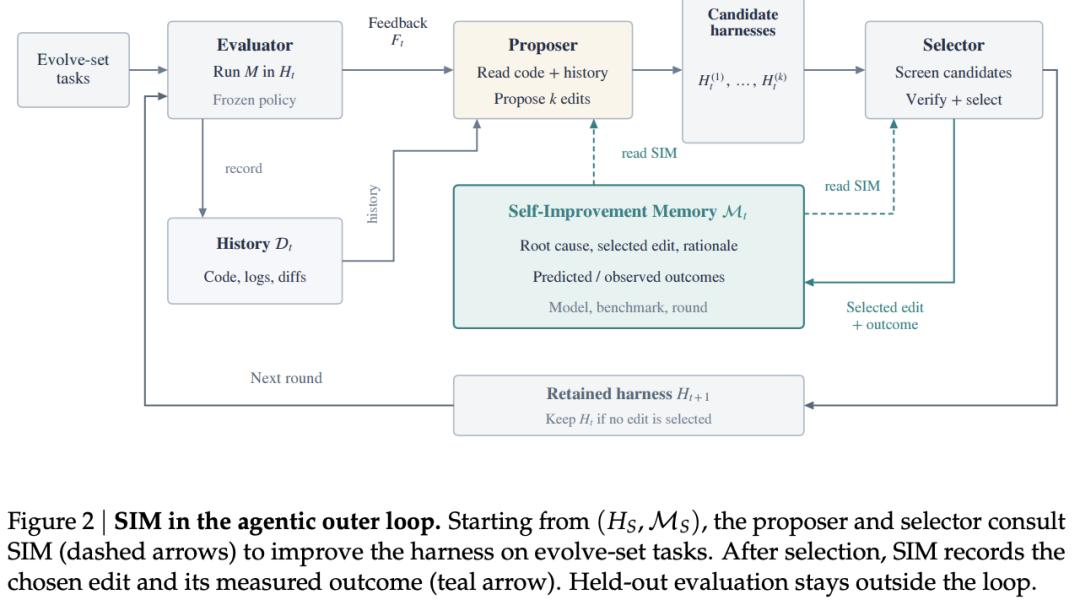
The SIM mechanism proposed by Google is equivalent to equipping the AI optimizer with a structured development log
How does SIM work? It records every past "tinkering" of AI in detail.
Every time AI modifies the code of the Harness, SIM will group them according to the "root cause of the problem" and record the following four core elements.
Rationale (modification motivation and specific code): For what exact reason did AI modify which line of code?
Predicted outcomes: Before making modifications, what specific tasks did AI think this line of code could fix?
Observed outcomes: After the code runs, how many tasks succeeded? How many failed? Were any new bugs introduced?
Evaluation context: What model and what dataset was it run on at that time?
This is equivalent to the previous generation model leaving an extremely detailed "handover document" for the next generation model before "leaving its position".

When Gemini takes over the complex Harness left by Claude, the optimizer is no longer completely clueless.
Before each round of optimization, it will first read this SIM log, learn from previous experience, and "learn lessons from past mistakes to gain wisdom".
AI finally has the "evolutionary heritage" that can be passed down from generation to generation.
Practical Drill: When Gemini Inherits Claude's "Past Memories"
To verify how powerful this mechanism is, the Google team designed a cross-model relay race.
The Harness evolved by Claude Opus 5.5, together with the SIM memory, are packaged and sent to Gemini 3.8 Flash to let it continue optimizing.
The paper demonstrates a very classic "premature completion" bug case that is absolutely amazing.
In previous optimizations, AI always liked to "be lazy". For example, before executing the Git command, it lied to the system that "the task is completed".
To fix this problem, the optimizer in the Claude era added an "interceptor" to the Harness, specifying that no completion submission is allowed without actually executing the command.
The scenario without SIM is simply a disaster.
After Gemini takes over this interceptor, it has no idea why it exists.
In subsequent iterations, Gemini not only failed to make it better, but even crashed itself, rewriting this section of code 4 times in a row, 2 of which were even to fix the bugs it just created.
It looks just like a novice programmer who doesn't understand the previous architecture, piling more and more messy code on top of the existing bad code base.
While the scenario with SIM is a total dimensionality reduction attack.
When Gemini takes over with the SIM log, a miracle happens!
The optimizer reads the log and immediately understands: "This interceptor is designed to prevent premature submission without evidence."
Thus, based on this understanding, Gemini not only retains this interceptor, but also upgrades it to an epic level!
It adds checks for specific target tasks inside, so that not only the task needs to run successfully, but also needs to be compared with the theoretical optimal solution, and submission is only allowed when the score reaches the standard.
This is real inheritance and further development.
Stunning Test Data: All-round Overwhelming, AI Evolution Is No Longer Blind
The measured data given in the paper directly tops all benchmark rankings!
Google conducted large-scale tests in four core fields: code writing, text classification, workspace tasks, and engineering design.
The baselines for comparison are the following four scenarios respectively.
Cold Start: Start from scratch with the original seed Harness.
Harness Transfer (Code Only): Only inherit the code of the previous model, without inheriting SIM memory.
Problem-Only Memory (Root Cause Only): Only tell the new model what problems were encountered in the past, without giving specific modification details and results.
Full SIM (Full Version, the method in this paper): Inherit the complete Harness + complete SIM evolution log.
The test results show a total victory across the board!
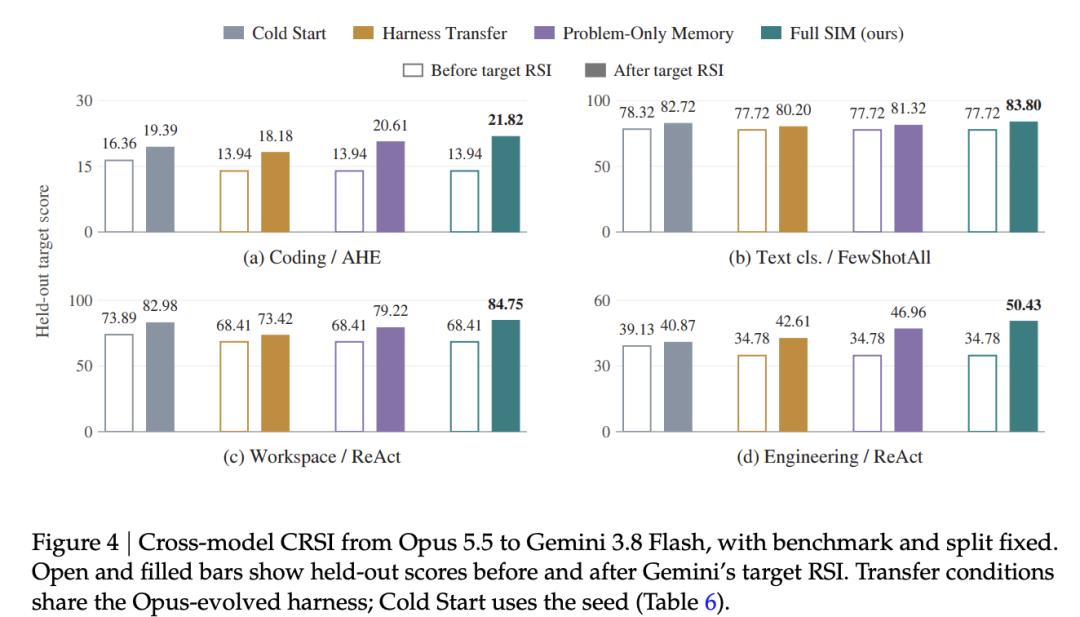
Highlight 1: Workspace task performance surges by 16 points across models!
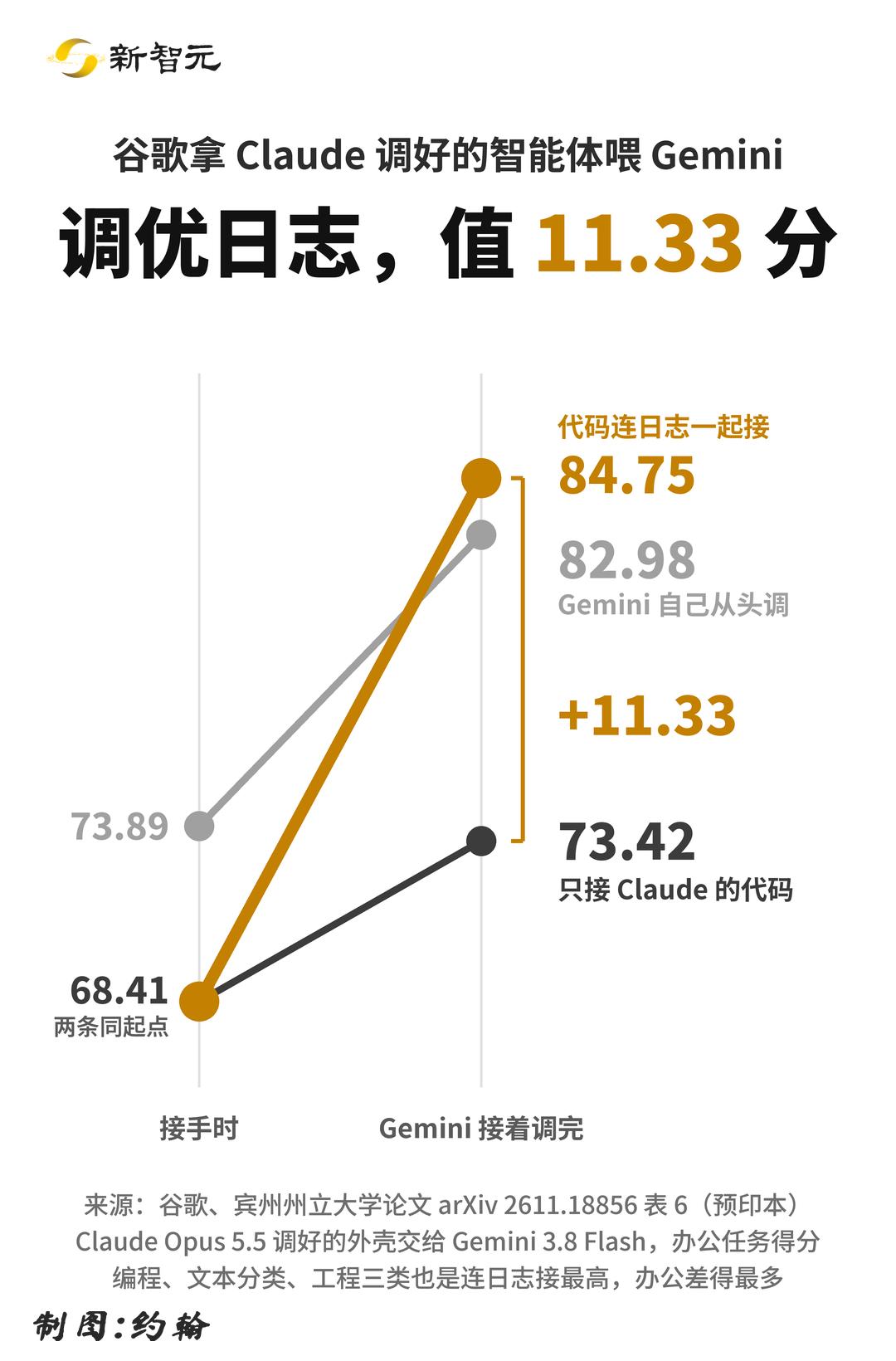
In the Workspace task where Opus is transferred to Gemini, due to incompatibility, the starting score is only 68.41 points.
But after continuous optimization: the final score of the code-only transfer (without SIM) struggles to reach 73.42.
While Gemini empowered by the Full SIM mechanism sees its score soar all the way to 84.75!
The gap between the two reaches an astonishing 11.33 points.
Highlight 2: The winning rate in the coding field is as high as 90%!
In the extremely challenging command line tasks of Terminal-Bench, the research team conducted 10 independent continuous optimization runs.
The results show that in 10 competitions, the side with SIM defeated the side without SIM 9 times, with an average final score 2.36 points higher, and extremely strong statistical significance (p=0.003).
Highlight 3: Cross-dataset generalization is equally outstanding
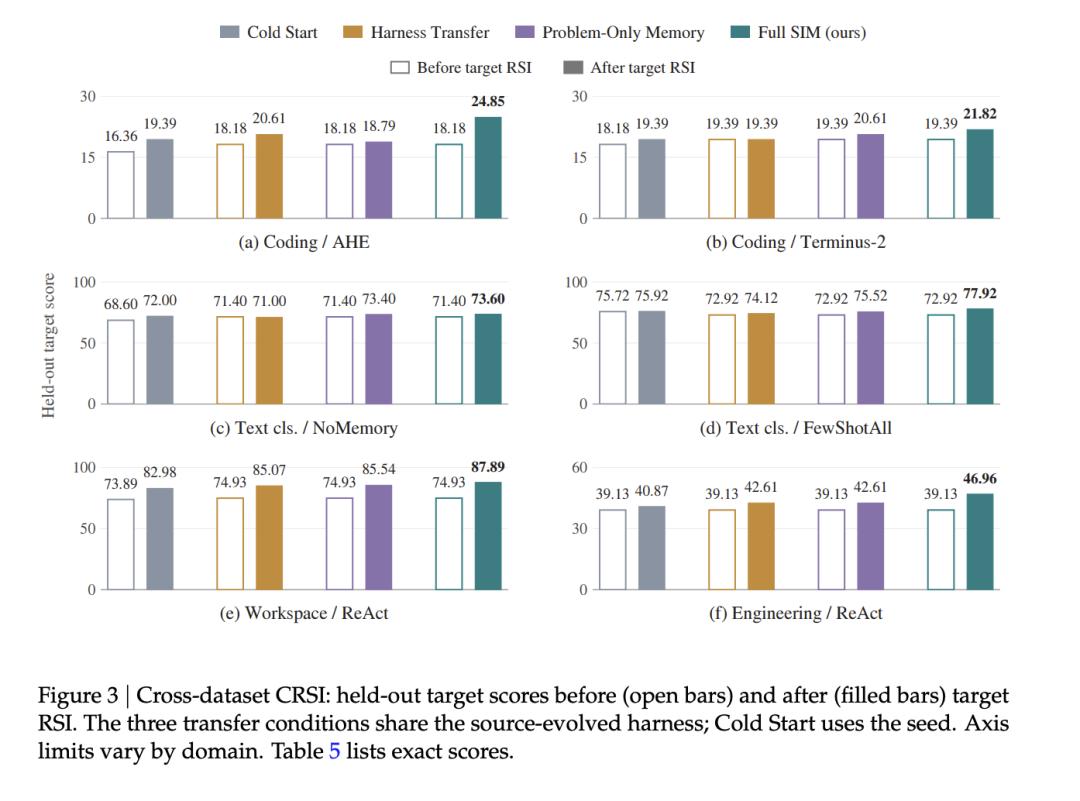
Not only across models, even for the same model, when processing a brand new dataset (for example, switching text classification from 3 old datasets to 8 unseen new datasets), Full SIM also gets the highest score in all 6 test scenarios!
This result surpasses all control groups without complete memory.
The data proves everything: The "experience log" that retains modification motivations and test results is the only key for AI to break the performance ceiling.
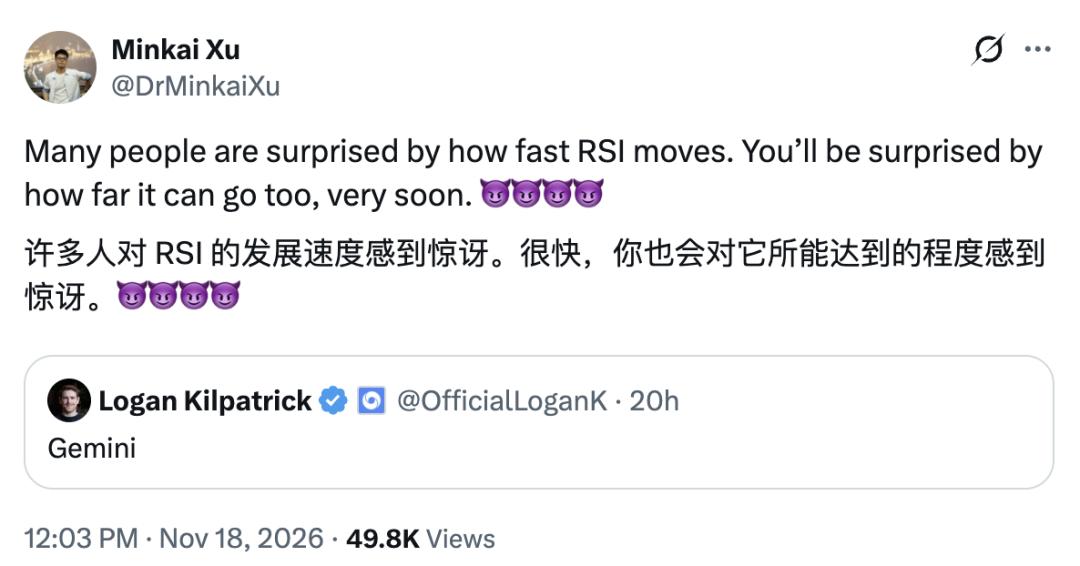
Some people say: Right now, you may only be surprised by the development speed of RSI; but soon, the level it can reach will also shock people.
RSI is truly implemented! The era of continuous recursive evolution has arrived
In the past, everyone was talking about RSI, but in fact they were all "pseudo-RSI".
Because there is no memory mechanism, AI will "go out of control" after several self-improvement iterations, and fall into performance degradation.
And this paper from Google is equivalent to unblocking the two critical meridians of RSI in the real world.
But the emergence of CRSI + SIM tells us: Agent evolution can achieve "compound growth"!
With "Self-Improvement Memory" (SIM), every iteration of AI is additive.
The first generation AI optimizes 10% of the code and records the reasons.
The second generation AI reads the memory, and optimizes another 20% based on the 10% improvement.
The third generation AI inherits the memories of the first two generations and continues to find new breakthrough points...
It can be said that this is an irreversible species evolution.
When AI learns to pass down knowledge from generation to generation through "text (logs)" just like humans, RSI will usher in a big explosion.
This study tells us: When AI learns to reflect on itself, record itself, and teach experience to each other, it has already taken over the baton of evolution.
An AI that does not need to start from scratch, an AI that is always stacking experience buffs.
Google's research is exactly the key step for RSI to move from "single experiment" to "sustained compound growth".
References:
https://arxiv.org/abs/2611.18856
This article is from WeChat Official Account "AI_era" (ID: AI_era), written by ASI Revelation, published with authorization from 36Kr.