Late at night, the AI sector of the US stock market crashed sharply, and Nvidia's market capitalization has plummeted by 2.7 trillion US dollars.
According to a November 21 report from Zhidx, the US stock market suffered a "Black Friday" overnight. Mounting fears of an intensifying AI bubble triggered a Wall Street sell-off, with panic erupting sharply across the market. US tech stocks tumbled across the board: Nvidia's share price plummeted 14%, Dell dropped 11%, Anthropic fell 9%, Oracle, SpaceX and Tesla all slumped 8%, Meta declined 6%, and Amazon shed 4%.
Chip stocks also faced sharp declines. The Philadelphia Semiconductor Index, a key benchmark for US chip stocks, fell 10.7% on Friday, marking a cumulative 43% drop from its peak in June. SanDisk plunged 16%, Micron Technology dropped 14%, AMD fell 13%, Western Digital, Broadcom and Marvell all slumped 12%, Applied Materials declined 11%, Lam Research shed 10%, TSMC fell 9%, Intel and Texas Instruments both dropped 8%, and ASML tumbled 7%.
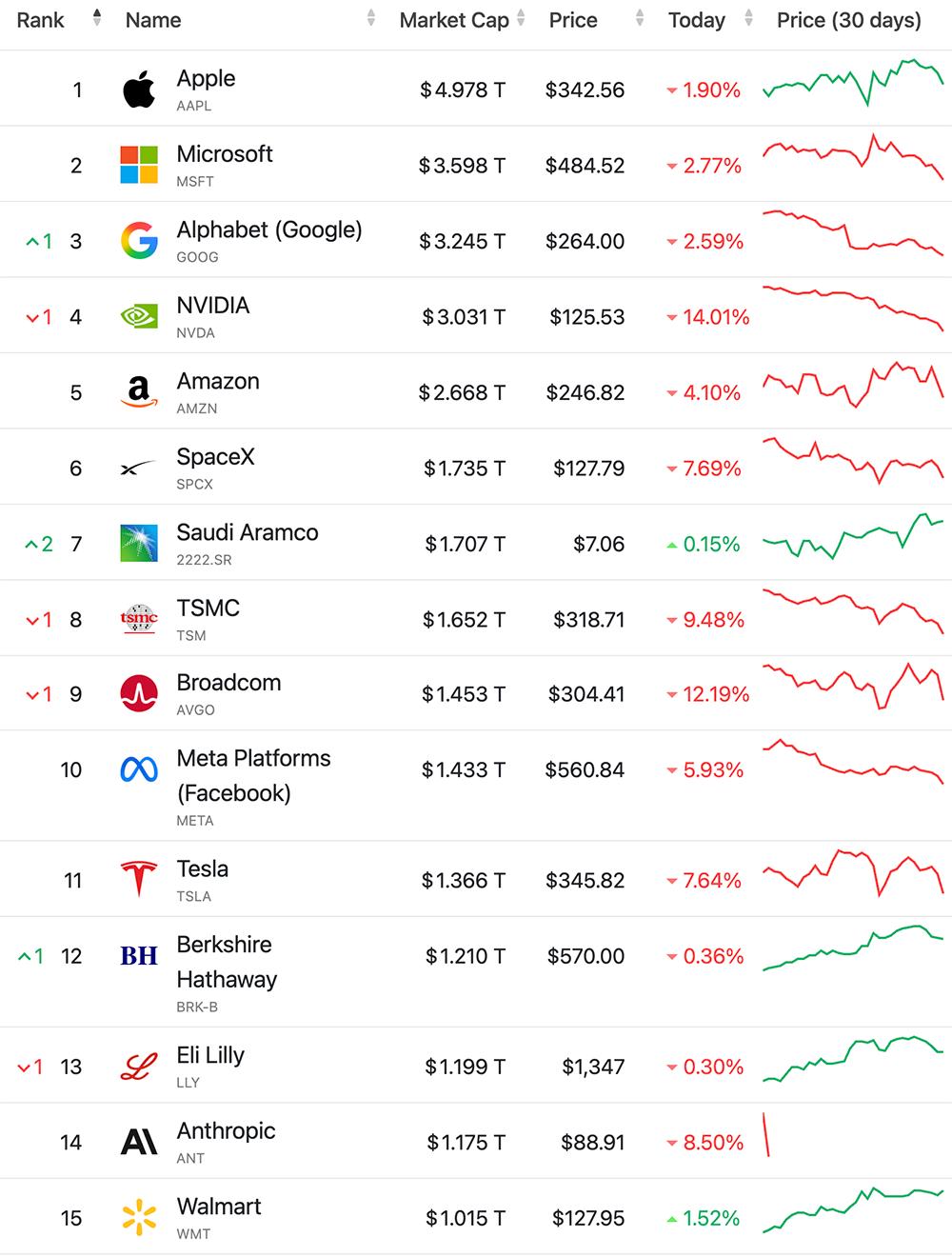
▲ The latest market capitalization and share price changes of the world's top 15 companies by market value (Source: Companies Market Cap)
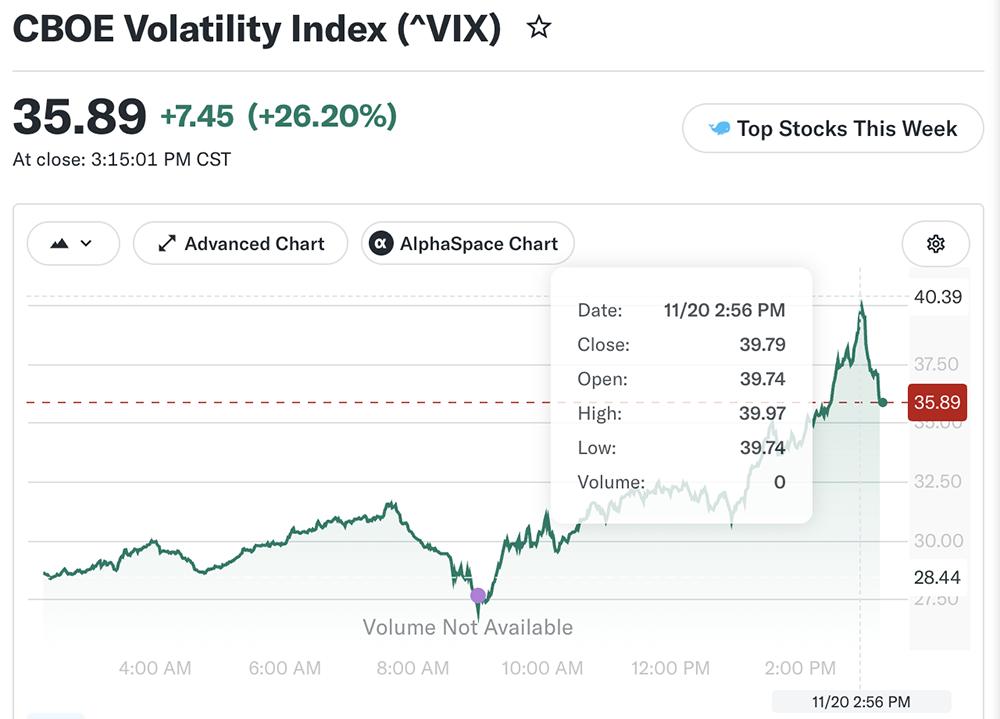
US stock trading was extremely volatile on Friday, with the sell-off intensifying toward market close, and AI-related stocks posting the largest declines. The VIX index, known as Wall Street's "fear gauge", once surged to 40 points, hitting its highest level since April 2025.
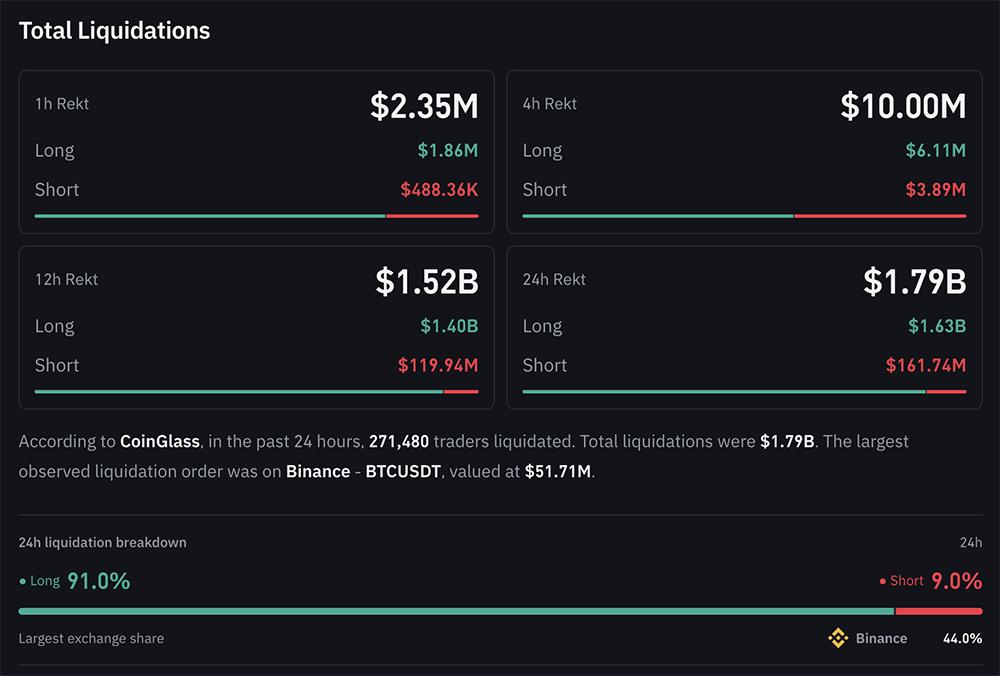
According to statistics from CoinGlass, a total of 271,500 users were liquidated in the past 24 hours, with the total liquidation amount reaching 1.79 billion US dollars.
For US stock investors, this is undoubtedly the worst and most terrifying day of 2026.
As of the latest US market close, Nvidia has recorded declines for 7 consecutive trading days. From its peak on October 6 to date, Nvidia's share price has fallen by a cumulative 47.5%, marking its longest losing streak since 2008, wiping out 2.74 trillion US dollars (equivalent to about 18.30 trillion yuan) in total market value.
Since Jensen Huang's resignation was announced on November 12, Nvidia's market value has evaporated by approximately 1 trillion US dollars (equivalent to about 6.68 trillion yuan) in total.
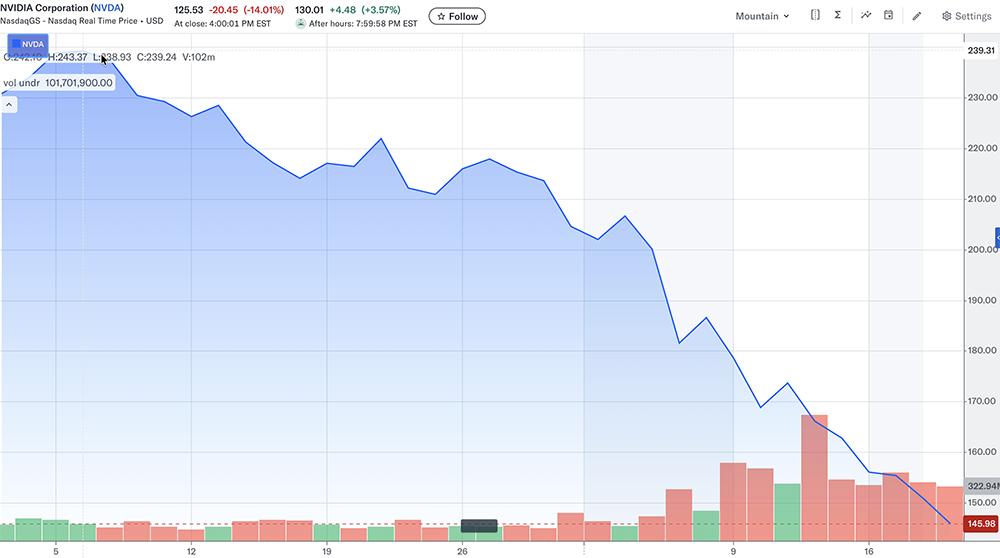
According to CNBC reports, the last time Nvidia saw such a severe consecutive weekly decline was during the 2008 financial crisis, when Nvidia's quarterly revenue was less than 1 billion US dollars. Today, Nvidia earns more than 1 billion US dollars in a single day.
The drop in Nvidia's share price was partly affected by the latest Reuters report. According to Reuters, two people familiar with the matter revealed that the U.S. Securities and Exchange Commission (SEC) is investigating possible accounting issues at Nvidia.
According to another Reuters report, an aide to U.S. Republican Senator Tim Scott released a statement on local time Friday, saying that former Nvidia CEO Jensen Huang has agreed to testify at a public hearing of the U.S. Senate. If the hearing proceeds as planned, this will be Jensen Huang's first public testimony since his resignation. In addition, Jensen Huang has agreed to attend a closed-door meeting with three committees of the U.S. House of Representatives on December 1.
"We have to protect our brilliant people, and Jensen Huang is one of them," U.S. President Trump said at a White House press conference on Friday, "I would love to see Jensen Huang come out with a big apology and come back... I really want him (Jensen Huang) to come back, we have one of the truly smartest minds in the world. Where else is he going to go? I really want to see Jensen Huang get a second chance... I think if the company is smart, they will bring that brilliant man back, accept the apology, and let him go back to work."
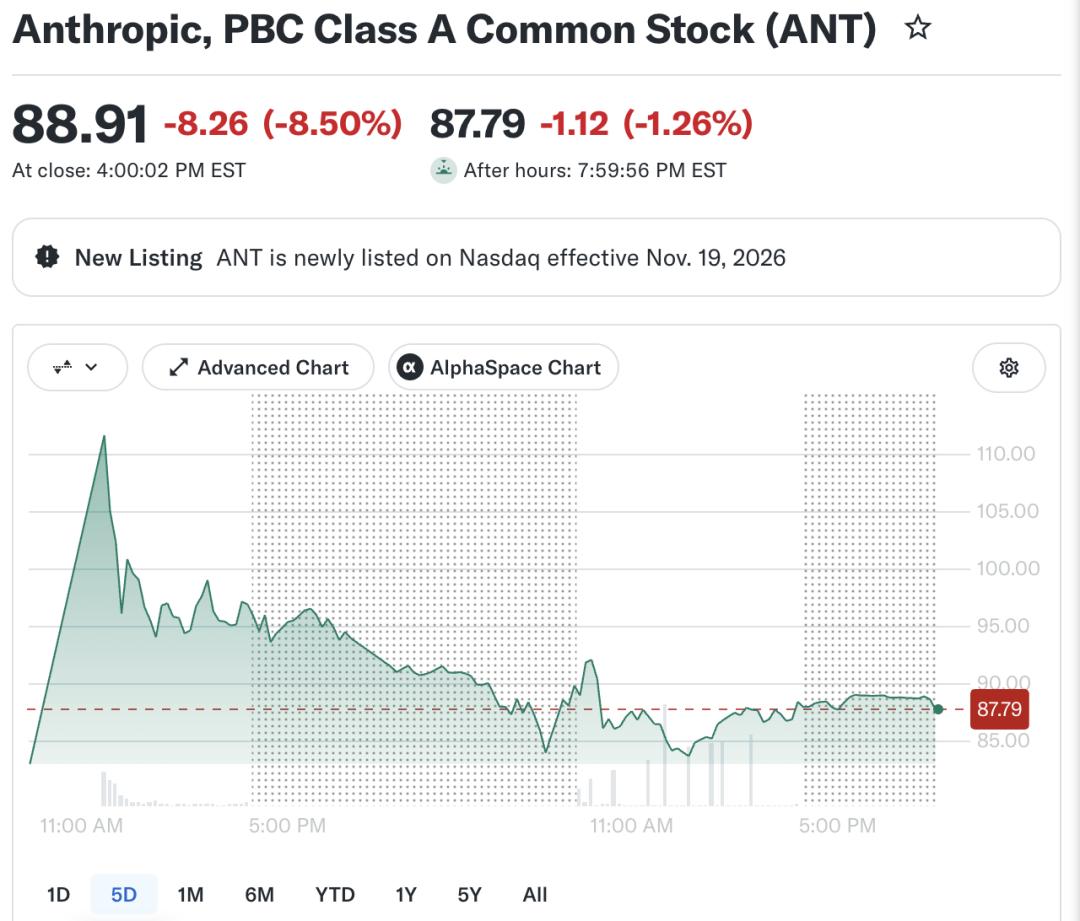
Anthropic, which just went public this Thursday, saw its share price fall close to its IPO offering price at one point, then narrowed its decline to close down 8.5%. Its total market value dropped to 1.18 trillion US dollars (equivalent to about 7.88 trillion yuan).
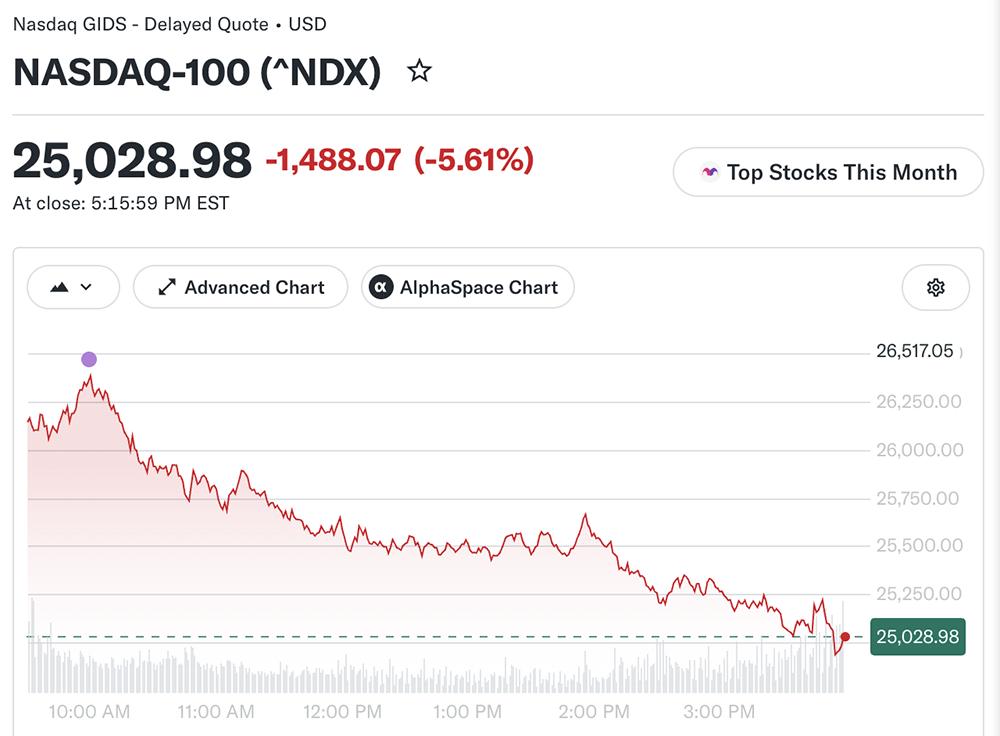
Hit by the sell-off, the tech-heavy Nasdaq 100 Index plummeted 5.6%, marking its 7th consecutive trading day of decline. It has posted a cumulative 10.4% drop this week, the largest single-week decline in more than 6 years. The index has fallen 20% from its intraday high on October 6, and a 20% drop is generally seen as a sign of a bear market.
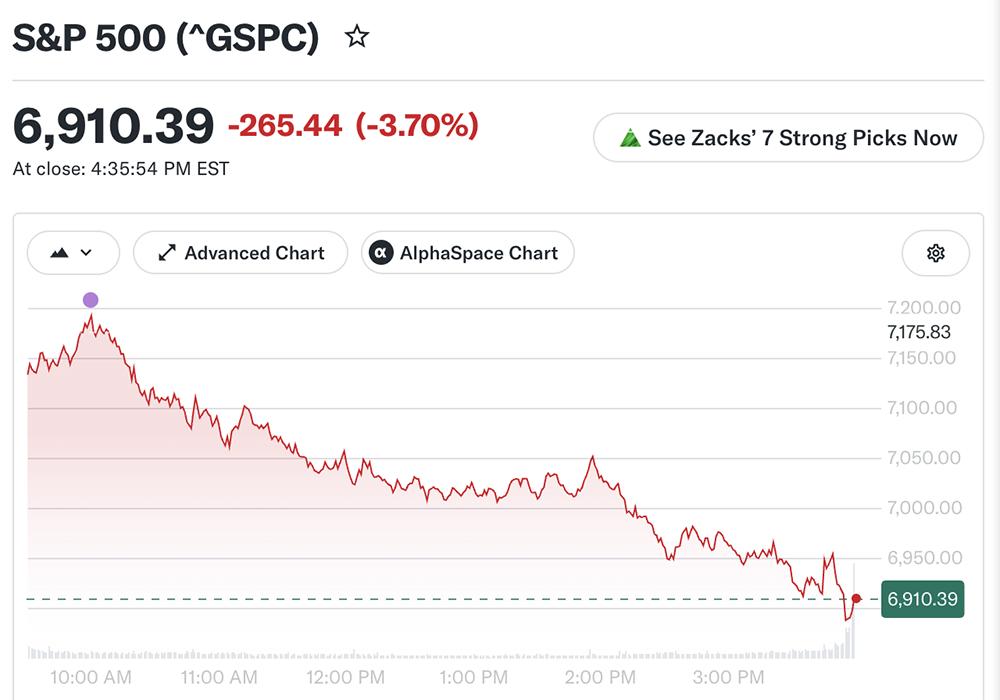
The S&P 500 Index fell 3.7%, with a cumulative decline of more than 10% from its high in October. Investors flocked to safe-haven assets, driving the yield on the 10-year U.S. Treasury note down 0.1 percentage point to 4.94%.
This sharp plunge is the latest sign that enthusiasm in the AI sector has shifted into concerns over the massive spending and borrowing by tech giants to invest in AI infrastructure.
Concerns about the AI bubble began to spread around the middle of this year. However, it was not until last month, as the trend that major economies such as the United States need to raise interest rates further to curb inflation became increasingly obvious, that the sell-off really began to accelerate.
This week, the sharp plunge in global financial markets deteriorated drastically, with concerns over AI and U.S. interest rates triggering large-scale sell-offs across assets from stocks to copper and gold.
Some figures are staggering. According to Reuters, since hitting its peak in August this year, the total market value of global stock markets has evaporated by nearly 9 trillion US dollars (equivalent to about 60.10 trillion yuan).
Among them, Nvidia is one of the most closely watched stocks.
Since Nvidia announced Jensen Huang's resignation, the company has continued to suffer heavy blows. Although Nvidia's latest quarterly financial report exceeded expectations, raised its performance guidance for fiscal year 2028, and promised to give employees pre-emptive pay rises and additional stock grants, these failed to stop the sell-off.
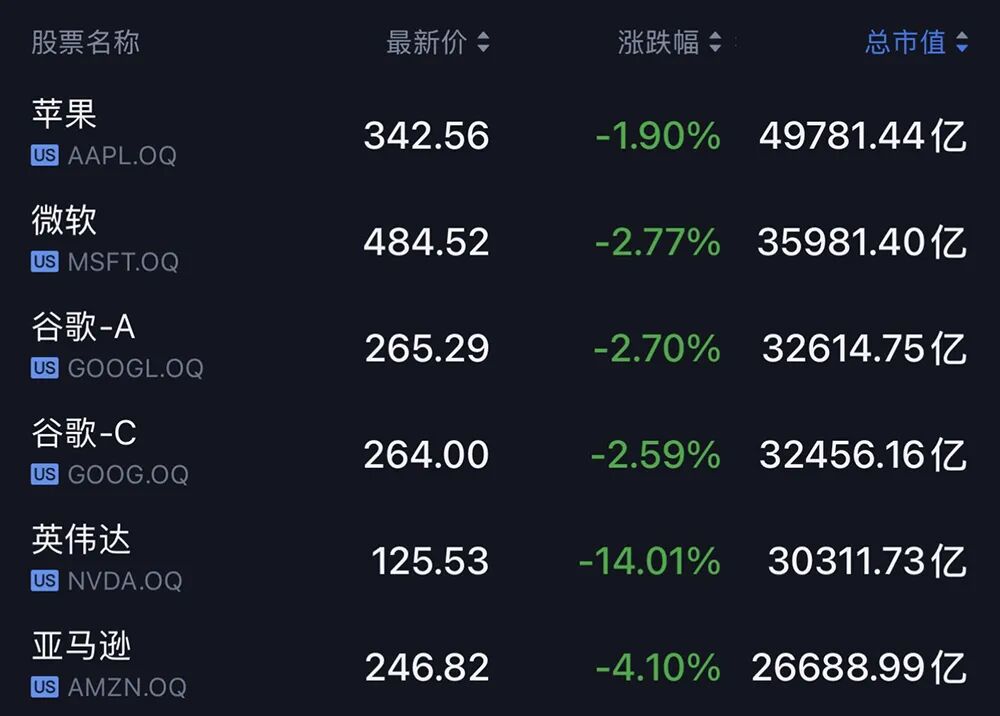
Nvidia used to be the company with the highest market value in the world, but now its market value has dropped to 3.03 trillion US dollars (equivalent to about 20.23 trillion yuan), ranking after Apple, Microsoft, and Alphabet, the parent company of Google. The last time Nvidia's market value stood at around 3 trillion US dollars was in May last year.
Investors are increasingly worried about Nvidia's future after Jensen Huang's departure, and are paying growing attention to circular AI financing transactions.
During the latest earnings call this week, Colette Kress, interim CEO and CFO of Nvidia, said that the company will be more cautious about AI industry financing transactions in the future.
The market confidence that Jensen Huang has built for Nvidia over a long period of leadership is being caught in the storm. At a time when investors are extremely sensitive to AI spending and returns, every move of AI giants and semiconductor giants such as Nvidia may trigger market turmoil.
For investors, questions remain over whether Nvidia relies more on Jensen Huang's vision and adventurous spirit, or has become a company that places greater emphasis on rigorous financial planning, and whether Nvidia can continue to innovate and maintain its strong influence in the AI market without Jensen Huang.
Sources: CNBC, the UK's Financial Times, Reuters
This article is from the WeChat Official Account "Zhidx" (ID: zhidxc om), written by ZeR0, and published with authorization from 36Kr.