How AI Has Come This Far: The 1958 Machine That You Are Still Using Today
Nowadays, converting images to text with vision models has become extremely popular. For almost all classification tasks, people will directly hand them over to GPT to handle. I fully understand this mindset: if the model works so well, why bother racking your brains for other solutions?
But all of us who have built practical projects know a well-recognized rule: never add complexity in advance, only add it when it is truly necessary.
Therefore, there is a question that few people ask: what if all you actually need is a simple "yes" or "no"? A binary choice: is it this one or that one? Spam or normal email? Defective or non-defective? Is there a crack on the light beam image or not? The output only needs one single bit. That is the core of the whole problem.
For this kind of task, you do not need a large language model with hundreds of billions of parameters. What you need is a decision maker: it takes an input vector, weighs it against the learned knowledge, and finally gives an answer with only one bit.
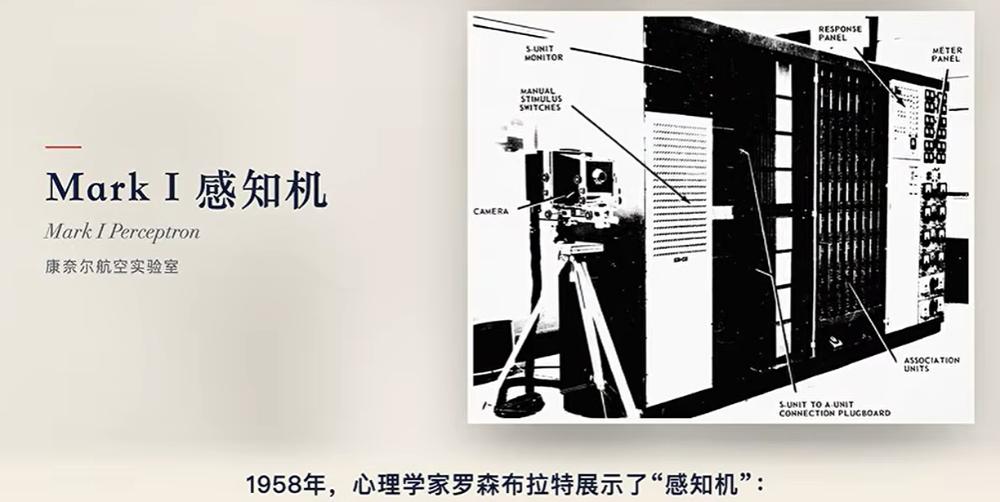
As it turns out, someone built this exact thing as early as 1958. It was composed of phototubes, electric motors and adjustable knobs, placed in a Navy-funded lab in upstate New York. The person who named it was Frank Rosenblatt, a psychologist. He called it the "Perceptron" — the first machine in history that could learn from examples and make "yes" or "no" judgments.
I have thought about this matter over and over again for many times. The math running in that 1958 machine is still running today, in every neural network you have ever used. Every neuron in GPT, every neuron in Claude, every neuron that the Cursor agent activates when selecting the correct tool. Every time the model generates a response, hundreds of billions of Perceptron-like units are running in parallel.
The simplest decision maker we have ever built has unexpectedly become the indispensable basic unit in the most complex system we have ever created.
The story of this series starts right here.
In the past few months, I have received many requests. A number of researchers and system engineers reached out to me, hoping that I could help them understand how artificial intelligence and agents actually work — not the version described in marketing pitches, but the real working principles. I hope these explanations can help them make clearer judgments when they sit back in front of their computers on Monday morning: whether this task should be assigned to a large language model (LLM), or a far smaller-scale solution is sufficient.
But when I tried to find relevant materials to recommend to them, I noticed one thing: almost all materials explain concepts one by one — RAG (Retrieval-Augmented Generation), attention mechanism, tool calling, MCP (Model Context Protocol), and they are completely independent of each other. For some readers, that is enough. But if you have been writing software for 15 to 20 years, or have spent your entire career writing research code, what you lack is not these concepts — you already know them all well. What you are missing is something else.
You are missing the main storyline: what connects these scattered pieces together? In what order do they appear? What problem does each part emerge to solve? In other words — how on earth did we get to where we are today?
I kept opening web pages: half-hour videos, research papers, articles on Substack. Some are well written, others are poorly written, but none of them are connected to each other. Then I suddenly thought: forget it, I will just make it myself.
Next, we will walk through the context of technological development: from Perceptron to backpropagation, from backpropagation to convolutional neural networks, then to the attention mechanism, then to Transformer, then to GPT, Claude, tool calling, agents, MCP, and all those systems you are quietly building today, step by step bringing you back to the technologies you are using.
This article is not written for total beginners. It is written for engineers and researchers who are tired of "pretending to understand" but do not have time to start learning from scratch; for people who have launched real-world systems but never figured out what exactly happens behind a single API call. If you are exactly that kind of person, you are very welcome. We will go step by step, and I will explain every part clearly, so you do not have to fumble around on your own.
Cornell, 1958
To understand the Perceptron, you have to first imagine the world when it was born.
It was the late 1950s. Computers already existed, but they were just cabinets full of vacuum tubes that took up entire rooms, mostly owned by the military and a handful of universities. The word "software" barely had any meaning at that time. Whether in the field of psychology, or among the few people who were about to call themselves "AI researchers", the mainstream view on intelligence was symbolism: they believed that the brain was a logical reasoning machine, and to create intelligence, you had to write down rules one by one. If A, then B.
Frank Rosenblatt refused to follow this idea.
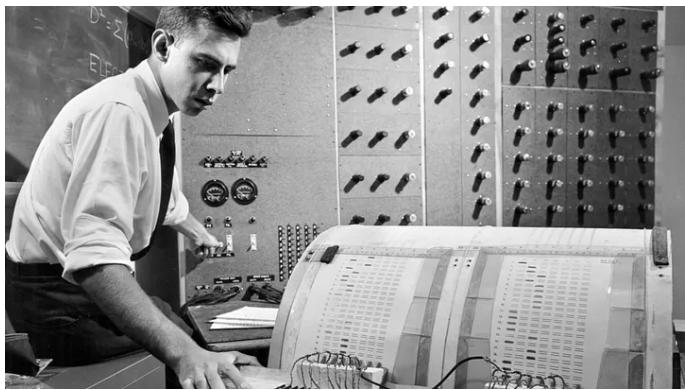
Rosenblatt was a psychologist. Not a mathematician, not a computer scientist, just a psychologist. He grew up in New York, attended Bronx High School of Science, then went to Cornell University, where he got his bachelor's degree in 1950 and his doctorate in experimental psychology in 1956. By 1957, he was already working at Cornell Aeronautical Laboratory in Buffalo — a contract research institution sustained by Navy funding.
He had a completely different view on how the brain works.
His view came from the empiricist tradition: the brain is not born with pre-set rules about the world, but develops almost randomly, then slowly organizes itself through continuous contact with the outside world and constant learning. Babies do not know what a face is at first. After seeing tens of thousands of faces, the neural connections that get activated when seeing a face are strengthened, while the connections that react to noise are pruned. Over time, this neural network learns things it could not do at birth — to recognize human faces. No one wrote rules for it, it adjusted itself.
Rosenblatt believed that for machines, the far more interesting problem is exactly this: not how to write out the rules, but how to build a system that can learn these rules by itself.
In 1958, he published this theory in a paper titled *The Perceptron: A Probabilistic Model for Information Storage and Organization in the Brain*, in the journal *Psychological Review*, not a computer science journal — because what he wanted to build was not a pattern recognizer, but a brain model. In his own words: "The Perceptron is first and foremost a brain model, and only secondly an invention for pattern recognition."
This distinction will be important later, keep it in mind.
How Exactly It Makes Judgments
In the simplest terms, let's take a look at what the Perceptron actually is.
Imagine a small machine that only does two things. First: receive a series of numbers. Second: give an answer — 1 or 0, yes or no, spam or normal email.
From input to answer, the Perceptron only takes three steps.
The first step: assign a weight to each input item. A weight is a number that indicates how important this item is. For example, when judging whether an email is spam, the weight of the item "the word 'invoice' appears in the email" may be 0.3, while the weight of the item "the email comes from an unfamiliar address" may be 0.8. These numbers are nothing mysterious, just ordinary values.
The second step: multiply each input value by its corresponding weight, then add up all the products. After adding, you get a number, which we call the score.
The third step: check whether this score crosses the threshold. If it crosses, the Perceptron is triggered and outputs 1; if it does not cross, it is not triggered and outputs 0. This is the step function: fully on or fully off, no intermediate states.
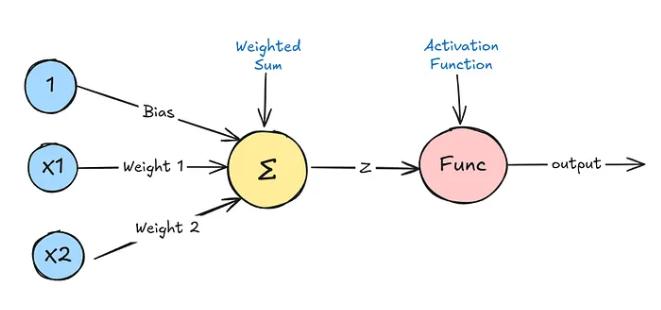
The entire architecture is nothing more than these: input, weight, summation, threshold. No hidden complex design, no layers, no magic at all.
If you draw it casually on a napkin, it is just a row of input points on the left, a circle on the right, a bunch of arrows in the middle, with a small number (weight) written on each arrow, and one more arrow pointing to 1 or 0.
This diagram on the napkin is all of that 1958 paper.
The really exciting part is below. The reason Rosenblatt's machine is interesting all lies in this point.
Learning Rule
The Perceptron does not know the correct weights at the very beginning, the weights are assigned randomly, all very small random numbers. When you ask it "is this spam?", it has a 50% chance of guessing wrong the first time — that is exactly what a machine that guesses blindly should do.
What Rosenblatt figured out is exactly how to make it correct itself.
You show the Perceptron a labeled example: an email, plus the correct answer (spam or normal email). Let it make a guess. If it guesses correctly, you do not need to do anything. If it guesses wrong, check which direction the error is in: if it should have said "no" but said "yes", slightly lower the weights that pushed it towards "yes"; if it should have said "yes" but said "no", slightly raise these weights.
Train it with one example first, then switch to another, then tens of thousands of examples. Every time you train it, the weights shift a little bit towards the direction of "answering correctly".
Rosenblatt used a mathematical theorem — the Perceptron Convergence Theorem — to prove this: as long as there exists a set of weights that can answer correctly, this process will definitely find it; and it does not need to wait infinitely long, it can be found within a limited number of steps.
In other words, this machine that starts from random initialization will definitely be able to answer the questions correctly in the end.
In another geometric way of saying it — people who prefer visualizations will see it this way — the Perceptron is actually learning to draw a line. Imagine each spam email as a red dot in high-dimensional space, and each normal email as a blue dot. What the Perceptron needs to do is find a straight line (a hyperplane when the space has more than two dimensions), so that all red dots fall on one side and all blue dots fall on the other side. The direction of this line is determined by the weights.
In 1958, this was still a brand new thing: a machine could find that dividing line only by its own experience.
The Machine Itself
The following things make me feel incredible every time I think about them.
Rosenblatt did not just write a paper, he personally built this machine — real hardware, physical parts one by one.
It was called the Mark I Perceptron, completed in 1957 at Cornell Aeronautical Laboratory in Buffalo, with funding from a Navy contract codenamed "Project PARA" (PARA stands for "Perceiving and Recognizing Automaton"). The Navy was willing to pay because they wanted a machine that could recognize objects in images, such as the outline of a warship. The Information Systems Division of the Office of Naval Research also participated in this research. At the end of the day, this was a sum of money invested in artificial intelligence research during the Cold War.
This set of hardware is almost a marvel from today's perspective.
The input layer is a 20×20 grid of phototubes: four hundred small light sensors, arranged like the pixels of a tiny camera. You hold a card in front of it, and each phototube measures the brightness of the small piece of card it is facing. These four hundred readings are your input vector.
Behind the phototubes are five hundred and twelve association units. And the weights — the values that the machine is actually learning — are stored as the physical positions of potentiometers: small adjustable knobs one by one. When the learning rule says "raise this weight a little bit", the machine sends an electrical signal to the electric motor, which turns the corresponding knob.
The memory of the Mark I is electromechanical, and its learning rule is implemented by the rotation of physical parts.
Theoretically, you could walk up to it while it is learning and watch it rewrite its own "memory" round and round.
This custom hardware made its first public debut on June 23, 1960. Before that, in 1958, Rosenblatt had already simulated the Perceptron with software on the IBM 704 — to verify the math first before the physical hardware was fully welded.
But I care more about the hardware side. Today, when we talk about "neural networks", we think of huge tensors lying in the GPU's video memory; but in 1958, when Rosenblatt talked about neural networks, he meant a rack of frames with electric motors turning knobs. The same idea, just in a different physical form.
The New York Times Report and the Navy's Narrative
The day after the Mark I was made public, on July 8, 1958, *The New York Times* published a report titled *Navy's New Device Learns by Doing: Psychologist Displays Prototype of Computer*. One of the most famous sentences in the history of artificial intelligence came from this report: the Navy expected this machine to eventually be able to "walk, talk, see, write, reproduce itself, and possess self-awareness".
Later, whenever someone wanted to make the AI researchers of the 1950s look stupid, they would bring up this sentence.
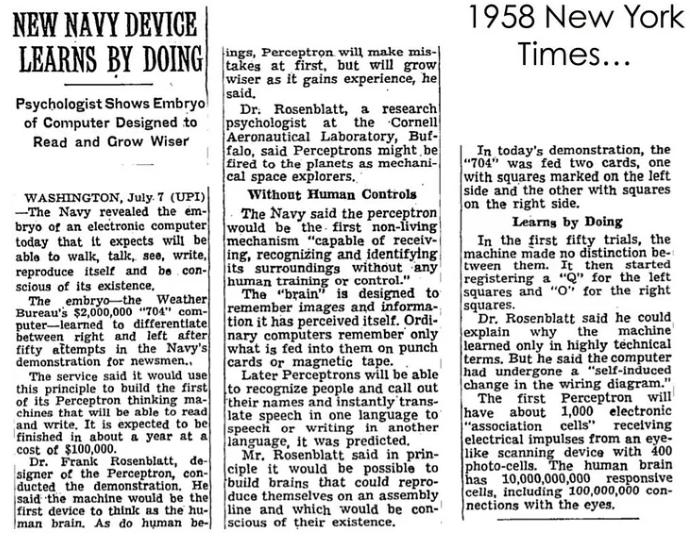
But it is worth clarifying who exactly said this: the entire framework of the report came from the Navy's press office — they organized the press conference, wrote the draft, and set the tone of the report. Rosenblatt was present at that time, and his own public statement about the Perceptron was not exactly modest, calling it "the first machine capable of generating original ideas"; but that article in *The New York Times* was more like a military public relations document, not a real introduction to his paper. The main body of the paper actually published in *Psychological Review* was rigorous mathematical and biological arguments.
This point is very important: the hype around the Perceptron would sooner or later cause problems. About ten years later, someone would stand up, focus on this over-promotion, write a book, and almost suppress the entire field.
But that is the story of the next episode.
Two Boys Who Grew Up in the Bronx
Before we leave 1958, let's talk about another past event. It will carry the weight of the entire story later.
Frank Rosenblatt was born in 1928, and graduated from Bronx High School of Science in 1946. Marvin Minsky was his classmate at the same school, one grade lower than him. The two most likely knew each other when they were teenagers. Ten years later, when they each became leading figures in this emerging field, they must have been very familiar with each other.
By the late 1950s and early 1960s, the two stood on opposite sides of the fiercest public debate in the early history of artificial intelligence