DeepSeek's first founder has been publicly unveiled.
A former early core member of DeepSeek has started his own business.
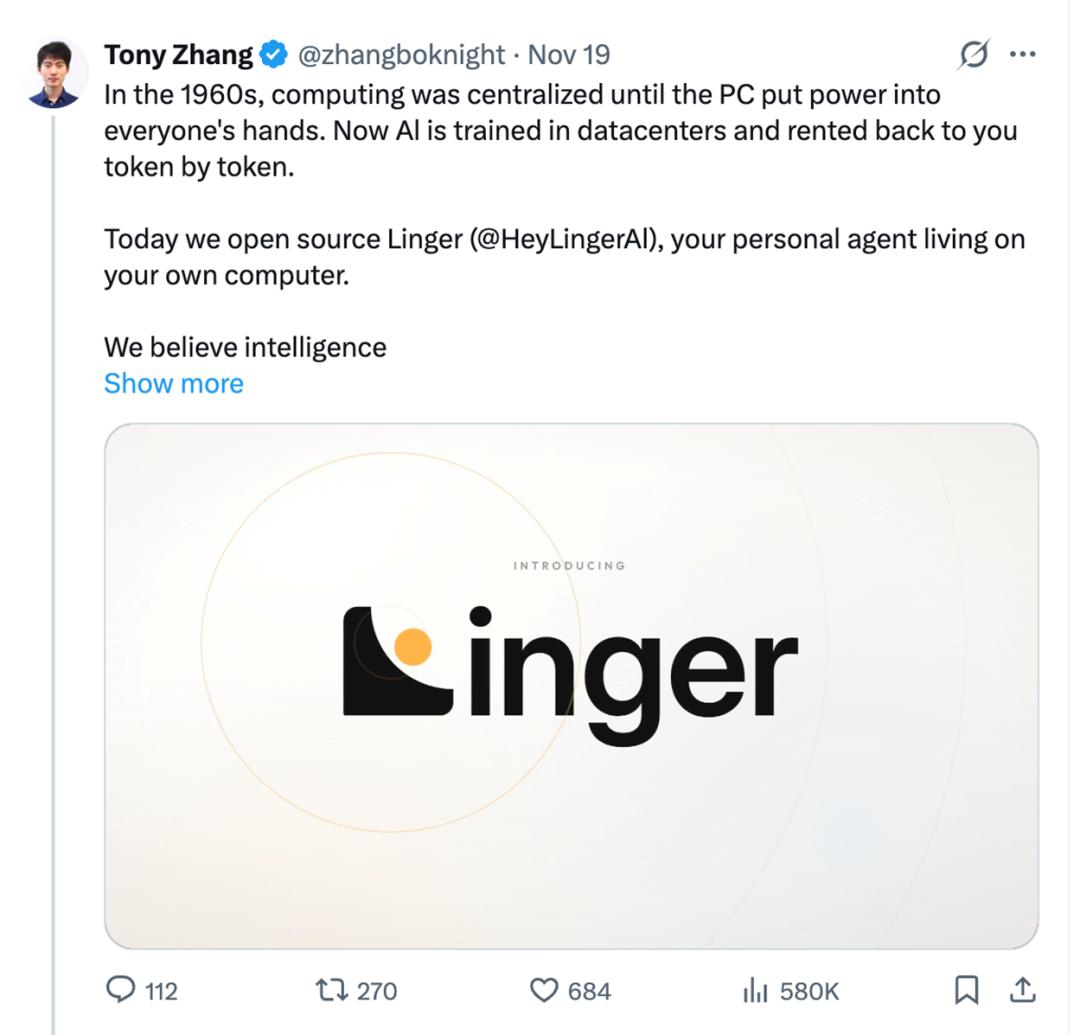
On November 19, Tony Zhang, former Project Lead of DeepSeek-VL, announced that Simplex AI, the AI company he founded, has officially open-sourced its personal agent product Linger. This product can run on users' personal computers, operate software on their behalf, process emails, and even enable multiple AI assistants to collaborate on completing tasks.
To lower the threshold for running large models on ordinary computers, Linger is also equipped with a local inference project named PolyStrata, which was created by an 18-year-old young developer on the team.
Zhang Bo left DeepSeek as early as March 2024, nearly a year before DeepSeek-R1 became a smash hit. After that, he returned to Zhejiang University to teach, and started his entrepreneurial journey in 2025. This January, Simplex AI also announced that it had secured $6 million in financing led by GL Ventures.
The core research team of DeepSeek has maintained high stability so far, with few employees leaving, and most of the few who left chose to join other technology companies. According to currently public information, Zhang Bo is the only entrepreneur among all departed core paper authors of DeepSeek who has publicly founded a company and launched products.
Leaving DeepSeek, he first returned to Zhejiang University
When Zhang Bo left DeepSeek, the company was far from as well-known as it is today.
Zhang Bo received his bachelor's degree from Zhejiang University in 2013, and obtained his doctorate in Electronic and Computer Engineering from the Hong Kong University of Science and Technology in 2019. In May of the same year, he joined Microsoft Research Asia, engaging in research on computer vision and generative models.
That was a place he had long admired.
In a Zhihu post published in 2024, he even called Microsoft Research Asia his "white moonlight since middle school".
During his four years at Microsoft, Zhang Bo participated in well-known research projects such as VQ-Diffusion and Rodin, covering directions including AI image generation and 3D digital humans. Among them, the CoCosNet v2 paper he participated in was shortlisted for the Best Paper Candidate of CVPR, the top computer vision conference in 2021.
In 2023, he resigned from Microsoft and joined DeepSeek, which was not long established at that time.
There, he participated in the R&D of the first-generation large language model DeepSeek LLM, and was in charge of another important project, DeepSeek-VL.
VL is the abbreviation for Vision-Language Model. Simply put, ordinary language models mainly process text, while vision-language models require AI to understand images, charts and other visual content, and then answer questions combined with text.
In March 2024, DeepSeek published the DeepSeek-VL technical paper. In the official project materials, Zhang Bo was clearly marked as the Project Lead, and also one of the paper authors. This is also his most representative achievement at DeepSeek.
But in the same month, he chose to leave.
After leaving his job, Zhang Bo joined the State Key Lab of CAD&CG of the College of Computer Science, Zhejiang University, and became a principal investigator under the Hundred Talents Program and a PhD supervisor.
He once recalled his experience at DeepSeek. He said that he learned the importance of focusing on doing one thing well from the "extremely excellent and extremely nice founder" of the large model startup. He also brought this idea to his own research team. When recruiting students, he proposed that everyone should attach importance to research quality, pursue "one paper equals three", and be willing to do truly creative work, instead of blindly pursuing the number of papers.
After returning to Zhejiang University, Zhang Bo did not stop exploring AI products.
On February 24, 2025, Hangzhou Topology Lingxi Technology Co., Ltd. was established with a registered capital of 1 million yuan, and Zhang Bo is its legal representative. The company's recruitment materials position its business in AI Agent R&D, with a focus on overseas markets.
After that, Zhang Bo's entrepreneurial project gradually came to light.
In fact, Linger is not the first product he launched after starting his business. In January 2026, Simplex AI launched Lev8, an AI business information search platform, which is mainly oriented to scenarios such as sales, recruitment and investment of overseas enterprises, helping users find potential customers, talents and business cooperation opportunities. For example, users can ask AI to find engineers who have changed jobs recently, or enterprise managers who meet specific conditions, and the system will retrieve and match through public information on the Internet.
In the same month, according to the announcement on the official website of Lev8, Simplex AI announced that it had secured a $6 million seed round of financing led by GL Ventures.
After that, the team also launched LiteResearcher, a lightweight AI model for in-depth research, and applied related technologies to Lev8. Until November 19, with the official open source of the personal agent product Linger, the business of Simplex AI further extended to the field of personal AI assistants, and Zhang Bo's entrepreneurial journey came into the view of more people.
18-year-old developer built a key engine
On November 19, when Zhang Bo released Linger, he reviewed the development history of personal computers. He mentioned that in the 1960s, computing power was mainly concentrated in large-scale computing systems. It was not until the emergence of personal computers that ordinary people gradually had their own computing power. Nowadays, most AI models run in data centers, and users need to pay per Token for usage.
Zhang Bo hopes to change this model and bring AI back to personal computers.
According to the official introduction, Linger is an open-source personal AI agent that can not only answer questions, but also perform tasks on behalf of users. Its main assistant is named Another Me, which means "a second self", and it can operate software and browsers on the computer, read authorized emails and meeting minutes, and organize important information into a personal knowledge base.
It can also work proactively. For example, after finding a task that is about to expire from an email, it will take the initiative to remind the user; if similar reminders are ignored many times, it will adjust the reminder method. The official calls this mechanism that continuously adjusts behavior based on user feedback "Dreaming".
When encountering complex tasks, Linger can also allow multiple AI assistants to divide the work and cooperate, being responsible for coding, checking results and other tasks respectively.
However, similar functions are not pioneered by Linger. What Zhang Bo's team wants to solve more is how to enable ordinary computers to run large models, reducing the cost for users to use AI.
This is where the 18-year-old young developer comes in.
In another post, Zhang Bo introduced that the local inference engine PolyStrata used by Linger was built by an 18-year-old developer on the team, and specially mentioned the developer's account @Vec_Szn. According to the GitHub personal homepage, this developer VecSzn is currently a computer science student, and other personal information has not been made public.
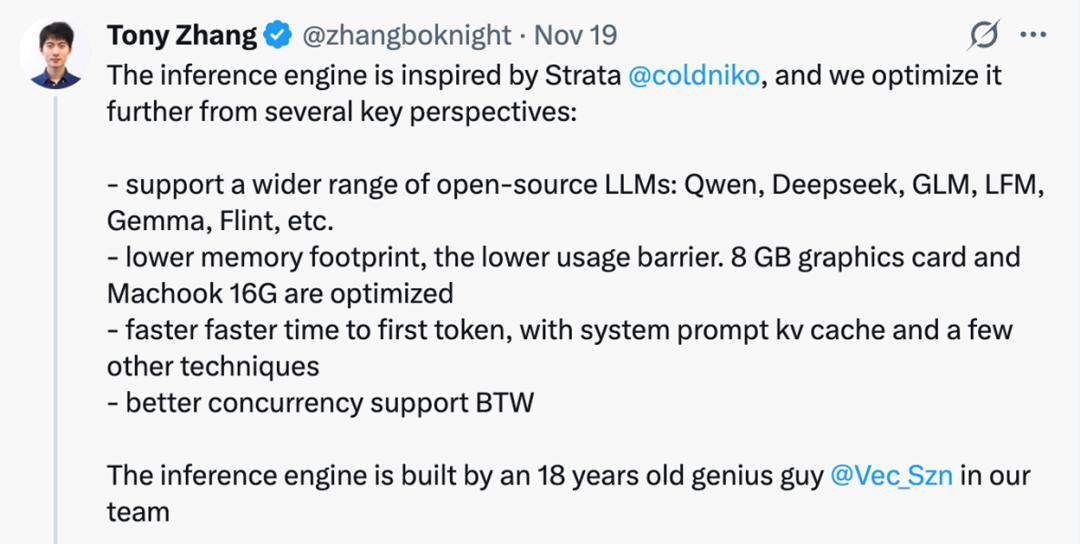
The engine he is responsible for is one of the most important technical highlights of Linger.
Usually, large models require a large amount of video memory. The larger the parameter scale, the higher the requirements for hardware. PolyStrata compresses the model and optimizes the storage method, so that large models that were originally difficult to run on ordinary computers can also run.
Take MoE (Mixture of Experts) models as an example. This type of model contains multiple "expert" modules, and only a part of them needs to be called each time it runs. Using this feature, PolyStrata puts some modules in the graphics card's video memory, and stores the rest in the computer's memory or hard disk, and retrieves them when needed, thus reducing the requirement for video memory capacity.
According to the test data released by Simplex AI, a computer equipped with an RTX 3060 graphics card with 12GB of video memory and 64GB of system memory can run Qwen3.8-Flash-Next, the 125-billion-parameter model from Alibaba's Qwen series, with a text generation speed of 45.5 Tokens per second.
However, this does not mean that all 125 billion parameters are loaded into 12GB of video memory. The above data also comes from enterprise tests and has not been fully verified by third parties.
The actual user experience remains to be verified by more developers.
PolyStrata is not developed entirely from scratch. According to the project's official GitHub introduction, it is extended based on the open-source engine Strata. The 18-year-old VecSzn retained some of the original technologies while developing a new inference engine, enabling more large models to run on ordinary computers.
After Linger was released, some discussions appeared on the X platform. Some users asked whether the product could connect to mobile phones, and Zhang Bo replied that the team plans to support related functions within a month. Some other users reported that they encountered model download problems during installation, and Zhang Bo said that the team had reproduced this bug and would fix it as soon as possible.
What is more worth discussing than technical performance is the "zero Token fee" that Linger focuses on.
According to the official introduction, users running local models on their own computers no longer need to pay Token fees to cloud model service providers. But this does not mean that using Linger is completely free. Costs such as hardware and electricity still need to be borne by users themselves. If external models or third-party applications are called, additional fees may also be incurred, and relevant data may leave the local device.
In terms of commercialization, Linger allows users to deploy it locally for free, but restricts other enterprises from using its source code to provide commercial hosting services without authorization. Simplex AI itself also plans to launch a hosted version, and the price has not yet been announced.
From these arrangements, Zhang Bo hopes that users do not have to rely on cloud models for everything, and can have an AI assistant that keeps working.
How far this path can go depends not only on technical performance, but also on whether ordinary users can actually use it.
DeepSeek's "only exception"
The reason why Zhang Bo's entrepreneurship attracts attention is that DeepSeek has almost no public cases of core members starting businesses before.
According to a report by *Caijing* on May 8, 2026, among the 27 technical papers published by DeepSeek from January 2024 to April 2026, there were 391 deduplicated internal authors and contributors in total, of whom 25 were explicitly marked as departed, accounting for 6.4%. Among the 15 researchers with the highest paper publication frequency, only 2 left the company.
This set of data is not equivalent to the actual employee turnover rate of DeepSeek, but it at least shows that the core research team has maintained quite high stability.
The destinations of the few departed employees are also relatively clear. Luo Fuli, who participated in the R&D of DeepSeek-V2, joined Xiaomi's MiMo; Wang Bingxuan, the core author of the first-generation large model, joined Tencent Hunyuan; Guo Daya, an important researcher of DeepSeek-R1, joined ByteDance's Seed Lab; Ruan Chong, a multimodal researcher, became the chief scientist of autonomous driving company MetaX. Most of them continue to work in the R&D teams of other technology companies, without starting their own businesses.
Against the background of frequent job hopping and entrepreneurship among AI talents, the stability of DeepSeek's core team seems rather special.
This may be related to Liang Wenfeng's management philosophy. In an interview in 2024, he said that innovation requires minimizing intervention and management as much as possible, so that researchers have space for free exploration and trial and error. Under this concept, DeepSeek has formed a relatively flat organizational structure, and also reserved a large space for independent exploration for researchers.
On the other hand, as DeepSeek introduced external financing in 2026, the options held by core employees have a clearer value reference. For core personnel who hope to continue to engage in cutting-edge research, staying at DeepSeek also has considerable appeal. Liang Wenfeng also attaches great importance to talent stability. He regards maintaining the stability of the core team as one of the most important interests of the company.
Zhang Bo's situation is different. He left DeepSeek as early as March 2024, when the viral R1 had not been released yet. After that, he returned to Zhejiang University to teach, and then founded Simplex AI, shifting his focus from large model R&D to AI products, hoping to enable existing models to run on ordinary computers and truly complete work for users.
This transformation also reflects new opportunities emerging in the AI industry.
In the past few years, capital and technical talents have mainly competed around foundation models, competing for computing power and model performance. Now, with the continuous progress of open-source models, more and more entrepreneurial teams begin to use existing models to develop applications, looking for opportunities to reduce costs and solve practical problems.
However, the personal AI assistant track already has many competitors.
OpenClaw can perform tasks on behalf of users and supports local models; there are also similar products in China. This February, NetEase Youdao launched the desktop AI assistant LobsterAI, which can process files and perform office tasks on the computer, and also supports running large models locally. QoderWork under Alibaba can also directly operate computer software and browsers to complete various types of work.
In contrast, Linger puts more emphasis on lowering the threshold for large models to run on personal computers. Through a dedicated inference engine, it allows computers with limited video memory to run large-scale parameter models, reducing dependence on cloud computing power.
DeepSeek is also strengthening the construction of its product side. This year, it has integrated teams including Harness, Web, App and Platform into the product department, which is led by Cui Tianyi. From foundation model R&D to specific applications, more and more enterprises are beginning to pay attention to how to make AI truly participate in people's daily work.
What makes Zhang Bo special is that, according to currently publicly verifiable information, he is the only entrepreneur among all departed core paper authors of DeepSeek who has publicly founded a company and launched products. Previously, Huxiu and Jiemian News reported the news of DeepSeek's departed employees starting businesses in June 2025 and June 2026 respectively, but neither disclosed the names of the parties concerned.
Conclusion
The direction Zhang Bo chose is to reduce the local operation cost of large models as much as possible, so that users do not have to continuously pay for cloud computing power.
But this path also has practical problems. Putting the model on a personal computer can reduce Token fees, but it puts higher requirements on equipment configuration, installation and maintenance, and data security. While opening the local version, Simplex AI plans to launch a paid hosting service, which is actually looking for a balance between technical ideal and commercialization.
For a startup company, technological breakthrough is only the first step. Whether it can enable non-technical ordinary users to get started easily and use it for a long time is the real question that Linger needs to answer next.
This article is from the WeChat Official Account "Rongzhong Finance" (ID: thecapital), written by Li Bingzhi, and authorized for release by 36Kr.