Brain-computer interface rules, China takes the lead this time.
On the brain-computer interface track, China is fully prepared to become a standard-setter!
In recent months, China has made frequent moves in the brain-computer interface standard sector. This September, *Information Technology — Brain-computer Interface — Reference Architecture* (ISO/IEC 27572:2026), developed under China's leadership, was officially released by the International Organization for Standardization (ISO/IEC), marking exactly one year since the first international brain-computer interface standard led by China, *Information Technology — Brain-computer Interface — Vocabulary* (ISO/IEC 8663:2025).
Meanwhile, the industry standard YY/T 2029—2026 *Quality Requirements and Evaluation Methods for EEG Datasets of Brain-computer Interface Medical Devices Used in Artificial Intelligence Algorithms* and the *Key Points for Technical Review of Clinical Trials of Implantable Brain-computer Interface Hand Motor Function Compensation System* have also been released one after another recently. The former is China's third industry standard for brain-computer interface medical devices, and the previous two are *Terminology for Medical Devices Using Brain-computer Interface Technology* (YY/T 1987—2025) and *Medical Devices Using Brain-computer Interface Technology — Test Methods for Perception and Response Performance of Implantable Neurostimulators with Closed-loop Function* (YY/T 1996—2025).
More notably, the country's first national high-quality brain-computer interface dataset project led by Tongji Hospital Affiliated to Tongji Medical College of Huazhong University of Science and Technology was recently launched in Wuhan.
With standards, data and review advancing in parallel, it is clear that in the brain-computer interface field, the domestic industry is no longer satisfied with technological breakthroughs, and is aiming for the global discourse power over brain-computer interface standards.
All three basic brain-computer interface standards are led by China
The discourse power over standards first requires defining "what a brain-computer interface is", so as to determine the design and review standards of brain-computer interfaces.
This June, China successively released the *Guiding Principles for Classification Definition of Brain-computer Interface Medical Device Products* and the *Guiding Principles for Naming General Names of Brain-computer Interface Medical Devices*, defining management attributes, categories and naming rules, thus making a preliminary definition of medical brain-computer interfaces.
The first international brain-computer interface standard led by China, *Information Technology — Brain-computer Interface — Vocabulary*, was headed by Pu Jiangbo, an expert from the Institute of Biomedical Engineering of the Chinese Academy of Medical Sciences, and jointly completed with experts from 8 countries including the United States, Japan and Australia. It sorted out 126 entries in 8 categories including basic concepts, classification, signals, experiments and applications, and was officially released last September.
In addition to the vocabulary standard, *Information Technology — Brain-computer Interface — Use Cases* (ISO/IEC TR 27599:2025) led by China was also released last May, collecting representative use cases in medical health, industrial control, intelligent environment and other fields.
This August, the first two national standards *Information Technology — Brain-computer Interface — Reference Architecture* (GB/T 47023—2026) and *Information Technology — Brain-computer Interface — Multimodal Data Format* (GB/T 47127—2026) were officially implemented domestically. Among them, the reference architecture focuses on four core issues of "what the brain-computer interface is, how to use it, what functions it has, and how to implement it", unifies the system composition, function division and implementation methods of different technical routes such as invasive, semi-invasive and non-invasive, and was drafted with the participation of Zhejiang University, China Electronics Standardization Institute, and enterprises including Huawei, Neuracle and BrainCo. So far, the three basic international brain-computer interface standards covering vocabulary, use cases and reference architecture have all been led and completed by Chinese experts.
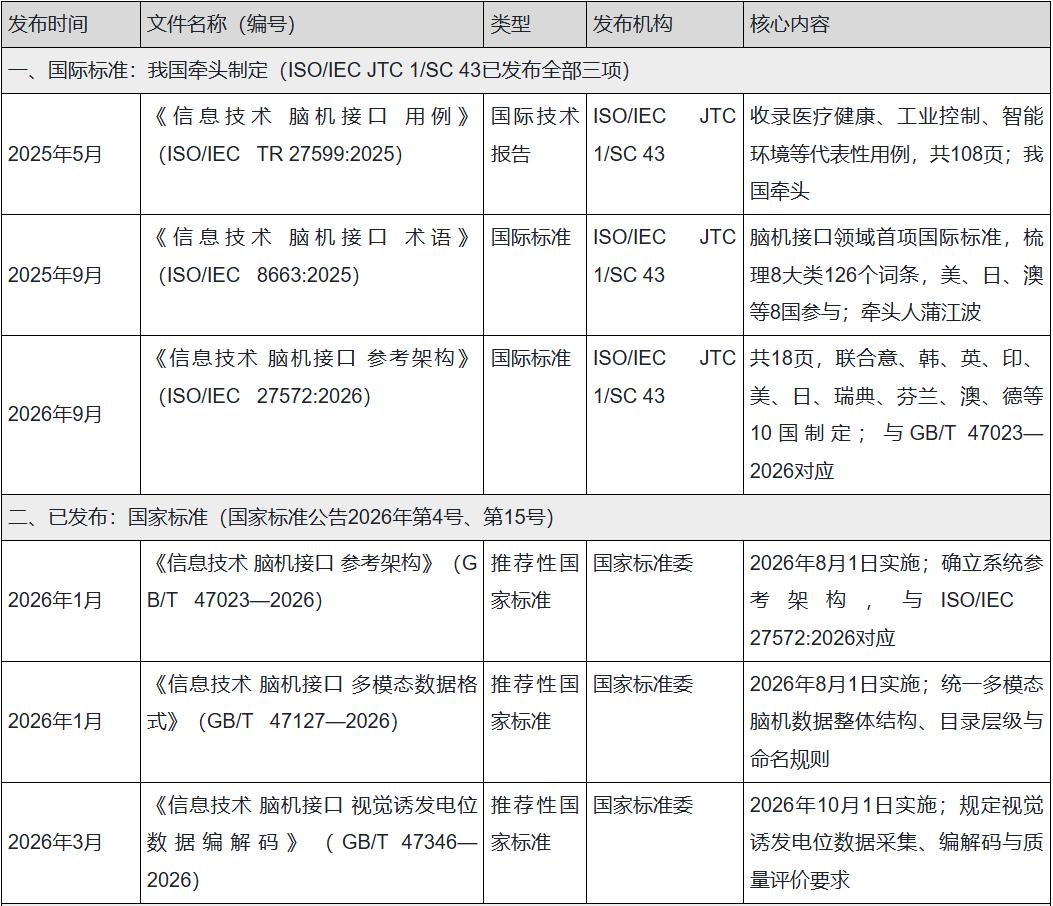
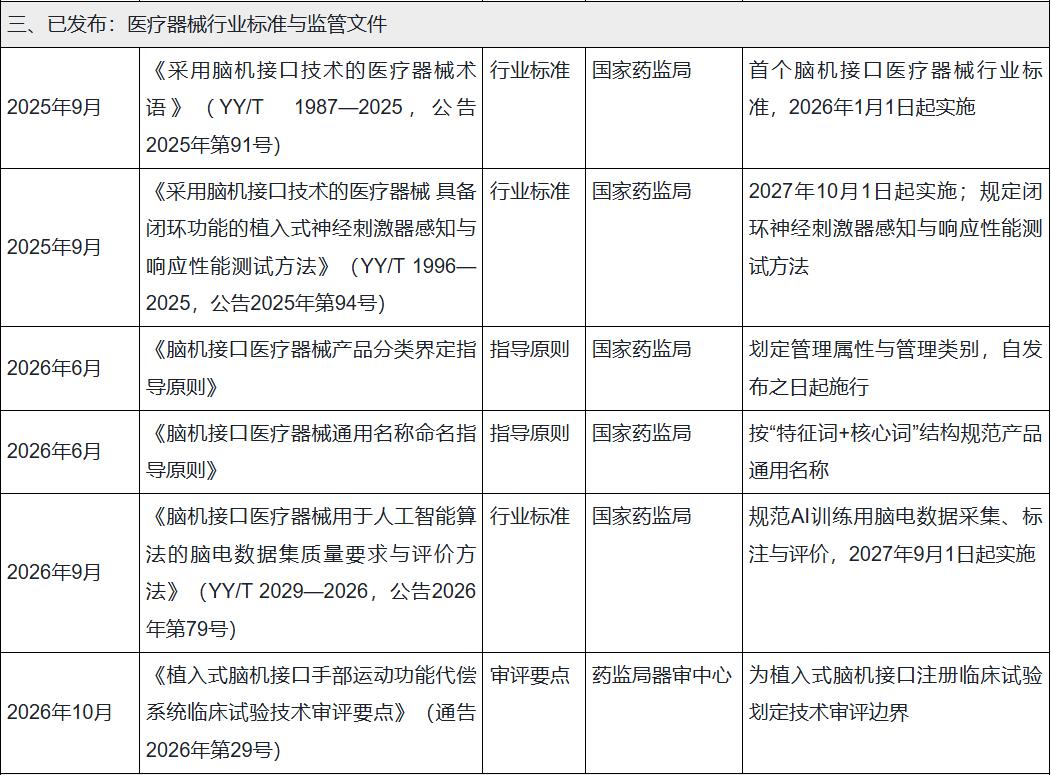
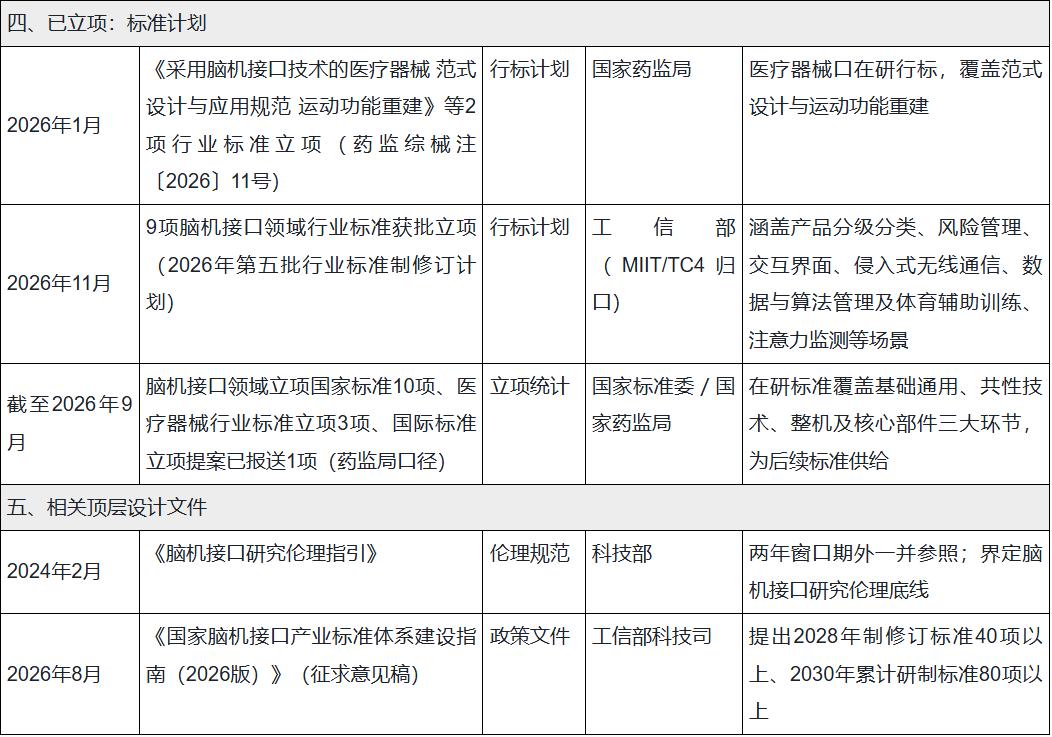
Overview of brain-computer interface related standards at home and abroad in the past two years
Regarding the intensive release of multiple standards and guidelines, Zhang Yutao, partner of Heyin BCI Fund, believes that this marks that the domestic brain-computer interface industry is stepping from scientific research prototypes into a standardized industrialization stage, trying to build a complete closed loop from definition right to review right: "First, ISO/IEC 27572:2026 defines the module and interface logic of invasive, semi-invasive and non-invasive BCI. Defining the architecture can determine future compatibility. This international reference architecture standard led by China marks that we are actively participating in and leading the top-level definition of global brain-computer interfaces. Second, YY/T 2029, as the world's first collection, labeling and evaluation standard for EEG data for AI training, turns data from materials into deliverables, fills the gap in the standardization of EEG datasets, and solves the problems of data source and quality judgment for AI model training. Third, the review points for the implantable BCI hand motor compensation system draw clear and implementable boundaries for the registration path of invasive BCI, and specify the effectiveness factors."
He further observed the impact of the intensive implementation of standards in combination with investment and valuation: "This will bring a major restructuring of the track valuation system. First, the standards set a passing line, and routes and products that fail to meet the standards or rely on story hype will be cleared out quickly. From the valuation perspective, the uncertainty discount is replaced by compliance premium, which greatly restricts concept hype and turns to enterprises that truly have clinical landing capabilities and conform to the standard framework. In other words, the valuation ceiling of early-stage projects is capped, but at the same time, the risk of valuation halving in the future is also reduced. The investment window period is clearer, and then the industrial investment route is clear, which will become the mainstream approach. Second, the logic of valuation anchor will switch, from the past project valuation that focused more on team background, laboratory papers and prototype parameters, to the future that clearly tilts to a clearer registration path, and compliance capabilities, standardized clinical evidence and dataset construction capabilities will determine valuation. In the short term, companies that enter the innovative device channel and have IIT data will get a premium. Subsequently, it will enter a differentiation period of approval documents and case volume, and the premium will gradually shift to enterprises that can achieve large-scale sales."
The perception from enterprises is more direct. Sisen Technology is an innovative company focusing on the R&D and industrialization of AI-driven ultrasound brain-computer interface technology. It initially completed the formation of its core team this May, built a platform-based technology and product layout around "data acquisition - algorithm analysis - simulation verification - clinical application", and its first product is positioned as transcranial low-intensity ultrasound-mediated blood-brain barrier opening to assist glioblastoma treatment. Xu Yihui, its co-founder, told VCBeat that the company has been continuously tracking the standardization progress in the brain-computer interface field and the technical review guidance documents for medical devices since its establishment. According to preliminary sorting, there are nearly 50 national standards, industry standards, association standards and national standard plans that have been released or are being formulated.
"This reflects an important trend behind it: brain-computer interface is moving from single-point technological breakthrough to systematic development, and the industry is gradually establishing a common technical language, data specification and evaluation framework. Among them, the brain-computer interface reference architecture, dataset quality requirements and evaluation methods, multimodal data format and medical device technical review guidance documents have important guiding significance for enterprises to carry out product definition, technology R&D, quality control and registration path planning." She also introduced the findings in the tracking study to VCBeat: "Most of the international brain-computer interface standards are concentrated in ISO/IEC JTC1/SC43, which is biased towards the information technology field, and international standard organizations in the traditional medical field have not released directly relevant standards. In China, both the National Medical Products Administration and the Standardization Administration of China are leading the promotion. I am also very looking forward to whether China can take the lead in speaking out internationally in the medical field, and even take the leading position."
However, with the increasingly diversified technical routes of brain-computer interfaces, the existing standard system still has room for further improvement. Xu Yihui admitted that the current relevant standards and technical review guidance documents are mainly focused on EEG signals and implantable electrode technologies, which are difficult to fully cover the technical characteristics and evaluation needs of ultrasound brain-computer interfaces. Sisen Technology is actively promoting the standardized research of ultrasound brain-computer interface related technologies, and strengthening exchanges with clinical experts, regulatory authorities, etc., hoping to integrate the unique needs and practical experience of ultrasound technology into the research and formulation of relevant standards.
Data infrastructure enables all EEG signals across China to "speak the same language"
Of course, beyond definition, data has always been a scarce resource for brain-computer interfaces. The national high-quality brain-computer interface dataset launched on October 24 is exactly a key move in this most scarce link.
According to public information, this first national project of its kind is led by Tongji Hospital, focusing on 10 disease directions such as stroke rehabilitation, spinal cord injury, Parkinson's disease, epilepsy and disorders of consciousness, covering a total of 6 data modalities. It will build multimodal datasets for brain signal acquisition, intention decoding, function assessment, neuromodulation and rehabilitation interaction, and is scheduled to be completed and put into use in 2027, forming a safe and controllable data circulation mechanism.
Jay Zhu, a senior expert in the BCI industry, believes that this initiative is of great significance. He said that the core reason why invasive BCI data has limited significance in a single enterprise system is that the value density of data depends on the breadth and diversity across samples, but the data scale of a single enterprise is not enough to support generalization capabilities.
He believes that the core engineering bottleneck faced by invasive brain-computer interfaces is large individual heterogeneity: there are deviations in the electrode implantation sites of different subjects, and there are significant individual differences in the anatomical morphology of the cerebral cortex, the evolution characteristics of glial scars after implantation, and the neural coding patterns of the target brain region. As a result, the decoding model trained by the algorithm on patient A often suffers a significant performance degradation when directly migrated to patient B. To break through this bottleneck, it is necessary to collect as much high-quality data from multi-center, cross-device and cross-indication sources as possible, train a foundation model that can extract general neural coding primitives, so as to improve the cross-individual migration ability.
"Enterprises seal their data separately, and each can only make local optimization based on dozens or even a few cases of data, which cannot give birth to an industry-level general decoding paradigm. More critically, the collection cost of BCI data is extremely high, and closed use means that the same data can only be mined once by one enterprise, and the total social return is severely diluted. Data locked in a safe will only depreciate over time. The earlier it is aggregated and the earlier it is used repeatedly by multiple algorithms, the greater its scientific and commercial value. This is why the national level promotes the dataset alliance and enforces standardized aggregation, which essentially focuses on breaking this closed pattern of each fighting its own battle and setting up barriers on its own. The core value of the national invasive BCI dataset is that this underlying infrastructure is expected to boost China's BCI industry from running in parallel with the United States to taking the lead. It should be noted that the base of brain disease patients in China is much larger than that in the United States, and the speed of administrative-driven infrastructure construction in China far exceeds that of the United States. For this reason, China has begun to significantly surpass the United States in the number of invasive BCI clinical trials. Neuralink has accumulated only 27 public implant cases in 10 years, while there are already 200-300 patients in China who have received BCI implants, and the number of patients whose devices are still in vivo with a usage time of more than one month has exceeded 100 according to reports," Jay Zhu explained the great significance of the public dataset to VCBeat.
"More critically, the driving logic for China to take the lead in the invasive BCI field does not lie in the stronger technology of a single project, but the superposition of 'patient base + administrative mobilization capacity + clinical scaling speed', which makes data infrastructure a natural product of clinical promotion, thus forming a positive cycle growth flywheel, and rapidly promoting more projects to enter the clinic, complete the clinic and surpass the clinic. This also means that when screening projects in the future, who can access the national dataset alliance earlier and whose clinical data can enter the standardized circulation pipeline will become a more critical indicator than the simple number of electrode channels, so as to make projects stand out and even excel," Jay Zhu further added.
Xu Yihui made a sober judgment on the value of public datasets based on her own needs: "The value of public datasets to us lies more in providing support for basic verification, methodological comparison and cross-modal research for algorithm R&D. Public datasets are obviously the basis and control for algorithm verification and cross-modal research. However, the existing datasets are still mainly focused on EEG and implantable electrode signals, and the data accumulation and standardization construction of emerging modalities such as ultrasound are relatively insufficient. In view of this situation, which is dominated by EEG and implantable electrodes and lacks the participation of ultrasound enterprises, Sisen Technology is exploring the construction of a multi-source data system integrating real acquisition, numerical simulation and public data. On the one hand, relying on self-developed ultrasound hardware, we gradually accumulate characteristic clinical data such as acoustic signals, cerebral microvascular blood flow and functional imaging. On the other hand, we use transcranial ultrasound simulation software to generate simulation data under different skull structures, brain region targets and acoustic parameter conditions, verify with real measurement data, associate and integrate with public datasets, and expand the data coverage in complex application scenarios. We will use self-developed hardware to supplement the collection of acoustic signals, then generate ultrasound simulation data, and comprehensively use it with public data and clinical self-collected data."
This also leads to a question about the data moat of brain-computer interface enterprises. Zhang Yutao said in response: "Overall, brain-computer interface enterprises need three necessary conditions to build a data moat. The first is irreplaceable collection scenarios, such as intraoperative and long-term follow-up after implantation. The second is the binding of annotation and parameters, which is not a bare signal, but the coupling of 'parameter-response'. The third is that the scale grows linearly with the installed capacity. Although the national high-quality dataset led by Tongji solves the first part, including multi-disease, multi-modal and cross-hospital mutual recognition, it cannot meet the latter two points. Public datasets cannot cover all segmented scenarios, such as specific subtypes and cases, and EEG signals from long-term follow-up for many years after long-term implantation. These scarce, long-cycle and complete prognostic follow-up data are still the core moat of enterprises."
"This will bring a major change to the project screening dimension. In the past, investors looked at whether enterprises have the ability to replicate large-scale EEG collection. In the future, they will look at whether enterprises can use public datasets to iterate algorithms, and at the same time build unique vertical private datasets. If an enterprise completely relies on public datasets and has no clinical accumulation of its own, its algorithms are easy to be homogenized. The competitive advantage will lie in whether enterprises can combine public basic data with their own scarce data to build a closed loop of clinical data integration," he further mentioned the valuation restructuring of brain-computer interface enterprises brought by data.
With the data base, single-point clinical breakthroughs can be precipitated into general capabilities.
The popularity of China's brain-computer interface continues to grow
Behind China's frequent formulation of standards recently is the prosperity of the brain-computer interface industry.
According to public reports, domestic BCI financing has been frequent and hit new highs this year. The total financing amount in the first half of the year alone exceeded 7.2 billion yuan, which is 3 times the level of the whole of last year. Among them, BrainCo completed a 2 billion yuan financing, setting the record for the largest single BCI financing in China. In addition, Steep Cloud Medical completed about 1.4 billion yuan of financing since the second half of the year, and the cumulative financing has reached 2.6 billion yuan as of September.
Since the beginning of this year, Neuracle, Steep Cloud Medical and NeuroMaster have successively launched IPO processes. At the same time, unconfirmed news shows that BrainCo has also secretly submitted its prospectus on the Hong Kong Stock Exchange.
On