Is the Riemann Hypothesis really proven by Claude? Fields Medalists including Terence Tao and Deng Yu have responded!
Zhidx reported on November 21 that last night, Levent Alpöge, a mathematician at Anthropic, released a statement on his personal website, claiming that he collaborated with Claude to find a proof for the Riemann Hypothesis and its stronger version, the Generalized Riemann Hypothesis (GRH).
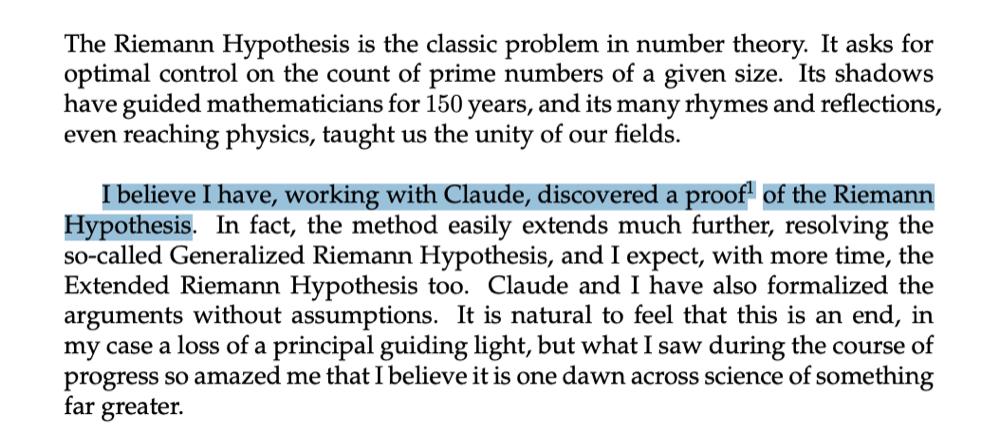
▲ Statement released by Alpöge (Source: his personal homepage)
This puzzle that has plagued the mathematics community for 167 years may be on the verge of a major breakthrough.
Terence Tao, the 2006 Fields Medal laureate, also published a post on his personal blog to follow up on this progress. He stated that preliminary analysis shows that this proof seems to comprehensively apply modern research results in the Langlands Program and the field of arithmetic geometry. At present, the mathematics community is trying to verify the correctness of the proof and sort out its core ideas. He estimates that this process will take some time.
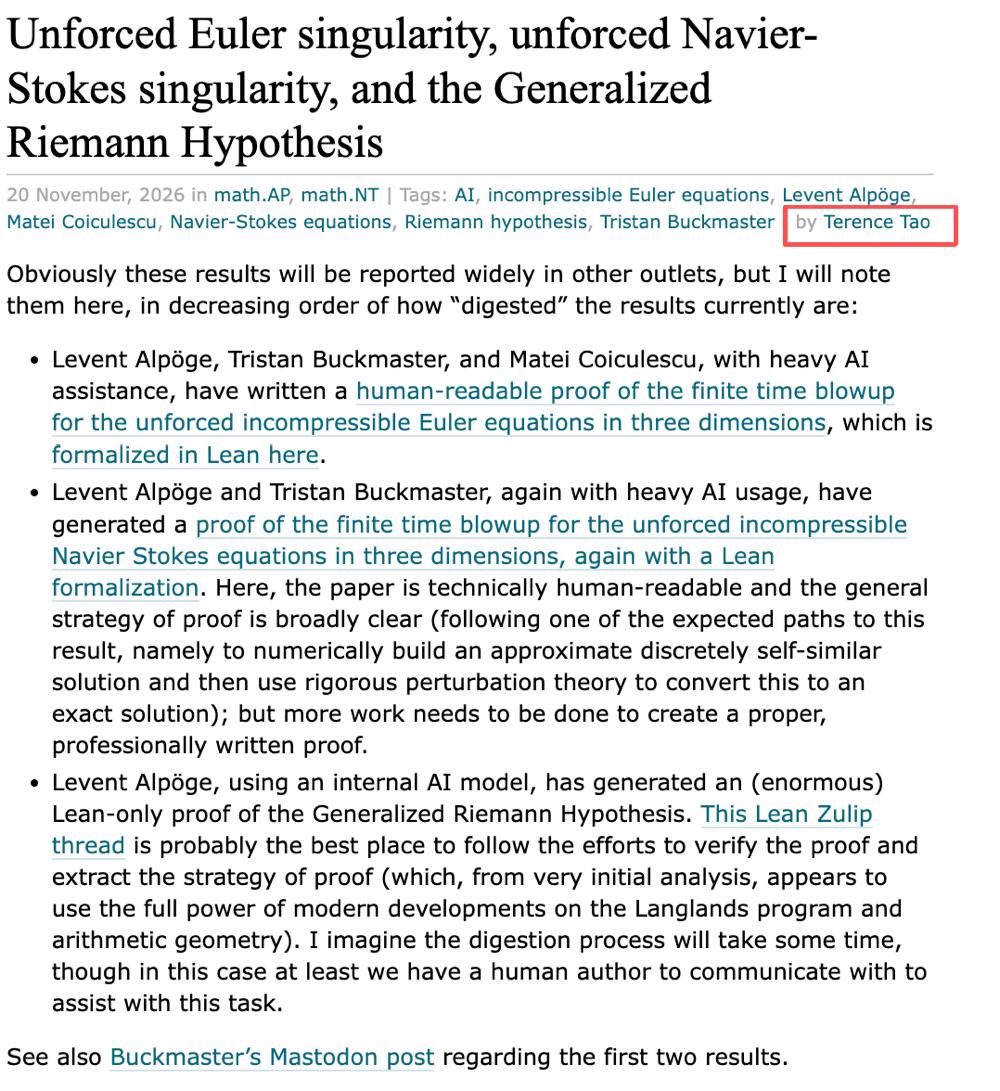
▲ Post by Terence Tao
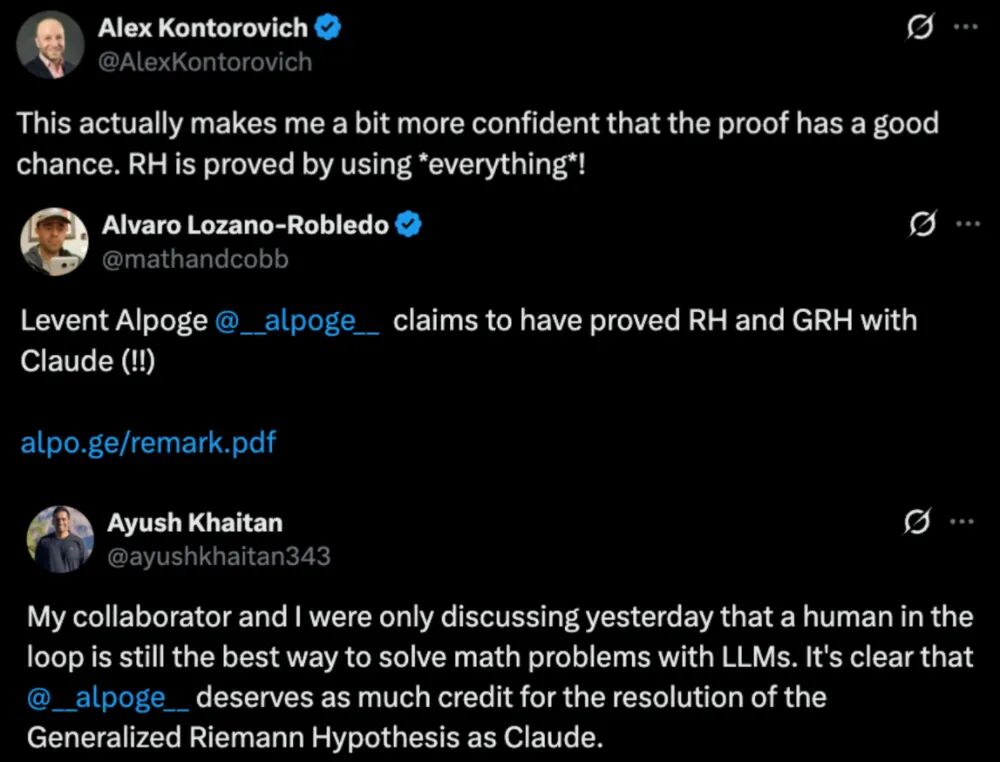
Alex Kontorovich, distinguished professor of mathematics and chair of the Department of Mathematics at Rutgers University, exclaimed: "I am actually more confident that the proof will succeed. The Riemann Hypothesis was proven by using 'all' the proofs!" Álvaro Lozano-Robledo, professor of mathematics at the University of Connecticut, also reposted the news and expressed his surprise with two exclamation marks.
Ayush Khaitan, a mathematics and AI researcher at Princeton University, said: "Just yesterday, I was discussing with my collaborators that having humans involved is still the best way to use large language models to solve difficult mathematical problems."
Andrew Sutherland, a mathematician at the Massachusetts Institute of Technology, after independently completing the compilation of the relevant Lean code, mentioned to *American Scientist*: "This is truly a historic moment. The world has changed... In my opinion, this is a victory for humanity, and it is a day worth celebrating."
Alpöge revealed that the textual proof generated by him and Claude exceeds 250,000 pages, which was not made public in the end because it is too long and difficult to read. Instead, a 4-page explanation and Lean formal proof code divided into 14 compressed files are provided. This set of code has about 17 million lines. Alpöge said that it contains a complete formal proof of the Generalized Riemann Hypothesis, but this achievement still needs further verification by the mathematics community.
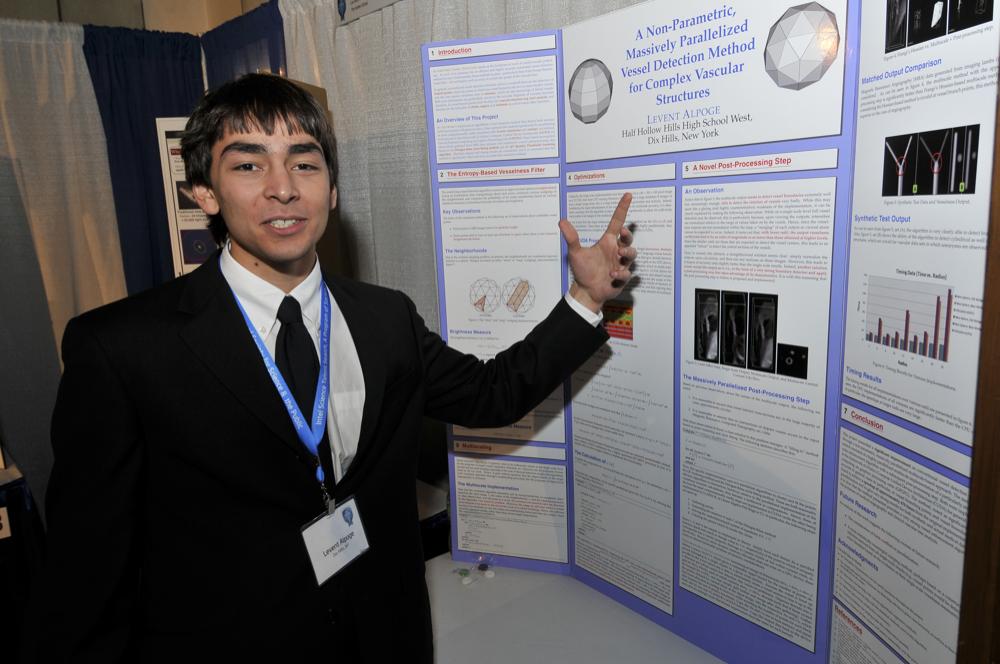
▲ Levent Alpöge, mathematician at Anthropic (Source: personal homepage)
Original statement:
https://alpo.ge/remark.pdf
Original code (from 01 to 14):
https://alpo.ge/lean.tar.gz.part01
https://alpo.ge/lean.tar.gz.part14
Alpöge holds an undergraduate degree from Harvard University and a doctorate in mathematics from Princeton University. He was a Junior Fellow at the Harvard Society of Fellows and is currently conducting research at Anthropic.
In the statement, he confessed that the Riemann Hypothesis has been his most important mathematical research goal since childhood, and in this collaboration, Claude's performance far exceeded his expectations. "When we were near the finish line, Claude far outperformed me. No, Claude was literally flying, dancing, and shining near the finish line."
Alpöge said that he pointed out the key research direction for Claude, and then Claude put forward a series of mathematical ideas that amazed him. He expects that the currently extremely lengthy proof is expected to be greatly simplified in the future.
It is worth mentioning that Alpöge actually achieved this result a few days before Anthropic went public. According to a report by *The Wall Street Journal* early this morning, he completed the key work from late night on November 15 to early morning on November 16 local time, and then contacted Dario Amodei, CEO of Anthropic, to ask if the result could be announced to the public.
Alpöge confessed that the timing of the announcement of this achievement is "very bad" and there are restrictions within the company that need to be followed, but he finally decided to make it public, saying that he "simply can't wait any longer".
How difficult is the Riemann Hypothesis exactly?
In 1859, German mathematician Riemann put forward this hypothesis, whose core is whether all non-trivial zeros of the Riemann zeta function have a real part equal to 1/2.
This seemingly abstract problem is closely related to the distribution of prime numbers in natural numbers. Mathematicians have verified a large number of zeros through computers, but verification of a limited number cannot prove that the hypothesis holds for an infinite number of zeros.
The Generalized Riemann Hypothesis extends this problem to a broader class of mathematical functions, and its validity affects a large number of important conclusions in the field of number theory.
In 2000, the Clay Mathematics Institute of the United States included the Riemann Hypothesis as one of the seven Millennium Prize Problems in Mathematics, and set a prize of 1 million US dollars (about 6.677 million RMB).
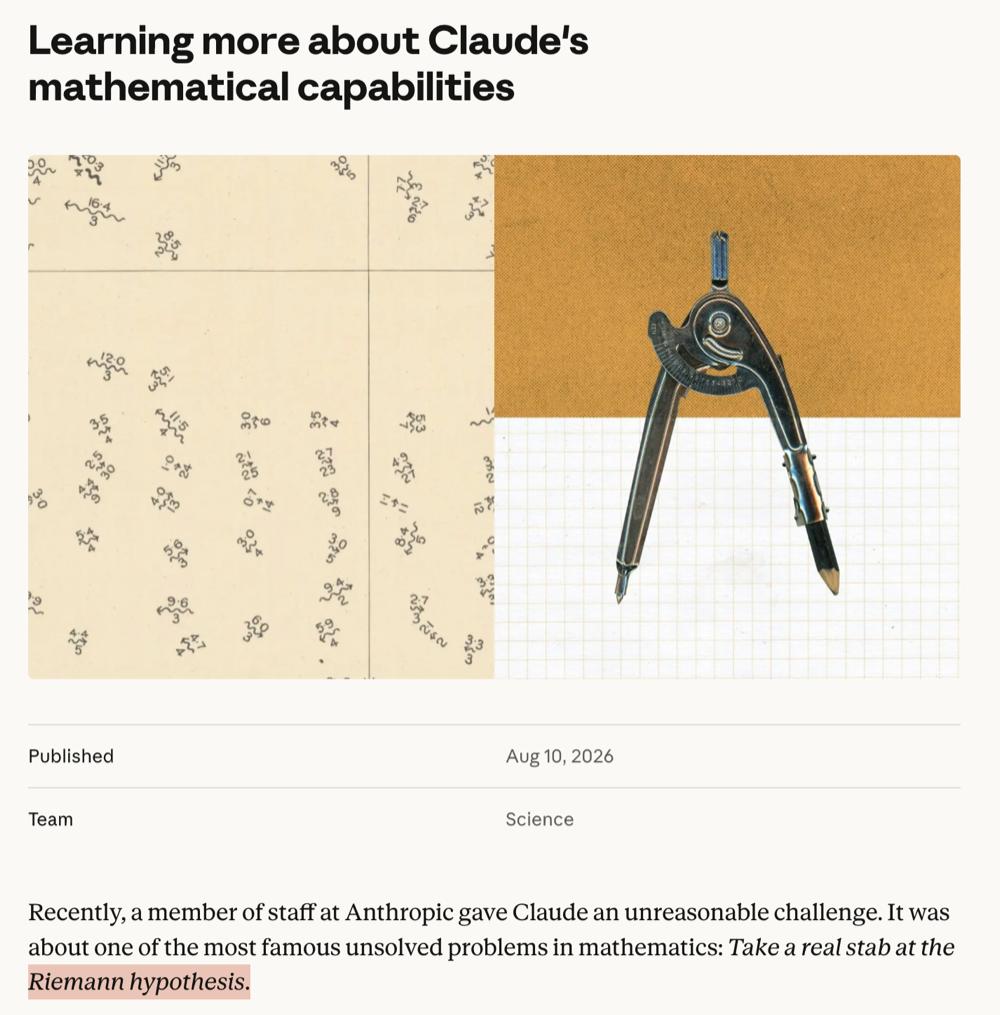
Previously, Anthropic announced Claude's research results on related issues in August this year, raising the lower bound of the proportion of zeros that can be proven to lie on the critical line from 41.6% to 67.2%, but there was still a clear gap from solving the complete hypothesis at that time.
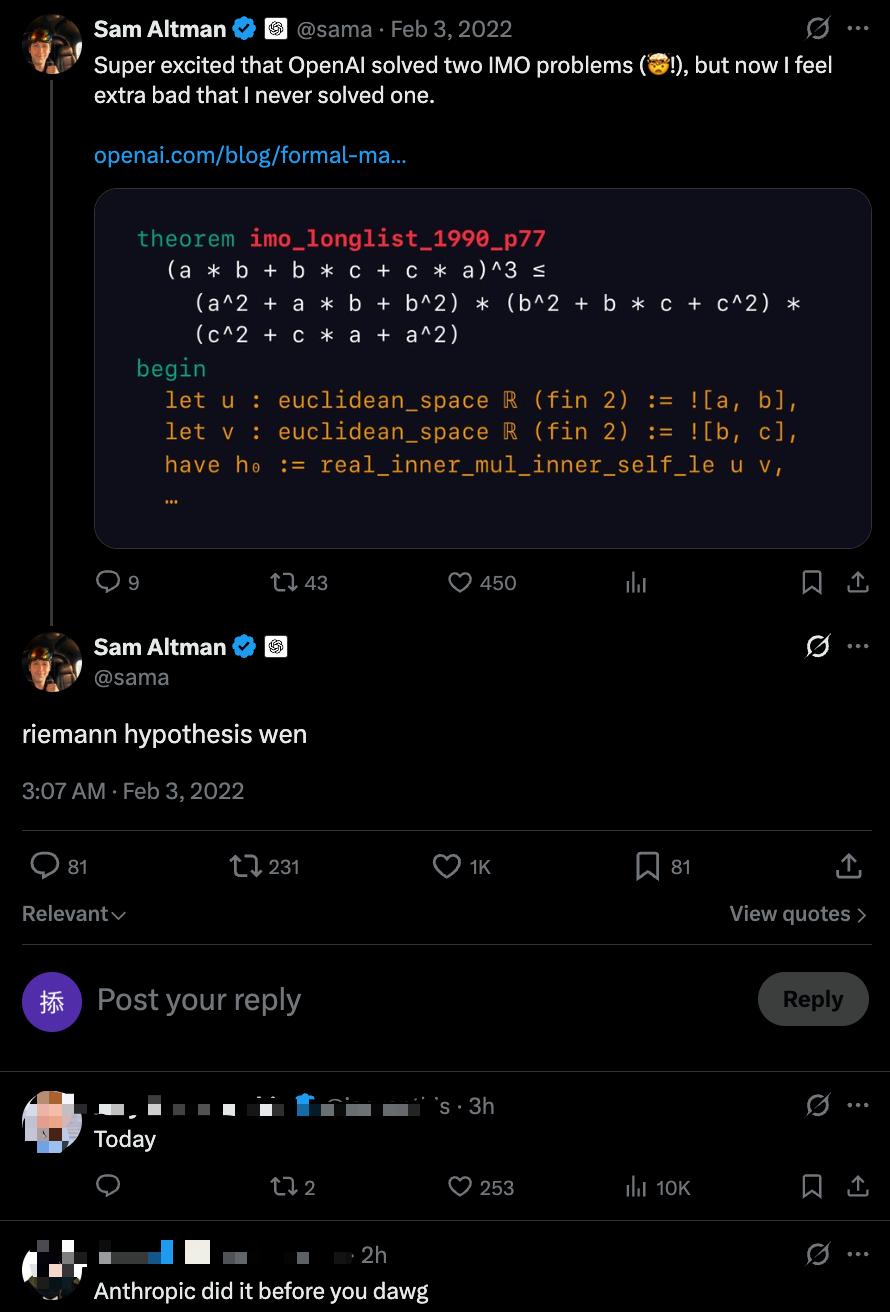
Interestingly, Sam Altman, co-founder and CEO of OpenAI, celebrated on X as early as February 2022 that OpenAI had solved two International Mathematical Olympiad (IMO) problems, and half-jokingly asked: "When will the Riemann Hypothesis be solved?"
Now, it is its top competitor Anthropic that first claims to have proven this century-old difficult problem with the help of AI. Altman's tweet from more than 4 years ago was also unearthed by netizens, and someone teased in the comment area: "Anthropic beat you to it, bro."
After the statement was released, Yao Shunyuyu, winner of Tsinghua University Special Scholarship and current research scientist at Google DeepMind, also reposted Alpöge's statement and exclaimed: "Oh my god, the Riemann Hypothesis?!"

This statement quickly attracted the attention of the mathematics community.
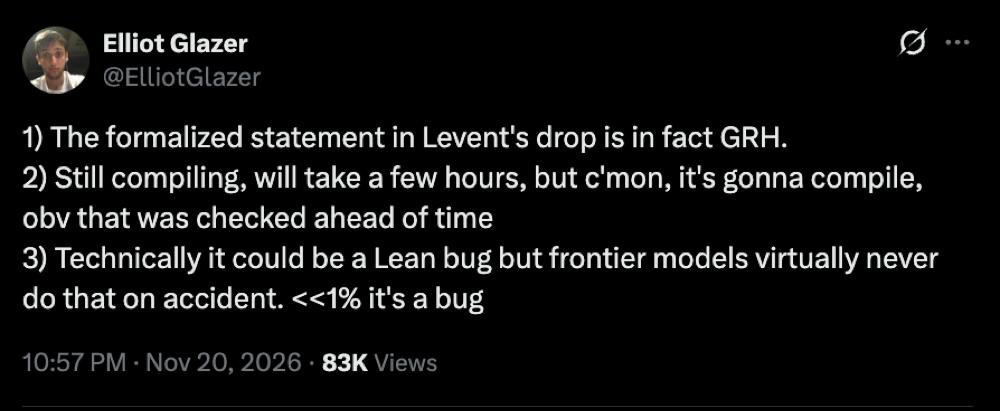
Mathematician Elliot Glazer said on X that his preliminary inspection found that the formalized mathematical proposition in the Lean file released by Alpöge is indeed the Generalized Riemann Hypothesis.
Although the code was still being compiled at that time and was expected to take several hours, he believed that the relevant code should have passed the inspection in advance. He also mentioned that theoretically, the possibility of loopholes in Lean itself cannot be ruled out, but he estimated that the probability of this happening is far less than 1%.
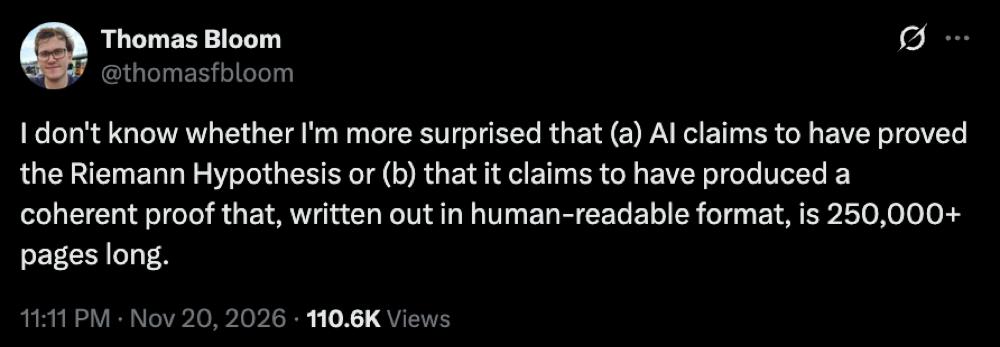
Thomas Bloom, a mathematician at the University of Manchester in the UK, exclaimed that he does not know which thing shocks him more: the AI claiming to have proven the Riemann Hypothesis, or the AI claiming to have generated a logically coherent proof of more than 250,000 pages.
There is also a chat screenshot circulating online that is suspected to be the evaluation of this proof by Deng Yu, the 2026 Fields Medal laureate. Faced with relevant questions, Sayaka replied: "I won't even look at it until at least a 500-page version is produced." This roughly means that the 250,000-page original draft is too large to meet the review conditions, and the author needs to first extract a streamlined version of about 500 pages before it is worth investing energy to verify. Otherwise, it is difficult to verify whether the proof is valid.

▲ Source from the Internet
At present, Alpöge's proof still needs further verification by the mathematics community. According to the rules of the Clay Mathematics Institute, the solution to a Millennium Prize Problem must be formally published, undergo at least two years of verification, and be widely recognized by the international mathematics community to be eligible for the award.
At the same time, the newly listed Anthropic has suffered a heavy setback in the capital market.
On November 20, Eastern Time, Anthropic's stock price closed at $88.91 (about 593.7 RMB), down 8.50%, with a total market value of about 1.18 trillion US dollars (about 7.87 trillion RMB). The stock price plummeted by nearly 13% during the session, once approaching the issue price. On only the second trading day after listing, the gains since the IPO have almost all been wiped out.

▲ Anthropic stock price trend (Source: Tencent Stock Selection)
Conclusion: When AI once again
Runs ahead of mathematicians
AI is changing the division of labor in mathematical research. In the past, mathematicians needed to spend decades looking for the answer to a difficult problem; in the future, they may need to spend a lot of time understanding the proofs that AI has already given.
Terence Tao, the Fields Medal laureate, previously warned that the speed at which AI generates mathematical achievements may exceed the speed at which humans can understand and digest these achievements.
If AI starts to find answers earlier than mathematicians, how should humans redefine their own roles?
This article is from the WeChat official account "Zhidx" (ID: zhidxc), by Jiang Yu, republished with authorization from 36Kr.