The Demise of AI Intermediaries in Southeast Asia
In 2015, a company named 7 Road International was registered in Singapore.
In its first few years, it flew under the radar. No one could have imagined that a decade later, this company would become a high-profile name in NVIDIA's advanced AI chip supply chain.
In 2023, the company was renamed Megaspeed International, and its business focus began to shift to cloud computing and AI infrastructure.
Shortly after that, its business expanded at a breakneck pace.
According to disclosed trade records, from May 2024 to February 2026, the value of NVIDIA products imported by Megaspeed's related businesses reached 4.13 billion U.S. dollars. In November 2025 alone, the company imported 17,454 units of GB300, worth approximately 787 million U.S. dollars.
A company with a gaming business background suddenly emerged as a key player in the AI chip trade.
But this business soon drew investigations.
In June 2025, investigators from the U.S. Department of Commerce raided Megaspeed's business site in Singapore. The Singapore Police Force also intervened in the investigation. Huang Le, the then CEO, had her passport confiscated and was later barred from re-entering Singapore.
What drew more attention was the roughly 50,000-chip gap between the chip inventory data NVIDIA submitted to the U.S. government and external trade records.
How did a previously obscure company grow into a multi-billion-dollar AI infrastructure player in such a short period of time? And why was it embroiled in an investigation spanning the United States, Singapore and Malaysia?
The answer lies in a burgeoning new business sector.
I. GPU Supply Falls Short of Demand, Computing Power Brokers Step In
The AI boom first reshuffled the allocation mechanism of GPUs.
While tech companies worldwide were scrambling for NVIDIA chips, brokers with access to procurement channels, capital and data center resources began to spot new business opportunities.
What Megaspeed did was convert chips into rentable computing power. It purchased full GPU servers from NVIDIA and its server partners, then deployed the servers to data centers in Malaysia and other regions, connected them to cloud platforms, and leased computing power to global clients.
Clients do not need to buy servers on their own, nor do they need to build computer rooms. As long as they connect via the internet, they can use GPU computing power on demand.
This sets it apart from traditional chip agents in one key aspect: agents sell hardware, while computing power brokers deliver usable computing capabilities.
A single GPU starts its journey from the NVIDIA supply chain, passes through server manufacturers and traders, enters data centers, and finally turns into cloud-based computing power that can be called remotely. Brokers profit from the price gap between hardware procurement, infrastructure deployment and computing power services, as well as the premium generated by integrating scarce resources.
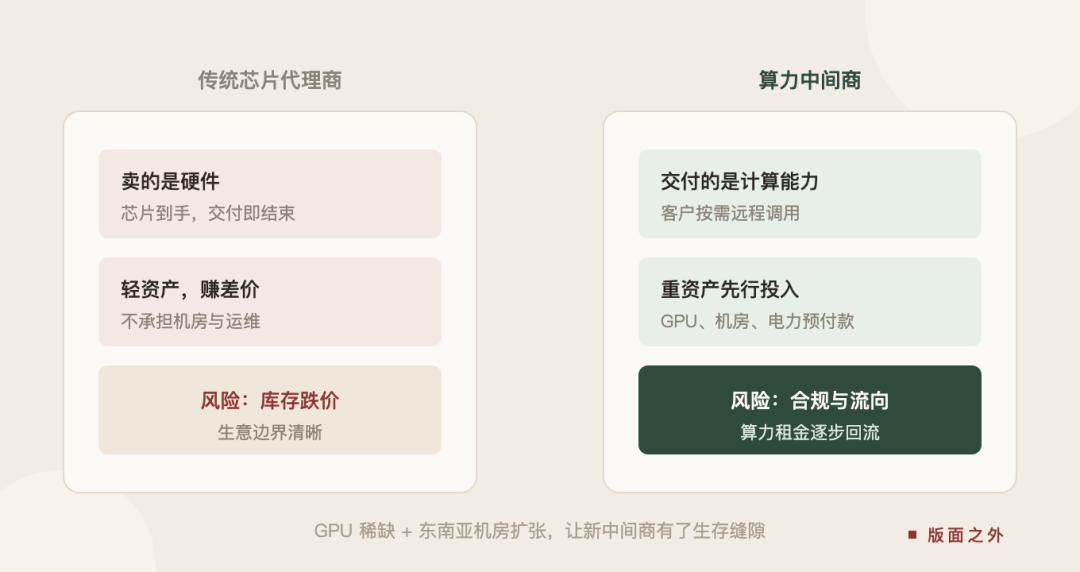
This business model is sustained by two driving forces.
On one hand, there is a global shortage of GPUs. The demand for large model training and inference is growing rapidly. Tech companies, startups and research institutions are all hunting for computing power, and companies that can secure chips and deliver them quickly stand a good chance of landing orders.
On the other hand, data centers in Southeast Asia are undergoing rapid expansion.
Singapore is a regional data center and financial hub, but land, electricity and energy consumption restrictions have put pressure on new projects. Malaysia, adjacent to Singapore, especially the state of Johor, has relatively abundant land and power resources, and has gradually taken over data center investment flows.
As a result, a new division of labor has taken shape: chips are procured from the global supply chain, servers are deployed in Southeast Asia, and computing power is delivered to clients in different countries via the internet.
This has also created a certain degree of separation between chips and computing power.
The physical location of the GPU can be in Malaysia, while the client using it may be located far away in another country. Clients do not need to ship chips to their own premises; as long as they can remotely access the data center, they can obtain the computing capabilities they need.
Remote access itself is not illegal. The crux lies in who the end user is, what the purpose of use is, and whether the specific service arrangement complies with export control requirements.
But in an era of GPU scarcity, the very ability to connect resources across different regions carries inherent commercial value.
Megaspeed seized this opportunity tightly.
II. Malaysia Underpins a Multi-Billion-Dollar Business
Megaspeed's expansion almost coincided with the takeoff of Malaysia's data center industry.
The company had ties to the gaming firm 7 Road International in its early years, and was mainly engaged in overseas game distribution and operation. After its 2023 renaming, it pivoted to cloud computing and AI infrastructure, and joined the NVIDIA Cloud Partner (NCP) ecosystem.
The speed of its transformation was quite staggering.
According to financial documents disclosed by Reuters, Megaspeed's total assets surged from roughly 32.9 million U.S. dollars in 2023 to nearly 3 billion U.S. dollars in 2024, a nearly 90-fold increase; its 2024 revenue reached 294 million U.S. dollars.
However, the expansion of scale does not mean the business has turned profitable. The company posted a post-tax loss of roughly 20 million U.S. dollars in 2024.
This is not hard to understand.
The computing power business is a capital-intensive sector. GPU procurement, data center leasing, electricity prepayments and equipment deployment all require large amounts of upfront capital investment. After the servers go into operation, the company still has to continuously cover depreciation and financing costs. Only when computing power rental income gradually flows back can the upfront investment be converted into profits.
Megaspeed needed to keep purchasing chips, building computing power resources, and then find clients to absorb its production capacity. The faster it grew, the greater its capital requirements became.
Its procurement scale was equally staggering.
According to statistics compiled by Bloomberg based on customs records from Malaysia and Indonesia, by the end of November 2025, NVIDIA hardware imported by Megaspeed and its affiliated companies was worth at least 4.6 billion U.S. dollars, involving roughly 136,000 GPUs.
To support this business, Megaspeed built a complex network of affiliated companies across Southeast Asia, with different entities participating in procurement, customs clearance and business operations respectively.
Problems soon followed: after such a large batch of chips entered Southeast Asia, where exactly were they deployed, and who was using them?
The Malaysian government began to tighten its regulation of high-performance chip circulation.
On July 14, 2025, the Ministry of Investment, Trade and Industry of Malaysia announced that the export, transshipment and transit of U.S.-origin high-performance AI chips require a strategic trade license.
This does not ban enterprises from importing and deploying chips in Malaysia. The regulatory focus is on whether the chips will continue to flow to other destinations after entering the local market.
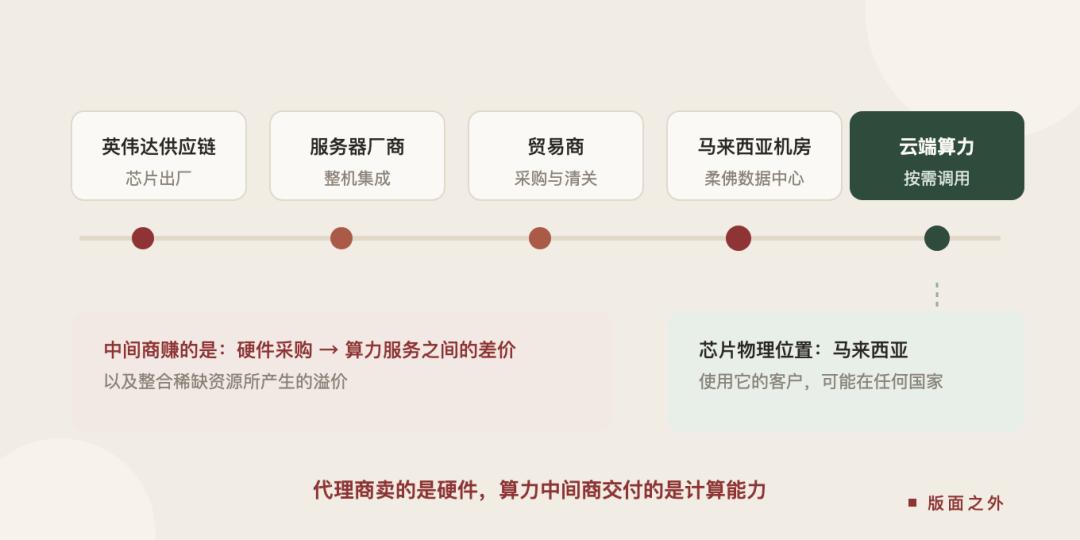
Malaysia's appeal lies not only in its land and power resources. It also offers a special condition: chips can be deployed locally, while the computing power generated can serve other markets via the internet.
In March 2025, The Wall Street Journal reported a rather unusual case.
Four engineers flew to Malaysia, each carrying 15 hard drives with a total of roughly 80TB of training data. Instead of transmitting the data across the border via the internet, they flew directly to the local data center with the hard drives, then rented servers to complete model training.
The data traveled by plane, the computing power stayed in the computer room, and the trained model parameters were transmitted back afterwards.
This incident has no known direct connection to Megaspeed, but it reveals a new demand that Southeast Asian data centers are catering to: clients do not necessarily need to own chips; as long as they can access computing power locally, they can complete remote computing tasks.
For regulators, the questions are becoming increasingly specific.
For companies like Megaspeed, their business requires chips to enter Malaysia smoothly, and computing power to be continuously delivered to overseas clients.
The local government's move to inquire about the next destination of the chips means that this supply chain is no longer as simple as procurement, deployment and leasing.
III. 50,000 Chips Uncover Supply Chain Mystery
On June 24, 2025, Megaspeed's troubles erupted all at once.
Investigators from the Bureau of Industry and Security (BIS) of the U.S. Department of Commerce arrived at the company's business site in Singapore to conduct end-use verification, and questioned Huang Le, the then CEO.
Almost on the same day, the Singapore Police Force also began questioning her and confiscated her passport.
The two groups of investigators were not focusing on exactly the same things.
The U.S. Department of Commerce was concerned about whether the advanced chips had flowed to restricted end users, while the Singapore Police Force was investigating whether there was false declaration during the server procurement process, and whether the equipment was shipped to locations other than the declared destinations.
One company, one batch of servers, two sets of investigation perspectives.
Singapore is a key hub for entrepôt trade and capital settlement. Servers can be procured and settled here before being shipped to Malaysia. For investigators, the key question is: where exactly did the equipment end up? Is the declared final destination the actual place of use?
The Singapore Police Force also repeatedly sought assistance from the U.S. Department of Justice and the FBI, hoping that U.S. server supplier Supermicro would cooperate with the investigation, but received limited support.
This investigation did not end quickly.
In February 2026, the Singapore Police Force determined that there was insufficient evidence to prove that Huang Le was involved in the server declaration crimes under previous investigation. But the police also confirmed that she had provided information she knew to be inaccurate during the investigation, attempting to downplay her role at Megaspeed.
In the end, the Singaporean authorities issued a stern warning to her, and barred her from entering the country again.
This does not mean that Megaspeed has been found to have violated the law. The investigation targeting the company and six other related individuals is still ongoing.
Huang Le's experience is only part of this controversy. What really complicated the investigation was another set of figures.
After comparing trade records and NVIDIA inventory data, Bloomberg found that the number of chips sold by NVIDIA to Megaspeed through its hardware partners may be roughly 50,000 units less than the number it reported to the U.S. government.
NVIDIA offered another explanation for this discrepancy: the company conducted an additional check of Megaspeed's other warehouses and found a batch of equipment that had not been included in previous statistics, but did not disclose the specific quantity.
Therefore, the 50,000-unit gap does not mean the chips went missing, let alone directly prove smuggling. But this figure is sufficient to show that tracking the advanced chip supply chain is far from simple.
A single GPU, starting from the manufacturer, may pass through server vendors, traders, affiliated companies and third-party colocation data centers. Inventory records, customs data and actual deployment status across different links may not be synchronized in real time.
And 50,000 GPUs are enough to support several large-scale computing power centers.
Megaspeed's investigation is therefore no longer just a matter of procurement and declaration for a single company.
In the summer of 2025, Tim Teter, NVIDIA's head of legal affairs, called Jeffrey Kessler, Deputy Under Secretary of Commerce for Export Controls, to ask whether BIS was involved in Singapore's investigation of Huang Le.
After that, internal communications and information requests related to NVIDIA within BIS were subject to additional restrictions, with some matters transferred to Kessler for handling. This change sparked questions from Congress and political circles.
In November of the same year, Axios revealed that U.S. Treasury Secretary Bessent had confronted Commerce Secretary Lutnick at a White House meeting, asking why Megaspeed had not yet been added to the Entity List.
The report also stated that the Treasury Department, the Department of Defense, the State Department and the Office of the U.S. Trade Representative had previously supported imposing restrictive measures on the company.
A chip trading business began to affect the interests and judgments of different departments within the U.S. government.
NVIDIA needs the global market and wants to expand chip sales as much as possible, while the U.S. government hopes that advanced computing capabilities will not flow to restricted users and regions.
The former focuses on business scale, while the latter focuses on technology flow direction.
Megaspeed happened to stand at the intersection of the two.
IV. The Good Old Days of Computing Power Arbitrage Are Over
Megaspeed's business model essentially relies on one kind of separation: where the chips are deployed is where the computing power is generated, but who ultimately uses the computing power can cross borders via cloud services.
This arrangement once left huge operating space for computing power brokers.
But now, regulators are starting to track not only the chips themselves, but also the computing capabilities the chips provide.
On November 16 this year, the Bureau of Industry and Security of the U.S. Department of Commerce released an Interim Final Rule (IFR) targeting remote access to advanced chips, extending regulatory scope to remote access of advanced computing capabilities.
The new rule sets a 12 million TPP threshold for advanced computing power, roughly equivalent to the computing power of 750 H100 or H200 chips. Data centers that meet relevant conditions may need to obtain U.S. export licenses if they provide remote computing power services to enterprises in specific restricted regions. Access provided through third-party intermediaries is also included in regulatory consideration.
The rule also involves license requirements for the export, re-export and transfer of advanced chips in Malaysia, Singapore, Indonesia, Thailand, Brazil and other regions.
This change hits the most critical link in the computing power broker business.
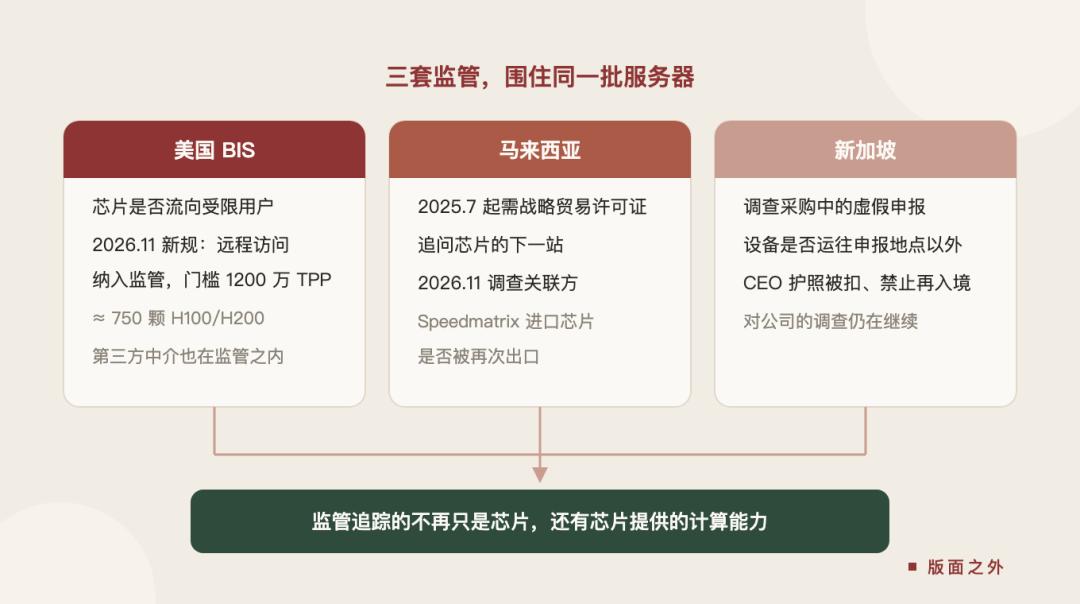
In the past, enterprises could build data centers in third countries, and then lease computing power to overseas clients via cloud services. But today, the physical location of chips is no longer the only basis for judging compliance. Remote access users and end uses have also been brought into the scope of review.
Of course, this does not mean that all cross-border cloud services are banned. Whether a license is required still depends on the computing power threshold, location, end user and specific access behavior.
But for Megaspeed, the difficulty of operation has changed.
It not only needs to source GPUs, computer rooms and clients, but also figure out who each batch of computing power is ultimately delivered to, whether a license is required, and whether the client's remote access meets regulatory requirements.
Global clients that could previously