Understanding Xiangshan: How an open-source processor core can be utilized by more enterprises
At the Integrated Circuit Design Industry Exhibition (ICCAD-Expo 2026) in November 2026, a RISC-V server equipped with the Jinjie Space-Time CPU chip V100 was displayed at the booth of the Beijing Open Source Chip Research Institute. The V100 is the industry's first computing chip that fully complies with RISC-V server specifications, indicating that RISC-V is marching towards the truly deployable and scalable data center market. This chip integrates 46 high-performance RISC-V computing cores, 6 of which come from the "XiangShan" open source project. These 6 cores are directly involved in general-purpose computing, and together with the 40 X100 cores self-developed by Jinjie Space-Time, they undertake the server service load. The key of this detail lies in: the selection of open source computing cores is not a technical demonstration, but a prudent decision for commercial implementation.
This is also how XiangShan was discussed at the 6th RISC-V China Summit this year. It is not a chip sample placed in a display cabinet, but a set of processor core designs that have been integrated into products by enterprises. In March this year, the "XiangShan" open source high-performance RISC-V processor system and the "Ruyi" RISC-V native operating system were jointly released; the China Summit in October provided a clearer observation window: commercial chips began to be put into practical use, the software toolchain is filling the shortcomings, and AI computing brings new demands; in the same month, Eswin Computing landed on the Hong Kong Stock Exchange and was called "the first RISC-V stock" by some media; in November, the "XiangShan Family" made another appearance at ICCAD-Expo 2026, intuitively demonstrating the implementation potential of the high-performance RISC-V open source route from the perspective of the entire integrated circuit industry chain.
The attention to this track continues to rise, but what is more worth asking than the "first stock" is: the open source route has become the business card of China's large models, making it comparable to international commercial closed-source large models; but in the chip field, can the open source route produce high-performance and highly reliable processors that meet commercial standards?
"XiangShan" is an excellent sample to observe this issue. For readers outside the industry, it is still an unfamiliar name; but in the RISC-V industry circle, it is being discussed as a reusable public industry base. To understand it, we must first clarify a set of relationships: RISC-V is the "language rule", the RISC-V manual is the "dictionary", XiangShan is the "draft", enterprise chips are the "works", and complete machines are the "commodities".

What is "XiangShan"
Not a chip, but a modifiable "draft"
For a chip to work, it has to understand a set of "languages", which is called the instruction set. In the past few decades, the global CPU instruction set has been mainly dominated by two systems: x86 and Arm. They have strong performance and large ecosystems, but their common features are: not open, requiring authorization and payment. RISC-V provides another possibility — the instruction set is open, enterprises can use it for free and customize it according to scenarios.
But RISC-V itself is not code, nor a chip. It is more like a set of "language rules", and the manual describing the RISC-V instruction set specification is like a "dictionary". "XiangShan" is an open source high-performance processor core written based on these rules, like a modifiable "draft". Enterprises integrate the XiangShan core and other functional modules into a system-on-chip (SoC), which is equivalent to completing their own "work" on the draft; the complete machine manufacturers then install the chips into servers, industrial control equipment, etc., to form the final purchasable products.
"XiangShan" is jointly built by the Institute of Computing Technology of the Chinese Academy of Sciences (hereinafter referred to as "ICT, CAS") and the Beijing Open Source Chip Research Institute (hereinafter referred to as "Open Chip Institute"). Since 2020, it has gone through three version iterations: "Yanqi Lake", "Nanhu Lake" and "Kunming Lake", achieving full coverage of scenarios from data centers, intelligent computing to terminals. In public tests, the single-core performance of Kunming Lake has steadily ranked in the first echelon of international RISC-V processor core performance.

Open source and high performance are never a single-choice question
The real demand of most enterprises is not to "build a CPU from scratch", but to obtain a stable and reliable core to embed into their own products. There are two traditional paths: either develop the basic processor core from scratch by themselves, which requires large investment and high trial-and-error cost; or purchase closed-source IP, which is mature and reliable, but the authorization fee and royalty are rigid costs, and the space for architecture adjustment is limited. For a long time, closed-source commercial IP has become the mainstream choice — what enterprises buy is ready-made verification results, at the cost of continuous payment and limited freedom. This model has been running for many years, and a problem is increasingly unavoidable: if every enterprise repeats investment in similar general-purpose cores, or pays authorization costs for the same technical base for a long time, where does the overall innovation efficiency of the industry come from?
XiangShan's answer is: make the most underlying, most general-purpose, and most capital-intensive processor core into a "public industry base". This means that enterprises no longer need to "reinvent the wheel", and can concentrate resources on scenario innovation that they are more familiar with: those who make servers optimize multi-core interconnection and memory bandwidth; those who make terminal chips polish power consumption and integration; those who make AI chips design data paths around the computing core.
But taking the open source route faces many challenges. The first difficulty is: can open source produce high-performance processors? The stereotypes that "open source equals low performance" and "open source equals low quality" once prevailed in the industry. In particular, RISC-V was widely deployed in IoT devices such as smart home appliances and sensors in the early stage, which further solidified its label of "only suitable for low-power control". Different from the lightweight cores for IoT devices, to achieve extreme performance for open source processor cores, it is inseparable from the industry-recognized extremely challenging work such as large-scale verification regression, back-end timing convergence, process adaptation coordination, and deep optimization of supporting software stacks. However, participants in the open source community are scattered. Under multi-party collaboration, it is not easy to maintain stable architecture and unified R&D goals, and continuous investment in long-cycle, high-cost closed-loop verification is required, which makes the R&D of open source high-performance processor cores more challenging.
But difficulty does not mean impossibility. At the 6th RISC-V China Summit, "XiangShan" presented its "open source high performance" answer sheet more thoroughly — the third-generation Kunming Lake processor core has a SPECint2006 score of 22 points/GHz, and its performance can match the internationally advanced level of Arm processors.
In addition to the impressive benchmark scores, it can be more widely applied in scenarios with strict computing power requirements such as servers, cloud computing, and AI inference. Aiming at the large model inference demand in the AI era, "XiangShan" has also launched two types of intelligent computing IP focusing on high throughput and low latency — "Badaling" and "Xianglufeng". Extending from a single CPU core to multiple IPs such as AI acceleration and open source on-chip interconnection network, "XiangShan" has made more and more layouts in the AI era, and has formed a "XiangShan Family" containing a variety of IPs and tools. At the summit forum of ICCAD-Expo 2026, Bao Yungang, Deputy Director of ICT, CAS and Chief Scientist of the Open Chip Institute, delivered a keynote speech titled "Accelerating the Construction of RISC-V Ecosystem for the AI Era". Facing the wave of AI transformation, "XiangShan" has built a full-stack open source ecosystem from underlying processor IP to AI-native software system, supporting the full implementation of end, edge and cloud computing power scenarios. This means that the competitiveness of "XiangShan" is not only performance benchmark scores, but an open source chip ecosystem jointly composed of IP, toolchain, software stack and application scenarios.
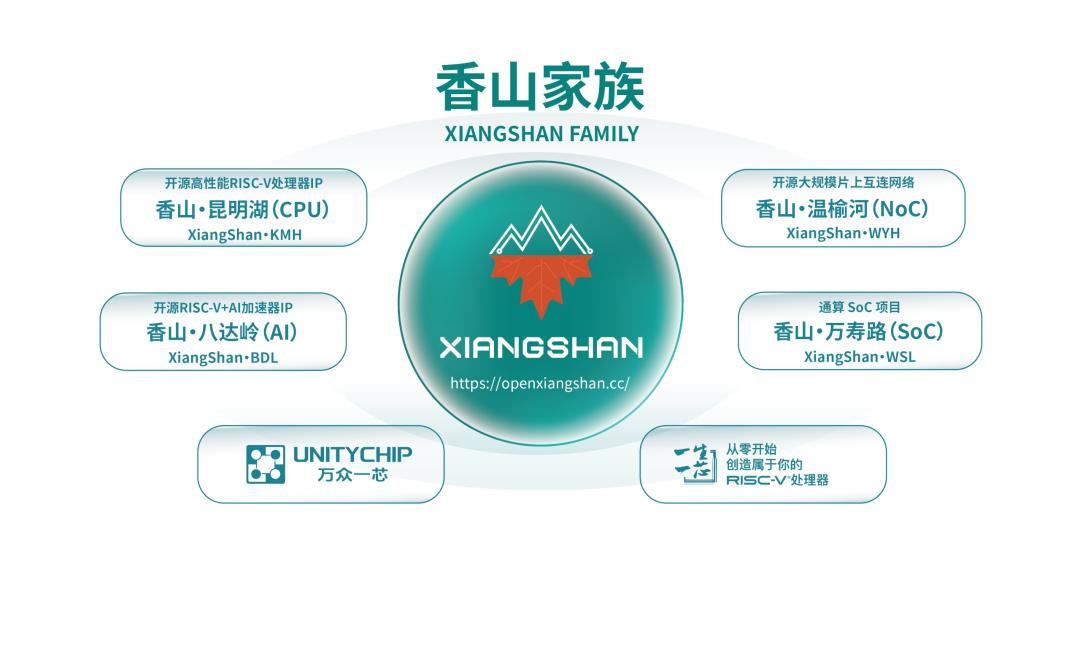
"XiangShan Family" series
Available technology only means that the prototype can run through the demonstration, and the real test ultimately depends on: whether enterprises dare to install "XiangShan" into their own products. Chip mass production requires high investment and the engineering fault tolerance space is extremely small, so enterprises are often extremely cautious in making choices. The industrialization and implementation of "XiangShan" is a direct proof of its product competitiveness: 2 chips have been successfully taped out in 2025, and 5 chips are expected to be taped out in 2026, including the Jinjie Space-Time V100. This implementation scale is not only particularly rare among open source high-performance RISC-V processor cores, but also very few in the field of commercial high-performance RISC-V cores. The industry side has cast a vote of confidence with real projects, which means that "XiangShan" has successfully passed the strict test of product-level delivery, and completed the key leap from technical verification to industrial implementation.
It needs to be clarified that open source does not mean free, no investment or no business model. "XiangShan" adopts the Mulan Permissive Software License Version 2, which opens source code, design documents, as well as various infrastructures and tools supporting the development of "XiangShan", allowing enterprises to directly modify and use it for commercial purposes, and also supporting third-party enterprises to provide customized chip design services based on the open source "XiangShan". The "XiangShan" open source chip community has also started to operate, organizing collaboration through working groups and technical proposals: in May 2026, the first working group of the open source chip community — the Simultaneous Multi-Threading SMT Working Group was officially established. ZTE Microelectronics and Alibaba DAMO Academy, as founding members, together with the Open Chip Institute, determined the community organizational structure and intellectual property strategy of the SMT Working Group, and reached a consensus to carry out joint SMT development based on Kunming Lake V3. Open source reduces the R&D threshold, but links such as verification, tape-out and mass production still require independent investment from enterprises. Open source provides a starting point, not an end point.
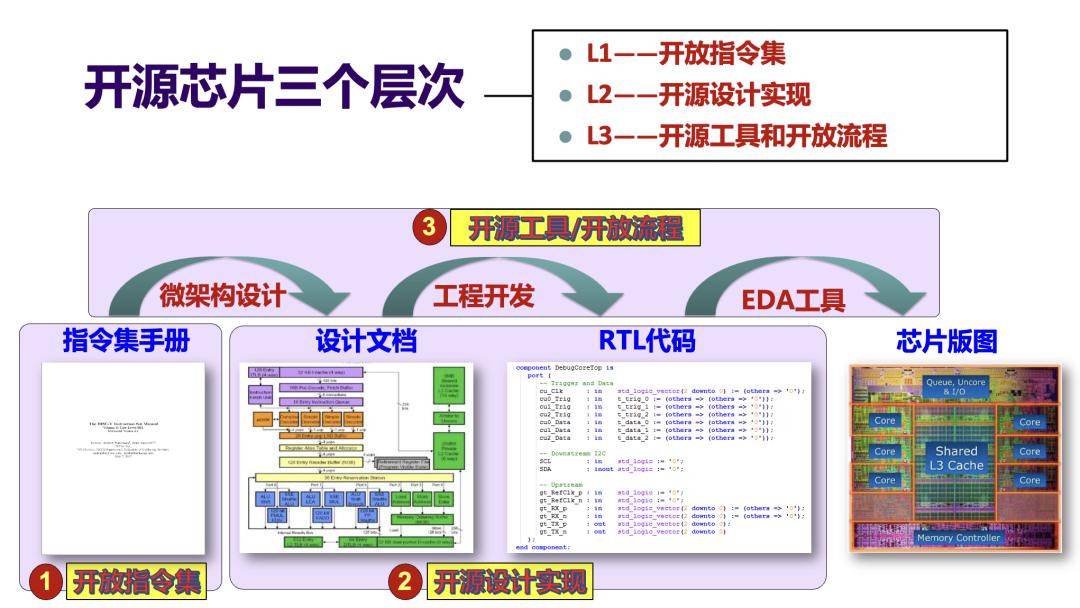
The open source scope of "XiangShan" focuses on L2 and L3 levels

Collaboration of industry, university, research and application, forming a closed loop from technical base to real business scenarios
As of August 2026, the number of ecological partners of the Open Chip Institute has exceeded 100, connecting scientific research institutes, chip design, complete machine systems, basic software and application manufacturers, forming a closed loop of "common base — enterprise development — software support — application verification".
On the base side, ICT, CAS and the Open Chip Institute take the lead in architecture R&D and community operation. Enterprises including Alibaba DAMO Academy, ZTE Microelectronics, Eswin Computing and SOPHGO participate in architecture definition in advance, and promote architecture co-construction with "real demand, high level and high quality". Moore Threads, Innosilicon, Jinjie Space-Time and other enterprises have completed product definition, chip integration and process optimization for tracks such as GPU, intelligent computing and servers based on the Nanhu core and Kunming Lake core. On the same base, the competition lies in who understands the scenario better and who is more differentiated. The implementation of hardware is inseparable from the software system that supports and evolves synchronously. The Institute of Software of the Chinese Academy of Sciences has worked closely with the "XiangShan" team since the R&D stage, and launched the "Ruyi" RISC-V native operating system, supporting the one-stop integrated development toolset RuyiSDK, aiming to release the hardware performance in the actual system, rather than staying on the benchmark scores. What really makes the closed loop run is the application verification in real business scenarios. When the chip is put into real business load, the defects and performance bottlenecks generated on the industrial side will continuously flow back to the architecture design end.
The reason why this closed loop can continue is that the underlying logic is multi-party win-win. Scientific research institutions undertake architecture R&D and community operation, in exchange for large-scale verification in real scenarios, so that the technology can be iterated and polished through industrial feedback; enterprises that participate in architecture definition in advance bring business pain points into the starting point of design, have the opportunity to influence the base design from the source, and reduce detours in subsequent adaptation; chip manufacturers carry out product definition, back-end design and mass production based on the open source base, saving the high authorization fee of closed-source IP, shortening the R&D cycle, and concentrating resources on innovation in their own tracks; the software team polishes the operating system and toolchain, precipitates the reusable RISC-V software stack on the unified hardware base, and amplifies the industrial value of the achievements; the application side opens business loads for actual measurement and continuously reports problems, in exchange for a technical base that continuously fits its own needs. After each cycle, the base is more stable, the product is more reliable, and "XiangShan" thus breaks through the achievement boundary of a single team and becomes a public base shared by all co-builders.
The spillover value of this closed loop is not only reflected in production lines and chip products, but also in the talent pool. The "One Student One Chip" chip talent training program was launched in 2019, which is practice-oriented and organizes students to fully participate in the whole process of processor chip design, tape-out and operating system operation. At present, the total number of applicants for the project has exceeded 25,000, covering more than 1,400 universities and scientific research institutes around the world, and many students have joined leading domestic chip enterprises such as HiSilicon, Loongson and Moore Threads after graduation. For "XiangShan", the ecosystem includes not only enterprises and code, but also a steady stream of people entering the industry.

From China's "XiangShan" to the world's "XiangShan"
Today, "XiangShan" has become one of the high-performance open source hardware projects with extremely high international attention. Up to now, it has obtained more than 7,400 Stars and 985 Fork