"Boycott AI, stop updating for one day", this statement has received 43,000 likes.
Multiple "AI purges" have taken place in the online literature industry this year. In February and May, Tomato carried out special governance targeting low-quality AI-generated content; Qidian completely banned AI-written texts in July, and processed hundreds of AI novels in one go in August, many of which were works with over ten thousand paid subscribers. On October 30, Qidian and QQ Reading released announcements stating that they would further crack down on the abuse of AI in contracted works and cancel welfare benefits for such works.
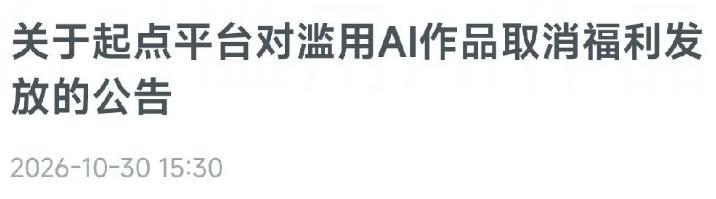
The newly released announcement from Qidian
However, after multiple rounds of governance, readers still complain that works on the leaderboards are "written by AI".
Compared with the full embrace of AI in short drama productions, why does the online literature industry insist on saying "no" to AI?
Do online literature platforms reject AI merely because AI-generated works are "not good to read"?
Once upon a time, "high output" was a core threshold for competition in the online literature sector.
Years ago, I once considered switching to writing online novels, but two major problems stumped me: 1. To unlock the full attendance bonus for paid serialized chapters on Jinjiang, a daily update of 3,000 words is the basic requirement; 2. My outline was brilliant, but the full draft read like popular science... hehe.
A daily update of 3,000 to 5,000 words is only an average level, while some top creators push their update volume to an astonishing level. Among the top tier, Tangjiasanshao once updated 8,000 words per day, and Mai Bao Xiao Lang Jun, the author of *The Lord of Great Feng*, did the same.
Writing from dawn to dusk, tapping the keyboard so hard that it almost overheats, and straining the lumbar spine from long hours of work, are the normal daily states for online literature authors.
The number of updated words largely determines the exposure and revenue of online literature works. The previous threshold for the full attendance bonus on Qidian was a daily update of more than 4,000 words for VIP chapters. However, after the emergence of AI, high daily word counts no longer give online literature authors a competitive edge.
In May this year, an author on Qidian caused public outrage. His work *The Great Sage of Warhammer Travels Through Dimensions* was updated with more than 4.7 million words in 8 months, averaging 20,000 words per day. From this astonishing update volume, you can probably guess what proportion of this book was generated by AI. Indeed, the editor of this book once publicly stated that the work was written with the help of Doubao large language model.
The author of this book also publicly taunted veteran creators who still insist on writing manually in the AI era. After the incident escalated, the work was removed from the leaderboards and penalized by Qidian.
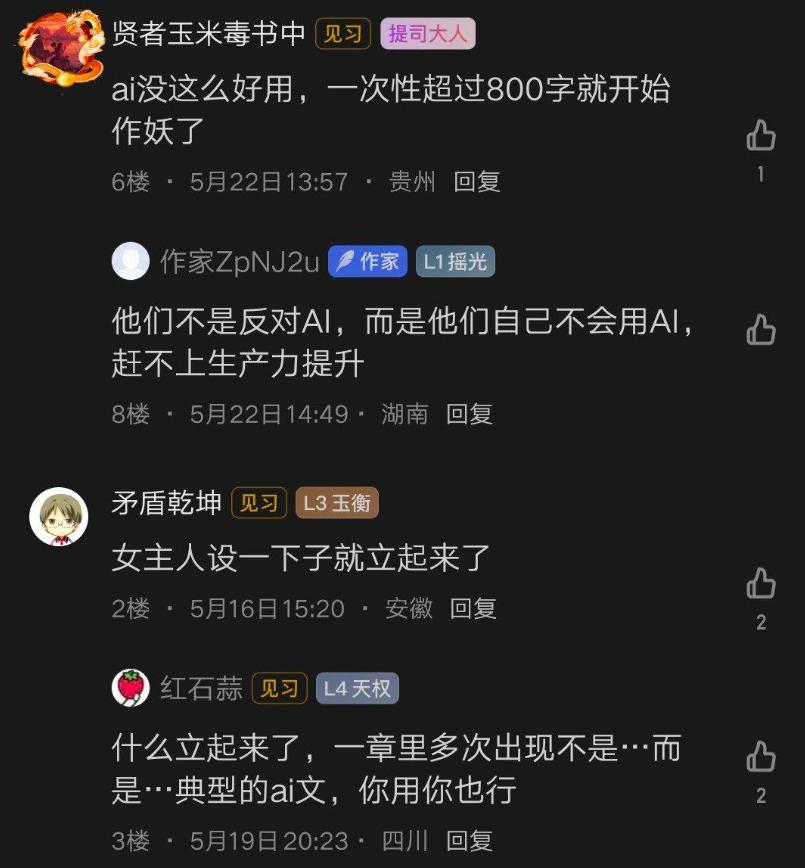
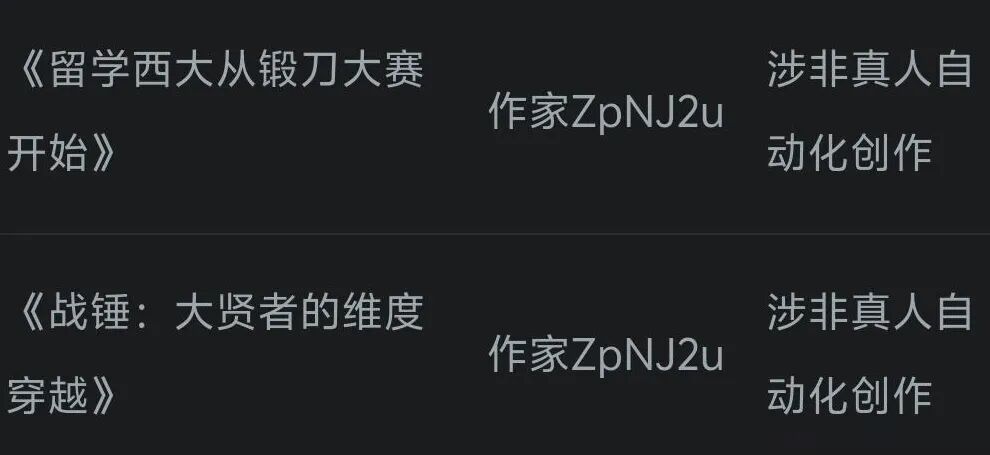
These books that can hardly be called original are rapidly seizing the benefits that once belonged to original creators, and the platform's substantial cash rewards are flowing to the wrong recipients. This is probably the fundamental reason why online literature platforms want to purge AI-generated texts.
Tomato is a vivid example. Tomato used to accept all AI-generated works, and even took the initiative to include a "manuscript selling clause" that required authors to authorize their own works to be fed to AI for training. The consequence was that the Tomato platform was half occupied by low-quality traffic-grabbing works generated in batches by certain studios. The platform's support resources were drained, the traffic of real original authors was almost completely snatched away, and readers were full of complaints.
The anger of Qidian's readers is even more predictable: you want me to pay by the word for something generated by AI?
Suspected AI involvement also affects copyright transactions, which is one of the important monetization methods for online literature authors and is also highly valued by platforms. At the end of July this year, the offer for Nigerian writer Jerry Adedayo Farad's debut novel *Call Me, I'll Hide The Body* was about to exceed 2 million US dollars. Two agents successfully secured six-figure and seven-figure copyright deals in the UK and the US respectively, and the work also attracted interest from film and television adaptation teams.
But overnight, the 2 million US dollar deal went down the drain, because the novel was deemed to be written by AI. Although the writer himself insisted that he wrote the entire novel manually, publishers are now very cautious about novels suspected of being AI-generated.
Every narrative payoff point in online literature can be quickly disassembled by AI
Novel creators (or studios) that produce hit works in batches usually build a workflow that can be automatically replicated in large quantities.
The first step is to disassemble popular hit works. The narrative pleasure brought by online literature can inherently be analyzed in a structured way.
When a complete article is fed to AI for analysis, the AI does not only analyze the choice of words and sentences, but the entire logic of how the story operates. How does the overall design and the situation of the characters attract readers? What does the protagonist pursue, what obstacles does he encounter, and how does he fight back? Is it a golden finger upgrade, or the trope of "pretending to be a weakling to outwit the strong"? Which delayed revelation of information can maximize the sense of suspense?
After disassembling a hit framework, the studio can get several structure tables containing character relationships, plot nodes, emotional returns and chapter functions. By combining these elements in different forms, multiple new story schemes can be generated in batches.
As a long-time paid user of short stories on Zhihu, let me give an example: the character setting can be the main wife of a marquis manor who was betrayed in her past life, a princess betrayed by her son-in-law, or the legitimate daughter of a noble family who trusted villains by mistake; the plot can be the male protagonist's first love, the misplacement of marriage before love, or the misunderstanding of "I love you but I just can't say it out loud"; the narrative payoff points can be hearing other people's inner voices, seeing bullet screen comments, or repeated rebirth. If you randomly combine these three elements, don't you feel that the resulting story feels familiar?
An article published in *Science Advances* argues that generative AI makes stories rated as more creative and better written, and this effect is more obvious among authors with inherently low creativity; but AI-generated stories are too similar to each other.
In other words, generative AI improves the individual creativity of authors at the cost of the loss of collective creativity.
Is it considered AI creation if one only uses AI to polish the text?
Among the online literature works purged by Qidian, many authors said that they only asked AI to help them check for grammatical errors and typos and appropriately polish the text after finishing the manuscript manually. Some penalized authors even posted side-by-side comparisons of their original and polished texts, crying out that they were wronged.
But even with the basis of a human original manuscript, AI polishing may make the writing styles of different authors more similar, even similarly mediocre.
A related study found that after using AI for polishing, the difference in writing complexity decreased by 21% to 50%. This is determined by the underlying logic of generative AI.
The creation logic of most generative AIs is still predicting what content is likely to appear next based on the preceding text, then selecting the option with a higher probability, and continuing this process. In some specific context scenarios, certain expressions are more likely to be selected by large models than others.
Let's take an example that you must be very familiar with:
I want to catch your emotions first. You are not too sensitive, but you have not been truly seen for a long time. Ultimately, what you need may not be an answer, but to allow yourself to stop for a while first.
Is this trope familiar? It is such a classic overused expression.
"Catch emotions" is not an original creation of AI. In some early psychology articles, similar expressions such as "appropriately catch the other person's emotions" were used.
As generative AI included this expression in its corpus, the usage of "catch" began to spread wildly. Now "catch" can refer to not only emotions, but also a person, an event, a scenario, or a problem, everything can be "caught". I can't remember how many articles that are half manually written and half AI-polished I have seen the word "catch" in.
AI polishing seemingly retains the author's original viewpoints and only adjusts the sentences to be smoother, but in essence, it compresses the diverse, imaginative expressions of human beings into several universal, high-probability templates.
The words and sentences we use not only tell stories, but also convey our personal identities, personal opinions, the environment we live in, and the society we are in. Through the language and text we output, we can show our values, and even diagnose and track our mental health status.
When reading literary works, sometimes we are not just reading the work itself, but also getting to know the author's inner spiritual world through the work. After AI polishing, the unique "self" that could have been identified through the text disappears.
Are various logical criteria for AI detection really feasible?
After talking about the rampant AI problem in the online literature industry, let's discuss a common discussion that easily happens in the comment sections of online novels: "Did you write this with AI?"
Nowadays, many people like to post a paragraph of text on the Internet and ask: Does this text have a strong AI flavor? We invite you to take a test too:
After he stood like that for a while, he heard a voice like a temple bell:
"Who is Ru Jinwu to you?"
The voice echoed dully in the temple.
Ru Haikuo looked around, his vision blocked by the light beam, unable to see anything outside the beam.
"He is my father." Ru Haikuo replied.
The voice turned into a laugh like flowing river water, then asked again:
"Is the Plum Blossom Sword behind you?"
"Yes, it is the Plum Blossom Sword."
If you also think this paragraph has a strong AI flavor, then congratulations, you also like analyzing AI and have your own insights.
But unfortunately, this paragraph was written by Yu Hua.
Hehe, you got tricked. A study published in *Nature* played exactly this kind of trick on people.
The researchers selected 10 poets and 1634 participants. Each participant was randomly assigned a poet and read 10 of his poems, 5 of which were created by the poet himself, and the other 5 were imitated and generated by GPT-3.5.
The result showed that the participants' judgment accuracy was only 46.6%, even lower than random guessing. In the "human-like degree ranking" of all poems, the last 5 works were all written by real human authors.
Human AI detection has errors, what about AI detecting AI? Bad news, it is also unreliable.
Common methods of AI detectors detect the predictability of text, that is, "reverse deduce" whether the text is generated by AI; they can also directly train an AI text classifier with human writing samples and samples generated by different models. It is said that Qidian's AI detection tool "Motong" (Ink Pupil) detects "work fingerprints" to find features that do not belong to human narrative layout.
But no matter which method is used, AI will make mistakes, and currently low false positive rate and high detection rate cannot be achieved at the same time. This is why many online literature platforms have long used identification tools, but AI-generated works still exist on the leaderboards.
Whether to "kill all suspects by mistake rather than let one slip through" or turn a blind eye to avoid wrongfully penalizing real human authors, platforms may also be making a difficult choice.
References
[1]https://www.thebookseller.com/news/it-was-inevitable-agents-react-to-major-book-deal-that-collapsed-over-suspected-ai-use?utm_source=chatgpt.com
[2]Porter, B., Machery, E. AI-generated poetry is indistinguishable from human-written poetry and is rated more favorably. Sci Rep 14, 26133 (2024).
[3]https://arxiv.org/html/2502.11266v2?utm_source=chatgpt.com
This article is from the WeChat Official Account "Guokr" (ID: Guokr42), written by Li Xuesen, and authorized for release by 36Kr.