Playing the pity card, provoking online flame wars and stoking public panic, what are these fake staged shoots draining away?
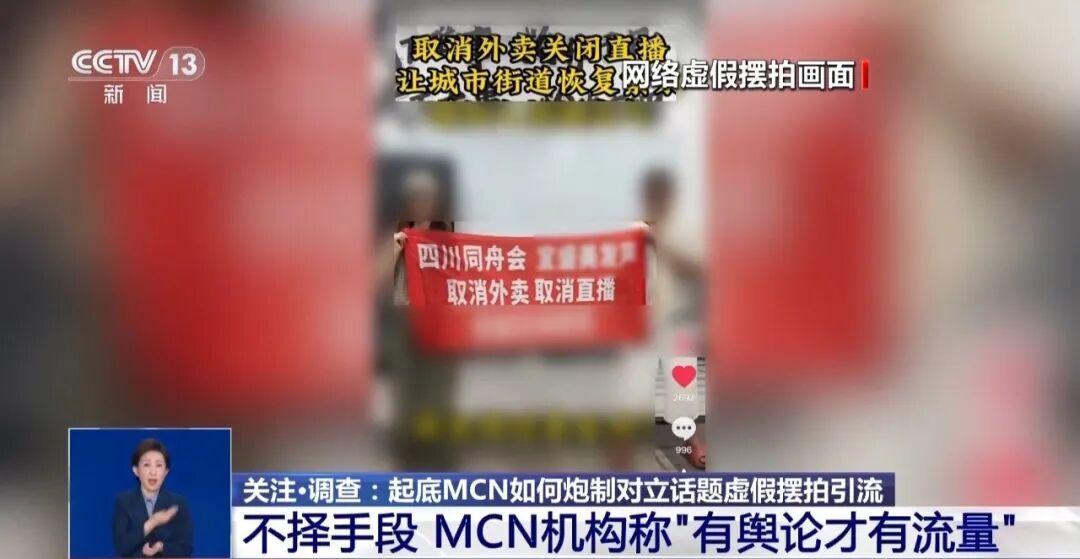
In Yibin, Sichuan Province in July 2026, at the entrance of a beef noodle restaurant, under the "escort" of two shop assistants, the restaurant owner with a black plastic bag over his head squatted on the ground, pointing at the words on a banner:
"Cancel food delivery, shut down live streaming, and restore the prosperity of brick-and-mortar businesses."
Relevant videos soon appeared on the local city page of short video platforms, attracting more than 20,000 comments in just a few days.
If you only come across one such video, you may take it as an emotional expression from catering merchants. However, right after that, another restaurant also in Yibin released a short video following the exact same template; then came a food stall restaurant, a clothing store...
When identical plots and similar copywriting appear in batches, the situation is far from that simple.
A business built entirely on fabrication
From November 10 to 13, CCTV News launched a series of investigative reports. Reporters followed the clues to find the noodle restaurant in Yibin, and found that its food delivery business was operating as usual. As for other restaurants and dining establishments, some did not remove their food delivery services at all, and some had never even launched food delivery services before.
This is not recording reality, but fabricating reality. Those stories of "canceling food delivery" are performances from start to finish, and those seemingly crude scenes are precisely carefully designed stories.
On the other end of the story is an MCN agency that knows well that "emotion equals traffic": Sichuan Tongzhouhui.
In CCTV's investigative report, it is this "Sichuan Tongzhouhui" that participated in the planning of the "cancel food delivery" short videos. They promised catering merchants that they could get the maximum traffic with the least time and the least money spent by the owner. For a monthly fee of 3,800 yuan, they would shoot 15 videos for the merchants and take charge of all planning, content creation and editing.
In the highly competitive catering industry, many merchants face considerable customer acquisition pressure and traffic anxiety, which makes operators believe that spending a small sum of money on a series of hit videos can bring back a large amount of local city traffic and convert it into their own customer base.
As a result, catering operators selectively ignore the falsity of the content, cooperate with the MCN agency to appear on camera, and use simple, crude and low-quality videos to create a sense of authenticity of amateur shooting.
The "cancel food delivery" plan is a universal template that the MCN agency has tested to be effective, which once aroused strong public opinion responses and thus gained massive traffic. This is exactly why those identical plots and similar copywriting appear in batches.
On the side of MCN agencies, they call this business "violent account growth". It is a business entirely built on fabrication, a business that only pursues gimmicks, and even a business that creates conflicts.
In a case uncovered by media investigation, a customer came to a catering store, called the waiter over after finishing the meal, and said directly to the other party:
"To be honest with you, I am a V8 customer, what are you going to do to compensate me?"
This video plot of "threatening merchants with bad reviews to get free meals" is also widely spread. In the video, the customer is aggressive while the merchant swallows the insult. Different cities and different accounts have similar plots - this is not a real dispute. Just like the "cancel food delivery" story, all the conflicts appearing in short videos are planned by the agency, and those "customers" are often played by the catering store operators themselves.
Apart from merchants, delivery riders are another role that is repeatedly used.
In Jiaozuo, Henan Province, since the beginning of this year, Jing and Kang have written, directed and acted in plots such as "I deliver food with my child in Henan" and "Single mother delivers food", to win social sympathy by rendering the hardships of life and emotional depression.
This kind of emotional teasing aroused public empathy. The two accounts they operated released more than 90 false videos in total, with the total number of reposts, comments and likes exceeding 10 million. However, all the traffic obtained by defrauding goodwill flows to another direction - traffic diversion for monetization and platform rebates.
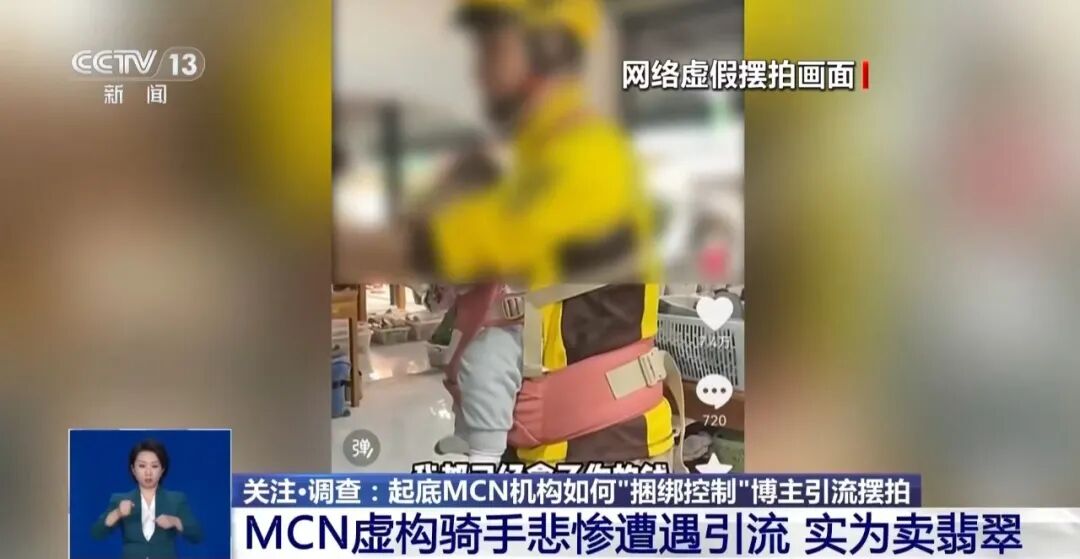
On the short video platform, an account named "Guizhou Xiaohong 6868" also posted videos of delivering food with a baby on the back for a long time. But after accumulating a certain number of fans, this account opened a merchandise showcase for sales and held regular live broadcasts.
This behavior track eventually made netizens full of doubts. After contacting the Meituan platform, the truth finally came to light - "Xiaohong" registered as a crowdsourced rider on the platform on March 23 this year. In the following 90+ days, he was online for only 5 days, completed a total of 19 orders, with an average of 2 orders per day and an average of 1 hour of delivery time per day.
The hard work in wind and rain shown in those videos does not match the actual number of orders at all, which is also a story of "trading traffic for benefits".
Under the operation of agencies, similar "sentimental drama series" have almost been pushed to the extreme of plot design.
The account "Juanzi Grateful for You" successively released stories such as "Daughter separated for 28 years delivers food while pregnant" and "Wife delivers food while pregnant after husband sacrificed for courageous act of justice"; "Hong Kong Haonan Positive Energy Life Record" released the story of "Boss takes in a food delivery girl"...
These extreme sentimental life experiences and family tragedies that can only be seen in storybooks, after being bound to the identity of delivery riders, create a continuous personal setting - this is a person worthy of sympathy, worthy of everyone's mutual help.
No matter it is "removing food delivery services", "sentimental delivery riders", "group conflicts" or "food delivery hygiene", the dense emergence of these cases all points to the same business logic: make up fake stories based on real public concerns, use fake stories to defraud attention, and then convert attention into income.
In this model, the account matrix is not only a communication channel, but also a tool for undertaking commercial conversion. Toxic traffic helps fraudsters become beneficiaries, but its harm is far more serious than we imagined.
The bill left to the society
Walter Lippmann, the founder of communication studies, put forward a theory in his book Public Opinion:
"When our views involve spaces, times and things beyond the scope of our direct observation, we have to piece them together based on the statements of others and our own imagination."
In China, this theory is expressed more concisely: When a lie is repeated many times, it will be taken as the truth.
The real harm of "account-making groups" and "toxic traffic" lies in that they use real offline merchants as actors, use the real occupation of delivery riders as roles, use real operating stores as scenes, and deliberately distribute the content on the local pages of short video platforms.
Many netizens who have come across such videos have seen these merchants and stores in real life, and are familiar with the riders who shuttle through buildings and communities day after day. It is easy for them to take the plots designed by "account-making groups" as real situations, and piece together fragmented information into complete events.
When these "real events" happen again and again and are seen again and again, the effect of "three men spreading rumors that a tiger is in the market" appears.
When artificially fabricated information affects the judgment of the public, content fraud begins to inject "toxin" into the trust of the real society in batches.
As the originator of this "poisoning", the profits of this "business" go to the fraudsters, but the whole public of the society pays the bill.
The most direct bill comes from hostility, which is counted on the heads of grassroots workers.
On the short video platform, the Liu Youlong gang, under the banner of veterans, fabricated false personal settings, took a large number of staged videos of conflicts between riders and security guards, attracted fans by creating confrontation, and then sold courses for profit.
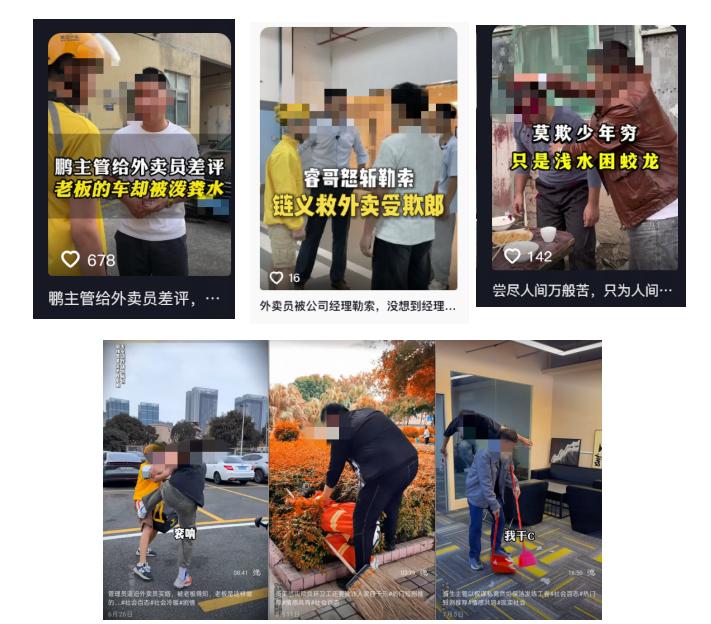
Anger is the easiest emotion to ignite and the easiest to harvest - the public brings the emotion in the videos back to real-life interactions: they presuppose malice towards delivery riders in work uniforms, security guards at community gates, and merchants in stores. Although there are not so many conflicts in reality, under the repeated rendering of these videos, the whole society is unconsciously shrouded in hostility.
The more expensive bill comes from panic, which is counted on the head of the entire industry.
Three people in Hunan, in order to attract traffic, planned and shot the false video of "delivery rider spitting into food", which directly hit the bottom line of food safety; some people spread rumors that riders re-boxed and delivered noodles that had fallen on the ground.
The cost of shooting a video of "delivery rider spitting into food" is almost zero: a work uniform, a mobile phone, and an extra who dares to act. But what it shakes is the trust of 545 million people in a meal. For people who make accounts, this is just a round of fan growth; for the industry with 80 million orders per day, this is a piece chiseled at zero cost on the basic plate of a trillion-yuan market.
What is more tricky is that there is no undo button for panic - although the three people in Hunan were detained in accordance with the law, the spread radius of clarification can never catch up with rumors.
The most expensive bill comes from goodwill, which is counted on those who are really in need of help and the whole public of the society.
Sentimental drama series are staged repeatedly and proved false again and again - today it is the "daughter separated for 28 years", tomorrow it is the "husband sacrificed for courageous act of justice". The audience's tears are harvested again and again, and they find themselves cheated again and again. Sympathy cannot be withdrawn repeatedly - the more times you withdraw, the less quota is left for real people asking for help. When workers who are really in difficulties ask for help, the first reaction they face is likely to be "it's just another performance".
This bill does not appear in any financial statement, but it is truly counted on the heads of people who have no ability to perform: they do not understand scripts, but they have to pay for the scripts.
The superposition of the three bills brings deeper loss: normal bad reviews are suspected to be extortion; real complaints are suspected to be hype; helpless pleas for help are suspected to be fraud. When every frame of picture needs to be verified for authenticity first, the trust cost between social groups is raised infinitely - this is the real payer of this business.
What false staged videos are hunting for is not only public emotion, but also real economy.
At present, China's domestic food delivery catering industry is associated with more than 10 million delivery riders, hundreds of millions of food delivery users, tens of millions of merchants, and a huge consumer market of trillion-yuan scale.
This means that the food delivery catering sector has long been an important part of China's economy, and every lie fabricated around it is essentially an infringement on the industrial foundation.
After the catering industry, it may be pharmacies, supermarkets, vegetable markets, and thousands of various business forms integrated into the social body. When real occupations and stores can be arbitrarily used as props, and public emotion can be arbitrarily exploited as traffic, the next physical industry to be infringed by "toxic traffic" is likely to be every unexpected one.
Governance should be traced to the end
Countless fraudsters are not completely unscrupulous, and the most powerful weapon is the crackdown from law enforcement agencies.
With the dense emergence and fermentation of false staged videos, the scale of penalties is gradually becoming denser.
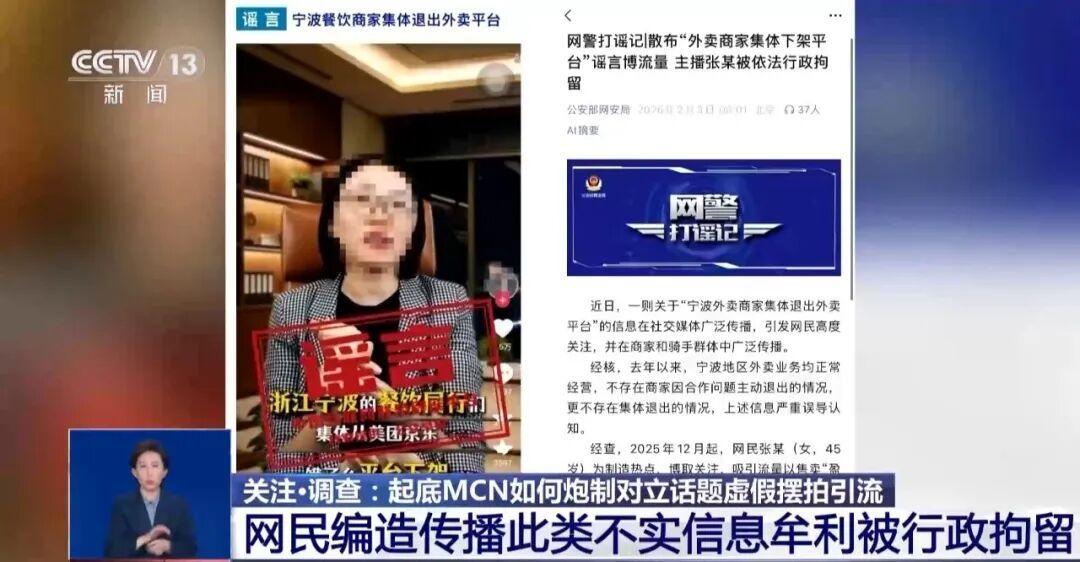
Zhang, a live streamer who fabricated and spread false information such as "Ningbo food delivery merchants collectively removed services from the platform" since December 2025, and took the opportunity to sell "profit growth classes" and "chain MBA classes" for profit, has been lawfully detained.
The three people in Hunan who planned and shot the video of "delivery rider spitting into food" were lawfully detained; Liu Youlong, who pretended to be a veteran and fabricated videos of conflicts between riders and security guards for profit, has been lawfully taken compulsory measures.
The Cyberspace Administration of China has suspended or closed multiple accounts that fabricated content about delivery riders, such as "Juanzi Grateful for You", "Guizhou Xiaohong 6868" and "Dongfang Mingzhu".
In the first half of 2026 alone, cyberspace administration departments urged websites and platforms to conduct in-depth self-inspection and self-correction, and lawfully disposed of more than 98,000 "self-media" accounts in accordance with regulations for violating content such as staged videos of delivery riders being discriminated against and conflicts between mothers-in-law and daughters-in-law. As the party responsible for clue verification and evidence fixation, Meituan has cooperated with public security, cyberspace and other departments to crack down on and investigate more than 50 relevant cases since 2024.
Deletion, account banning, public notification, administrative detention, criminal detention... From these penalties, we can see that there is no lack of tools in the law enforcement toolbox, from content to accounts to individuals.
But we also need to face up to a problem: No matter how dense the penalties are, they only apply to individual cases.
Banning accounts can block one account, but it cannot block the whole business. Account-making groups calculate an account: the profit of one hit video is far greater than the cost of one penalty. As long as the chain of "making up stories - defrauding traffic - monetization" can still run, after the penalty is implemented, they can change a script, change a batch of accounts, change an industry, and the business will still open as usual.
This is exactly the question raised by some media in their investigations: After false staged videos earn traffic, how can we just ban the accounts and call it a day?
The answer to solving the problem lies in the whole industrial chain. The key of the staged video business is never the dozens of seconds of video in front of the camera, but the division of labor behind the camera - who supplies the scripts, who organizes the distribution, and who undertakes the monetization. If governance only plays "whack-a-mole" targeting videos and accounts, what is knocked down is only the output port at the very end of the chain; to make it difficult for this business to make profits repeatedly, we have to trace upstream along the chain.
For short video platforms, it is very easy to find out these clues.
Identical content, similar copywriting, highly consistent naming of account matrix, the exact same voiceover of "I personally remove services from the food delivery platform with real-name authentication", appearing in batches on the local city pages of dozens of cities - these traces mean that the technical threshold for identification is not high. It only needs to check along the same content, related accounts and common diversion entrances. After confirming the violation, what is dealt with is not just a video or an account, but the illegal monetization