IDG bought it
Recently, Shiseido announced that it will transfer 100% equity of Shiseido Liyuan Cosmetics Co., Ltd. (abbreviated as: Shiseido Liyuan), the operating entity of AUPRES, to an investment consortium led by IDG Capital. The transaction covers the AUPRES brand, the Beijing factory and all production equipment.
This was a landmark Sino-Japanese beauty joint venture in the 1990s, which incubated the local brand AUPRES tailored for Chinese skin, and was once the segment with the strongest overseas performance in the Shiseido Group. In September this year, along with the equity change, Shiseido Liyuan was converted from a joint venture to a wholly-owned subsidiary of Shiseido.
Just two months later, AUPRES officially bid farewell to the Shiseido era and welcomed IDG Capital as its new owner.
IDG Leads the Acquisition of the National Cosmetics Brand
The story of AUPRES is a long epitome of China's beauty market.
In 1991, Shiseido and Beijing Liyuan jointly established Shiseido Liyuan, which was also the first Sino-Japanese cosmetics joint venture in China. In January 1994, AUPRES, developed exclusively for Chinese consumers, opened its first counter at Beijing Wangfujing Department Store, and its revenue exceeded 20 million yuan in that year.
The following more than ten years were the golden age of AUPRES. It was the most stable era for offline beauty retail, where counters, beauty consultants and a unified price system formed a moat. AUPRES, together with OLAY and L'Oréal Paris, was called the "Three Ou" in the industry, with counters spread across major shopping malls nationwide. At its peak, its annual sales once approached 3 billion yuan, making it one of the star brands in China's skincare market.
In 2008, AUPRES completed the independent brand upgrade, removed the Shiseido logo from its products and promotions, and signed celebrity spokespersons. In a sense, it not only operated a brand, but also incubated the first generation of operation methodologies for China's beauty industry.
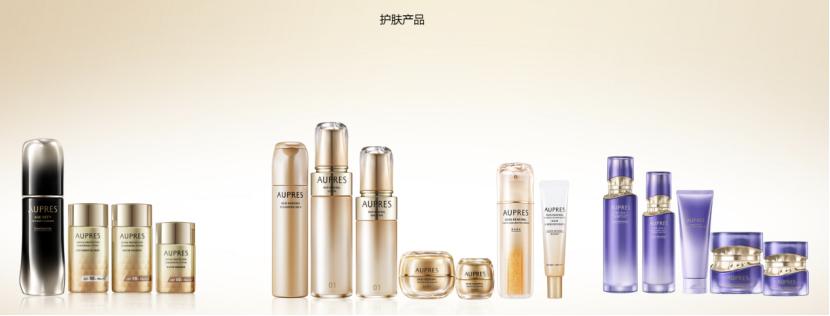
Image source: AUPRES official website
The turning point came with the change of channels. With the rise of e-commerce, the continuous shrinkage of department stores, and the successive rise of emerging domestic brands and efficacy skincare brands, the competition in the beauty track has become crowded. The counter, which used to be AUPRES's long-term advantage, later became a burden. The company's fundamentals continued to be under pressure, with revenue shrinking year by year and falling into losses.
In the whole year of 2025, Shiseido Liyuan achieved an operating revenue of 869 million yuan, with a net loss of 41.337 million yuan; in the first five months of 2026, its revenue shrank to 234 million yuan, and the net loss expanded to 53.4152 million yuan — it lost as much in five months as the whole of the previous year.
In August this year, Shiseido (China) took over 35% of the equity held by Beijing Liyuan for 199.5 million yuan, and completed the wholly-owned holding on September 1. However, just over two months later, this company that had just been reclaimed full ownership was put up for sale as a whole — from Sino-Japanese joint venture, wholly-owned by the Japanese side, to complete withdrawal, Shiseido Liyuan completed three identity switches within five months.
Now, the consortium led by IDG Capital has taken over. The announcement discloses that the consortium consists of three parties: two special purpose vehicles invested and established by funds managed by IDG Capital hold a total of 95% of the shares, and an external management partnership established by the new management team of Shiseido Liyuan holds the remaining 5%.
Shiseido said that IDG has rich investment experience and professional knowledge in the consumer goods sector, and it believes that under its leadership, it will be able to better respond to the changing needs of Chinese consumers and provide better services for consumers and business partners. At this point, this old brand that carries the beauty memories of a generation of Chinese people has turned a new page.
Consumer M&A Boom
This is a highly contrasting scene at present: the consumer investment atmosphere is sluggish, but a series of super deals have emerged one after another.
Looking back at this year, consumer mergers and acquisitions have blossomed in multiple areas:
In January, Anta announced the acquisition of 29.06% of PUMA's shares for about 12 billion yuan;
In February, CPE Yuanfeng completed the delivery of the acquisition of 83% of Burger King China's shares;
In March, Dazheng Capital took over the global store operation rights of Blue Bottle Coffee;
In April, the equity delivery between Starbucks and Boyu Investment was officially implemented, and the joint venture began to operate;
In June, the controlling acquisition of Golden Goose by HSG was fully completed;
In July, CPE Yuanfeng acquired Mammut, the rival of Arc'teryx;
In August, Yum China spent 1.2 billion US dollars to buy the ownership of the Pizza Hut brand in Chinese mainland.
In addition, CITIC Capital acquired the two cultural tourism projects *Only Henan·Drama Fantasy City* and *Zhengzhou Movie Town* for 3 billion yuan; CPE Yuanfeng will acquire 81% of the equity of A.O. Smith's China business; DCP Capital is reported to spend more than 13 billion yuan to acquire Jinhua, the national "ham king".
From fast food and coffee to outdoor sports, a number of legendary brands familiar to consumers around the world have quietly changed ownership to Chinese operators.
This is no accident.
At present, global consumer brands are ushering in a round of asset revaluation. On the one hand, many brands laid out by European and American private equities in the early years have successively reached the exit cycle; on the other hand, many multinational groups are also actively sorting out their businesses, divesting non-core sectors and recovering funds. In this scenario, the Chinese market is still the growth position with the most imagination, and a number of PEs are flocking in.
Sorting out this round of consumer M&A, we can find that Chinese PEs are no longer satisfied with minority equity investment, but seek controlling stake to hold the decision-making power of localization in their own hands; at the operation level, they have respectively demonstrated differentiated integration capabilities — some rely on mature experience in multi-brand operation, some rely on global channels and supply chain networks, and others directly bring operation teams to the front line.
"It is the right time to do M&A in China now," Wu Keyao, partner of PAG, once said bluntly at the Zero2IPO Annual Meeting, "The Chinese economy has reached a considerable volume, which means a large number of M&A opportunities are emerging, and at the same time, there is a window period for the inheritance of some entrepreneurs."
Cycle Rotation
This scene is thought-provoking.
Looking back at the past two years, the balance of the primary market has obviously tilted towards technology: hard technology tracks such as AI have almost absorbed the vast majority of large-scale financing, while consumer investment has cooled down visibly, and once reached the point where no one cared about it.
But for smart money, this is precisely the window to pick up assets in a contrarian way. Amid the noise, part of the capital began to look for directions that can hedge against fluctuations, and those assets with brand memory, cash flow and supply chain foundation have re-entered the field of vision.
A consumer investor once talked about his judgment — the prosperity of consumer M&A often does not occur when the consumer track is the hottest, but more appears at the stage when the technology narrative is the most crowded, the most expensive, and the most disturbing. It is also when capital sentiment is at its lowest that consumer brands will be favored again.
Shan Weijian, head of PAG, also said in an interview this year: "There are two different opportunities in the market — venture capital invests in high-tech, and the biggest opportunity for M&A investors lies in the consumer sector."
The logic behind it is actually very simple: the consumer industry has always been regarded as a rigid, anti-cyclical industry. When the economy fluctuates, demand will shrink, but will not disappear; on the contrary, in times of uncertainty, brands and cash flow appear more manageable.
Of course, the rising tide does not mean easy success. There is a consensus in the M&A circle: spending money to buy is only the first step, and the integration and operation after the acquisition is the real touchstone.
It took McDonald's China nearly ten years to expand from 2,500 stores to more than 8,000 stores; after RT-Mart was controlled by DCP Capital, it closed inefficient stores and turned losses into profits, which did not rely on a single transaction. After the brand changes ownership, how to rebuild channels, how to maintain the price system, and how to motivate the management team are all the most realistic tests.
The cycle goes back and forth. When the sentiment of hard technology begins to fluctuate, the next big deal in the consumer sector may be coming soon.
This article is from the WeChat official account "Pedaily" (ID: pedaily2012), written by Zhou Jiali, and authorized for release by 36Kr.