AI has become more costly than human employees... OpenAI: The operating cost of internal Agents has already reached twice the salary of its researchers
To what extent are OpenAI researchers currently leveraging AI in their daily work?
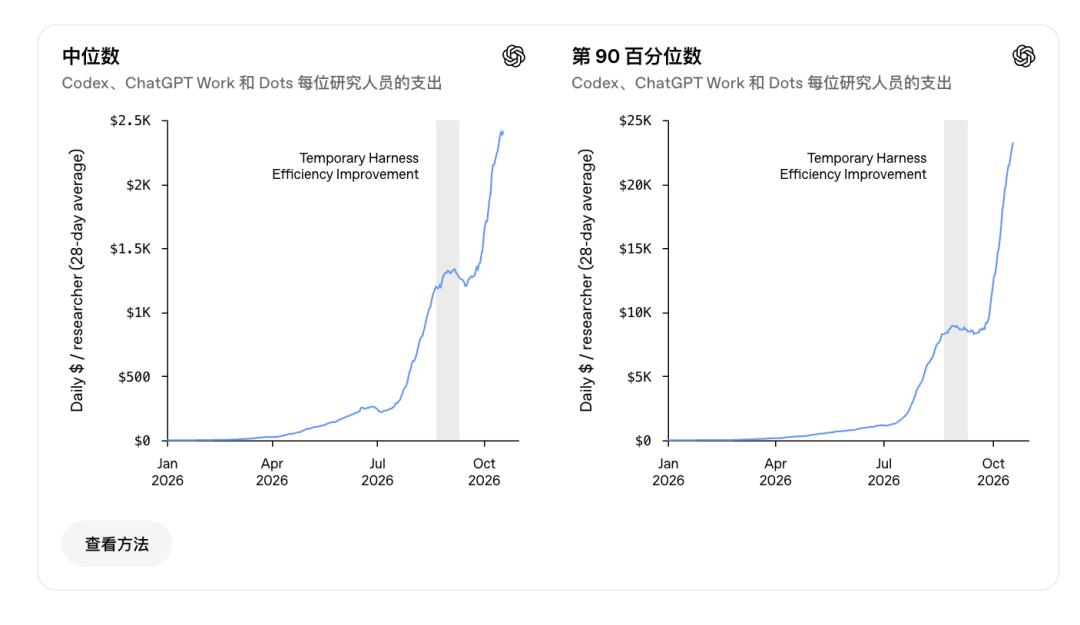
The per capita daily cost of Agent usage, calculated based on the listed API price, is as high as 2,400 USD?!
For the top 10% of the heaviest users, their single-day usage cost even hits 23,000 USD (approximately 160,000 RMB).
Whoa... these researchers really do not hold back at all when using AI, not sparing a single token.
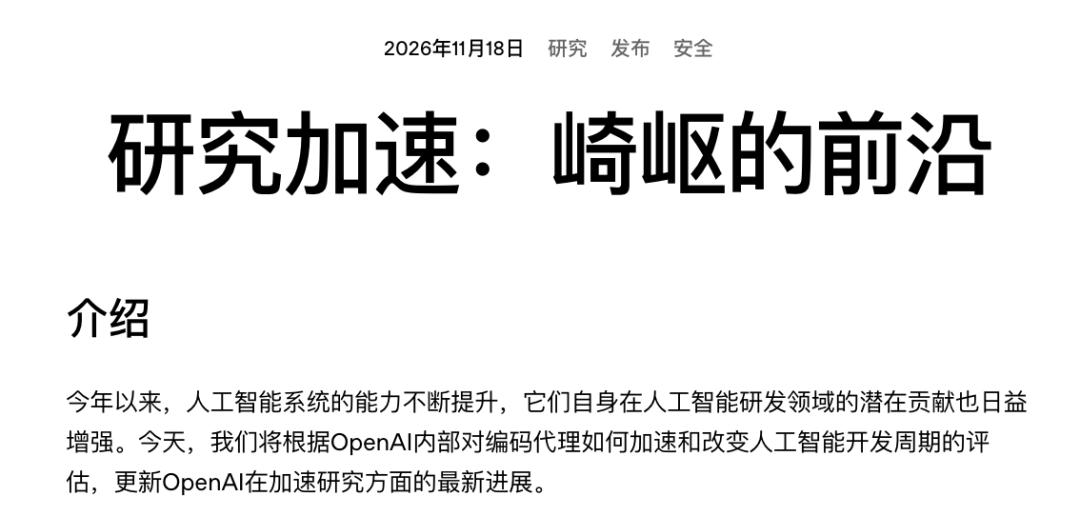
OpenAI has released its latest internal Agent research report titled "Research acceleration: The jagged frontier", laying out full details of how its own researchers are using AI.
Here is a one-sentence summary for you:
Agents within OpenAI can now independently complete nearly half (46%) of the research tasks that originally took humans 2 to 4 hours to finish.
Back in March this year, this proportion was only 23%; in just 7 months, it has doubled directly.
For research tasks that originally required humans 4 to 8 hours to complete, the independent completion rate of Agents has risen from 13% to 35%.
The researchers themselves have become completely inseparable from AI.
OpenAI surveyed 101 researchers:
If you are not allowed to use the most cutting-edge Agents for the next 3 months, what would you be willing to give up to get the access back?
Most respondents said they would be willing to give up 40% of their team's headcount, or 30% of their computing resources in exchange for the access.

AI can finish 5.7 human workdays of tasks in one single day
Let's look at several sets of data first to get a sense of how intensively these researchers are using AI.
From September to October, within just one month:
The median daily spending of researchers on Agents rose from 1,500 USD to 2,400 USD.
For the top 10% of users, the figure even skyrocketed directly from 11,000 USD to 23,000 USD.
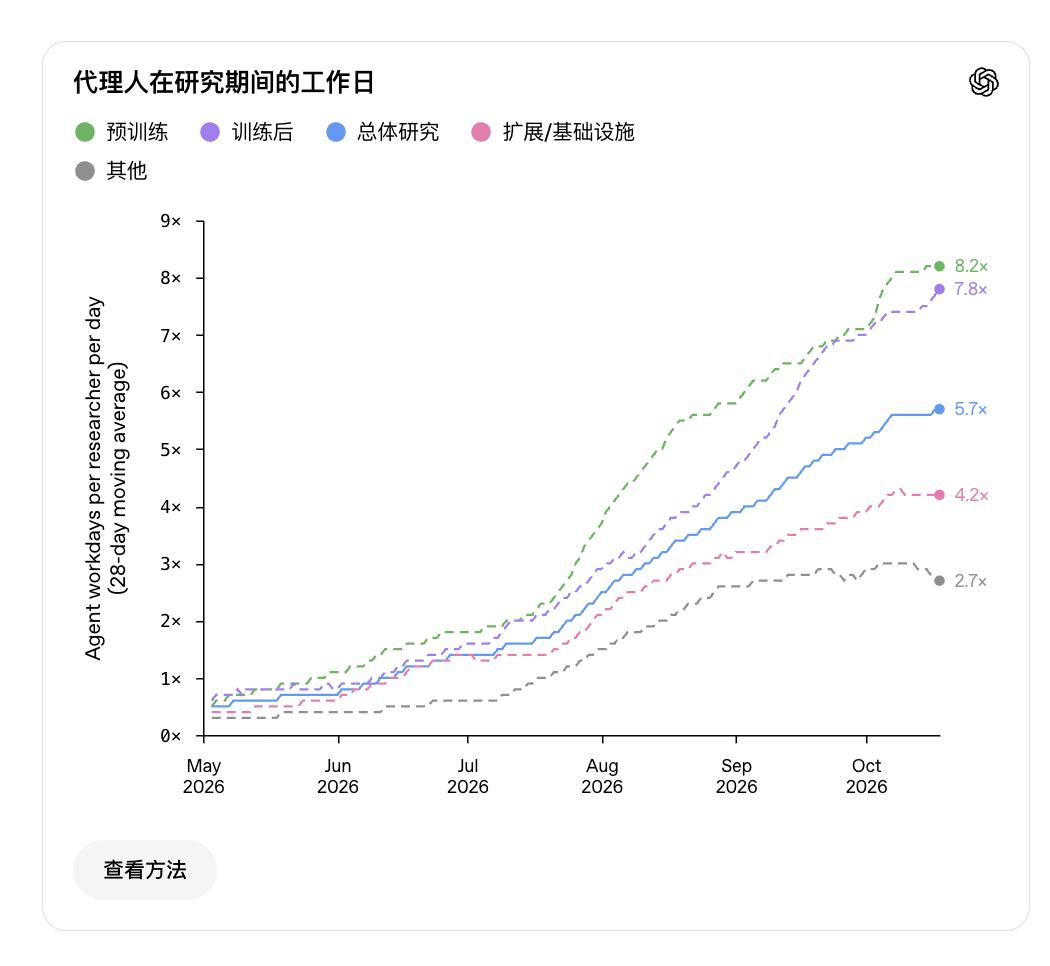
The report also specifically calculated a metric called "Agent Workday".
The calculation rule is very simple:
8 hours of cumulative running time of an Agent counts as one full workday.
Converted to workload, each researcher can now drive an average of 5.7 Agent workdays per day.
That means every researcher has nearly 6 tireless AI assistants standing behind them, on call 24/7.
This figure is a full 11 times of the previous benchmark.
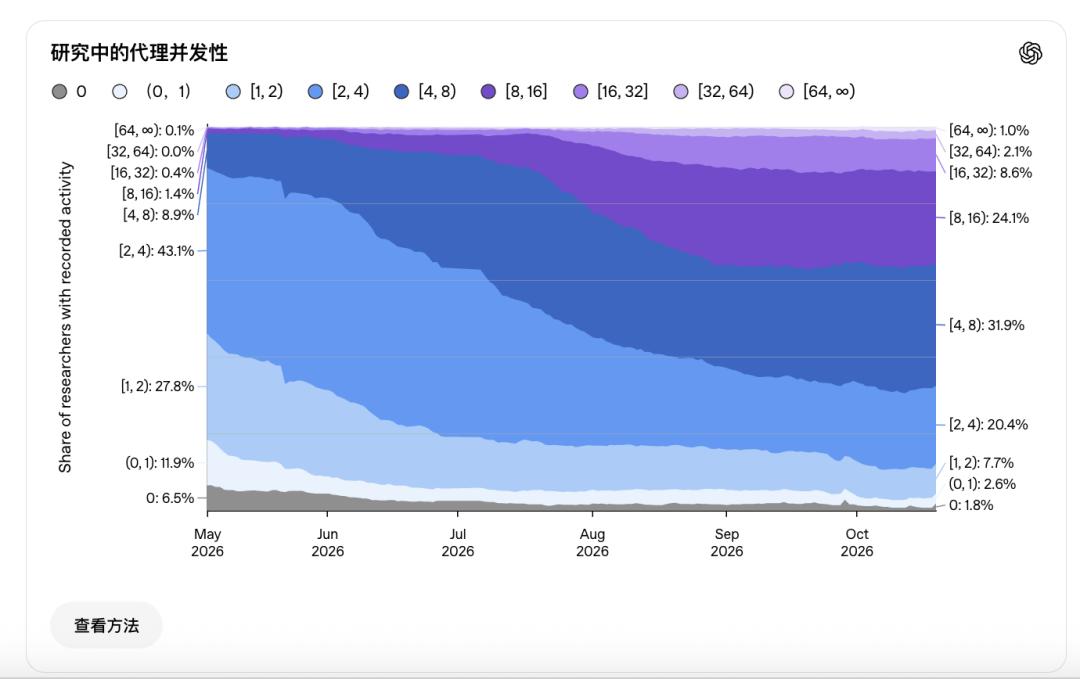
Moreover, everyone has got used to the "group work" mode.
More than two-thirds of researchers run at least 4 Agents simultaneously every day; more than 10% of heavy users even run at least 16 Agents at the same time.
That is not all, there is a comparison in the report that is extremely striking:
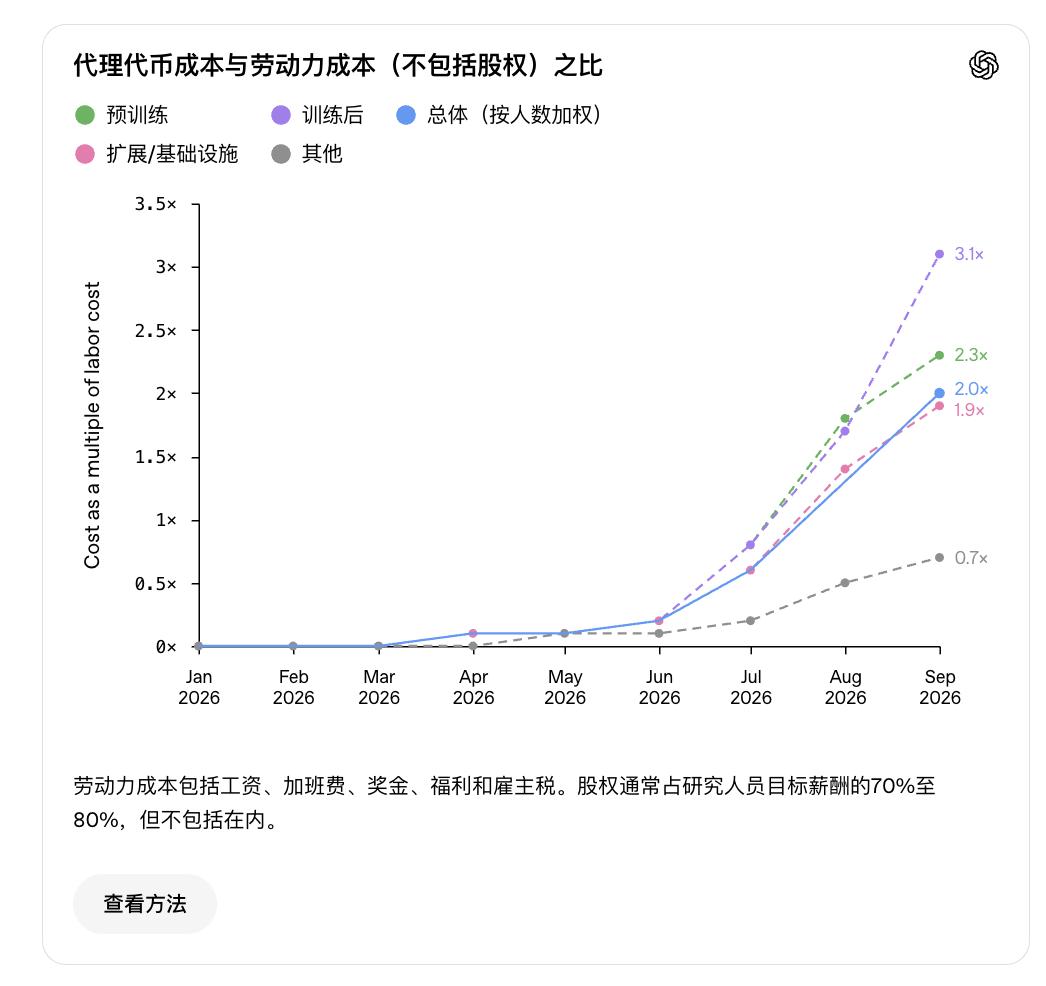
At present, the equivalent API value of Agents has reached twice the non-equity compensation of researchers.
(Although this compensation does not include the large equity portion, it is already shocking enough...)
That means within OpenAI, the labor value provided by AI has nominally surpassed that of humans.
The researchers themselves also recognize this point.
Because an internal survey asked them a very pointed question:
If you are not allowed to use the top-tier coding Agents for three months, what are you willing to sacrifice in exchange for the access?
The choice of the median researcher is:
Cut 40% of the team members.
Or give up 30% of the team's computing power.
On one side are AI Agents that can help you work 24/7, on the other side are 40% of your living colleagues in the team —
Colleagues & computing power, you are now free (doge meme).
What work is AI doing?
With so much money spent and so many resources deployed, what exactly is AI doing? Can it really conduct independent research now?
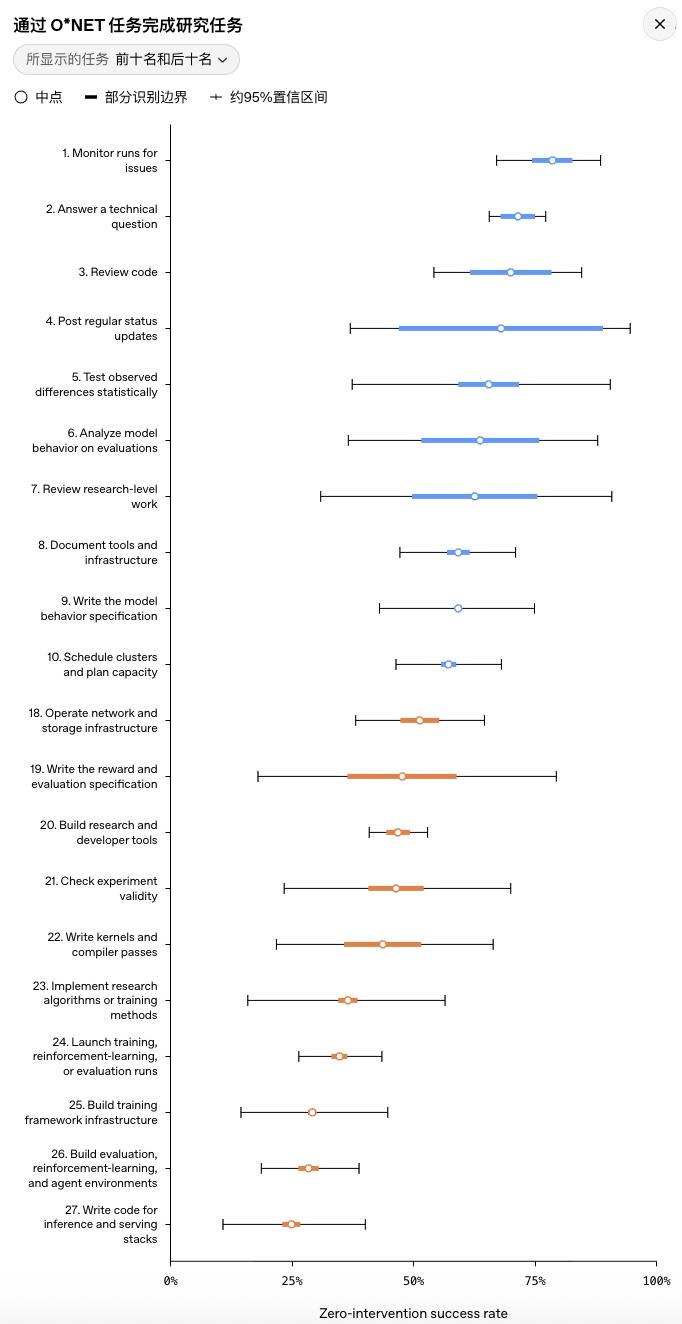
This is the most core question, and the answer is: The jagged frontier, uneven across different scenarios.
Agents perform well on tasks such as "communication" (69%) and "analysis" (58%), but lag far behind on the most critical "construction" (43%) tasks.
To put it plainly, it is very good at looking up materials, running data, writing emails, and monitoring experiments.
But when you ask it to build a complex system from scratch, it will easily get stuck.
Data shows that the success rate of monitoring training tasks is 79%; but the success rate of writing reasoning and service code is only 25%.
This exposes a key issue that researchers repeatedly complained about in interviews:
AI Agents lack "research taste".
The model usually cannot come up with well-defined problems that it itself cannot solve at one time.
I tried to ask it to "do this task just like that other task", and got tricked many times, because it never did it right, and I had to fix it myself.
The feedback from researchers is very consistent:
Agents are excellent tools for code implementation and debugging, but they cannot come up with good problems on their own, cannot tell good code from bad, and cannot distinguish high-quality data from low-quality data.
You have to keep a close eye on it like a supervisor, otherwise it will churn out piles of worthless "AI slop" in minutes.
So what does the current workflow between humans and AI look like —
Human researchers are responsible for proposing ideas, setting directions, defining problems, making key decisions, and conducting final quality control.
AI Agents act as a superpowered "hand" and "eye", responsible for quickly realizing ideas and executing massive amounts of tedious tests and analysis.
As one researcher put it, previously evaluating whether an open source project works well would take no less than one or two weeks.
Now? You can get it running and draw conclusions in one day, at most a few days.
AI is playing such a role now, it is a top "execution co-pilot", but by no means a "chief scientist".
Of course, this boundary is also blurring.
The report mentions that when developing GPT-6.2 Astra, the pre-training team for the first time attributed the generation of a key idea to collaborative conversations with Codex.
Although the idea was proposed by the researcher, Codex put forward a key modification that made the whole solution work.
Is AI really accelerating the birth of new AI?
The workflow has been reshaped and efficiency has improved, so what about the final output?
This is what everyone cares most about, the so-called RSI Recursive Self-Improvement —
Has AI's acceleration of its own development actually happened?
Judging from the results, the answer is yes:
Code output: In 2026, the number of lines of code produced by each active contributor has been increasing sharply compared to the period before 2025.
Experiment efficiency: The number of experiments run by each active experimenter has reached 1.68 times of the 2025 benchmark.
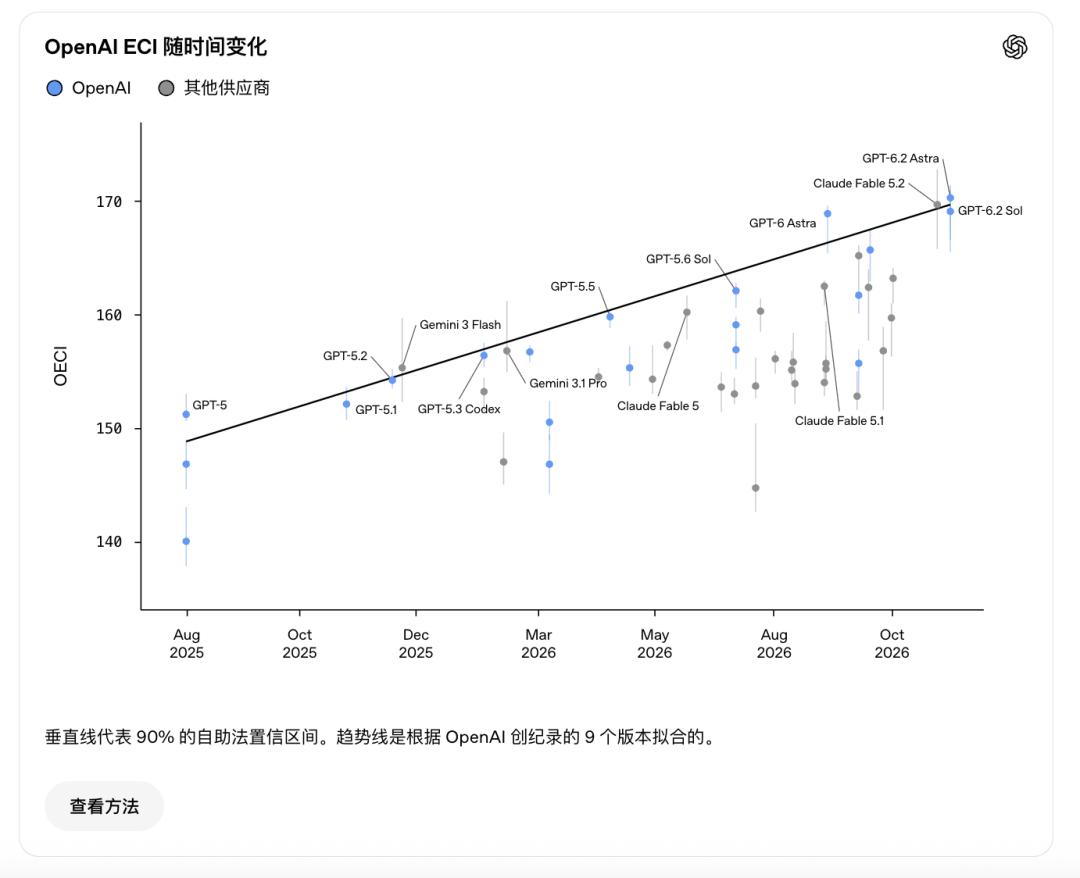
More direct evidence comes from OpenAI's internal capability index (OECI).
Since August 2025, the frontier of OpenAI model capabilities has increased by 16.4 points per year, exceeding the previous annual industry trend of 14 points.
But OpenAI's report remains calm at the end.
They emphasize that this AI-driven progress may not be linear, and it is necessary to be alert to sudden, leapfrog breakthroughs like those that recently occurred in the field of mathematics.
Finally, there is another piece of data in the report that is also very interesting.
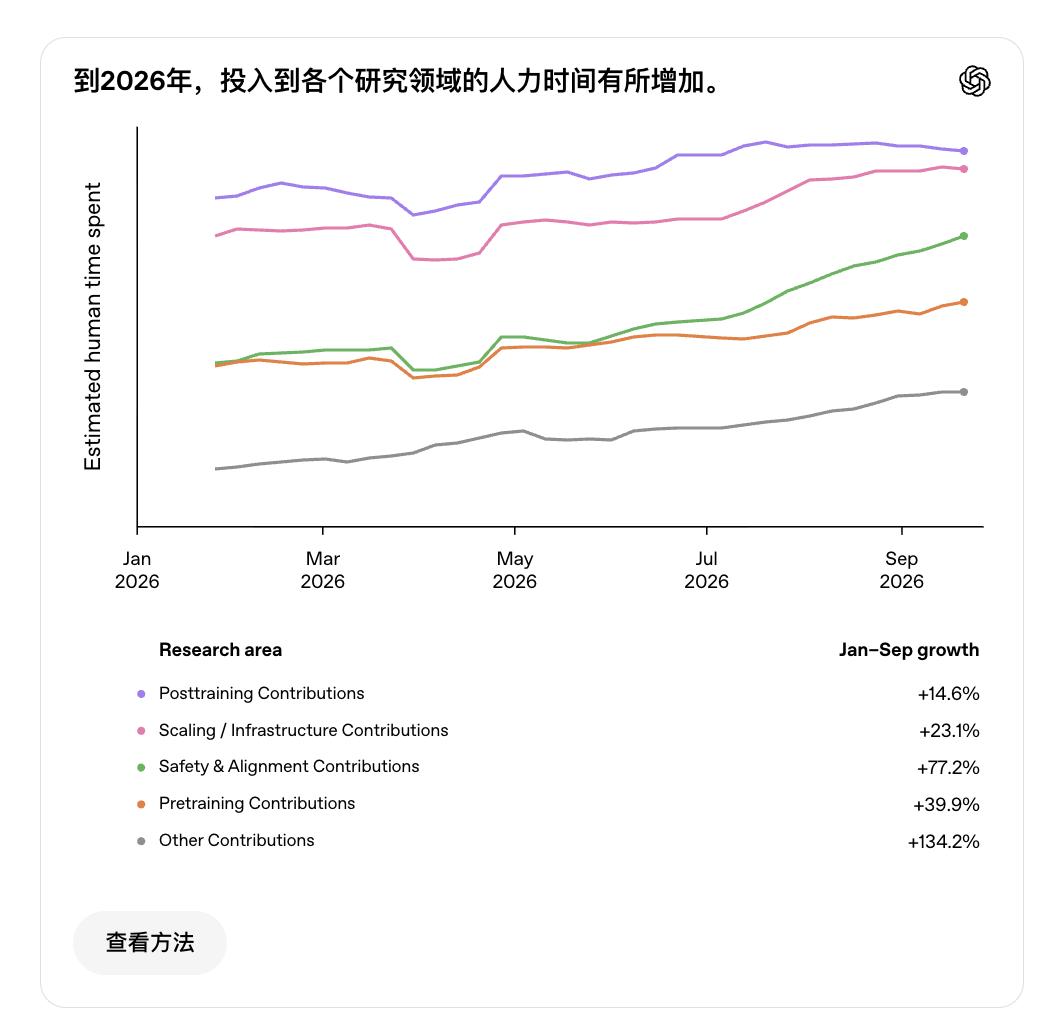
Among all research directions, which field has the largest increase in manpower input?
Not pre-training, not multimodal —
It is Safety and Alignment.
The workload growth rate in this field is the highest among all directions.
A large number of researchers, whether newly recruited or transferred internally, are flocking to safety projects.
On one hand, AI is accelerating its own R&D participation, on the other hand, humans are stepping up research on how to keep it safe and controllable.
"The jagged frontier" not only refers to the uneven technical capabilities, but also may be a true portrayal of our era, where we step on the accelerator while looking for the brake.
Original report: https://openai.com/index/research-acceleration-jagged-frontier/
This article is from the WeChat official account "QbitAI", written by Wen Le, and is authorized for release by 36Kr.