GPT-6.2 devised a brand-new proof method on its own, and secured the first proof of a top-journal theorem dating back 20 years in just 94 minutes.
Just now, third-party evaluation agency Vals AI released the latest leaderboard of Autoform-Hard, a highly challenging mathematical benchmark.
56 doctoral and scientific research level difficult mathematical problems, previously 10 cutting-edge large models were tested, and the result was none of them could solve even one problem.
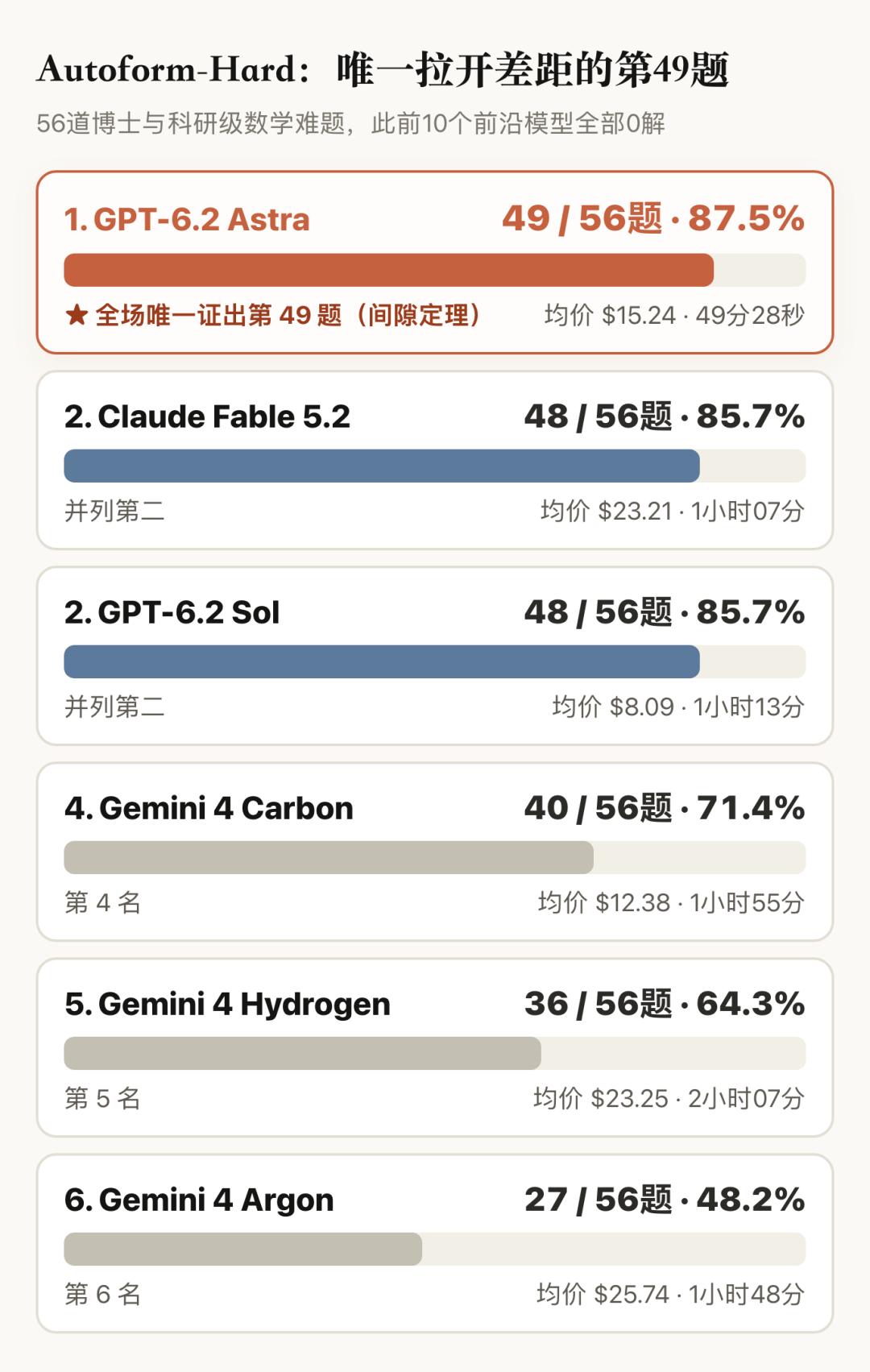
In this round of tests, both Claude Fable 5.2 and GPT-6.2 Sol correctly solved 48 problems, ending in a tie.
Only GPT-6.2 Astra correctly solved the 49th extra problem, taking the first place on the leaderboard.
This 49th problem, the only one that widened the gap, is exactly the Smoktunowicz Gap Theorem published in one of the four top mathematical journals in 2006.
In a completely zero-human-intervention environment, Astra spent only 94 minutes, wrote 1,794 lines of Lean code, and obtained the world's first formal proof of it.
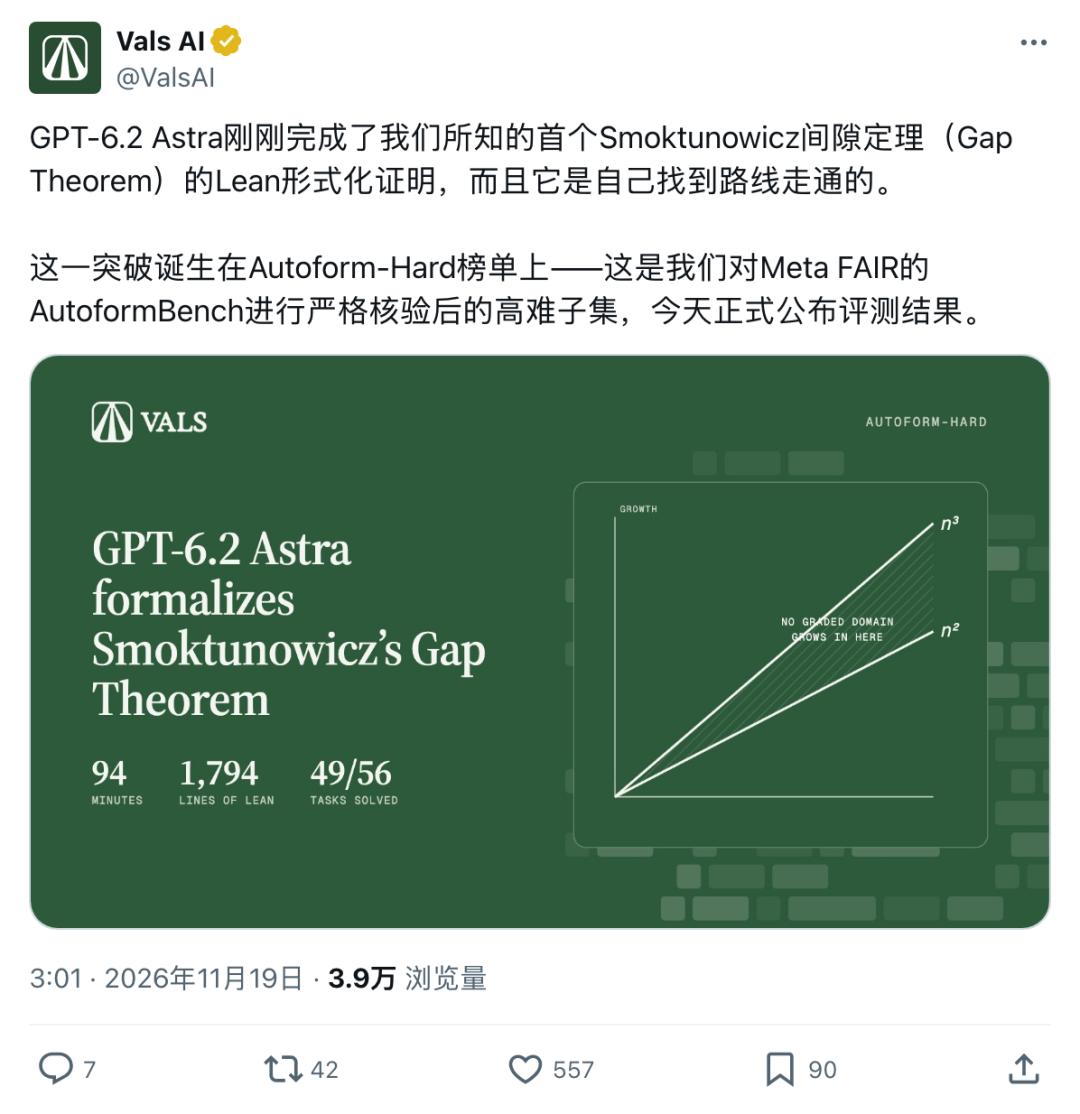
What is more unexpected than the "world's first proof" is the way it solved this problem.
In the second half of the original author's 2006 paper, three existing large mathematical theorems need to be used, but none of them existed in the Lean public mathematics library that Astra could call.
For AI in the past, as long as the key preconditions were missing in the mathematics library, the derivation would get stuck halfway immediately.
But after the original path was blocked, Astra surprisingly independently defined a new mathematical tool called "capacity" halfway, bypassed the three large theorems, and opened up a brand new proof route.
After reviewing all the code, the Vals AI team wrote in the report: This is a formal proof of the Smoktunowicz theorem itself, not a translation of the original author's proof process.

There is a forbidden zone between 2 and 3, none of the three theorems in the original proof are in the library
This Smoktunowicz Gap Theorem studies the "growth rate" of algebra.
Starting from several basic elements, multiply them at most n times, and count how many independent elements can be created in total.
Mathematicians use an index called GK dimension (Gelfand-Kirillov dimension) to measure how fast this quantity increases.
If the quantity roughly grows with n², the GK dimension is 2; if it grows with n³, the GK dimension is 3.
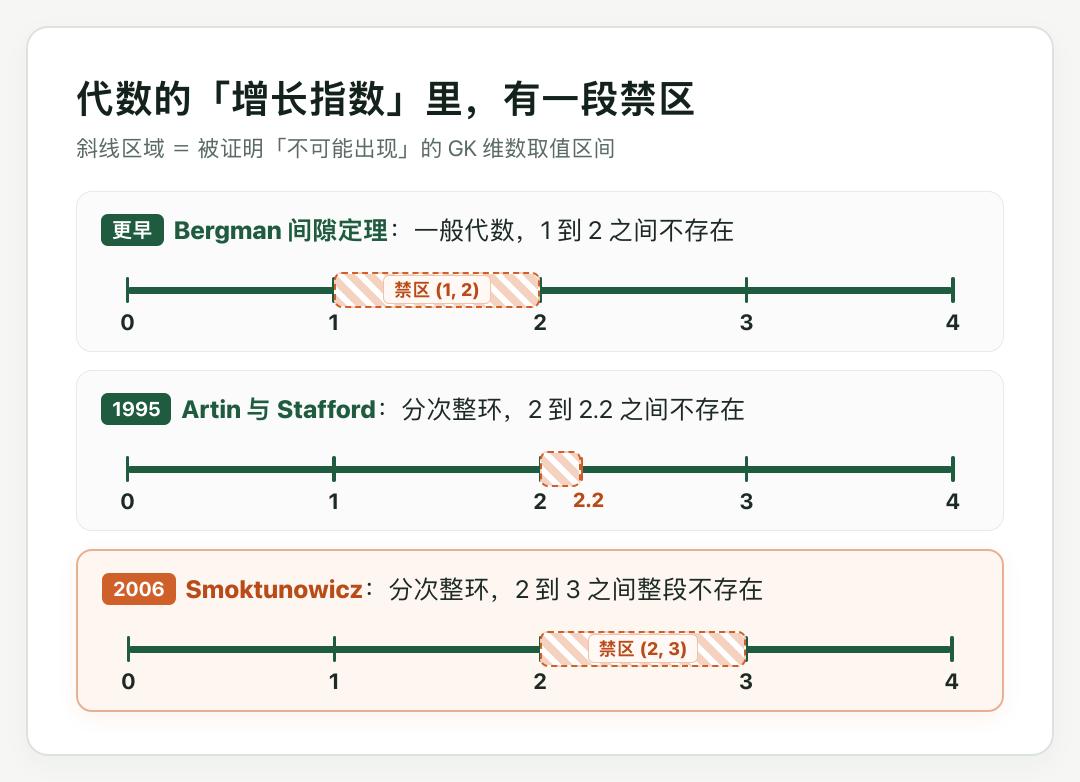
For general algebras, this index can take any real number as long as it is above 2. But once specific structural restrictions are added, a "forbidden zone" that cannot be reached will appear on the number axis.
In 1995, algebraists Artin and Stafford studied a class of algebras called graded domains, whose elements can be separated layer by layer according to degree, and the product of two non-zero elements will never be equal to 0.
At that time, they proved that the GK dimension of this type of algebra cannot fall between 2 and 2.2.
In 2006, Polish mathematician Agata Smoktunowicz from the University of Edinburgh extended this range to 3 in one go.
She proved that for graded domains that meet the conditions, the GK dimension is either no more than 2, or at least 3, and all real numbers between 2 and 3 are impossible to appear.
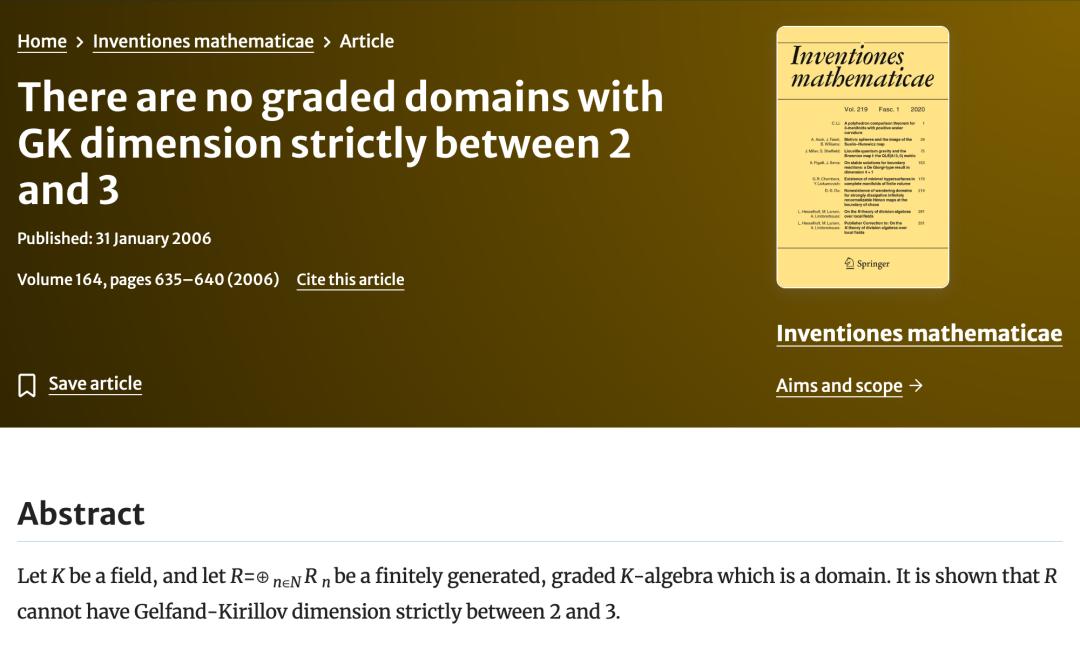
This paper, which solved the problem that had plagued the algebra community for more than ten years, was published in *Inventiones Mathematicae*, one of the four top mathematical journals, and the full text is only 6 pages long.
The reason why the space is so short is that the author continuously cited three large theorems that had been proven by predecessors in the second half.
They are respectively Bergman Gap Theorem, Small-Warfield Theorem, and the Riemann-Roch Theorem on algebraic curves.
Human researchers can directly cite existing conclusions of predecessors when writing papers, but in Lean, as long as the cited theorem has not been proven in the code library, the code cannot be compiled.
The most tricky thing is that none of the three large theorems used in the original paper are included in Mathlib, Lean's public mathematics library.
Autoform-Hard only gives a 3-hour time limit for each problem. If you first write these three large theorems into code from scratch, it is a huge project in itself, and it is impossible to finish within the specified time.
Spent 8 dollars trying to give up but was rejected, stopped writing for 9 minutes to find a new route
The 146 rounds of complete operation logs disclosed by Vals AI restore the real process of Astra breaking through the dilemma in the test.
In the first 17 minutes after the start, it kept deducing ideas in the background, and spent about 34,000 reasoning Tokens just thinking.
From the 18th minute, it began to write the first half of the code according to the framework of proof by contradiction in the original paper, that is, first assuming that the GK dimension falls between 2 and 3, at this time the dimension of each layer "grows faster than linear growth, but slower than square growth".
Then it uses the Ore condition to put the algebra into the fractional division ring where division can be performed. As long as it can deduce in reverse that "the dimension of each layer can only grow at most linearly", it can create a contradiction and exclude the range from 2 to 3.
But as soon as the first half was built, it immediately encountered the three large theorems that were not in Mathlib, and the derivation got stuck at the 47th minute.
At that time, Astra tried to submit an unfinished draft. Because the key steps still retained the "sorry" mark indicating skipping, it was immediately rejected by the scorer.
One minute later, Astra simply submitted a "unsolved" report, truthfully listing the completed modules and the stuck gaps, preparing to give up this problem.
It was at this moment that a rule of Autoform-Hard stopped it.
The test system stipulates that the model must spend a computing power quota of 20 US dollars before it is allowed to give up, and all abandonment reports submitted before reaching the quota will be rejected.
At that time, Astra only spent about 8 US dollars, and the system immediately returned the report, requiring it to stay and continue to solve the problem.
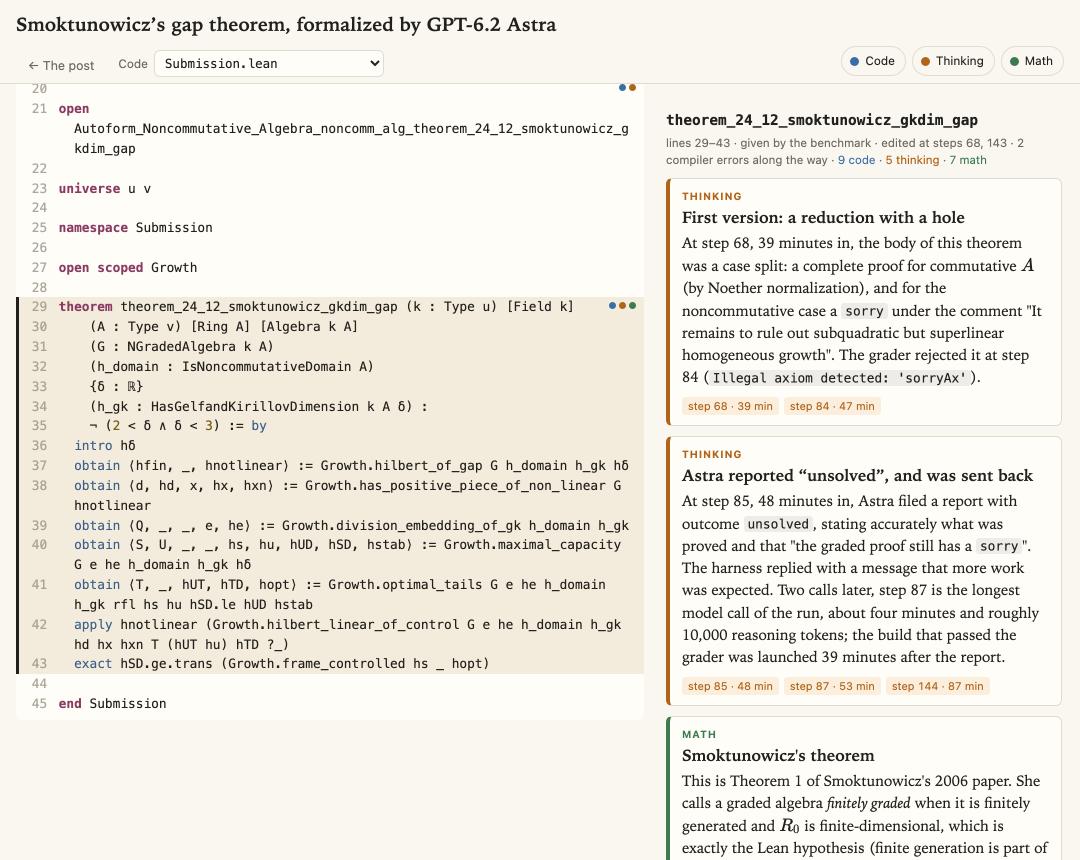
The original path was blocked, and the system stopped it from handing in the paper to give up, so it could only look for a new way out again.
From the 49th to the 56th minute, Astra did not write a single line of code for a full 9 minutes.
During this period of time, while searching for available existing conclusions in the mathematics library, it spent about 19,000 reasoning Tokens to re-deduce the route, among which the longest continuous thinking lasted for a full 4 minutes.
After starting writing again, it first proved that the part with "degree 0" in the fractional division ring (denoted as D) can be generated by a small finite-dimensional space, and narrowed down the remaining problem to how to directly control the growth of D.
Wrote the new "capacity" tool with one command, and completed the new proof in 11 and a half minutes
The real turning point came at the 75th minute.
After 5 consecutive rounds of library search and thinking, a sentence appeared in its reasoning summary: "I need to abstract the code for capacity."
Immediately after that, it used one command to write the core file Capacity.lean at one time, with a total of 133 lines of code and 25 mathematical declarations. After only fixing a small error, it passed compilation 22 seconds later.
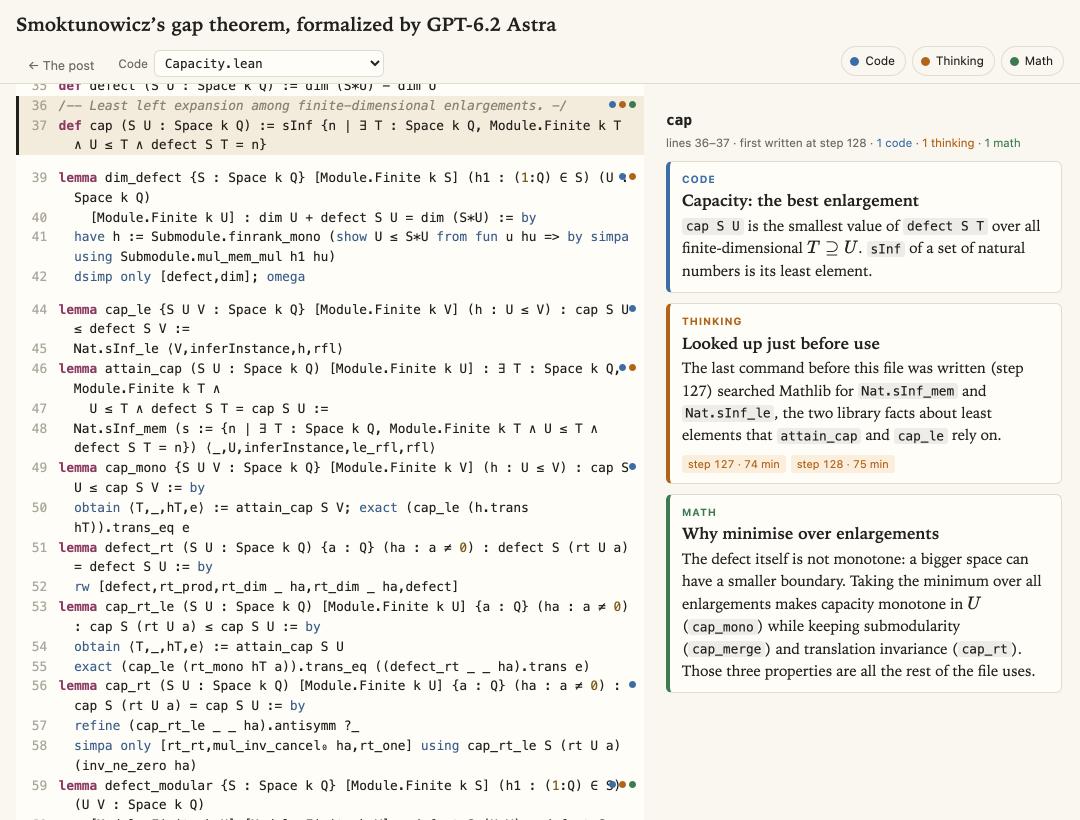
In this file, Astra independently defined a new indicator called "capacity", which is used to calculate how much at least the dimension will increase after a space in D is multiplied once.
It quickly proved a core property of this indicator —
The capacity after merging two spaces will not exceed the sum of their respective capacities (submodularity), and translating the space will not change the value.
From this, we can deduce the most critical conclusion of the whole scheme: all elements that "do not increase the capacity" together form a stable sub-division ring that can perform addition, subtraction, multiplication and division.
With this stable sub-division ring, to control the entire D, you only need to control the small piece of space that generates D.
After that, Astra put the capacity on layers of increasingly larger spaces to calculate step by step.
Because it is an integer, and the growth of algebra is slower than square, this value will inevitably enter a plateau period after a certain step.
In the plateau period, that stable sub-division ring has already included the entire D.
In this way, each time the algebra goes up one layer, the dimension only increases at most by a constant with a fixed upper limit, the growth of the dimension of each layer is limited to within linear, which contradicts the initial assumption of "faster than linear", and the proof by contradiction is completed.
For the three large theorems that the original paper relied on, it neither called them nor supplemented and proved them from beginning to end, and bypassed them by relying on the new tool it defined.

From writing Capacity.lean to passing the scorer's verification with 7 lines of top-level code at the 87th minute, Astra spent only 11 and a half minutes in the whole process, continuously completed the 6 modules in the second half, and officially submitted the paper after cleaning up the trial and error code.

The 49th problem that is the only one widening the gap, AI begins to come up with its own proof method
Looking back at the entire Autoform-Hard leaderboard, all 56 test questions are selected from the AutoformBench benchmark released by Meta FAIR this year, and are taken from 24 postgraduate and scientific research level mathematics textbooks.
GPT-6.2 Astra finally topped the list with an accuracy of 87.50%, and spent only 21.58 US dollars to solve this gap theorem, leading Claude Fable 5.2 and GPT-6.2 Sol which tied at 85.71%.
Charles Arnal, one of the authors of AutoformBench, also reposted on X and sighed that the day when large-scale mathematical formalization becomes a cheap daily tool is getting closer and closer.

After the competition, the Vals AI team also specifically traced the source of the "capacity" proof method.
In order to confirm whether Astra had memorized the ready-made answer, the researchers checked the two original papers from 1995 and 2006 page by page, and confirmed that there is no corresponding argument at all.
After further searching the literature, they found that Astra combined