Amodi: AI Trailblazer
On November 19 US time, Anthropic officially debuted on the Nasdaq, listed under the ticker symbol "ANT", setting the record for the largest IPO in global history.
The day before going public, Anthropic set its offering price at $83 per share, increased the number of shares issued from 825 million to 980 million, and the final public offering size reached 813.4 billion US dollars.
Calculated at the offering price, this AI company founded less than six years ago has a fully diluted valuation of approximately 1.5 trillion US dollars.
In its prospectus, steep revenue growth curves coexist with astronomical commitments to computing power infrastructure. Countless eyes are fixed on this company: the market is scrutinizing it, and also waiting for it.
Standing at the absolute center of the spotlight is Dario Amodei, founder and CEO of Anthropic.
In public appearances, this 43-year-old leader always wears simple casual shirts and has his signature fluffy short hair. Rather than looking like a CEO running a trillion-dollar company, he looks more like a scientist who has just stepped out of the laboratory.

After Transformer laid the technical foundation, large model R&D has gone through two particularly distinct turning points.
One was the establishment of Scaling Laws, which made model expansion a continuously promotable technical path; the other was the rise of programming capabilities, allowing machines to take over human work and in turn accelerate the R&D of the models themselves. Amodei stood at the bow of the ship when both tides converged.
Today, this man who once helped AI sail into the fast lane has begun to call for setting speed limits for it.
He warned in an article: AI is becoming powerful at an unprecedented speed, and humanity's ability to understand and control these systems may have fallen behind technological progress.
1
On February 14, 2019, OpenAI released a piece of news.
In a remote valley of the Andes Mountains in South America, Dr. Jorge Pérez, an evolutionary biologist at the University of La Paz, and his team discovered a mysterious creature that had never been recorded by humans before. It has four horns, a silvery-white body, and can even speak fluent English.
The creature was named "Ovid's Unicorn" by the researchers. Dr. Pérez explained in the report in all seriousness that it might have originated in Argentina and was related to a lost ancient ethnic group. As for where it exactly came from, perhaps only DNA testing can give the answer.
"Ovid's Unicorn"? How could such a thing exist. But the news was written in great detail, with everything from the scientist's name, research institution, on-site description to expert quotes fully presented.
The report was generated by the language model GPT-2 that OpenAI announced on the same day. The researchers only wrote the first two sentences, and the rest of the content was continued by GPT-2 on its own.
That same day, *Wired* covered the achievement with the headline "The AI Text Generator So Dangerous It Can't Be Made Public". The Verge summed up the new model's capabilities with a rather ironic headline: "OpenAI's New All-Powerful AI Can Write, Translate, and Even Libel".
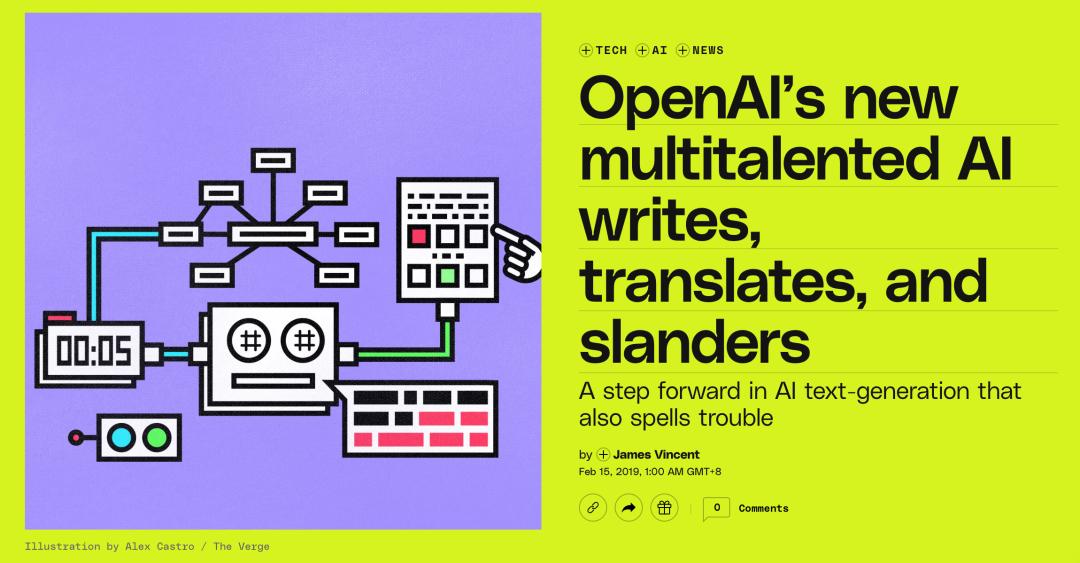
From today's perspective, GPT-2 is far from intelligent. Its largest version has 1.5 billion parameters, which can perform simple translation, question answering and text summarization, but it often repeats itself, goes off-topic in long-form writing, and even makes absurd plots such as fires breaking out underwater.
Even so, OpenAI decided not to release the weights of the largest version of the model for the time being. The company worried that this technology capable of generating massive amounts of false content could be abused, so it chose to release it in stages, leaving time for researchers and society to assess the risks.
Inside OpenAI, Dario Amodei saw another more distant possibility.
In 2026, in an interview with biographer Walter Isaacson, Amodei recalled his reaction to GPT-2 back then:
"I personally was super freaked out by it."
He said that about 90% of the people around him did not think this model was anything special. After all, its performance in translation, writing or any other individual task was not outstanding.
But he had already begun to imagine that if the scale of such a model was expanded by another million times, machines might one day surpass humans in almost all tasks. At that time, the entire economy, science, and even the way countries and societies operate could be changed as a result.
In many subsequent public interviews, Amodei traced back to his underlying perspective on technological evolution.
In 2006, Amodei's father Ricardo passed away from hepatitis C. After that, as a new generation of antiviral drugs came out one after another, breakthroughs were made in the treatment of hepatitis C. By the mid-2010s, the cure rate of some treatment regimens had risen to more than 90%.
Right before the opening bell rang, Amodei stood on the bell-ringing stage with his sister Daniela and talked about their father once again.
"The disease he suffered from became curable just a few years later," Amodei said.
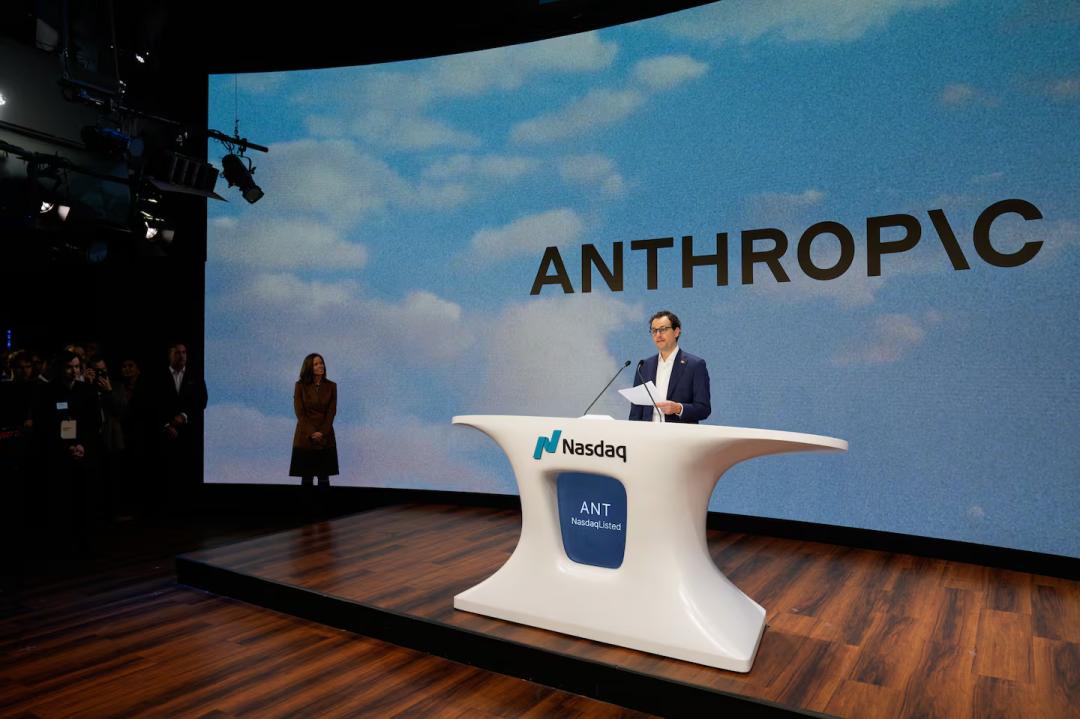
This incident changed Amodei's research direction. Originally majoring in theoretical physics, Amodei turned to biophysics and computational neuroscience. While pursuing his PhD in physics at Princeton University, he worked with electrical signals of brain neural circuits all day long, trying to dismantle the operating logic of living systems.
However, the complexity of biological systems also made him gradually realize that with only human researchers, many problems might take an extremely long time to be solved.
He needed a new tool that could fundamentally compress the scientific research cycle. This idea led him to set his sights on artificial intelligence, hoping to use the computing power of machines to speed up scientific discovery.
At the end of 2014, Amodei joined Baidu and worked on speech recognition with Andrew Ng's team. At that time, deep learning had made some progress, but researchers were still exploring how to further improve model capabilities.
Amodei tried a "brute force" approach: increasing the number of layers of the neural network, expanding the training data, and devoting more computing resources.
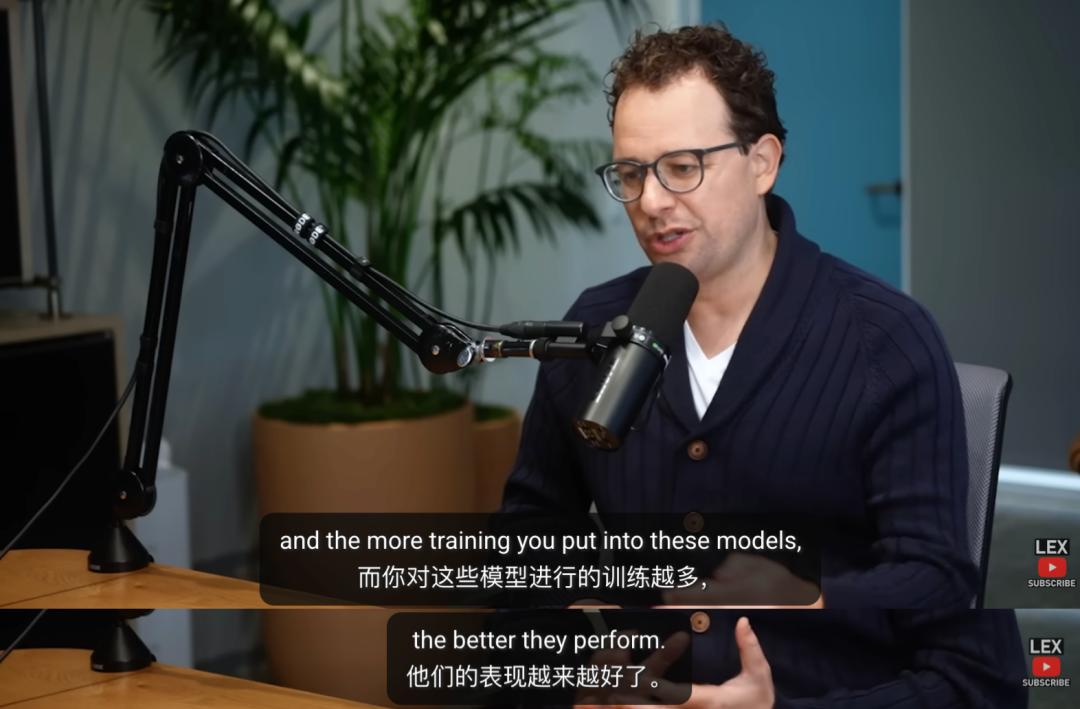
In a later interview with Lex Fridman, he recalled that he had not yet accurately measured the mathematical relationship in it at that time, but he had formed an intuitive judgment with his colleagues: more data, larger models and longer training often led to better results.
At first he thought this might only be a special rule in the field of speech recognition, until he came into contact with the early GPT model, he realized that LLM (Large Language Model) was probably no different in this regard.
On January 23, 2020, the OpenAI team published a paper titled *Scaling Laws for Neural Language Models*, which later rewrote the paradigm of AI R&D. The research was led by Jared Kaplan and Sam McCandlish, and Amodei, as a co-author, provided research guidance for the entire project.
The most striking part of the paper were several almost straight curves. On a logarithmic scale, as model size, data volume and computing volume increase, the prediction error of the language model continues to decrease along a trend that can be described by a mathematical formula. Even at the maximum scale covered by the experiment, the researchers did not observe obvious signs of this trend failing.
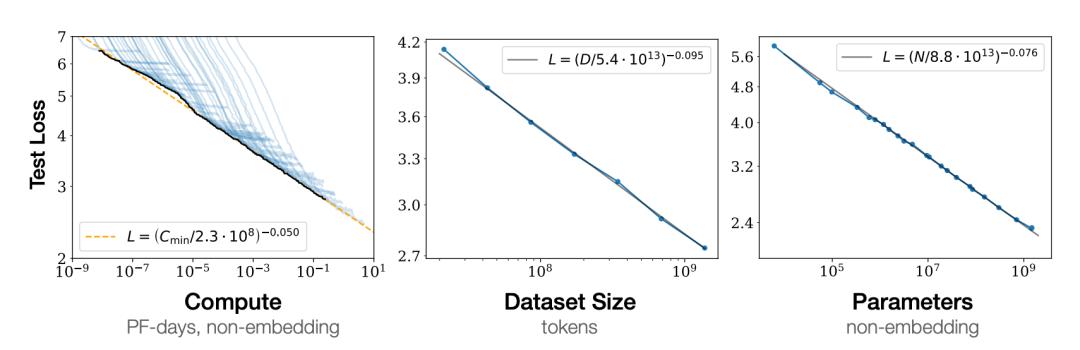
This set of data provided an important basis for the development of LLMs (Large Language Models).
Prior to this, improving model performance often required researchers to repeatedly adjust algorithms, architectures and training schemes. The Scaling Laws allowed research teams to deduce the benefits of adding parameters through small-scale experiments, and arrange larger-scale training accordingly.
Scale expansion gradually evolved from a research judgment into a quantifiable and verifiable engineering path.
Amodei then participated in an even larger experiment. According to a feature profile from Big Technology, OpenAI put Amodei in charge of the GPT-3 project and invested about 50% to 60% of the company's computing resources at that time.
A few months later, on May 28, 2020, OpenAI announced GPT-3.
It has 175 billion parameters, more than 116 times that of GPT-2. The same model can switch between different tasks without retraining parameters for each task. Researchers only need to give a few examples in the prompt, and GPT-3 can follow through to complete tasks such as translation, question answering, and text generation.
As OpenAI gradually opened up its API to external developers, more unexpected results emerged one after another. Some people asked GPT-3 to imitate the writing style of different writers, while others input a natural language description and asked it to generate runnable web page code. Those capabilities that originally stayed in papers and laboratories began to appear in real software interfaces.
Although GPT-3 still has errors, biases and capability limitations, the versatility it demonstrated was enough to make more and more research institutions re-evaluate the future of LLMs. A competition centered on parameter scale, data and computing resources gradually unfolded.
The judgment Amodei formed in his early speech recognition research has been verified again and again through GPT-2, the Scaling Laws and GPT-3. The technical route he helped promote has begun to become an important development direction for the entire industry.
But the more powerful the model is, the harder it is to avoid the problems he worried about.
As the GPT series models achieved breakthroughs, OpenAI began to speed up its commercialization pace. Amodei's differences with the company's management on R&D direction, security guarantees and organizational governance gradually deepened.

According to an investigative report by *The Atlantic* in September 2026, Amodei had tried to solve the problem through internal reforms. In negotiations with CEO Sam Altman, he put forward a series of conditions to stay, including granting the security team veto power over new product releases.
This requirement meant that security researchers would have the right to block models they considered to have significant risks from entering the market, even if the company's management wanted to move forward.
The two sides ultimately failed to reach an agreement.
In December 2020, OpenAI held an all-hands video conference. After Altman introduced the company's daily progress, he handed the floor to Amodei. Amodei then announced in front of all employees that he would leave OpenAI together with six other colleagues.
The meeting chat window was quickly flooded with surprised messages. Amodei thanked his colleagues and expressed his best wishes to the company. He emphasized that the two sides still share the same goal - to make safe general artificial intelligence benefit humanity.
On December 29, OpenAI officially announced his departure to the public. The announcement reviewed Amodei's contributions to GPT-2 and GPT-3, as well as his experience of co-leading the company's research direction with chief scientist Ilya Sutskever.
In January 2021, Anthropic was officially founded.
2
Fast forward to 2024, in the studio of well-known host Lex Fridman, Amodei talked about the research problems he was familiar with with an extremely serious expression.
"You would be surprised how many of the challenges in developing these models ultimately boil down to software engineering and performance engineering."
Amodei said that it is easy for the outside world to imagine AI breakthroughs as scenes in movies - scientists suddenly have a flash of inspiration and find some amazing method. But real-world research is far less romantic than that.
"Even incredible discoveries almost always end up landing on details. And often extremely, extremely boring details."
After founding Anthropic in 2021, Amodei invested a large amount of resources in foundational model R&D. How to train larger models, improve computing efficiency, and refine training methods has always been the core work of this company.
As Claude's capabilities continued to improve, Amodei noticed that the tasks the model could complete were changing.
Programming is one of the important areas.
Lex told Amodei on the podcast that he had been using Sonnet 3.5 paired with Cursor for programming recently, and could clearly feel that the model had become smarter. Amodei smiled and talked about the internal feedback from the company.
"There are several really good engineers at Anthropic. Previously, programming models developed by either us or other companies were of no help to them. They would say: 'This might be useful for beginners, but it's useless for me.'"
"But after Sonnet 3.5 came out, for the first time they said: 'Oh my god, it helped me finish a task that would have taken me hours. This is the first model that actually saved me time.'"
"The water line is rising," Amodei stated.
In June of the same year, an internal Agent programming test announced by Anthropic showed that Sonnet 3.5 could solve 64% of software engineering problems, while the previous Opus 3 only achieved 38%.
This test required the model to fix bugs or add features in a real open-source codebase based on natural language descriptions.
In the second half of the interview, Lex steered the topic towards the future of software development.
"Programming is so closely linked to the development of AI itself. What do you think will happen to the way humans program in the future?" Lex asked.
"I think this will be one of the fastest changing areas," Amodei replied. "