AGI is not the end point yet, and DeepMind has begun to ponder the future of ASI.
Recently, Google DeepMind Institute released its latest blog post titled "What Comes After AGI?", exploring the technological evolution direction after Artificial General Intelligence (AGI), and the possible paths for human beings to move towards Artificial Super Intelligence (ASI).
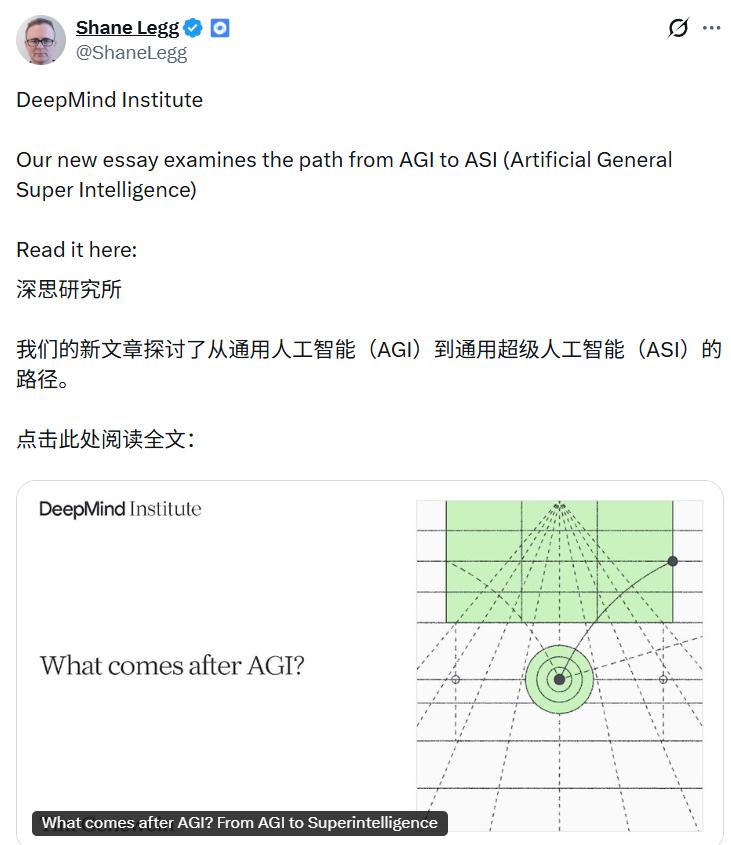
Article link: https://institute.deepmind.com/essays/what-comes-after-agi/
The article points out that AGI is not the end point of artificial intelligence development, but may only be a stage on the intelligence continuum. With the continuous improvement of model capabilities, computing efficiency and multi-agent collaboration level, AI has the potential to further surpass the cognitive capabilities of human experts, and even accelerate its own technological progress.
DeepMind conducts analysis from the perspectives of intelligent capability boundary, cognitive industrialization, technology development path and recursive self-improvement, puts forward four potential technical routes leading to ASI, and emphasizes that the key challenges in the era of superintelligence are not only how to achieve more powerful AI, but also how to measure, predict and govern such technological progress.
I. AGI is not the end point, how far is ASI away?
Over the past decades, artificial intelligence research has been centered on an important goal: to achieve AGI that can reach human-level performance on almost all human cognitive tasks.
But DeepMind believes that AGI is not the end of artificial intelligence development. Human-level intelligence is only a node in the entire intelligence continuum, and there is still a huge capability space above it.
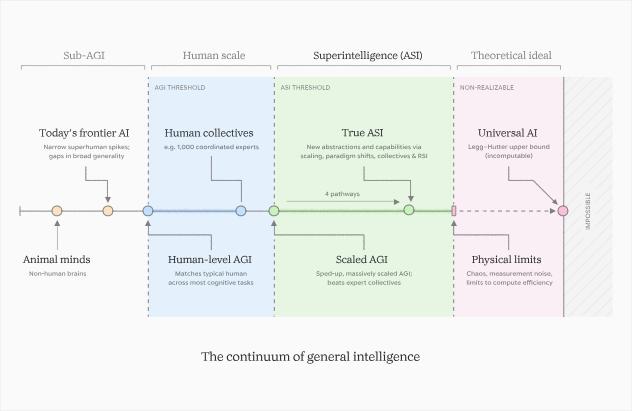
The article describes Artificial Super Intelligence (ASI) as an AI system that can continuously outperform large teams of human experts in almost all tasks that human beings care about.
For example, ASI may achieve progress in a very short period of time that a scientific research field would take many years to make, or achieve chip design and technology R&D results that large technology companies can complete in one year with fewer resources.
In fact, current AI has demonstrated capabilities beyond humans in chess, Go, protein structure prediction and some mathematical proof tasks. But these are still breakthroughs in specific fields, and there is still a clear gap from comprehensive superintelligence.
DeepMind emphasizes that although humans have been able to study the theoretical limits of intelligence from the perspectives of mathematics and physics, the size of the capability space between human-level AGI and these limits is still a problem that has not been fully explored.
In addition to the capability breakthrough of the model itself, DeepMind also points out that the continuous growth of computing power and the rapid decline of operating costs may also become important factors driving AI towards superintelligence.
The article thus introduces the concept of "Cognitive Industrialization": with the continuous improvement of AI computing efficiency, more and more cognitive work may realize standardized, automated and large-scale production like the physical labor in the industrial era.
The article points out that over the past decade, the growth of AI's effective computing power has been mainly driven by three factors:
Improved hardware performance: The computing power that can be purchased per dollar has long been growing at a rate of about 1.5 times per year.
Higher algorithm efficiency: The amount of training computation required to achieve the same performance continues to decrease, and the efficiency of inference algorithms is also improving rapidly.
Increased investment in computing infrastructure: AI hardware investment has maintained rapid growth in the past decade, driving the continuous expansion of global computing resources.
The combined effect of the three factors makes the annual growth rate of global effective computing resources reach about 10 times or even higher.
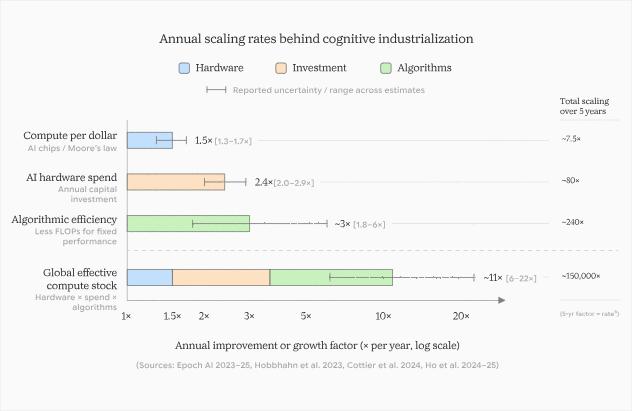
DeepMind further deduces that if the relevant trend continues for ten years, the cognitive work that currently requires 1 billion US dollars of AI computing cost to complete may only cost about 1,000 US dollars in the future.
Of course, this prediction is based on the assumption that the efficiency improvement trend can continue, and does not mean that the cost will inevitably decline at this rate.
More importantly, even if there is no major breakthrough in the basic capabilities of AI models, relying solely on lower operating costs, faster processing speeds and a larger number of agents can also significantly change knowledge work and socio-economic structures.
In this scenario, billions of AI agents that can run at high speed and cooperate continuously may form a comprehensive production capacity far exceeding that of a single human or a single AI system.
This also means that the process from AGI to ASI may not entirely depend on a single disruptive model breakthrough. The continuous improvement of the number of agents, operating speed and collaboration scale may also become an important force driving the leap of intelligent capabilities.
II. From AGI to ASI,
DeepMind proposes four technical routes
However, the improvement of the number and operating speed of agents cannot solve all the limitations of AI in cognitive capabilities. DeepMind believes that to truly move towards ASI, breakthroughs in key technologies are also required.
To this end, the article summarizes four potential development paths.
The first route: Expand the scale of models and data.
This is the current main route of AI development, which continuously improves system capabilities by increasing training data, model scale, training computation and computing resources in the inference stage. However, this method also faces limitations such as insufficient high-quality data, diminishing returns from model expansion, and constraints on infrastructure such as energy and chips.
In the future, high-fidelity simulation environments, synthetic data, reinforcement learning and inference-stage computing may become important means to break through these bottlenecks.
The second route: Promote the transformation of technology paradigm.
The current mainstream large models are mainly built on the Transformer architecture and sequence prediction mechanism. Although this paradigm has achieved remarkable success, models still have some limitations different from human intelligence in continuous learning, world modeling, decision-making ability and sample efficiency.
It is still controversial whether the future realization of ASI only requires continuous improvement of existing technologies, or must rely on a brand-new model architecture and learning paradigm.
The third route: Improve the multi-agent collaboration capability.
The capability of a single AI may be limited, but a collaborative system composed of a large number of AI agents has the opportunity to form stronger collective intelligence. Just like enterprises, scientific research institutions and markets can solve problems that a single human cannot complete, thousands of AGI agents in the future may also complete more complex cognitive tasks through task division, information sharing and mutual collaboration.
However, the multi-agent system is not necessarily more effective as its scale increases. Problems such as communication cost, coordination efficiency, information distortion and group behavior may all limit the improvement of its capabilities.
The fourth route: Achieve recursive self-improvement.
This is also the path that the article focuses on.
Recursive Self-Improvement (RSI) means that AI is no longer just a technical tool developed and improved by human beings, but can participate in the R&D of the next generation of AI systems.
With the improvement of AI R&D capability, it may further improve the efficiency of model architecture design, algorithm optimization, chip design and training data generation, thus accelerating subsequent technology iteration. If this feedback loop can continue to operate, the progress speed of AI may no longer fully depend on the work efficiency of human researchers.
DeepMind further points out that this process can be realized through three levels: first, code and design optimization, to improve model architecture, training algorithm and chip design; second, data-driven improvement, to generate higher-quality training data through simulation, reasoning and experiments, and AlphaZero has demonstrated a similar mechanism; third, group collaboration improvement, to improve R&D efficiency through specialized division of labor of agents.
DeepMind compares these three mechanisms to genetic evolution, cultural evolution and social evolution in biological evolution respectively.
However, the article also emphasizes that recursive self-improvement does not necessarily lead to runaway exponential growth. On the one hand, as technology gradually matures, it may become more and more difficult to discover new effective improvements; on the other hand, without a reliable evaluation and feedback mechanism, the self-improvement process may stagnate or even degenerate.
Therefore, fields that can perform automatic verification such as mathematical proofs may take the lead in achieving a higher degree of recursive self-improvement, while tasks that rely on complex real-world judgments may progress more slowly.
DeepMind emphasizes that the above four routes are not independent of each other, but may promote each other and jointly drive the improvement of AI capabilities. Even if one route encounters a bottleneck, other paths can still continue to make progress.
This also means that restricting only a single factor such as model training computing power may not be enough to control the overall AI development speed. When the restricted factor is broken through, there may even be a sudden leap in capabilities. Therefore, future AI governance needs to pay attention to multiple dimensions including model scale, algorithm efficiency, multi-agent collaboration and automated R&D at the same time.
III. Establish a new measurement and prediction system
At the end of the article, DeepMind turns the discussion to a more realistic issue: if AI enters the stage of surpassing human intelligence, how should human beings respond?
Its core suggestion is: Model, measure, predict, and iterate continuously.
Since the capabilities of superintelligence may exceed the evaluation scope of human experts, existing testing methods will face challenges. Therefore, it is necessary to establish more reliable benchmark tests, automated verification mechanisms and prediction models in the future to continuously track the development of AI capabilities. This not only requires the participation of cutting-edge AI laboratories, but also requires interdisciplinary cooperation between scientific research institutions and policy makers.
DeepMind believes that the possibility of continuous and rapid development of AI in the next decade deserves serious attention. The move from expert-level AGI to superintelligence may accelerate scientific breakthroughs in medicine, materials and clean energy and other fields. Even if superintelligence does not arrive quickly, cognitive industrialization may profoundly change knowledge work and the global economy.
AGI is not the end point of artificial intelligence development. Compared with only focusing on how to achieve AGI, human beings need to understand the technological evolution path, development speed and its far-reaching impact on society after AGI in advance.
This article is from the WeChat official account "Synced", edited by the Editorial Department of Synced, and published with authorization by 36Kr.