GeoFlow V4 Release | From "combinable" to "druggable", BioMap Unveils New-Generation Drug R&D Engine | StarLink Portfolio Updates
On November 19, BioMap officially released the new-generation drug R&D engine GeoFlow V4. Supported by the collaborative expansion of data and models, this upgrade further enhances the capabilities of structure prediction, candidate screening and de novo design, and simultaneously launches the GeoFlow Code agent-based drug design orchestration system, which jointly supports the drug developability-oriented RSI dry-wet feedback closed-loop that integrates model, molecule and data.
GeoFlow V4 achieved an average experimental hit rate of 34.6%, about 85% higher than the previous generation in 15 de novo design tasks covering 13 disease therapy-related targets. The new-generation model supports de novo design of multiple molecular types including small proteins, cyclic peptides, nanobodies and IgG antibodies under a unified framework. The affinity of multiple molecules reaches the pM level, and the designed antibodies show excellent performance in multiple developability-related indicators such as expression, purity, thermal stability and non-specific binding.
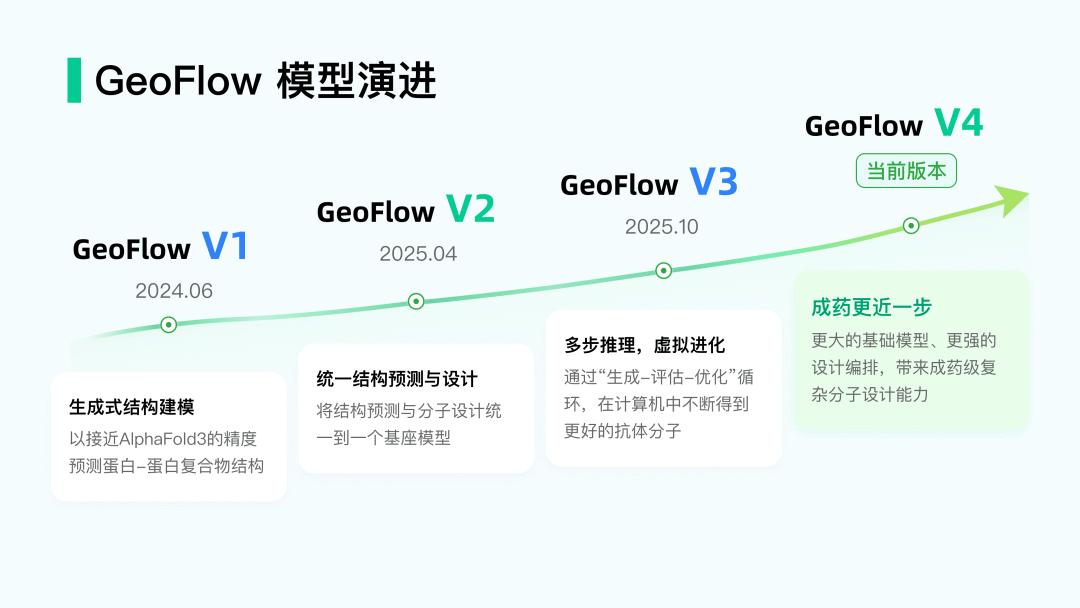
From the first-generation antibody generation, to the unification of all-atom structure prediction and generation, and then to multi-step reasoning-driven epitope-oriented design, the GeoFlow series continues to expand the capability boundary of artificial intelligence in the molecular R&D field. Beyond obtaining hits, GeoFlow V4 takes a further step toward drug developability.
New-generation foundational model:
More accurate structure prediction
More reliable candidate screening
To make antibodies precisely bind to the specified epitope and screen out molecules worthy of verification from a large number of candidates, the model needs to understand intermolecular interactions more accurately. On the public antibody-antigen structure prediction benchmark FoldBench-AB, the Top-1 prediction success rate of GeoFlow V4 reaches 75.4%, which is at the international cutting-edge level (comparable to IsoDDE). At the same time, the model also shows excellent inference-time scaling performance: when the number of inference samplings increases to 100, the prediction success rate further rises to 78.8%, indicating that increased inference computation can continuously improve the structure prediction performance.
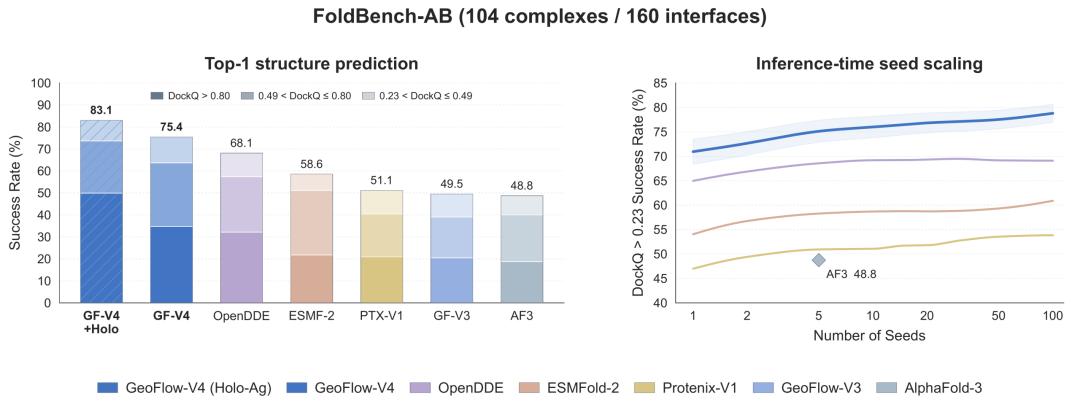
Structure prediction performance on FoldBench-AB: (Left) Success rate comparison; (Right) Inference-time scaling
More accurate structure prediction also provides a basis for screening. The confidence score of GeoFlow V4 can help distinguish between binding and non-binding molecules, and prioritize the identification of candidate molecules with stronger binding. On the IGDesign antibody dataset, the top 5% of candidate molecules achieve a 6.0-fold enrichment of binding molecules. In the more challenging SKEMPI affinity ranking task, the performance of GeoFlow V4 on multiple antibody systems is significantly better than that of the previous generation model, which can better identify affinity differences that were difficult to distinguish in the past.
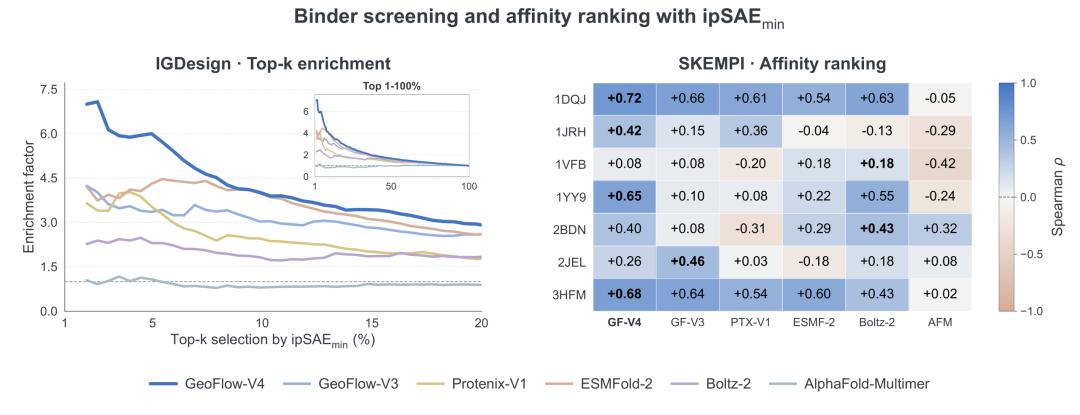
Candidate screening capability of GeoFlow V4: (Left) Binding molecule enrichment; (Right) Affinity ranking
GeoFlow Code:
Specialized for protein design field
Programming language and execution framework
The discovery and optimization of high-affinity molecules often require multiple rounds of design and screening. When the project further involves complex requirements such as cross-species recognition and receptor selectivity, the R&D team also needs to explore different design paths and adjust strategies according to the results of each round. This also puts forward higher requirements for the design system: it not only needs to continuously optimize candidate molecules, but also support task planning and strategy selection, and organize multiple rounds of design into executable and adjustable R&D processes.
Compared with the "virtual evolution" process proposed by V3, which continuously iterates and optimizes candidate molecules through multi-step reasoning, GeoFlow V4 does not stop at multi-round optimization under a fixed strategy, but introduces GeoFlow Code, a dedicated programming language and execution framework for the protein design field, to realize autonomous exploration and execution of design strategies.
GeoFlow Code organically combines the powerful planning, decision-making and execution capabilities of large language models with the powerful structure understanding and generation capabilities of GeoFlow. It can independently carry out literature retrieval, epitope selection, design orchestration and result analysis, and decompose and transform diversified drug R&D requirements into executable design programs. The system will fully record the molecular design process and screening basis, which is convenient for experts to check, adjust and reuse later. The working dialogues of experts in the system and the feedback data of wet experiments can be further used to update the next round of design goals and strategies, so that design experience can be accumulated in iterations and transformed into reusable R&D methods for subsequent projects.
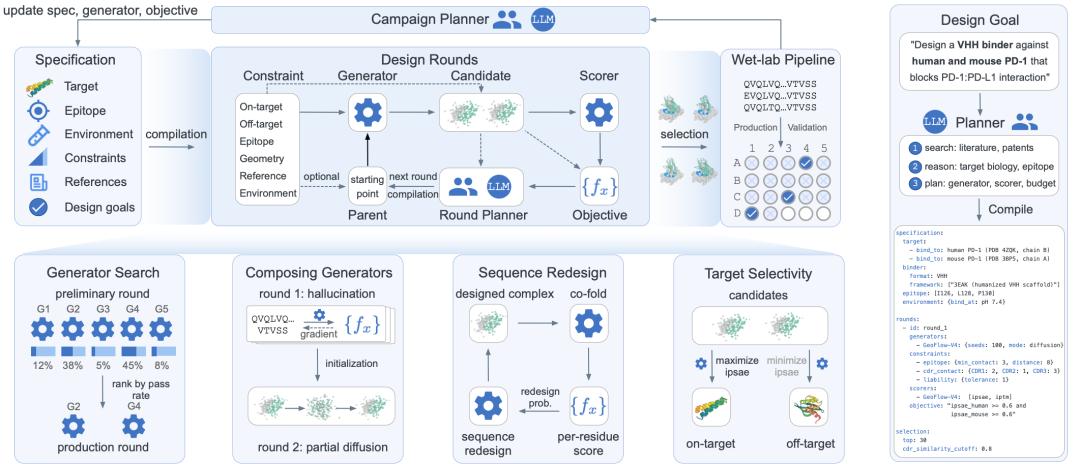
GeoFlow Code protein design engine
In the PD-1 cross-species IgG antibody design task, experts competed on the same stage with GeoFlow Code: within 48 hours, design molecules that can simultaneously recognize human, monkey and mouse PD-1 and block their binding to PD-L1. Under the unified computational screening standard, the comprehensive pass rate of the expert planning process is 0.16%, while that of the GeoFlow Code autonomous orchestration process reaches 4.23%, which is about 26 times of the former; the sequence diversity index also reaches 19 times of the former.
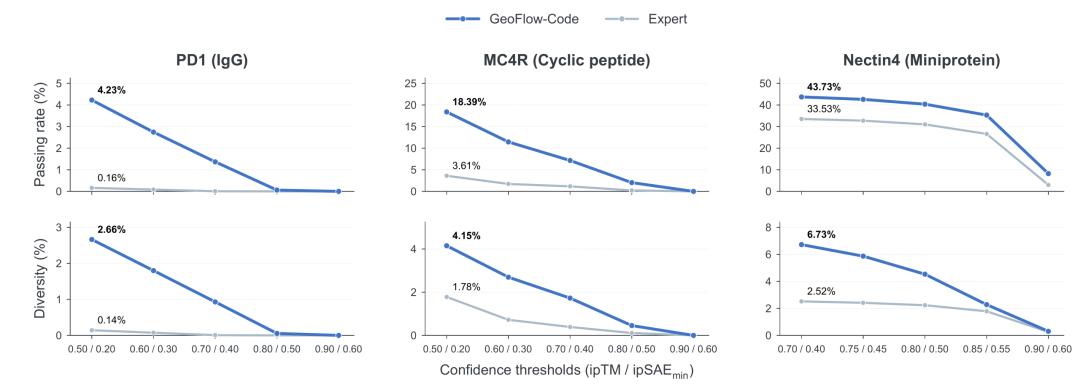
Comparison of pass rate and diversity of expert and agent design under the same computing power
The value of GeoFlow Code lies not only in process automation, but also in discovering new design strategies, and actively selecting more appropriate design starting points and architecture conditions.
•Explore more effective design starting points: In a certain cross-species design, GeoFlow Code tried to use antigens of different species as the design starting point. The results show that the proportion of cross-species binding candidates obtained by using murine antigen as the starting point is 2.5 times that of the human antigen starting point, which provides a basis for the selection of subsequent design paths;
•Actively search for complementary structures: In a certain epitope-oriented design, GeoFlow Code actively searches for structural fragments with complementary characteristics according to the morphology of the target epitope, and carries out subsequent design based on this, which increases the computational design success rate of the corresponding strategy to 5 times of the original.
GeoFlow Code effectively promotes the implementation of the drug discovery mode of "experts define developability requirements, agents independently explore design schemes, and experimental feedback guides iteration", so that R&D experience can continue to accumulate in iterations, fully release the potential of the model, and help R&D teams break through complex developability problems faster.
Cross-modal design:
Multiple proteins obtain high-affinity molecules
The value of the all-atom model needs to be tested in real R&D projects. Following GeoFlow V3's leading breakthrough in VHH de novo design technology in China, GeoFlow V4 expands its de novo design capability to four molecular forms: small proteins, nanobodies, IgG antibodies and cyclic peptides.
In 15 de novo design projects covering 13 disease therapy-related targets, the project-level average hit rate of GeoFlow V4 reaches 34.6%, about 85% higher than the previous generation. The experimental verification adopts corresponding binding or functional detection according to the characteristics of the target, and strictly evaluates the reliability of the binding signal and the quality of curve fitting in affinity evaluation.
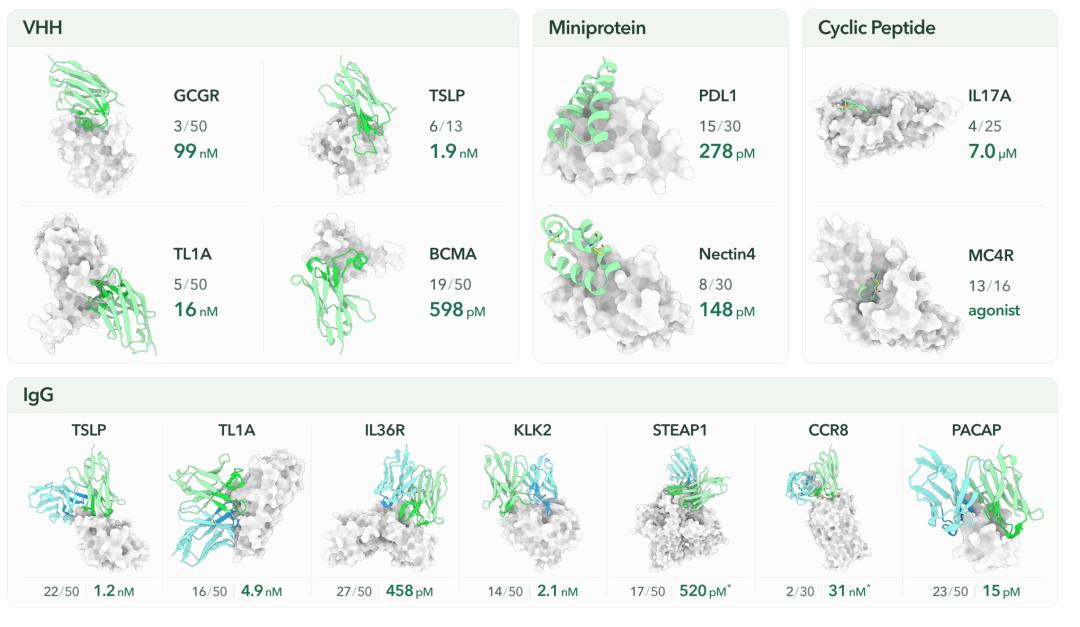
GeoFlow V4 successfully completed de novo design of 4 drug forms and 15 projects
While the hit rate is improved, the maximum affinity is about 100 times higher than that of the previous generation.
GeoFlow V4 has successfully designed pM-level affinity molecules for multiple targets:
• For small proteins designed for tumor targets PD-L1 and Nectin-4, the affinity reaches 278 pM and 148 pM respectively;
• For the nanobody designed for the multiple myeloma target BCMA, the affinity reaches 598 pM;
• For the IgG molecule designed for the autoimmune target IL36R, the affinity reaches 458 pM;
• For the IgG molecule designed for the short peptide target PACAP in the pain field, the affinity is as low as 15 pM.
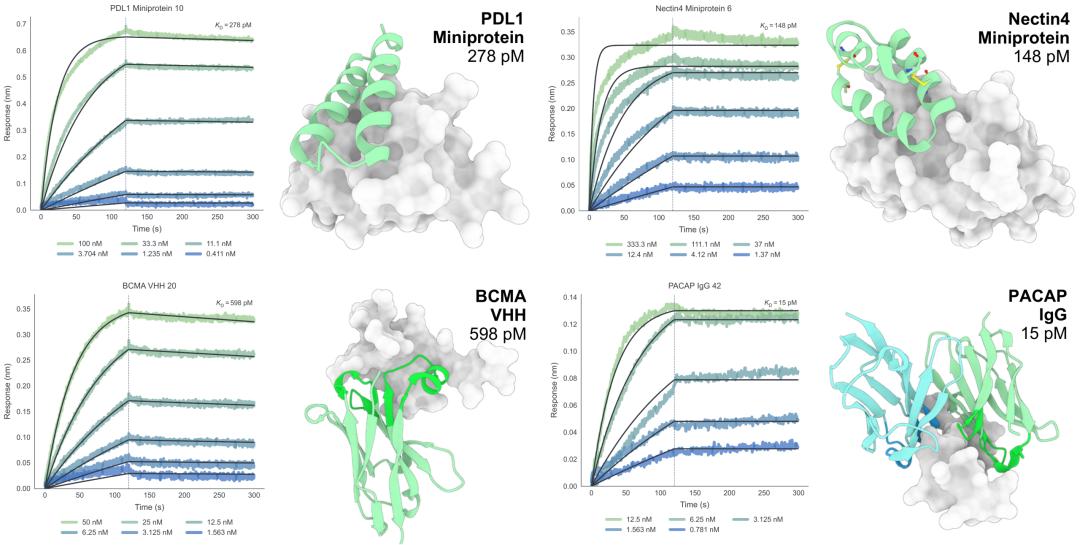
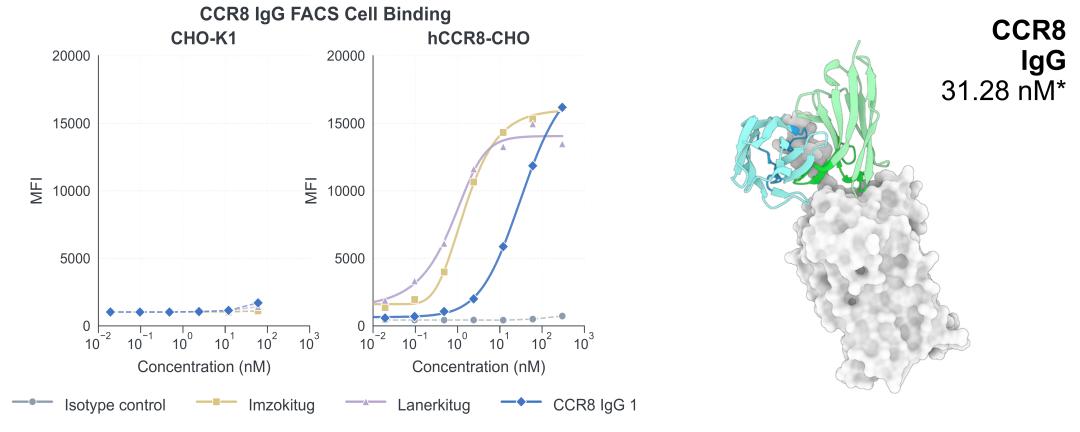
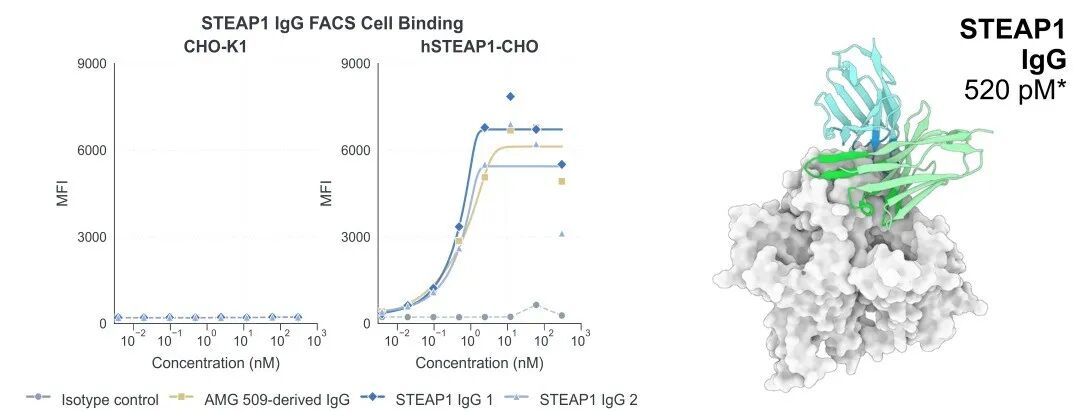
The design capability of the model is also verified in the more challenging scenario of multi-pass transmembrane proteins. GPCR targets such as GCGR and CCR8 have limited recognizable extracellular surfaces and high conformational flexibility, which puts forward higher requirements for de novo design.
The antibodies designed by GeoFlow V4 for three multi-pass transmembrane targets STEAP1, CCR8 and GCGR all show cell binding activity, with apparent EC₅₀ reaching nM level or lower. On the STEAP1 target, binding molecules with apparent EC₅₀ at pM level were obtained, whose cell binding performance is equivalent to or better than that of the anti-STEAP1 terminal IgG of AMG 509.
More than just binders:
Function and developability verification
Obtaining binding molecules is only the starting point of drug development. Subsequent R&D also needs to investigate the functional activity, species cross-activity, specificity of the molecules, as well as developability indicators such as expression, purity, thermal stability and polyreactivity. For example, for signal transduction targets such as GPCRs, binding molecules may produce different downstream signal effects — binding does not equal function.
For MC4R, a key target of energy metabolism, among the 16 tested cyclic peptides designed by GeoFlow V4, 13 of them showed agonistic activity in the cellular cAMP experiment, accounting for more than 80%. This result provides experimental basis for the model to carry out molecular design around the target function.
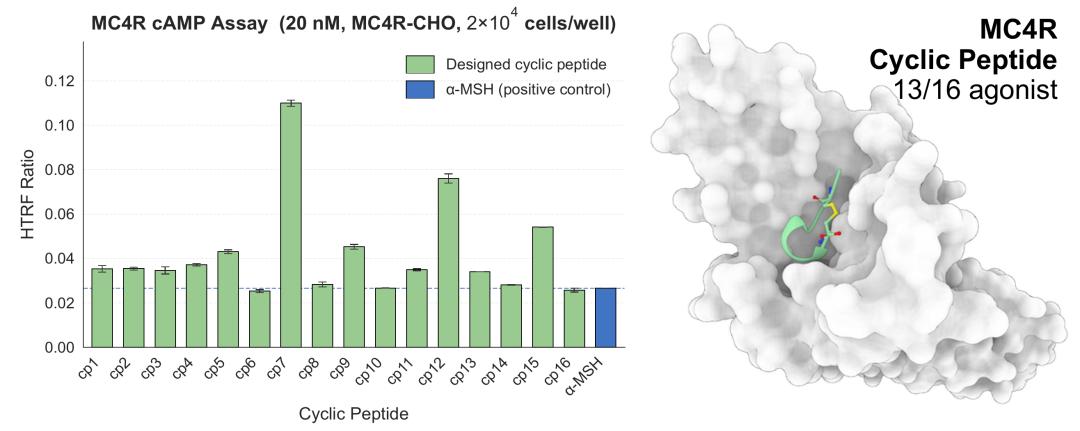
Agonistic activity experiment of MC4R cyclic peptides (the lower the value, the stronger the agonistic activity)
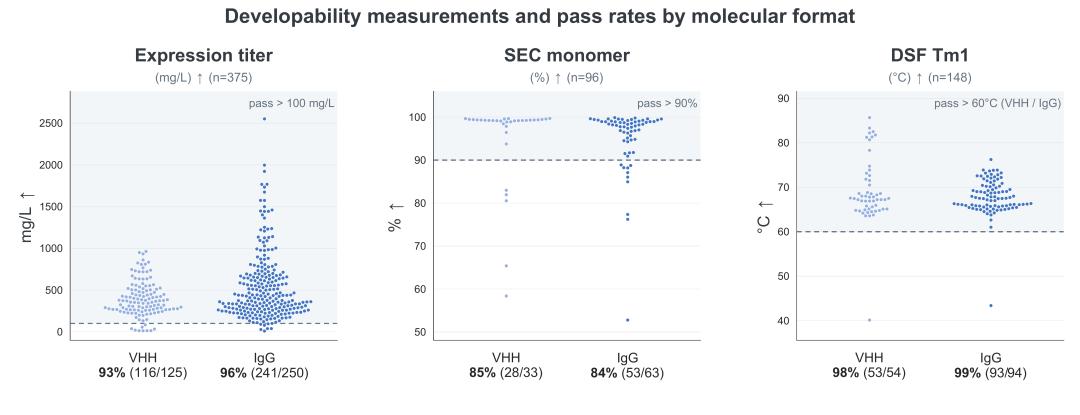
In addition to functional verification, GeoFlow V4 also carried out multi-dimensional developability evaluation on hundreds of VHH and IgG molecules.
•Expression level: 93% of the tested VHHs and 96% of the tested IgGs meet the preset expression level screening criteria;
•Non-specificity: All 94 tested molecules passed the dsDNA and insulin non-specific detection, and the BVP-ELISA detection pass rate reached 99%, with excellent overall performance;
•Purity and thermal stability: More than 80% of the tested VHHs and IgGs have a monomer ratio of more than 90% after one-step purification by Protein A; 98% of the tested VHHs and 99% of the tested IgGs have Tm₁ exceeding 60℃, showing good thermal stability.