Year-end Showdown for Innovative Drugs: From "Faith-based Positions" to "Performance-based Positions", Who Can Deliver the 2027 Answer Sheet?
Since mid-November, it is the most intensive period of position adjustment in a year.
Institutions need to decide where to allocate their capital in the coming year, while individual investors need to decide whether to stay in the market or exit. At this point, the market no longer only demands new stories; it is more eager to figure out which companies have generated real tangible profits, and which are still stuck in expectation projections.
In the past two years, a considerable amount of capital in the innovative drug sector was bet on imagination: a clinical data point, a licensing deal, a narrative around a specific track, and many more. These bets have reached their verification points one after another this autumn: ivonesimab from Akeso received a complete response letter from the FDA and was rejected for marketing application; the Phase III data of DB-1303 from ImmuneOnco was "statistically significant but modest in magnitude"; the PFS endpoint of CMG901 from Kintor Pharma failed to meet the statistical significance threshold. Individually, these are separate situations for three different companies, but taken together, the market has started to reprice for "real delivery of performance".
In this article, we attempt to translate the concept of "performance visibility" into several key data dimensions, and present an observation list.
01
Why Now
The period from mid-November to January of the next year is the season of valuation shift and position adjustment. After crossing this stage, the 2026 financial reports are basically finalized, and expectations for 2027 will start to dominate market pricing.
In other words, companies that can clearly explain their revenue sources for 2027 in this quarter will more easily obtain the next round of capital allocation.
Let's also look at the payment side. Data from the National Healthcare Security Administration shows that in the first 10 months of 2026, the fund expenditure on negotiated drugs within the agreement period has exceeded 120 billion yuan, averaging over 10 billion yuan per month. This is the first time such a sustained, large-scale capital flow has emerged since innovative drugs were included in the national medical insurance catalog.
On the other hand, the 18 drugs in the first version of the commercial insurance innovative drug catalog have been deployed in 1710 designated medical institutions and pharmacies. The number of equipped institutions is about 140% higher than before the catalog was launched, benefiting nearly 30,000 person-times and driving sales of about 600 million yuan.
Both the medical insurance and commercial insurance channels are opening up at the same time. A few years ago, the industry was debating whether innovative drugs could be included in medical insurance, but now the core contradiction has evolved into: after being included, whose drugs have actually achieved real sales growth.
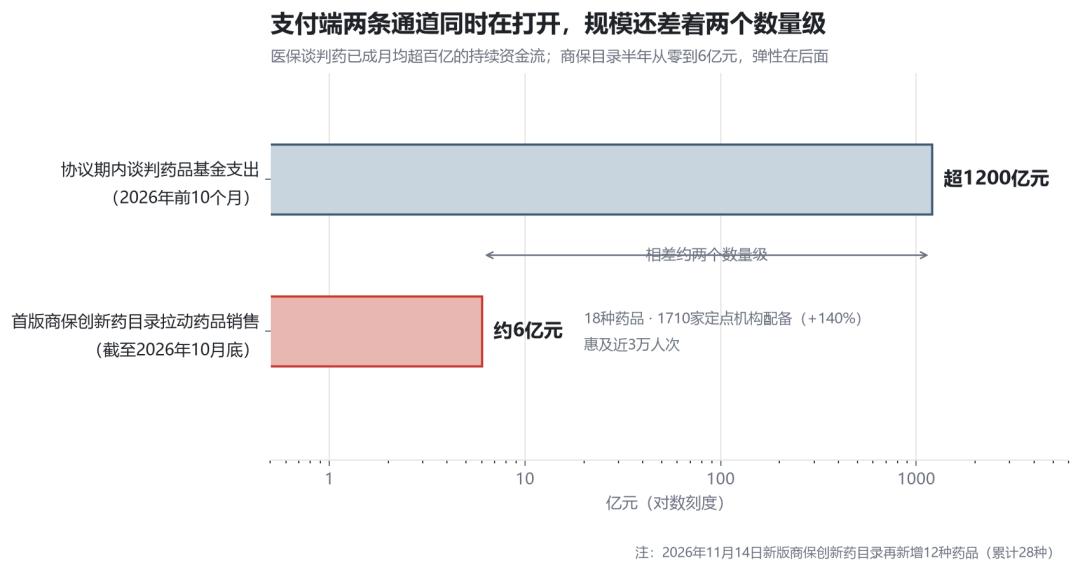
Figure: Scale comparison of the two channels on the payment side (logarithmic scale). Source: National Healthcare Security Administration, Xinhua News Agency, November 2026
This is exactly what "performance-focused positions" need to track, and it will also be the biggest expectation gap for the innovative drug sector in 2027.
02
Three Screening Dimensions
To judge a company's performance visibility, we can observe from three perspectives, each corresponding to one key data metric.
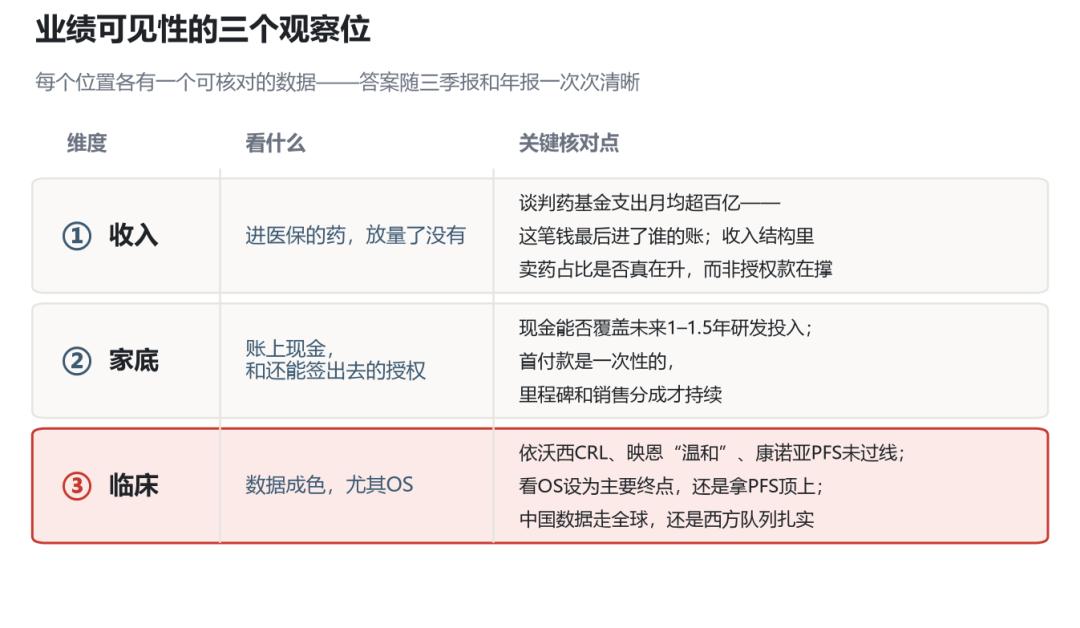
Figure: Three observation points for performance visibility. Source: Arranged by Yiyao
1. Look at revenue: Have the drugs included in medical insurance actually achieved sales ramp-up?
The monthly expenditure of over 10 billion yuan from medical insurance will be audited to confirm which companies' accounts it finally flows into. For varieties included in medical insurance, we need to check whether their revenue growth rate can keep up with the pace of medical insurance-driven sales ramp-up, and whether the proportion of revenue generated from actual drug sales in the revenue structure is truly increasing, instead of being propped up by one-time licensing payments.
Hengrui Medicine is a ready example.
The sales revenue of innovative drugs in the first three quarters reached 13.871 billion yuan, a year-on-year increase of 17.05%, accounting for 64.59% of the total drug revenue. Breaking down the data, the revenue from anti-tumor innovative drugs was 9.865 billion yuan, with a year-on-year increase of only 3.13%; the revenue from non-oncology innovative drugs was 4.006 billion yuan, up 75.36% year-on-year. New products are growing while old ones are slowing down, but the overall product sales growth rate is only 2.52% — the medical insurance-driven sales ramp-up is taking effect, but it is not fast enough to offset the decline of generic drugs and the impact of volume-based procurement clearance.
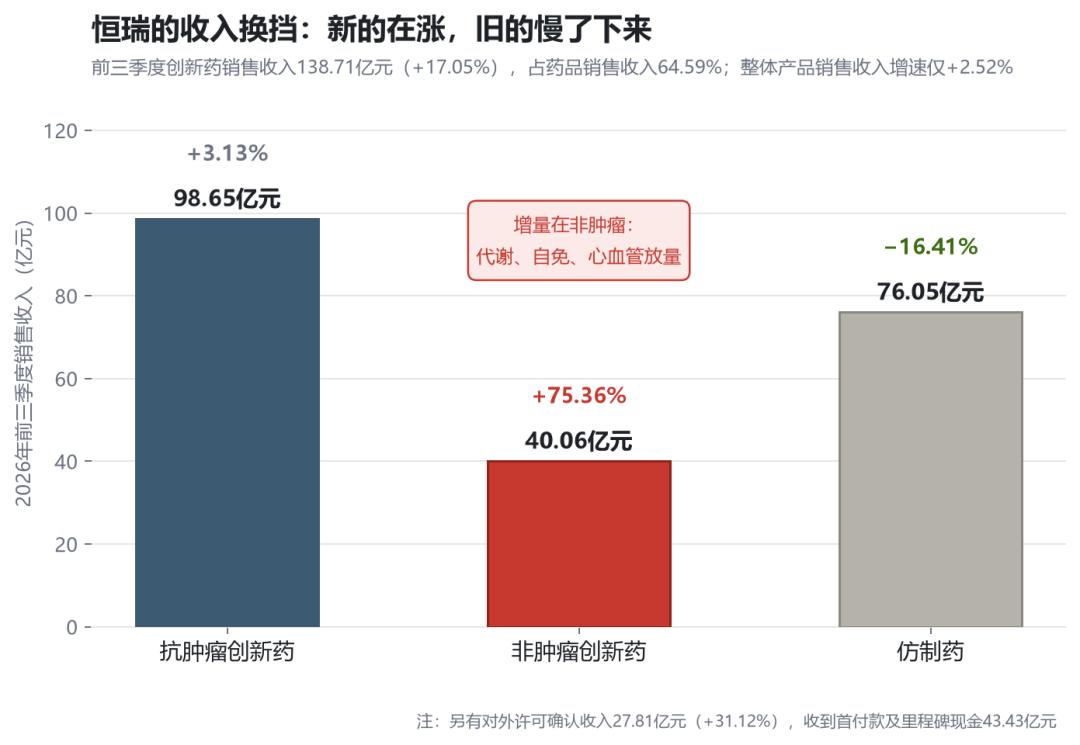
Figure: Revenue structure of Hengrui Medicine in the first three quarters of 2026. Source: Q3 2026 Financial Report of Hengrui Medicine
Both the growth rate and quality of revenue need to be closely tracked.
2. Look at the fundamentals: Cash on the books and upcoming licensing deals that can be signed.
Innovative drug R&D is capital-intensive, and overseas expansion cannot be rushed. For a company to survive until the day of performance delivery, it depends on at least two factors: how much cash it holds, and how many subsequent licensing deals can be signed to replenish cash flow.
Cash determines whether the company can stay afloat, while licensing deals determine whether the cash flow can be sustained — upfront payments, milestone payments, and sales royalties are the sources of profit elasticity in the next few quarters. Upfront payments are one-off, while milestone payments and sales royalties are sustainable.
Some companies' high profits on their financial statements, when broken down, are propped up by licensing revenue rather than drug sales. How long this can last depends on whether the cash on hand can cover R&D investment in the next 12 to 18 months, and whether the rhythm of signing licensing deals remains uninterrupted.
3. Look at clinical progress: Whether the data is fully mature, especially the OS (Overall Survival) data.
This point has been repeatedly verified this year.
The CRL for ivonesimab, the "modest" top-line data from ImmuneOnco, and the failure of Kintor Pharma's PFS endpoint to meet the significance threshold all point to the same implication: under the global registration standard, relying only on PFS benefit while OS benefit is only marginal is increasingly difficult to directly obtain marketing approval, and the FDA is tightening the requirements for OS evidence.
For 2027, this standard will focus on two key points for subsequent pipelines: whether the clinical design sets OS as the primary endpoint, or uses PFS as a temporary alternative; whether the company uses Chinese data to support global registration, or completes Western cohort studies in advance to solidify the data foundation.
The former determines whether its overseas assets will eventually turn into real tangible overseas revenue, or only remain on licensing announcement documents.
03
Observation Pool: Stratified by Performance Visibility
Using the above framework to analyze current companies in the sector, they can be roughly divided into three groups with different levels of visibility.
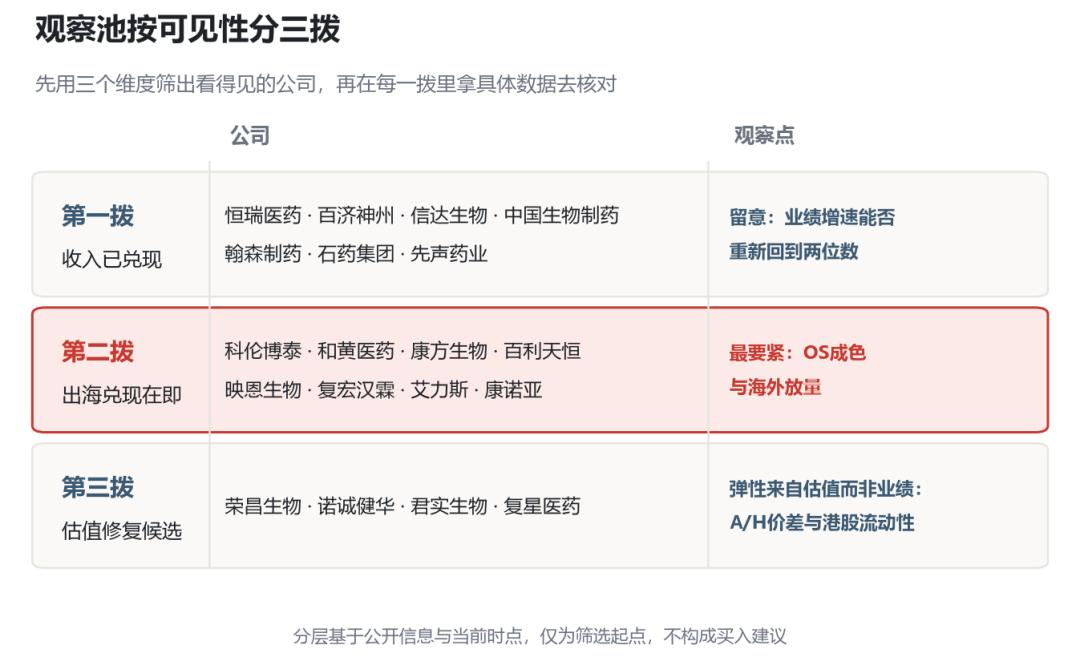
Figure: Observation pool stratified by performance visibility. Source: Arranged by Yiyao
The first group: Revenue has been delivered and the structure is improving.
Hengrui Medicine, BeiGene, Innovent Biologics, Sino Biopharmaceutical, Hansoh Pharmaceutical, CSPC Pharmaceutical Group, and Simcere Pharmaceutical all fall into this category. They have already generated large-scale innovative drug revenue, the medical insurance-driven sales ramp-up and in-hospital access are taking effect, and their profits are no longer solely supported by one-time licensing payments. For this group, the key point to watch is whether their performance growth rate can return to double-digit levels.
The second group: Overseas performance delivery is just around the corner.
Kelun-Bio, Hutchmed, Akeso, Baili Tianheng, ImmuneOnco Bio, Henlius, Allist Pharmaceuticals, and Kintor Pharma all hold large-scale finalized licensing deals, and will successively enter the cycle of overseas commercialization or milestone confirmation starting from 2027.
The opportunities and risks for this group are two sides of the same coin: whether their global registration applications can be approved, and whether their overseas sales ramp-up can be achieved. The quality of OS data in clinical trials is the most critical observation point for this group.
The third group: Candidates for valuation recovery.
Rongchang Biotech, Nuance Pharma, Junshi Biosciences, Fosun Pharma have no fundamental flaws, but the A/H share price gap compressed by the liquidity pressure in the Hong Kong stock market still exists. Once the capital side loosens, their performance elasticity will mainly come from valuation expansion rather than profit growth.
It should be noted that this stratification is only based on public information and the current time point, does not constitute investment advice, and does not make judgments on any individual target. It is only the starting point of the screening process — first filter out companies with visible performance through the three dimensions, then verify them with specific data within each group.
04
Conclusion
The shift from "belief-driven positions" to "performance-driven positions" essentially means changing the perspective of evaluating companies: first check how much payment-side sales ramp-up and performance delivery has been achieved, then check the strength of cash reserves and licensing pipelines, and finally look at the quality of clinical data, especially OS data.
With all three aspects supported by verifiable data, the market outlook will become clearer and clearer as the quarterly and annual financial reports are released one after another.
In summary, several specific figures need to be closely tracked in the future: whether the fund expenditure on negotiated drugs in the medical insurance catalog can continue to maintain an average of over 10 billion yuan per month; whether the number of equipped institutions and sales driving effect of the commercial insurance innovative drug catalog can continue to expand; and whether the first milestone payment or sales royalty can be received as scheduled by several leading companies focusing on overseas expansion in the first quarter of next year.
By observing how these sets of data perform, we will roughly know which companies can deliver satisfactory results for 2027.
This article is from the WeChat Official Account "Yiyao", author: Wang Zhe, published with authorization from 36Kr.