Hu Baosen's Last Card: Countdown to the ownership transfer of Jianye New Life to Temasek
Image generated by AI
Hu Baosen has long overseen and advanced the restructuring of offshore US dollar debts and cross-border debt negotiations. There are not many assets available for financing, among which the equity of the listed property enterprise is the cleanest one.
On November 18, Jianye New Life Services announced in a circular that Hu Baosen, the controlling shareholder, through his wholly-owned Chuangyi Limited, reached debt restructuring for the term loan financing entered into with SeaTown Private Credit Master Fund II on September 24, 2024, signed the amended and restated deed, and simultaneously completed three share-related transaction documents.
The three documents are as follows: converting part of the outstanding loans into 259,827,600 shares, accounting for about 20.00% of the issued shares; granting the security agent an option to purchase 428,715,540 shares, accounting for about 33.00% of the issued shares; and granting a charge on the held shares in favor of the security agent.
Chuangyi currently holds 848,092,944 shares in Jianye New Life Services, accounting for 65.28% of the issued shares. After the debt-to-equity swap is completed, its shareholding will drop to 588,265,344 shares, accounting for 45.28%.
After the three documents take effect, a calculable alternative possibility for the control of this property enterprise has emerged for the first time.
01
Where Does the Debt Come From?
The circular clearly states that the converted shares come from the shares held by the borrower. This means that the debt-to-equity swap will not dilute other shareholders, and only 20% of the shares held by Hu Baosen will be transferred to the lender.
The consideration is not disclosed. The circular only mentions "part of the outstanding loans", and neither gives the amount of the converted loan nor the price per share.
Calculated based on the closing price of HK$0.315 on July 27, 2026, with a total market value of HK$409 million, the market value corresponding to 20% of the shares is less than HK$100 million.
The second document is an option for 428,715,540 shares, accounting for 33.00%, granted to the security agent, who can purchase the shares from the borrower under agreed conditions. If the option is fully exercised, Chuangyi's shareholding will drop from 45.28% to 12.28%, and the lender will hold a total of 53.00% of the shares.
According to the Hong Kong Takeovers Code, holding 30% of the shares will trigger the obligation of a general offer. The hypothetical result of 53% has already crossed this line.
The circular does not specify when the option can be exercised, how the exercise price is determined, and whether a whitewash waiver will be applied for after the exercise.
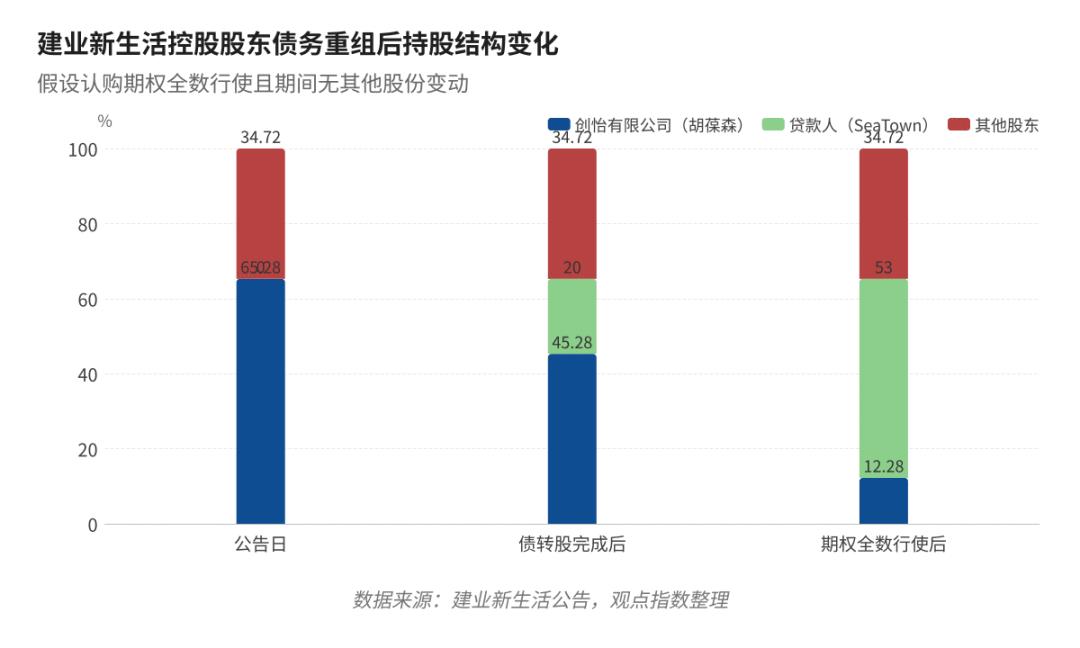
Changes in the shareholding ratio of the controlling shareholder of Jianye New Life Services before and after debt restructuring, data source: Jianye New Life Services announcement, sorted out by Viewpoint Index
The third document is a charge, under which the borrower pledges the held shares to the security agent and grants the charge for the benefit of the security agent.
Putting the three matters together, the path is clear: the creditor first takes 20% of the shares, then locks the disposal right of the remaining equity with the 33% option, and the charge restrains the part that has not been transferred. What is left for Hu Baosen is a possible curve that shrinks all the way from 65.28% to 12.28%.
The starting point of this financing is outside the listed company Jianye New Life Services.
Since Jianye Properties triggered the default of US dollar debts in June 2023 due to failure to pay the interest on senior notes, it has been seeking a comprehensive solution for offshore debts.
According to its announcement dated June 30, 2026, the company has completed the due diligence of the comprehensive offshore debt solution and the first draft of the winding-up analysis report, is formulating a preliminary restructuring plan, and has submitted the core framework of restructuring terms to the creditor's financial advisor.
Hu Baosen himself faces more direct pressure. Since the trust products issued by Jianye to internal employees are guaranteed by him with personal unlimited joint and several liability, in September 2025, the Zhengzhou Intermediate People's Court ruled in the first instance that Jianye Holdings and Hu Baosen should pay Zhongyuan Trust a total of 1.15 billion yuan including principal, premium and liquidated damages; in 2026, Zhongyuan Trust applied for compulsory enforcement, and his assets were included in the enforcement scope.
02
Suspense of Ownership Change
According to relevant reports, since the second half of 2025, Hu Baosen has long overseen and promoted the restructuring of offshore US dollar debts and cross-border debt negotiations.
In such a situation, there are not many assets available for financing, and the equity of the listed property enterprise is the cleanest one among them.
For the term loan in September 2024, the borrower is Chuangyi, which is wholly owned by Hu Baosen, the guarantor is Hu Baosen himself, the collateral is the shares of Jianye New Life Services, and the funds do not enter the listed company.
The lender SeaTown Private Credit Master Fund II is the lender related to the original financing agreement as stated in the announcement. Taking action on collateral and shareholder guarantees is a conventional option for such funds.
The only difference is that this time the collateral is the equity of a property enterprise that is still operating normally.
The statement of the board of directors still follows the standard caliber: the sale of shares by the borrower is expected to expand and diversify the company's shareholder base, which may help improve the liquidity of share trading, and is not expected to have a material adverse impact on the business operation and financial status of the group.
This statement is procedurally valid: the borrower is only a shareholder, Hu Baosen does not serve on the board of directors, and the current board of directors consists of three executive directors namely Chairman Wang Jun, Yan Xuewen and Guo Liyuan, plus three independent non-executive directors namely Liang Xiang, Luo Ying and Xin Zhu; the listed company also has not disclosed that it provides guarantee for this loan.
However, with the equity pledged to others, the control right will no longer be determined solely by the controlling shareholder.
The pricing of the capital market is more straightforward. On July 27, 2026, the share price of Jianye New Life Services fell to HK$0.315, hitting a record low since its listing, with a total market value of HK$409 million. Calculated on this basis, 20% of the shares are worth less than HK$100 million, and the nominal market value corresponding to the 33% option is about HK$135 million.
For a property enterprise with a market value of HK$400 million, the creditor's calculation is not difficult to understand.
Rather than continuing to extend the loan and wait, it is better to take over the shares, so as to hold at least one disposable asset. The controlling shareholder also has limited choices, using 20% of the equity to gain time, and pushing the disposal of the remaining equity to the future.
This is also a rare path for Hong Kong-listed property enterprises. In the past few years, changes in the equity of property enterprises were mostly driven by mergers and acquisitions, privatization or active reduction of holdings by major shareholders, and there are not many cases where private credit creditors take over through the combination of debt-to-equity swap and option.
If the 33% option is finally exercised, the controlling party of Jianye New Life Services will be a Temasek-backed private credit fund, rather than a real estate developer or a peer property enterprise.
Caught in the middle is the property company itself. The equity disposal at the controlling shareholder level will not change the managed contracts, nor will it change the cleaning staff and security guards in the community, but it will change who makes decisions.
For the time being, before the completion of the swap agreement, Hu Baosen and his parties still hold 45.28% of the shares as the largest shareholder, and the board of directors has not made adjustments for the time being.
This article is from "Viewpoint", written by Wuliaoshe, and published by 36Kr with authorization.