Dubbed the "central bank of the AI world", where does all NVIDIA's money flow to?
In recent years, NVIDIA has long been hailed by industry insiders as the "central bank" of the AI circular financing economy. Under the leadership of former CEO Jensen Huang, NVIDIA has not only built the underlying core foundation for the global AI wave — GPU chips, but also built a huge "capital ammunition depot" with strong financial resources.
However, with the sudden departure of this "leather jacket tech leader", Wall Street and Silicon Valley are all deeply worried: will this endless stream of capital continue to flow? Once the capital tap is suddenly turned off, what kind of chain shocks and collateral heavy losses will it trigger?
According to industry statistics, the total value of NVIDIA's investment portfolio exceeds 1000 billion US dollars, covering equity investment in cutting-edge laboratories and bets on power producers and cloud computing companies. It is precisely this series of capital operations that has pushed NVIDIA to the very center of the AI financial landscape — while injecting capital, it has also locked in a steady stream of procurement demand for its own computing power chips.
In other words, the vigorous vitality of the entire AI ecosystem today relies to a large extent on NVIDIA's generous "capital transfusion".
NVIDIA's interim CEO Colette Kress said on the earnings call on Tuesday that NVIDIA is proud of the role it has played in supporting the development of the industry and will continue to evaluate future transactions with a rigorous attitude. She added that the company "still has a lot of work to do to figure out whether these are the right types of investments we need to make".
The following is an industry summary of the capital flow of this "central bank in the AI sector":
The huge layout in the public market
Regulatory filings show that as of September 30, the market value of NVIDIA's shares held in 8 publicly listed companies has exceeded 48 billion US dollars, and its shareholdings are mainly concentrated in partners that purchase NVIDIA products such as GPUs.
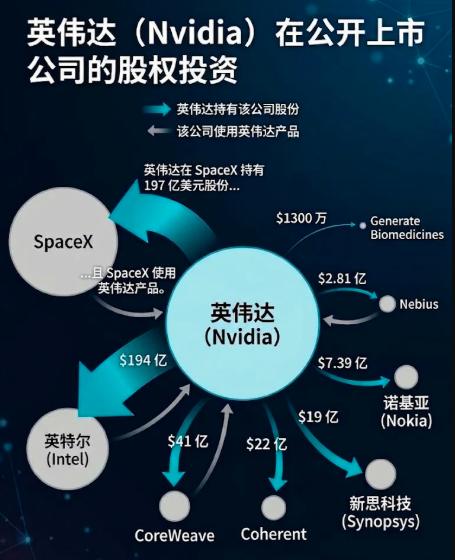
This practice has indeed aroused doubts from some investors and analysts — they call it "circular financing" and worry that the weakness of one company may trigger a chain reaction across the entire market.
Take cloud computing power unicorn CoreWeave as an example, NVIDIA's shareholding ratio in it has reached 10%. CoreWeave purchases a large number of NVIDIA chips, and then leases and sells its computing power to its data center customers.
In addition, NVIDIA's capital tentacles have extended to similar cloud computing power platform Nebius Group, long-established semiconductor powerhouse Intel, and xAI before it was merged into SpaceX.
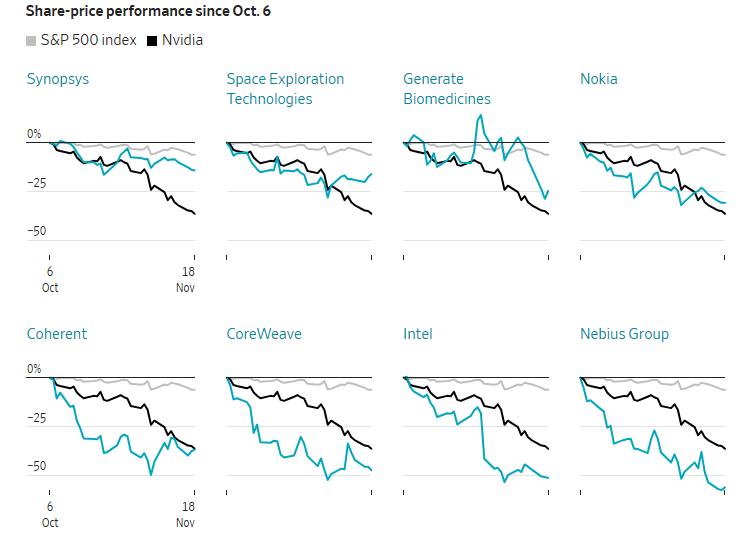
It is worth noting that following NVIDIA's own adjustments, investors have recently begun to flee related targets on a large scale.
Since NVIDIA's stock price hit an all-time peak on October 6, the total market value of the 8 listed companies in which it holds shares has evaporated by as much as 820 billion US dollars in the selling spree, with SpaceX and Intel contributing the vast majority of the decline. At the same time, the sharply rising cost of capital borrowing has also made many AI enterprises struggling.
Betting on the cutting-edge model camp
During Jensen Huang's tenure, NVIDIA also placed huge heavy bets on leading cutting-edge large model players such as Anthropic and OpenAI.
Although these companies are the engines of innovation across the economy, they do not have investment-grade ratings. In order to train models and support upper-layer applications, cutting-edge laboratories have an insatiable demand for massive computing power — which is directly converted into hot sales orders for NVIDIA's high-end chips.
Take Anthropic as an example, as part of Anthropic's initial public offering on Thursday, NVIDIA has committed to purchasing 10 billion US dollars worth of Anthropic shares. According to media reports, in response, Anthropic has signed a 350 billion US dollar agreement with Lambda, another NVIDIA-backed company, to lease data center computing power powered by NVIDIA chips.
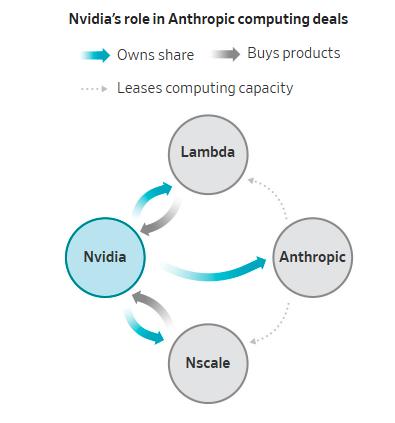
This year, Anthropic also reached an agreement with Nscale, another NVIDIA-backed cloud service provider, to obtain additional computing capacity.
Aggressive venture capital layout
In addition to making large bets on Wall Street's AI darlings, NVIDIA is also one of the world's most active startup investors, and these startups are competing to drive the arrival of the next boom.
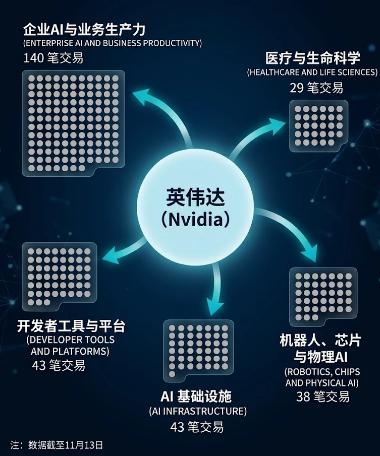
According to PitchBook data, as of November 13, the company has participated in 129 venture capital and startup accelerator transactions this year. So far this year alone, the total amount of venture capital that NVIDIA has participated in jointly with other investors has reached 2200 billion US dollars, accounting for 27% of the total global investment of this type.
According to PitchBook's statistics, since the AI boom fully heated up in 2023, NVIDIA has completed at least 293 investment and acquisition transactions.
Surge of commitments in the future
In addition, the total amount of NVIDIA's off-balance-sheet financial commitments in the next few years is even larger.
NVIDIA reported on Tuesday that the total amount of its commitments in areas such as long-term supply agreements and data center leases reached 5180 billion US dollars, a sharp increase from about 850 billion US dollars a year ago.
One of the guarantees is that NVIDIA will provide up to 1050 billion US dollars in guarantees for SB Energy, a subsidiary of SoftBank, for its planned data center in Ohio, to assist it in issuing bonds for construction costs, and will also make a 1.5 billion US dollar equity investment.
OpenAI has agreed to lease the computing capacity of the data center after its completion, and NVIDIA has the exclusive right to supply chips for the first half of the project.
Of course, there is actually a big question mark as to whether many of these commitments and guarantees can be truly fulfilled at the moment.
For example, in August this year, Jensen Huang led the way to obtain commitments from many companies including Apollo, Blackstone, BlackRock, Brookfield, Goldman Sachs and KKR to raise an astonishing 5000 billion US dollars in funds, with NVIDIA providing fallback arrangements and guarantees. This huge sum of money was originally intended to help NVIDIA's startup customers finance the purchase of required chips. However, according to people familiar with the matter, no funds have actually been invested so far.
Now, with Jensen Huang stepping down, investors are increasingly skeptical about whether this plan can achieve its ambitious goals.
This article is from the WeChat official account "CLS", author: Xiaoxiang, published with authorization from 36Kr.