Nvidia's leadership shakeup: Why is even Bezos in a hurry to warn that "no external hiring is allowed"?
NVIDIA has suddenly entered the post-Jensen Huang era, and Silicon Valley's reaction is unusually unanimous. After Jensen Huang announced his resignation on November 12, the NVIDIA board of directors quickly searched for a successor, and veterans such as Arm CEO Rene Haas were included in the candidate list.
But Amazon founder Jeff Bezos directly poured cold water on the idea, warning that NVIDIA must never hire an external CEO, arguing that the success rate of an outsider taking over is extremely slim. Meanwhile, a number of heavyweight Wall Street funds wrote to the board of directors demanding that a window be reserved for Jensen Huang to return, and a large number of joint petitions signed by employees supporting the founder's reinstatement emerged on the company's internal intranet.

For a giant company with a market capitalization of trillions of dollars, there used to be a standardized procedure for the founder to step down. Back then, Apple, Microsoft and Amazon all smoothly transitioned to professional managers after leadership changes, but everyone's attitude towards NVIDIA is completely opposite. All the external anxieties actually point to the same underlying fact: NVIDIA is ostensibly a semiconductor giant, but internally it is a super mechanical system deeply tied to Jensen Huang. In this company, hardware architecture, network topology, software ecosystem and supply chain quotas are all locked on the same gear.
A traditional professional manager who is used to reading financial statements and receiving reports layer by layer, once parachuted in, will most likely not even find the start key. With 60 people reporting directly to him, Jensen Huang is not a manager but a system bus. To understand why outsiders find it so hard to take over NVIDIA, you first have to understand its counterintuitive organizational structure.
In typical Silicon Valley giants, the management hierarchy is like a pyramid, with responsibilities scattered layer by layer. But NVIDIA has long maintained an extremely flat wheel-shaped structure. According to disclosures from the Financial Times of the UK and many other media outlets, about 60 senior executives inside NVIDIA report directly to Jensen Huang in a single line.

Over the past 30+ years, this company has never set up a chief operating officer position, nor has it had co-presidents. Jensen Huang calls core backbones to meetings every Monday, rarely arranges one-on-one communications, but instead brings heads of chip design, system architecture, network interconnection, software compilation and sales together to resolve technical differences face to face. He also personally spot-checks the emails of the top 5 most important tasks submitted by employees every week, and even skips layers to enter front-line R&D email groups to follow up on details.
This management method is often judged as high-risk in business school textbooks, but at NVIDIA, it has become the most efficient technical router. Chip design is not a stack of independent software. For a graphics processing unit, from wafer tapeout to underlying compiler matching, any change will affect the overall situation.
In a pyramid structure, cross-departmental compromises can drag on for months at the middle management level. But at NVIDIA, Jensen Huang is a full-bandwidth system bus, with 60 technical ports directly connected to his mind. He can make a spot decision in the corridor to shift resources to liquid-cooled full racks, and decide the internal bus standard for next-generation chips within one day.
This highly centralized model eliminates intermediate frictions, allowing NVIDIA to maintain a brutal pace of iteration once a year. But the entire company has not developed a decentralization mechanism over the past 30 years. Once the core router is removed, the 60 high-speed running spokes will lose their coordination benchmark. External managers who are used to relying on middle-level reports will face overwhelming underlying engineering decisions, and will not even know who to affix the company seal for.
Selling chips has turned into selling full racks, outsiders cannot move this hardware-software flywheel at all Many people still regard NVIDIA as a company that sells graphics cards and acceleration chips, which is exactly the biggest misunderstanding of its business model. If NVIDIA only sold chips, replacing it with a professional manager would not be difficult at all.
Qualcomm, Broadcom and even AMD all follow the business logic of designing chips well, handing them over to TSMC for manufacturing, and then selling them to server manufacturers by the unit. But today's NVIDIA has undergone qualitative changes in its delivery logic. During the GTC conference held in Berlin, Germany, Jensen Huang demonstrated the NVLink 72 system.
What NVIDIA sells to Microsoft, Meta and Amazon today is not loose chips at all, but ultra-high-density computing power full racks that integrate 72 graphics processing units, 36 central processing units, a large number of high-speed copper cables, power supply units and liquid cooling pipes into one sealed unit.
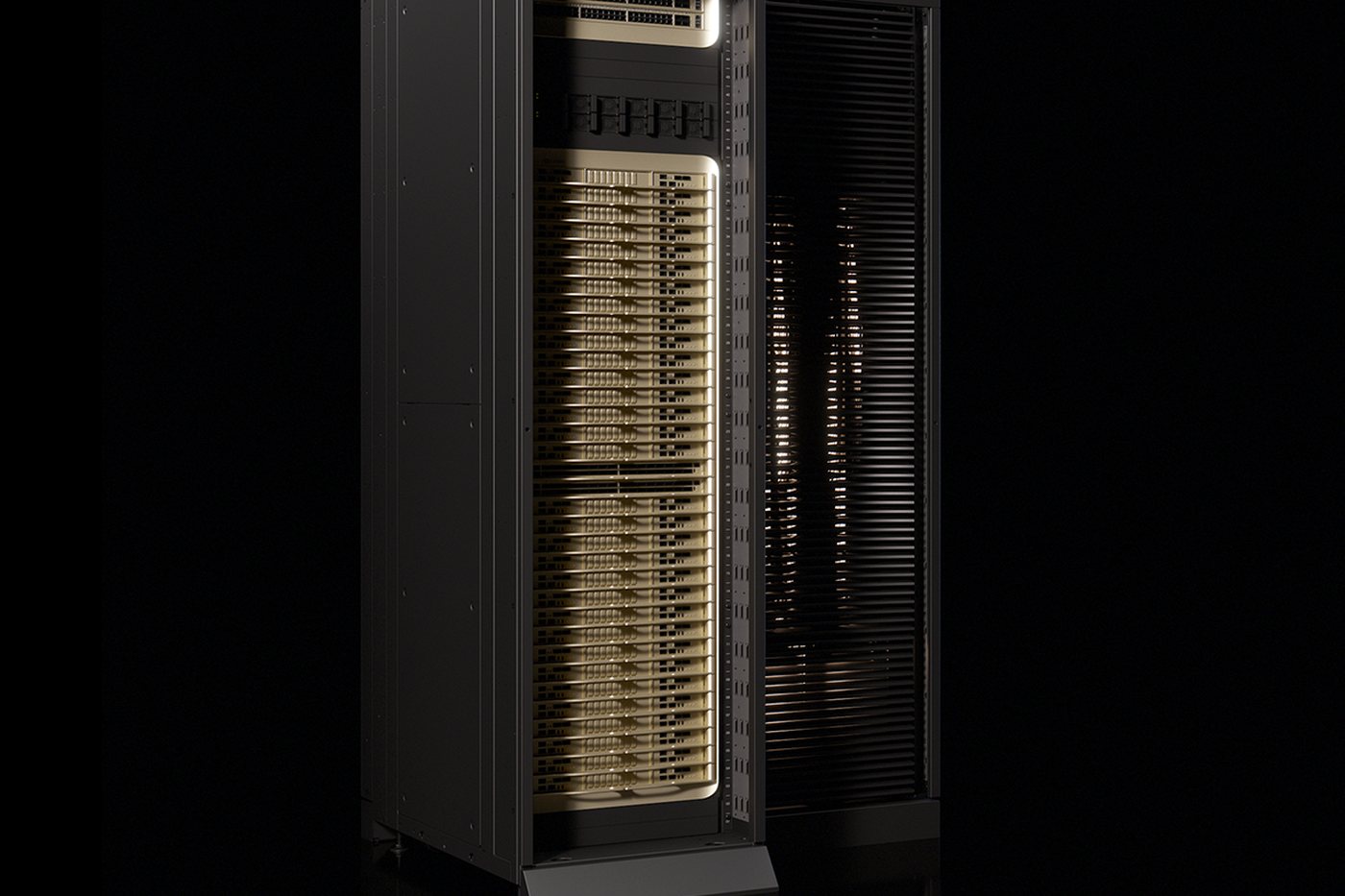
A single rack weighs more than one ton, with power consumption as high as hundreds of kilowatts, and the assessed price is generally at the level of millions of US dollars. Upgrading the chip business to full rack delivery directly raises the competitive barrier to the level of complex system engineering.
In a single rack system, 72 chips need to form one large-scale computing power domain through the proprietary NVLink network bus. Any tiny impedance change or coolant jitter will cause large model training to report errors and shut down. To maintain system stability, microsecond-level tuning must be carried out between the chip microarchitecture, switch design, motherboard wiring and CUDA communication library.
When software engineers write communication operators for CUDA, they can directly find network executives to modify the switch register logic. When the network team encounters bottlenecks, they can cooperate with the chip department at any time to adjust the next-generation mask. What external professional managers are best at is usually drawing clear boundaries of rights and responsibilities and accounting for independent profit centers.
If the new manager splits the chip, network and system integration departments to calculate their input-output ratios separately, the entire tightly meshed technical flywheel will fall apart immediately. The reason why NVIDIA can deliver supercomputers in batches today relies on system-level coordination that does not count partial costs.
The high-stakes bet without a second-in-command means professional managers cannot afford the zero-fault-tolerance cost. The core reason why NVIDIA has crossed countless life-and-death hurdles in the past 30 years is that it dares to fight those deadlock battles that may not see returns for ten years. According to disclosures from semiconductor analysis agency SemiAnalysis, many strategy-level R&D projects promoted by Jensen Huang are internally called zero-return bets.
This kind of bet not only cannot bring profits to the company in the first five or even ten years of project approval, but also needs to continuously swallow tens of billions of dollars in R&D budgets. The most typical example is CUDA.
In 2006, when Jensen Huang decided to stuff expensive computing logic into every graphics card, chip manufacturing costs rose sharply, gross margins were hit hard, and Wall Street analysts publicly criticized this practice as suicidal resource waste.
But Jensen Huang persisted in investing for seven or eight years under the pressure of plummeting stock prices, and finally built a software moat that no AI developer in the world can bypass when deep learning exploded.
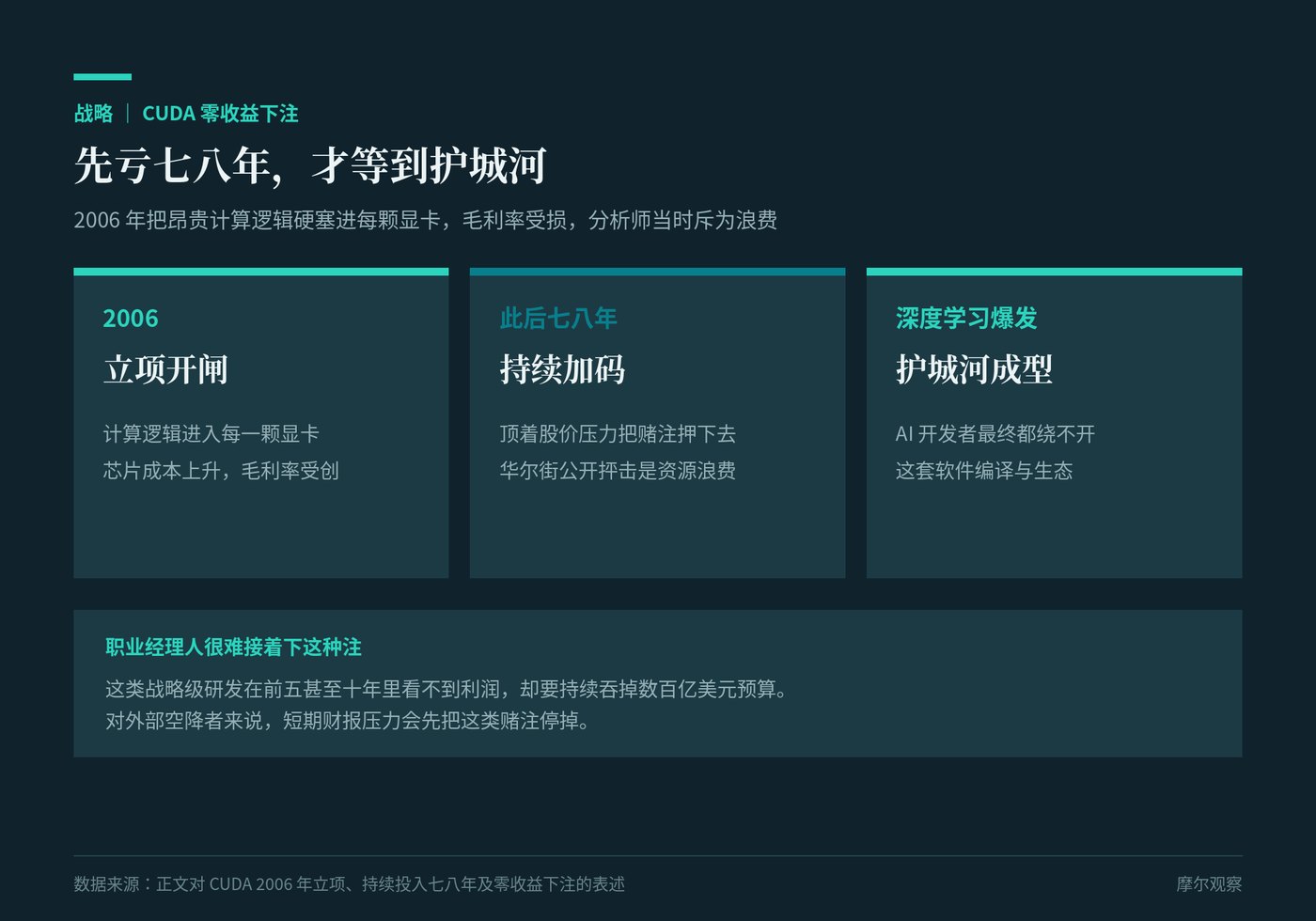
The premise for being able to make this kind of strategic high-stakes bet is the absolute prestige and right to speak that Jensen Huang has as a co-founder. Even when facing doubts from external investors, he has enough capital to say no to the board of directors, and bet the entire company's fate on his own technical judgment.
But the survival logic of professional managers is completely determined by board terms and quarterly financial reports. If an external executive takes over, the top priority will inevitably be to stabilize stock prices, control capital expenditures, and improve short-term profit margins to deliver results to Wall Street. Facing those cutting-edge explorations that burn billions of dollars every year and see no certain returns within three to five years, professional managers have almost no motivation to continue to bear the political risk of failure.
Now when large model training shifts to inference computing, there are full of divergences in chip architecture iteration. Should NVIDIA continue to maintain the expensive large chip interconnection route, or compromise on low-cost dedicated architectures? This kind of life-and-death choice requires the paranoid intuition of an architect, not the balanced plan of a consultant. To avoid risks, professional managers often instinctively choose the safest compromise plan.
But on the highly competitive semiconductor battlefield, compromise is often the beginning of falling behind. TSMC and the Taiwan foundry circle never rely on a single procurement contract. NVIDIA's seemingly unbreakable business empire actually has a fragile fatal flaw at the physical level: it is a typical fabless semiconductor enterprise that does not produce any silicon wafer itself. Its computing power advantage ultimately has to be implemented in TSMC's advanced packaging production lines and Taiwan's dense server manufacturing factories.
The origin of Jensen Huang's connection with TSMC can be traced back to the 1990s. In the darkest moment when NVIDIA's early R&D funds were almost exhausted, TSMC founder Morris Chang personally answered his call for help and lent a hand on the foundry scheduling.
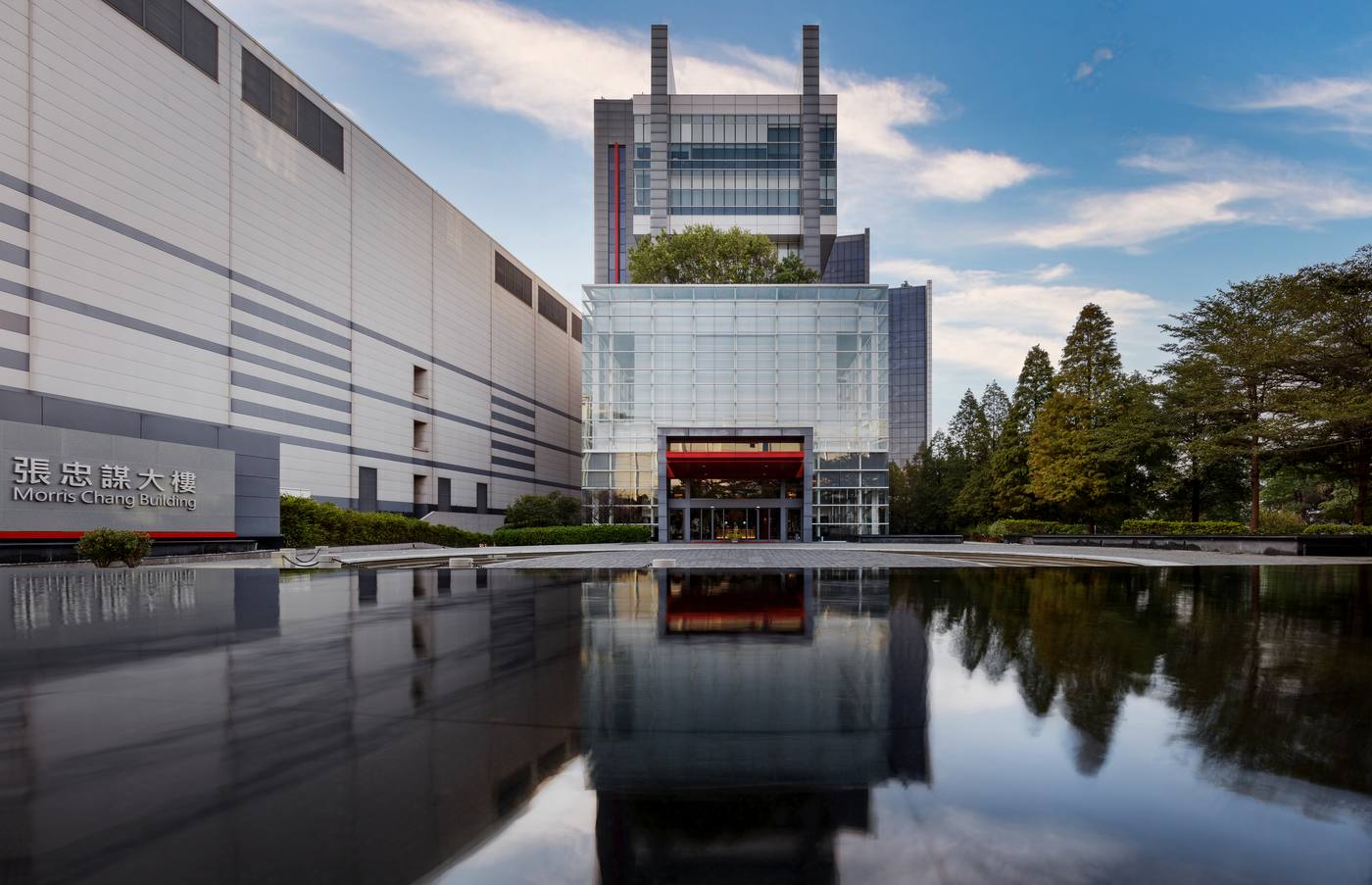
Over the past 30 years, Jensen Huang has regarded Morris Chang as his mentor, and is deeply tied to TSMC in advanced process and later advanced packaging technologies. Even when TSMC was under pressure to cut prices from European and American customers due to soaring expansion costs, Jensen Huang spoke up for TSMC on many public occasions, emphasizing that TSMC's technical value was seriously underestimated, and publicly supporting reasonable price increases.
This community of interests nurtured over the long term with real money and personal credit can never be replaced by several cold procurement contracts. In the field of high-end chip manufacturing, production capacity is never spot goods that can be bought just with money.
In the past two years, the global advanced packaging production capacity has been in full shortage. The reason why TSMC firmly reserves the first batch of advanced packaging production capacity for NVIDIA is not only for commercial interests, but also for decades of mutual technical trust. Looking downstream of the industrial chain, full rack manufacturing also relies heavily on the personal network that Jensen Huang has cultivated over the years. Foundry giants such as Foxconn, Quanta and Wistron have been his allies since the graphics card era.
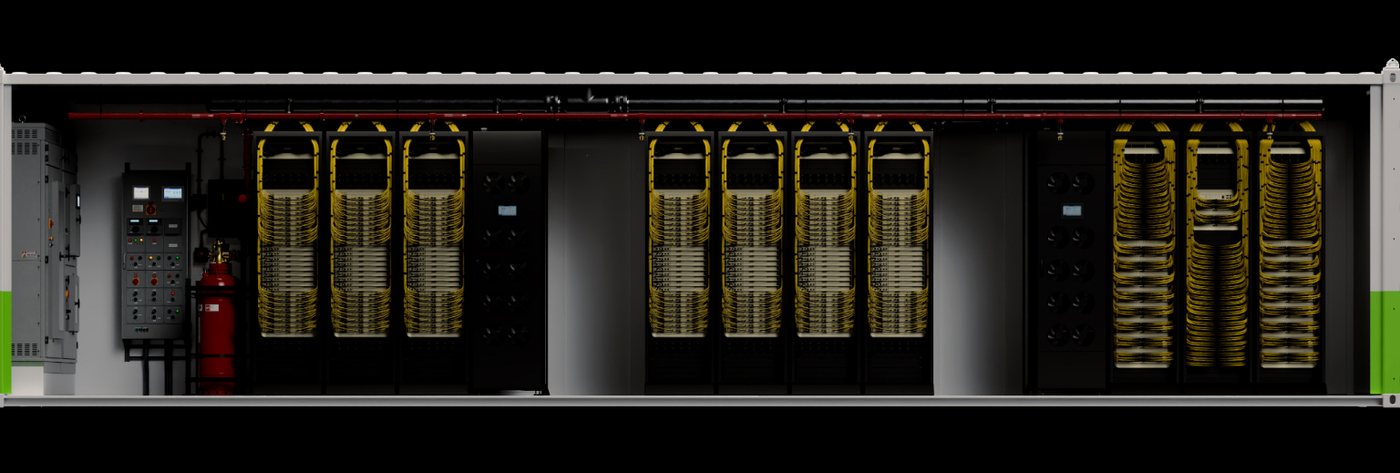
Today's full-liquid-cooled racks have complex structures. In order to keep up with the pace of annual iteration, foundries must invest hundreds of millions of dollars in advance to help NVIDIA rush work and test errors. The reason why the heads of foundries are willing to take the risk of production line scrapping is entirely because they bet on Jensen Huang's personal reputation. If a parachuted external manager uses cold audits to force the supply chain, the original tacit understanding will collapse in a short time.
At the juncture of production capacity shortage, even a few weeks of quota fluctuations in the supply chain will lead to delivery disasters measured in tens of billions of dollars. In conclusion Bezos' public warning on NVIDIA's leadership change is not a polite comment, but this business veteran who has experienced several technological transitions saw through the special structure inside NVIDIA's huge body at a glance. NVIDIA has never been a traditional multinational company that operates on its own relying on institutionalized gears. Every bus, every compiler, every high-stakes bet on cutting-edge technologies, and the cross-Pacific foundry alliance, are all customized according to the instruction set of Jensen Huang, this "processor".
This unexpected leadership change storm has actually pushed NVIDIA to an unavoidable technological fork in the road. If the board of directors yields to compliance pressure and external discipline, forcibly introduces a professional manager who lacks full-stack hardware understanding, and dismantles the flat wheel structure into a standardized pyramid with distinct layers, NVIDIA may be able to produce several stable and compliant financial reports in the short term, but the agility and wildness that it relies on to dominate the AI era will also be worn away. There is no halftime break in computing power competition. When a super giant starts to become overly stable, those self-developed chip camps eyeing it from behind will finally get the best window to overtake.
This article is from the WeChat Official Account "Moore Insight", and 36Kr is authorized to publish it.