Beyond Embodiment, the Other Half of the Endgame of Physical AI: A 59-page Long Paper by Fei Hao of Oxford Proposes the New Paradigm of "Cognitive Symbiont"
Over the past decade, progress in AI has been measured by only one metric: how many tasks machines can complete independently.
Measured by this standard, the results are quite impressive. Today's Agents can write and review code, draft documents, and work continuously on computers for hours; Meta, xAI, and OpenAI have successively launched resident background personal intelligences to monitor long-term goals for users; Embodied AI is another rising trend, where robots are gaining their own bodies, perceptions, and goals. Personal Agent and Embodied AI are almost the two most popular terms in the AI circle right now.
But a simpler question is rarely asked: as AI gets more powerful, have humans become stronger as a result?
You get a brilliant idea in the morning, but forget it the moment you sit down at your desk; when a colleague asks you about a result from three years ago in a meeting, you just can't recall that number; late at night, facing a familiar choice, you can't remember how you figured it out last time. AI does more and more things for us, but the boundary of human cognition itself has barely moved.
Recently, Hao Fei, a senior researcher in the Department of Computer Science at the University of Oxford, published a 59-page perspective paper on arXiv. He argues that in addition to embodied robots, there is a second equally important intelligent individual in the physical AI era: AI-augmented humans.
Embodied AI gives AI its own body, which is the most widely discussed half of physical AI. The paper focuses on the forgotten other half: AI steps out of computers, integrates into human life, sees what people see, hears what people hear, and ultimately makes humans cognitively stronger themselves.
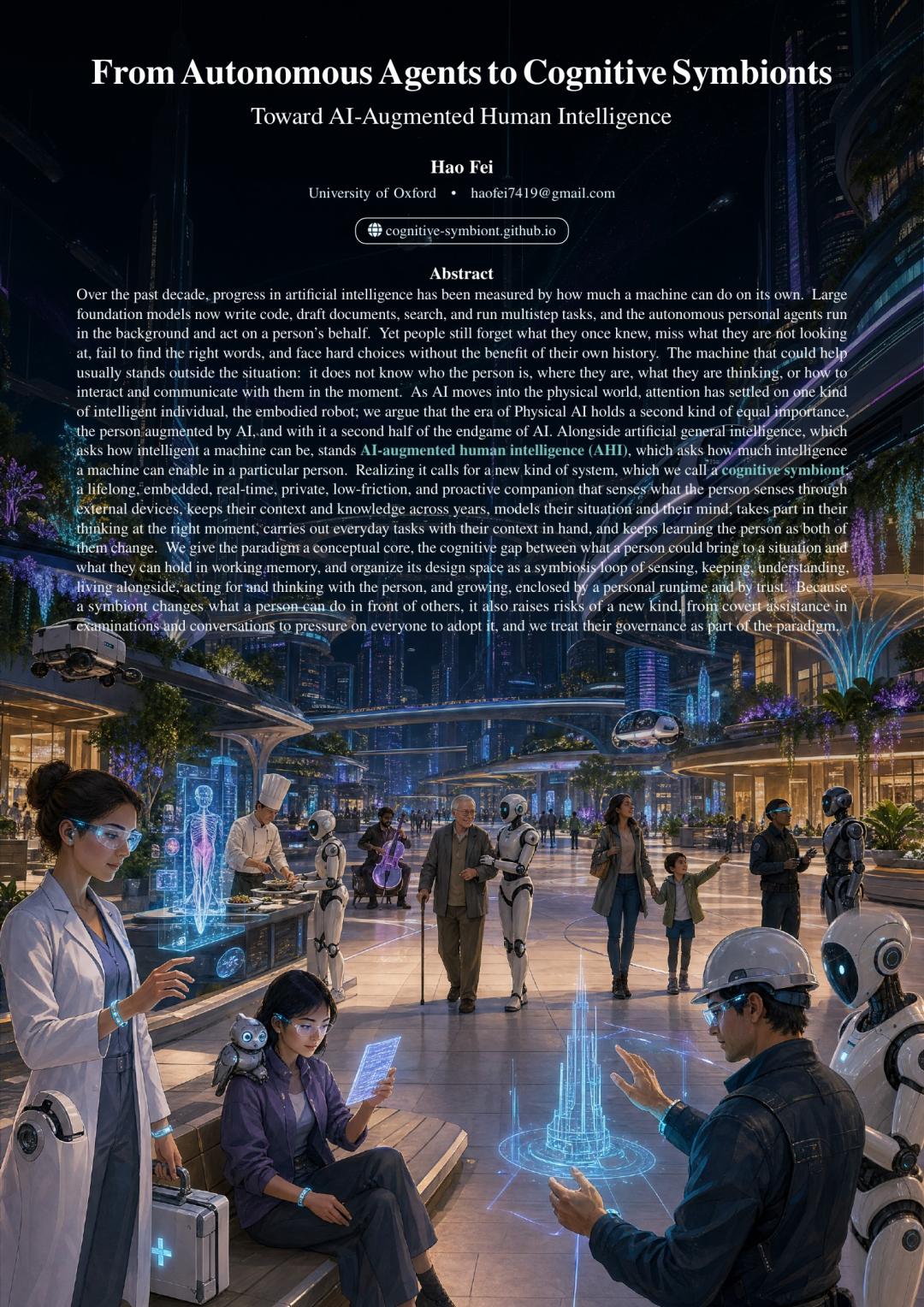
Based on this judgment, the paper names the "other half" of AI's end state as "AI-Augmented Human Intelligence (AHI)", and proposes a system form to achieve it: "Cognitive Symbiont".
- Thesis Title: From Autonomous Agents to Cognitive Symbionts: Toward AI-Augmented Human Intelligence
- Thesis Link: https://arxiv.org/abs/2611.05376
- Project Homepage: https://cognitive-symbiont.github.io
- Concept Video: https://www.youtube.com/watch?v=OBQF9SN7S3E
AGI asks "How smart can machines be?"
AHI asks "How smart can a specific human being become with the help of machines?"
If you want to use a well-known public image to understand the Cognitive Symbiont, the reference given in the paper is Jarvis in Iron Man: it is always present, has known its owner for many years, can participate while the owner is speaking and acting, and never asks the owner to stop to explain. The paper discusses how to make everyone have such a system, and how far it should go further than Jarvis.
The core proposition of the paper can be broken down into five key words:
- The second type of intelligent individual: In the physical AI era, AI-augmented humans are as important as embodied robots, and the two share the same cognitive core;
- Cognitive Symbiont: A new form of AI existence, which is lifelong, embedded, real-time, private, low-friction, and proactive;
- Cognitive gap and symbiosis loop: Provides a measurable core for this paradigm, as well as a complete map of the design space;
- Nearly everyone: From an ordinary person's daily life to the most demanding experts, from classrooms and clinics to the living rooms of the elderly, the symbiont has a role to play wherever humans need cognitive assistance;
- Risk and governance: A system that can make people stronger in public must design the risks it brings as an integral part of the paradigm itself.
Hao Fei writes very restrainedly in the paper: this article does not propose new algorithms, it advocates a framework, a map of the design space, and a set of evidence standards. But he also clearly expresses his expectation that this concept can orient a new AI research paradigm; in this paradigm, the measure of progress is how capable each specific human being becomes.
Next, we start with one person's day.
One person's day:
Five failures, none of which are due to insufficient intelligence
The beginning of the paper does not talk about models, but describes an ordinary day of a researcher.
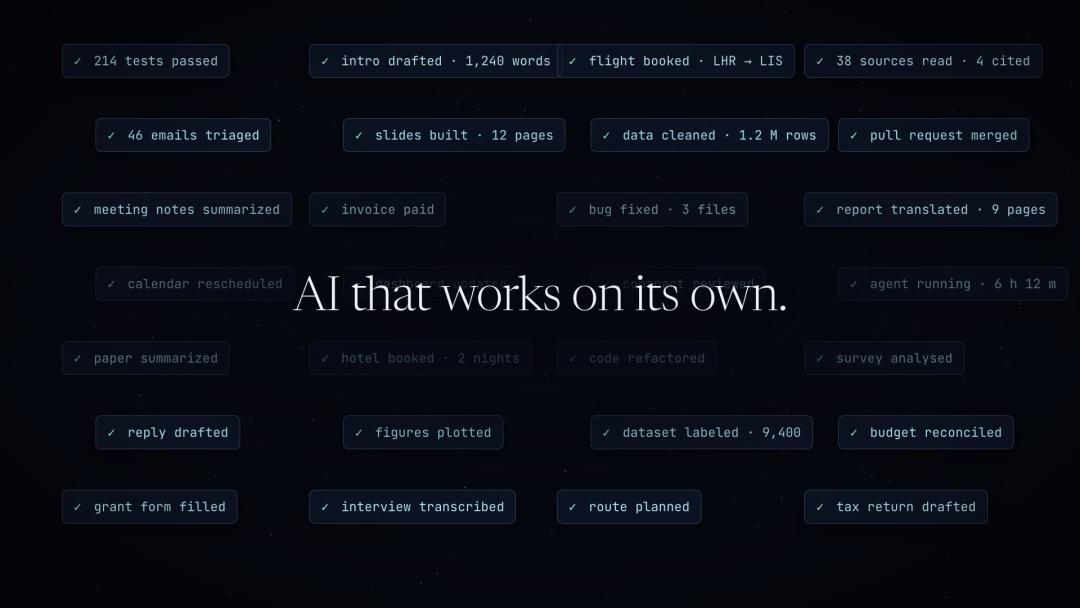
Figure 1: AI is increasingly "doing things for us". Source: Concept Video
According to the paper, for the part of work completed in front of the screen, productivity has been transformed by AI and has been largely solved. But this researcher's day still has the losses that have always existed.
In the morning, when she was working alone, an idea popped up and slipped away before she had time to write it down. At the afternoon meeting, a colleague asked her about a result she published three years ago, and she couldn't remember that number. At night, she faced a decision, but couldn't remember how she reasoned when she encountered a similar situation last time.
The other two gaps fall into the same category: travelers in a foreign country don't know how to politely decline an invitation; people who have just experienced failure need words from someone who truly understands them, but only receive general encouragement.

Figure 2: Her three failures. Source: Concept Video
The author divides these five incidents into two categories. The first three are failures of "access": things that humans already own fail to be present at the moment they are needed; the last two are gaps in knowledge and support that humans cannot fill by themselves at that moment. None of the five incidents is an intelligence problem.
What is more thought-provoking is the subsequent judgment of the paper. In every scenario, AI that masters the relevant knowledge actually exists, but it is not present: it does not know who this person is, where he is, what he wants to do, how he feels at the moment, nor is there a natural way to communicate with him right now.
AI is getting stronger, but humans are still the same. What went wrong?
The forgotten other half:
The second type of intelligent individual in the physical AI era
AI is leaving the screen and stepping into the physical world. The ensuing question is: what intelligent individuals will exist in that world?
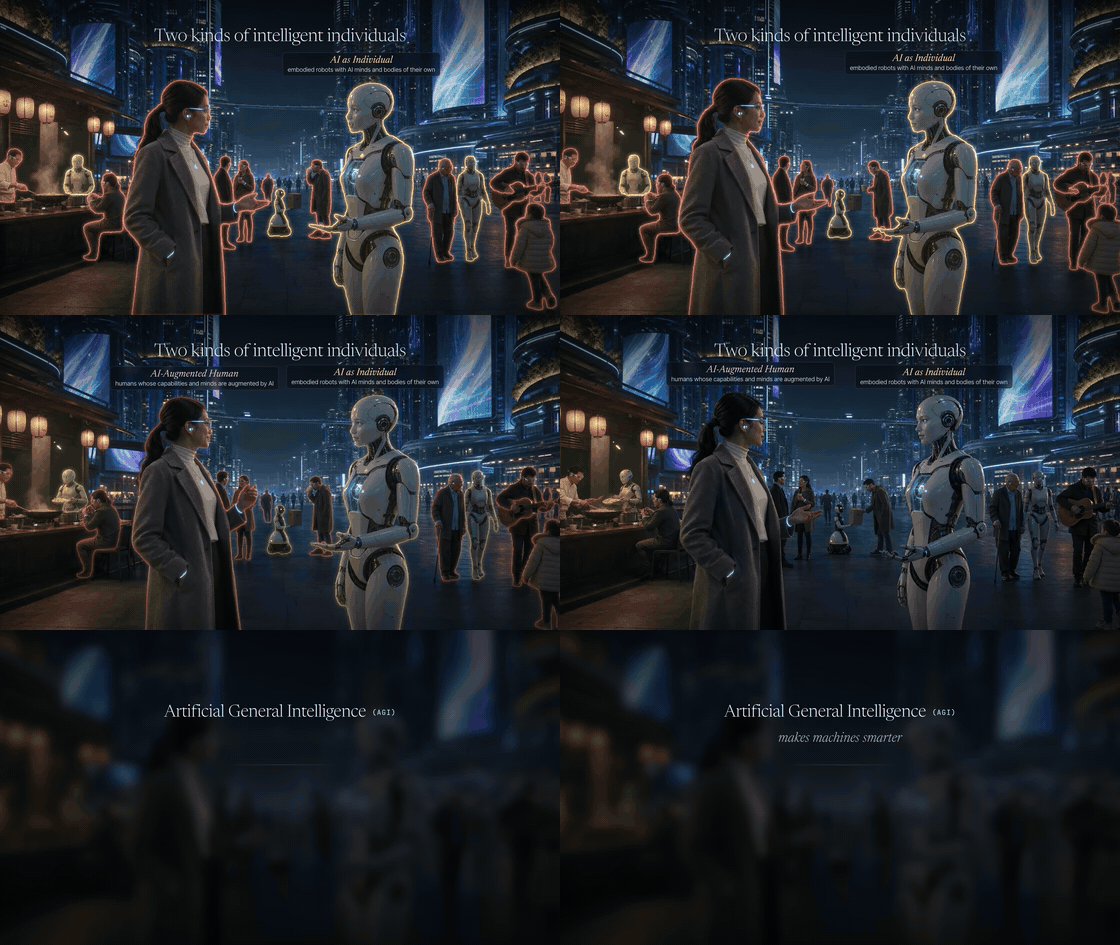
Figure 3: Two types of intelligent individuals in physical AI. The red outline is the AI-augmented human, and the yellow outline is the embodied robot. Source: Concept Video
The industry's answers are almost unanimous: embodied robots, an AI with a body, perception, and its own goals. The other main line is personal intelligences. The paper specifically mentions that several personal intelligences released in 2026, such as Meta's Muse, xAI's Grok Bot, and OpenAI's Dots, can already track long-term goals, run continuously in the background, and learn user preferences, so it is inaccurate to say that they only complete tasks.
But these two main lines have one thing in common: the object being evaluated is AI. One line focuses on what AI can do for humans, the other focuses on what AI can do on its own. But the value of AI ultimately falls on humans.
The judgment of the paper is that there will be a second equally important intelligent individual in the physical AI era: a human whose own senses, memory and judgment are connected to an AI that "lives" on him.
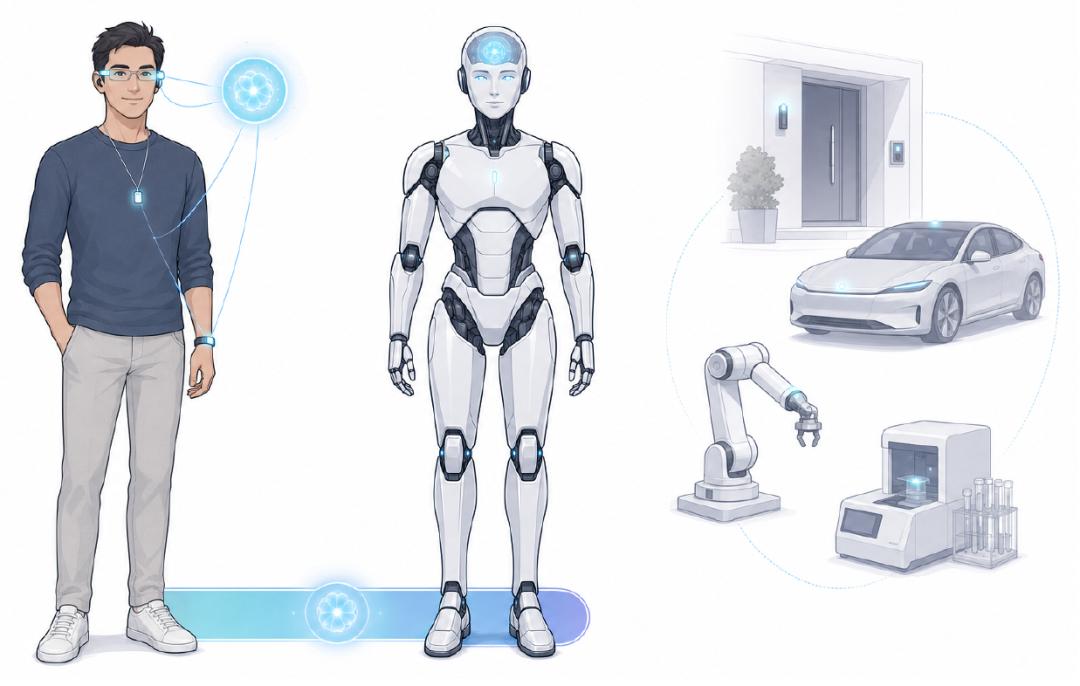
Figure 4: Two types of intelligent individuals. The left is the AI-augmented individual, the middle is the embodied robot, and the two share the same cognitive core; the light-colored part on the right is the environmental equipment that both can extend into. Source: The Paper
The author makes a clear distinction between these two individuals. The AI-augmented individual is a real person who obtains a symbiont through wearable devices and other interfaces; the human is always the subject, the goals are his, the body is his, and the AI borrows his senses and his hands. The AI as an individual is an embodied robot with its own body, perception, action, and goals.
The core thesis of the paper is that the two share a cognitive core: long-term memory, modeling of situations and other people's minds, timely intervention, and learning from experience. The only differences between them are three points: whose goals, whose body, and who is responsible.
This also changes the ruler for measuring AI progress. The paper divides the final state of AI into two halves:
Artificial General Intelligence (AGI) asks how smart machines can be; AI-Augmented Human Intelligence (AHI) asks how much intelligence a specific human can have with the help of machines.
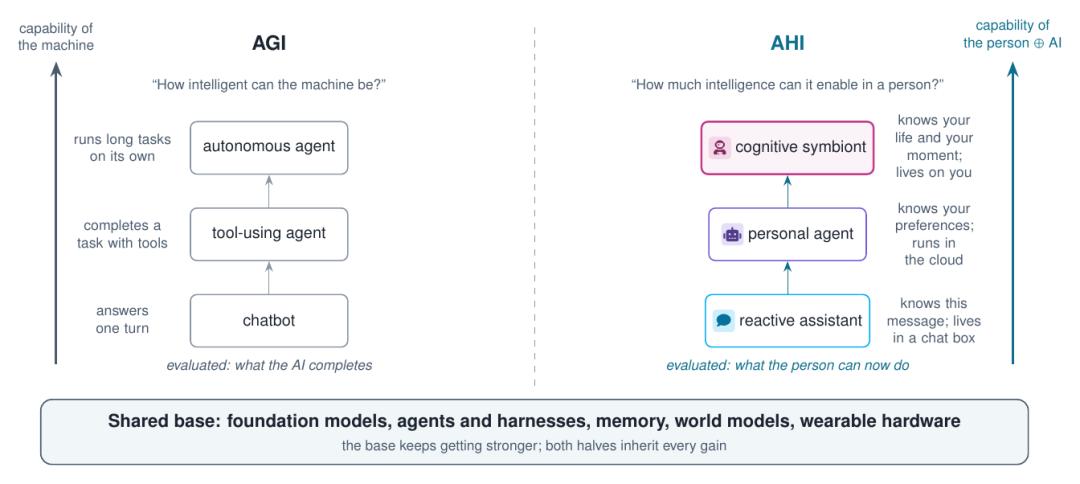
Figure 5: The two halves of AI's end state. On the AGI side, it evolves from chatbots to autonomous agents, evaluated by what AI has accomplished; on the AHI side, it evolves from passive assistants to cognitive symbionts, evaluated by what this human can achieve now; the two sides share the same foundation. Source: The Paper
The two halves are built on the same foundation: the same base model can be both an autonomous agent that completes tasks and a cognitive symbiont that augments a human's cognition. The differences lie in the evaluation object, the way of existence, and the relationship with humans. The paper also emphasizes that these two halves are parallel, not two successive alternative stages, and AHI will inherit every progress of the foundation.
From the perspective of the relationship between humans and AI Agents, the paper sorts out four roles and forms that Agents have played: passive assistants represented by ChatGPT, Claude, and Gemini; autonomous agents represented by Claude Code and Codex; personal intelligences that do things for you in the cloud in your way; and cognitive symbionts that are close to humans and make humans themselves more capable. Looking forward, what the Agent knows expands from a single message to a whole life, and its location moves from the chat window to the computer, the cloud, and finally lands on the human body.
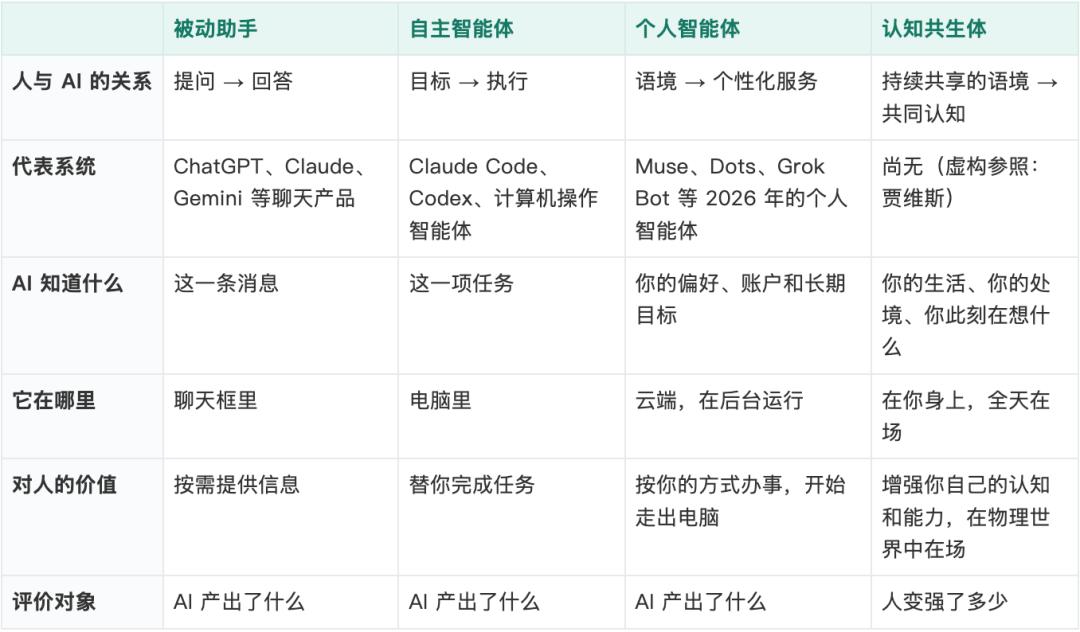
Table 1: Four roles in the human-AI relationship. From left to right, AI knows more and more, gets closer and closer to humans, and its value shifts from providing information to making humans stronger. Source: Compiled from Table 1 of the Paper
The last line of the table is the most worth reading: the first three roles evaluate what AI outputs; only when it comes to the symbiont, the evaluation object is replaced by humans. The paper specially points out that the fourth role includes the first three: a symbiont must first be a competent autonomous agent and personal intelligence, and then it can be something more. As for the difference between personal intelligence and symbiont, the paper points it out in one sentence: personal intelligence does things for humans in the cloud, while symbiont thinks with humans by their side.
Then why now? The author's answer is: The bottleneck has shifted.
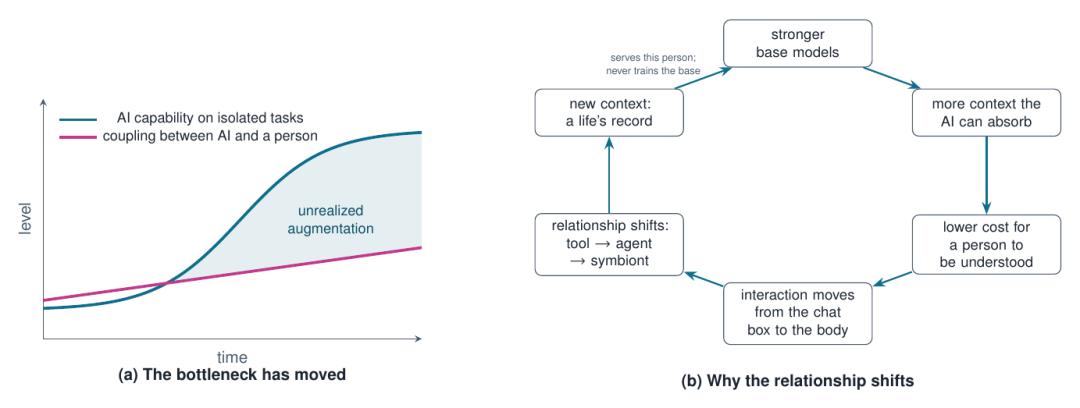
Figure 6: In the left figure, AI's ability on isolated tasks continues to rise, while the coupling between it and a specific human has hardly changed, and the shaded part is the augmentation that has never been realized; the right figure is the mechanism of relationship transformation. Source: The Paper
Human cognitive bandwidth is fixed: working memory can only hold a few things, attention can only focus on one place at a time, and there are only 24 hours in a day. AI's ability on isolated tasks keeps rising, but the "coupling" between it and a specific human has hardly changed: how much it knows about this person, how fast it can intervene, how much disturbance it causes when intervening, and how much this person trusts it. As a result, the gap between what the model can contribute and what humans actually get is widening.
The judgment of the paper is: The next step for personal AI is tighter coupling, and tighter coupling is a different problem from building larger models.
The author also gives three symptoms of insufficient coupling: you have to explain the background from scratch every time you talk; help comes too late or is too noisy; people dare not entrust any important things to it.
Cognitive Symbiont:
Everyone's Jarvis, six steps further
To fill this other half, a new form of AI is needed, which the paper calls Cognitive Symbiont.
In the words of the paper, it perceives what this person perceives, preserves his life, models his situation and mind, participates in his thinking at the right moment, does things for him with his context, and continuously learns about this person in the process where both are changing.
See what you see, hear what you hear, understand what you think
The symbiont does not have its own body, and its senses are borrowed.