36Kr Exclusive | Backed by state-owned investors from multiple regions, this neutral-atom quantum computing enterprise has secured hundreds of millions of yuan in Series B round financing.
Source / Enterprise
This article contains approximately 3600 words, with an estimated reading time of 9 minutes
Author | OU Xue
Editor | YUAN Silai
Hard Krypton has learned that Hangzhou MatriQ Computing Co., Ltd. (MatriQ, hereinafter referred to as "MatriQ"), a neutral-atom quantum computing company, recently announced the completion of a Series B financing of several hundred million RMB.
This round of financing was jointly participated by institutions including Hangzhou Industrial Investment Group, Hangzhou High-Tech Financial Investment, Chengdu Science and Technology Innovation Investment, Hongruida Investment, Bosch Venture Capital, Guangzhou Haizhu Urban Development, and Sichuan Venture Capital, bringing together state-owned capital platforms, industrial capital and market-oriented investment institutions from multiple regions. The financing will support the company in connecting regional resources, launching mass hyper-convergence pilot projects, and deepening industrial ecological cooperation. Within one year, MatriQ has completed five consecutive rounds of equity financing, with the total accumulated financing amount exceeding 1 billion RMB.
Founded in 2025, MatriQ is a cutting-edge technology enterprise focused on full-stack solutions for neutral-atom quantum computing. Centered on engineering, productization and commercialization, it is committed to building practical quantum computers.
Xia Xiyuan, founder of MatriQ, obtained his bachelor's and master's degrees from Imperial College London, and pursued his doctoral studies at Heidelberg University and the Max Planck Institute of Quantum Optics (MPQ, hereinafter referred to as "Max Planck Institute"), under the supervision of Anton Zeilinger, the 2022 Nobel Prize laureate in Physics. The Max Planck Institute is one of the birthplaces of global neutral-atom quantum computing, which first realized independent manipulation of single atoms and single-site resolution readout in optical lattices, and is also an important participant in the drafting of the global strategic whitepaper for this technical route.
In addition, the company has gathered R&D talents from universities and scientific research institutions including the Max Planck Institute, Imperial College London, University of Cambridge, Carnegie Mellon University, Columbia University, Zhejiang University, Shanghai Jiao Tong University, and Sun Yat-sen University, covering fields such as quantum physics, optical engineering, precision manufacturing and quantum algorithms.
Among the multiple technical routes of quantum computing, superconductivity, ion trap and neutral atom each have their own advantages and disadvantages. MatriQ chose the neutral-atom route, whose core advantage lies in its natural edge in large-scale qubit expansion.
Neutral-atom quantum computing has continued to gain increasing attention in recent years. Xia Xiyuan told Hard Krypton that in the past three to four years, the number of physical qubits in the neutral-atom route has achieved large-scale growth, leading overseas teams have made successive breakthroughs in nodes such as logical qubit coding and continuous atom loading, and core indicators such as single-qubit gate and two-qubit gate fidelity are also improving rapidly.
At present, MatriQ has built full-link technical capabilities from independent R&D of core devices to complete machine system integration, realizing the construction and stable operation of a defect-free array of up to 2310 physical qubits, making it one of the few neutral-atom quantum computing manufacturers in China with the delivery capability of kilobit-level complete machines.
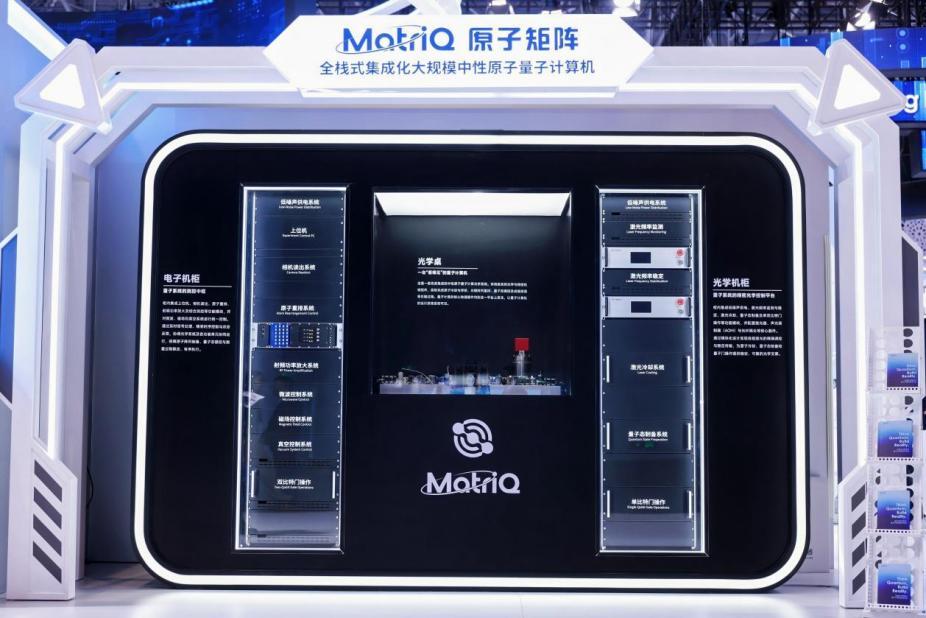
Physical picture of the complete machine (Source / Enterprise)
In terms of product architecture, MatriQ adopts a storage and entanglement partition design. Xia Xiyuan explained that a core challenge of neutral atoms is that when performing laser operation on a specific qubit, it is easy to interfere with surrounding qubits that do not need to be operated. The partition architecture moves atoms from the storage area to the entanglement area before performing gate operations, which not only avoids the impact on other qubits, but also supports parallel operation on multiple pairs of atoms at the same time, thus improving computing efficiency.
For errors introduced by non-target light irradiation, the partition architecture itself is one of the solutions — atoms will not be affected when light hits the storage area. In addition, the team will use lasers of other wavelengths to "cover" the atoms that do not need to be operated for shielding, to further reduce errors.
In terms of commercialization pace, MatriQ adopts a two-wheel drive strategy of "complete machine + cloud platform". On the complete machine side, the company provides on-site deployable neutral-atom quantum computing complete machines for computing infrastructure customers such as data centers, and has already signed the first batch of commercial orders for complete machines with domestic data centers.
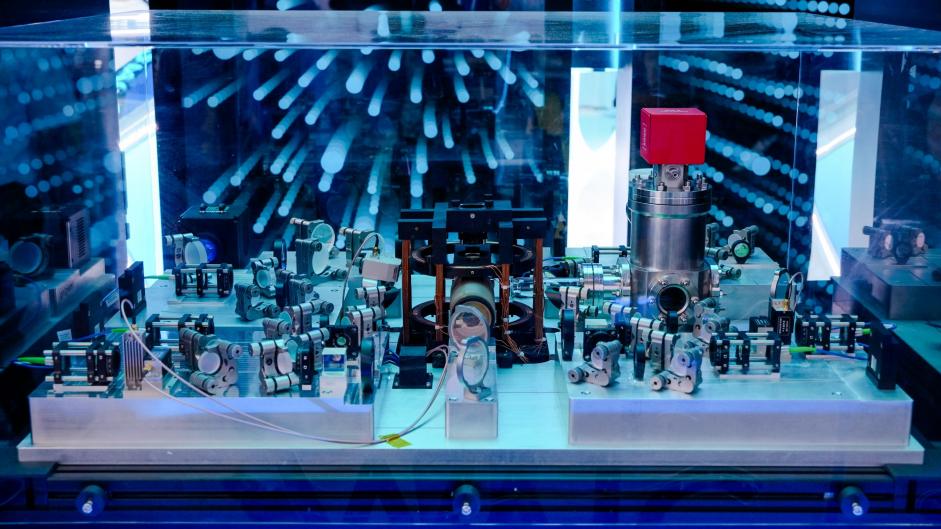
Partial detail picture of the complete machine (Source / Enterprise)
On the cloud platform side, the MatriQ quantum cloud platform is directly connected to the self-developed complete machine computing power, equipped with standardized programming interfaces and intelligent task scheduling, mainly serving domestic and foreign scientific research institutions, quantum software and algorithm startups, and R&D departments of large enterprises in fields such as biopharmaceuticals and materials.
Xia Xiyuan revealed that the cloud platform is currently undergoing final internal testing and internal customer testing, and will be opened to more customers as soon as possible, and commercial orders have been communicated with some customers. He judged that complete machines and cloud platforms will be equally important in the short to medium term, and in the long run, the cloud platform is expected to become a larger business segment, "because it has lower requirements for customers than complete machines and is more convenient".
In terms of technical indicator planning, MatriQ's goal next year is to realize the logical coding conversion from thousands of physical qubits to dozens of logical qubits, achieve 99.99% single-qubit gate fidelity, and stably reach more than 99.5% two-qubit gate fidelity; the year after next, it will further achieve nearly 10,000 physical qubits and nearly 100 logical qubits.
Xia Xiyuan told Hard Krypton that both the team and investors have long-term expectations for the quantum computing track. "We will take this track as a 10-year track for layout."
In his view, the next challenges are mainly concentrated at two levels. On the technical side, how to increase the number of physical qubits and operation accuracy faster, and convert fewer physical qubits into logical qubits with lower error rates, requires multi-dimensional iteration of R&D, hardware, software algorithms and error correction algorithms. On the ecological side, how to build a developer community and find truly usable segmented scenarios for quantum computing is as difficult as hardware iteration.
The following is an excerpt from the interview between Hard Krypton and Xia Xiyuan (edited):
Hard Krypton: The neutral-atom route has attracted significantly increasing attention in the past two years. As an insider, what do you think of the differences between this route and other routes?
Xia Xiyuan: In the past three to four years, the neutral-atom route has stood out, mainly for several reasons. First, the number of physical qubits has achieved a very large-scale growth; second, leading overseas teams from Harvard and MIT have made technical milestone breakthroughs in realizing logical qubits through error correction coding of physical qubits. The advantages at these nodes have excited the industry. But quantum computing itself is a track with a very long cycle, the technical path has not actually converged, and there is still a very long way to go.
Hard Krypton: Very few people in the industry are working on cloud platforms. What are the technical difficulties in this area? Will it become a larger source of cash flow in the long run?
Xia Xiyuan: First of all, a complete complete machine is required. Without a complete machine, the cloud platform is more like a castle in the air, which requires a complete machine with stable performance indicators. The second layer is the capability to build a complete cloud platform, involving multi-layer software from underlying hardware control, intermediate compilation layer to upper-layer cloud platform and even application layer, which requires the company to have full-stack capabilities to combine hardware R&D and delivery capabilities with in-depth software understanding. In addition, finding more customers, lowering the usage threshold, and allowing ecological partners to join in is a task with a long cycle and relatively higher difficulty.
In the long run, with the outbreak of quantum computing in specific segmented industries, the cloud platform will indeed become a relatively large business segment, because it has lower requirements for customers than complete machines and is more convenient. We will attach equal importance to complete machines and cloud platforms in the short to medium term, and in the long run, we will explore more business models of cloud platforms, including cooperating with ecological partners and cloud vendors to open up the complete machine computing power to more users.
Hard Krypton: Overall, what are the company's competitive advantages?
Xia Xiyuan: Our competitive advantage does not lie in a single patent, but in engineering and full-stack capabilities. Since its establishment, the company has anchored engineering, productization and commercialization, and has spent a lot of time and resources converting laboratory instruments into repeatable, mass-producible and deliverable products. Our team has the complete capability to build a complete machine from 0 to 1, with independent design capabilities for core components. At the same time, leveraging the advantages of China's supply chain, we have great advantages in cost and iteration efficiency.
In addition, we started early, and our first round of investors invested after seeing our complete machine. Quantum computing is a global competition. In the long run, the advantages of Chinese companies in cost and delivery time will continue to be amplified. We will not only compete in cutting-edge innovation, but also participate in global competition in the commercialization path.
Investor Views:
Hangzhou Industrial Investment Group stated: "Quantum technology is an important layout direction for Hangzhou's future industries. Rooted in Hangzhou, MatriQ continues to promote full-stack R&D of neutral-atom quantum computing, has formed kilobit-level complete machine delivery capabilities, and has obtained commercial orders from data center customers. We are optimistic about the team's technical accumulation and engineering execution capabilities, and look forward to the company further gathering high-level talents, strengthening cooperation with local scientific research institutions and upstream and downstream enterprises, and forming more complete quantum computing R&D, product and service capabilities in Hangzhou."
Hangzhou High-Tech Financial Investment stated: "Hangzhou High-Tech Financial Investment has long been optimistic about the neutral-atom route. With remarkable advantages such as high scalability, no need for extremely low temperature refrigeration, and lower error correction overhead, this route is one of the most promising technical directions for large-scale fault-tolerant quantum computing. The core backbone of the MatriQ team comes from top international scientific research institutions such as the Max Planck Institute, has realized the stable operation of a 2310-atom defect-free array, and has a clear iteration path for subsequent series of models, completing the leap from laboratory prototypes to commercial products. As a Hangzhou state-owned capital platform, we hope to deeply accompany the growth of the enterprise, help the enterprise take root in Hangzhou, and cultivate a local rising star in quantum computing. We look forward to the team continuously polishing the performance of complete machines, outputting domestic quantum computing power for scenarios such as scientific research, biomedicine, and material simulation, and promoting the accelerated maturity of the domestic neutral-atom quantum computing industry."
Hongruida Investment stated: "Quantum computing is still in the stage of diversified exploration. Hongruida Investment adheres to the idea of multi-route layout, and embraces the coordinated development of multiple technical routes of quantum computing. Relying on the self-developed partition storage-entanglement architecture and full-stack engineering capabilities, MatriQ has taken the lead in realizing the landing of kilobit-level neutral-atom quantum complete machines, and is a benchmark team in the first echelon of the domestic neutral-atom route, with both cutting-edge theoretical innovation and industrialization realization capabilities. We expect MatriQ to continue to overcome core problems such as large-scale entanglement and stable operation, and drive the accelerated maturity of the domestic neutral-atom quantum computing power ecology."
Chengdu Science and Technology Innovation Investment stated: "We pay attention to the actual progress of the transformation of cutting-edge scientific and technological achievements into industries. MatriQ has completed the advancement from prototype R&D to complete machine order signing, and has the conditions for in-depth cooperation with scientific research institutions, computing power centers and industrial customers. We look forward to combining Chengdu's scientific research and industrial resources to expand joint R&D, complete machine deployment and application verification with MatriQ, explore the synergy between quantum computing and existing computing infrastructure, and introduce new technical forces for the development of the region's future industries."
Bosch Venture Capital stated: "What we value is the combination of quantum hardware, algorithms and actual industrial problems, as well as the team's ability to continuously carry out engineering R&D and application verification. MatriQ's accumulation in neutral-atom complete machines and full-stack technology provides the foundation for such exploration. We look forward to the company carrying out research with more industrial partners, testing technical progress through specific tasks, and gradually expanding the industrial application of quantum computing."
Guangzhou Haizhu Urban Development stated: "We are optimistic about the long-term development prospects of quantum computing, and also pay attention to the ability of enterprises to transform technical accumulation into products and businesses. MatriQ's continuous investment in the field of neutral-atom quantum computing and the progress it has made in complete machine R&D and commercialization are important bases for our investment judgment. Quantum computing requires long-term R&D and patient investment. We look forward to supporting the company to steadily promote product iteration and market expansion through this investment, and realize the growth of enterprise value in the long-term development."
Sichuan Venture Capital stated: "Quantum computing requires long-cycle investment, and we pay attention to whether the team can continue to make progress around a clear technical route. MatriQ has both underlying physical research and complete machine engineering experience, and is simultaneously promoting key tasks such as product delivery, quantum error correction and logical qubits. We are optimistic about the expansion potential of the neutral-atom route, and also recognize the team's long-term R&D ideas. We look forward to the team improving the full-stack system capabilities in continuous iteration and promoting the industrialization of quantum computing."