From Anthropic's listing bell-ringing ceremony, how are China's large language models priced?
Anthropic's listing is more like a stress test targeting the entire AI industry.
Text by Wei Linhua
Edited by Liu Junhong
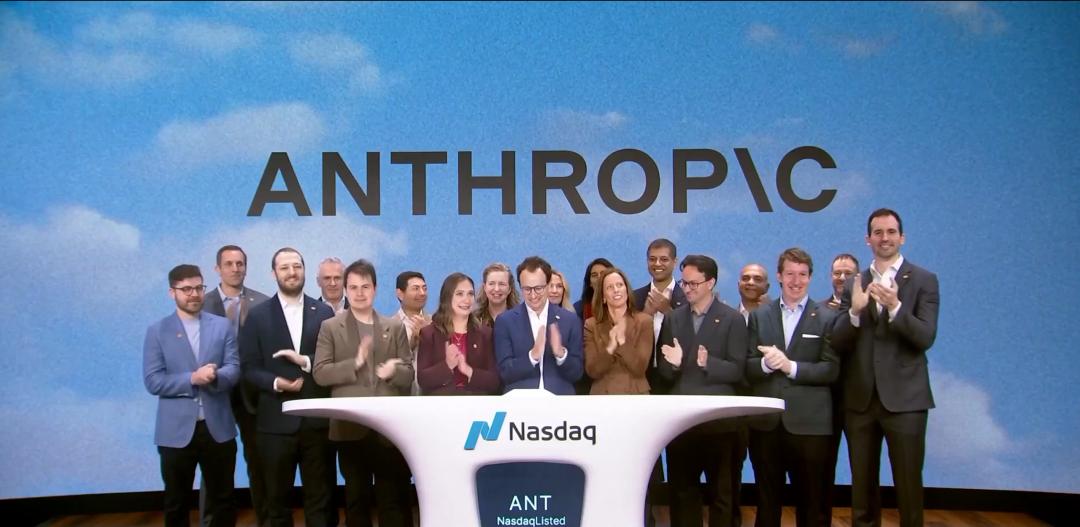
At 11:48 a.m. Eastern Time on November 19, carrying the aura of "the largest IPO in human history", Anthropic (ticker: ANT) officially started trading on the Nasdaq.
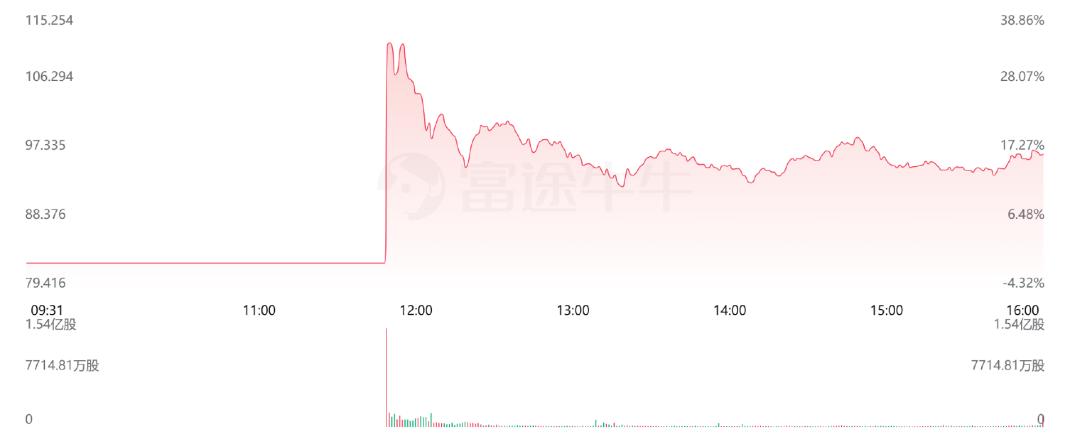
Compared with the finalized issue price of $83 per share, Anthropic's opening price jumped directly to $111.50, surging 34.3%, and once hit a peak of $115.10 during the session. On a fully diluted basis, Anthropic's maximum valuation reached 2.02 trillion US dollars, surpassing SpaceX which went public in June this year in one move.
However, the post-opening carnival lasted for less than half an hour. By the close, Anthropic's market cap had taken a rollercoaster ride.
From the afternoon onwards, Anthropic's share price plunged all the way, hitting an intraday low of $92.72, and finally closed at $97.17. Although it still closed up 17.07% compared to the $83 issue price, counting from the intraday high, Anthropic wiped out roughly 3244 billion US dollars in market value by the close. On a fully diluted basis, the company's valuation fell back from 2 trillion US dollars to around 1.76 trillion US dollars.
The bell rang on the other side of the ocean, while in China's AI circle, almost all large model founders, investors and secondary market analysts stayed up late to watch the market. What they were tracking was not the rise and fall of Anthropic alone, but looking for an answer: When the "anchor" of global AI valuation falls into the deep waters of the public market, how on earth should China's AI models be priced next?
After all, right before the listing bell, around Anthropic's pricing, from the initial 2 trillion US dollar valuation set by investment institutions, to the valuation cut during Anthropic's Q3 roadshow, to the impact of the US midterm elections and Nvidia's sudden "leadership reshuffle", Anthropic's market value kept falling again and again.
To continue pushing for an IPO at this node, for Anthropic, it is more like a stress test for the entire AI industry.
Anthropic's listing has never been a story about "whether it is expensive or not", it tells a story about "how to calculate".
And the new yardstick Wall Street uses to examine Anthropic today will be applied to every Chinese large model company as it is.
Anthropic's valuation has risen
But it has long been stripped of its excess bubble
As the "model" for global large model companies, Anthropic's 17% share price increase is very normal.
The market's buying enthusiasm is still there. According to news revealed by Bloomberg, the size of subscription orders reached about 6 to 7 times the number of shares available for sale, and the subscriptions mainly came from large intention orders from institutional investors.
As a result, Anthropic not only had the confidence to raise the price, but also planned to earn more under the favorable market conditions to accumulate more capital for itself.
By November 18, Anthropic finally raised its pricing range from $70-78 to $83. Anthropic also forcibly expanded the number of shares issued by 19%, skyrocketing from the originally planned 825 million shares to 980 million shares, forcibly raising nearly 200 billion US dollars in cash.
In the context of insufficient stock supply, Anthropic is also escorted by a group of computing power suppliers:
Right before its listing, a group of tech giants that can be called the "global computing power all-stars" — including Nvidia, Google, Microsoft, AMD, Broadcom, Micron, and TSMC's partners, collectively agreed to subscribe for 260 billion US dollars worth of Anthropic shares. Among them, Google and Nvidia are the most generous, each contributing 100 billion US dollars.
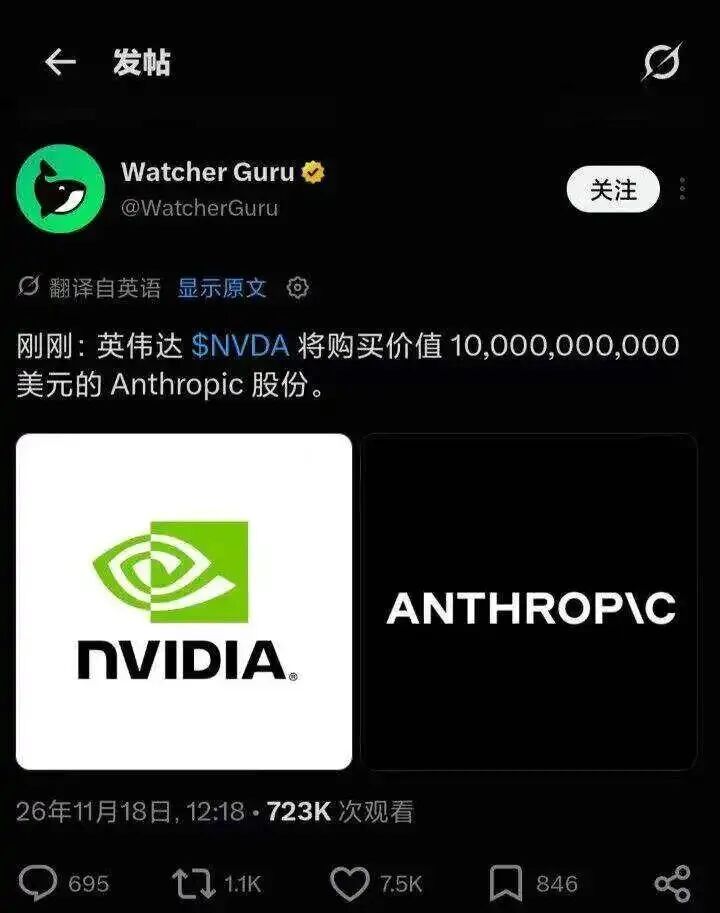
These computing power suppliers and cloud manufacturers stepping forward are equivalent to being firmly bound to Anthropic, locking in a batch of computing power orders in advance.
The 260 billion US dollar investment is more like a "strategic locking fee" paid by the giants. As long as Anthropic takes this money to continue expanding wildly and training next-generation models, this sum of money will eventually turn into orders, flowing back to Nvidia's chips, Broadcom's servers and the data centers of major cloud manufacturers along the procurement contracts.
Among them, who is the largest holder behind Anthropic? The answer is Amazon and Google. According to data disclosed by Anthropic, Amazon's total shareholding ratio is 14.7%; Google follows closely with a 13.7% stake.
Although the company's market value finally settled at around 1.76 trillion US dollars, if we stretch the timeline, the ups and downs of Anthropic's market value today were actually foreshadowed as early as three months before its listing.
In August this year, the market was still enthusiastically calculating a 2 trillion US dollar valuation for Anthropic. At that time, the pricing logic was simple and crude, exactly the same as the frenzy for large models in China's primary market: as long as the model is still iterating and revenue growth is still surging, the imagination for the company's valuation can go through the roof.
But reality poured a cold bucket of water on it. Since October, Anthropic has experienced multiple moments of falling valuation:
First, the revenue growth rate fell short of expectations, prompting investment institutions to start re-examining its value. Anthropic disclosed during its October roadshow that the company's Q3 sequential revenue growth rate dropped from 144% in Q2 to 47%. As a result, investment institutions first stripped part of its bubble, adjusting its valuation to 1.5 trillion US dollars.
The above adjustments were still doubts about Anthropic itself, and the subsequent fall in the company's valuation was more driven by everyone's concerns about the prospects of the AI industry.
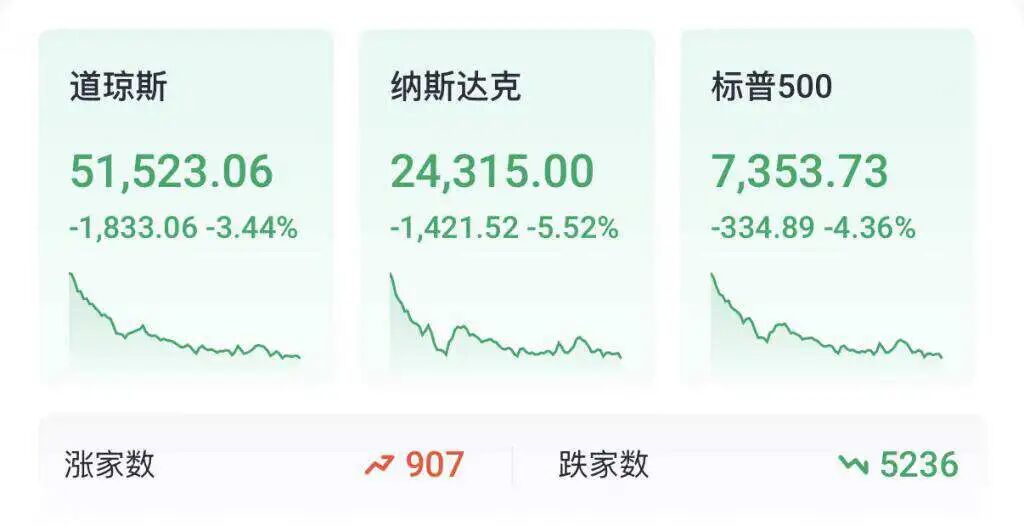
After the US midterm elections, pessimism over tightening data center regulations led to another round of slump in US AI stocks. On November 6, the Nasdaq fell 5.52%, and the Philadelphia Semiconductor Index plummeted by about 12%.
In this process, what Anthropic's falling market value erased is the premium of imagination.
In addition, the giants taking sides and the binding of computing power will also make investors cautious at the same time. After all, among those glossy financings and surging revenues on the books, how much comes from natural demand in the real market, and how much is a circular game piled up by giants "investing money with the left hand and selling computing power with the right hand"?
On the basis that the total committed expenditure on procurement commitments and lease agreements is as high as 9009 billion US dollars, Jensen Huang, who has led Nvidia for 33 years, suddenly resigned, plus the new signals released by CFO Colette Kress after taking over as CEO, pulled out the most critical load-bearing pillar in the AI computing power financing game.
During Nvidia's earnings call, Kress publicly laid out new rules: Nvidia will extremely strictly review enterprises that receive financing support in the future, and data center guarantees will only be launched after the facilities are actually built and ready, and no guarantees will be provided during the construction period; once data center construction is delayed, Nvidia's guarantee will no longer exist.
In the past two years, Nvidia has not only been the shovel seller, but also the "super guarantor" of the entire AI infrastructure construction. By the end of October this year, Nvidia's exposure to AI infrastructure financing guarantees provided externally has snowballed and expanded to 118 billion US dollars.
Previously, the market dared to give high valuations to large model giants like Anthropic that are highly bound to computing power, largely because it took for granted that Nvidia was backing them up, and the big brother would take responsibility if something went wrong. Now, the big brother has suddenly changed, and the first thing the new person does is to take back the blank check of unlimited underwriting, so it is hard for the market not to worry.
When the credit endorsement no longer takes effect, everyone has to re-examine whether Anthropic's future growth expectations can be fulfilled, and to what extent they can be fulfilled.
The same applies to the Chinese market.
In the past two years, many domestic large model companies have relied on binding cloud resources of major manufacturers and receiving strategic investments to support high valuations, but Anthropic's experience has spoiled the ending in advance. Once they enter the public market, investors will sooner or later separate the bubble of major manufacturers' subsidies from commercial performance and make independent calculations.
Anthropic's listing has sent a signal to Chinese large model companies — the era when you can dominate the secondary market with a single-dimensional high-growth story is over.
Watching Anthropic fall from the cloud of 2 trillion US dollars back to the reality of 1.5 trillion US dollars, it is inevitable to worry that, relying on revenue growth to drive up valuations as well, what will happen to the fate of domestic large model companies next?
Valuation bubble stripping, frenzied demand
How to price Chinese large model companies?
To understand the valuation of Chinese large models, we have to start with Anthropic's changes, because it is not Anthropic that has changed, but the pricing yardstick in the hands of the capital market.
In fact, compared with Wall Street which only started to "strip the bubble" for Anthropic today, the market value of Chinese large model companies has long been at a more rational position.
Taking the currently listed Zhipu AI and MiniMax as examples, long before Anthropic rang the listing bell, the two companies have already demonstrated the "valuation bubble stripping" process for the entire industry in advance.
When they landed on the Hong Kong Stock Exchange in January this year, Zhipu AI and MiniMax were at the height of their popularity, and Zhipu AI even set a record of trillion-dollar market value. Why were they so outrageously expensive back then? The core relies on two words: scarce supply and the surging ARR narrative.
When MiniMax went public, its tradable shares on the Hong Kong stock market were only about 17.07 million shares, accounting for less than 6% of the total share capital, but it attracted 420,000 people to frantically subscribe, with over-subscription as high as 1837.17 times; Zhipu AI also won an over-subscription record of 1159.46 times.
But just a few months later, looking at the current valuation of the companies, compared with the highest point, the market value of both has fallen by more than 80%. Business revenue is still surging, but as the lifting of the ban on restricted shares approaches, the scarcity premium of the tradable share pool instantly vanishes into thin air.
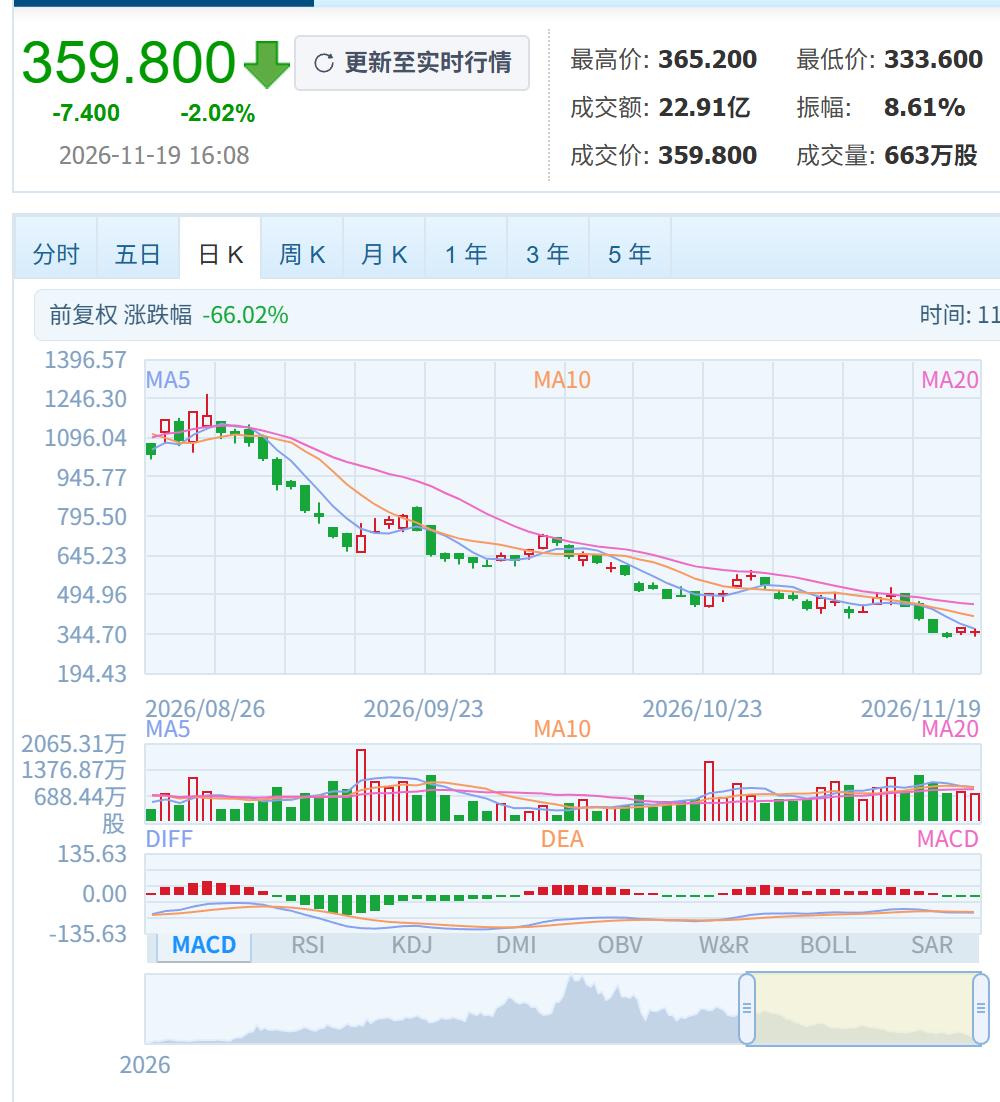
Market value of Zhipu AI
What is more worrying is the large model companies that are still at the poker table and have not yet gone public — the chill from the secondary market is inevitably flowing back to the primary market.
Overseas veteran OpenAI, in order to replenish ammunition before Anthropic's listing, is also stepping up the promotion of a new round of financing recently. Originally, OpenAI's ambition was to raise 300 billion US dollars at a valuation of 1.4 trillion US dollars, but investors' appetite is obviously not that big.
In the end, the valuation of this round of financing was reduced from 1.4 trillion US dollars to 1.25 trillion US dollars, directly erasing 1500 billion US dollars, a decrease of 10.7%, and the first installment of the received funds also shrank to about 150 billion US dollars. Under the scrutiny of capital, OpenAI cannot avoid any discount it deserves.
Even OpenAI has to take the initiative to bow and offer discounts, then turning our attention back to China, how much room is there for the unlisted Chinese large model companies to push up their valuations next?
After the bubble is completely squeezed out, how much Chinese large model companies are worth no longer depends on painting empty pies, but is bound to their real commercial monetization capabilities.
However, pulling the camera further to the entire global AI industry, although the capital market is frantically "stripping the bubble" from AI valuations, there is still huge room to tap the real demand for AI from other industries.
Objectively speaking, the real demand for AI applications has not only stood firmly, but will usher in a real full-scale outbreak period next.
In the past two years, China's AI circle has been quite anxious about the commercialization of large models: MaaS revenue on the B-end is limited, and no real hit product has been tapped on the C-end for a long time.
By 2026, with the outbreak of Coding and the establishment of Agent demand, Token prices have started to rise.
According to the report "Large Model Token Service Performance Monitoring Report (2026)" released by China Academy of Information and Communications Technology, the normalized average price in China in the second half of 2025 was 6.8 yuan, while the average price since the beginning of this year is