Bypass gold shops to buy gold
If you hold gold funds or have purchased accumulated gold from banks, checking your account recently will probably make you feel rather uncomfortable.
Gold prices kept rising some time ago, but have been falling all the way over the past half month. The international gold price has dropped from $5598 on January 29 to around $3700, and the domestic raw gold price has fallen from 1243 yuan to 798 yuan.
Despite such a sharp drop, people's reactions to gold purchases vary greatly.
On November 10, the price of gold jewelry per gram at several gold shops in Shaoxing was 500 yuan lower than the peak in the middle of the year, but there were few customers at the counters; a citizen browsed for a long time but finally did not make a purchase, saying that "if I buy it today, the price may drop again tomorrow".
A week later, Caibai in Beijing presented a completely different scene. Investment gold bars of 10 grams and 30 grams were all sold out, leaving only large-weight gold bars on the counter.
Facing the same sharp drop in gold price, why are some people still waiting while others have started snapping up gold?
……
This topic starts with the price of gold.
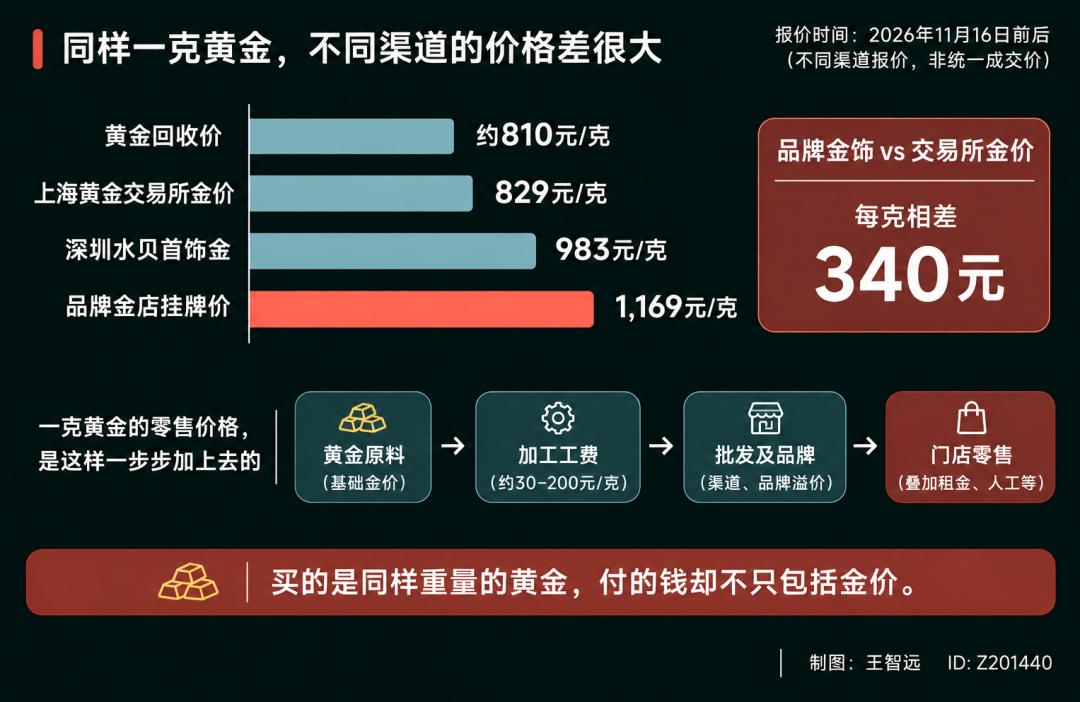
On November 16, the gold price at Shanghai Gold Exchange was 829 yuan per gram, gold jewelry in Shuibei, Shenzhen was sold at 983 yuan per gram, the listed price at branded gold stores was 1169 yuan per gram, while the recycling price was only around 810 yuan per gram.
For the same gram of gold, there are four different prices. From 829 yuan to 1169 yuan, there is a 340-yuan gap in between, and not all of this money is earned by a single gold store.
When gold is processed into jewelry, the processing fee for a plain plain ring is 30 to 50 yuan per gram, while that for ancient-style gold and hard gold may be 80 to 200 yuan per gram. After processing, the products will go through wholesalers and brand operators before being placed in gold stores in shopping malls.
Shuibei in Shenzhen is a major domestic distribution hub for gold processing and wholesale, and the goods of many gold stores come from here. When you add brand licensing fees, shopping mall rents and staff salaries, the price naturally goes up.
But when you take the gold to sell, the accounting rule is totally different.
Recyclers mainly judge the value based on the purity, weight and real-time gold price, and the processing fees and brand premiums you paid when buying the gold jewelry are usually non-refundable.
Therefore, for the same gram of gold, where you buy it and what you buy it for determine how much you will spend; and when you want to sell it, the buyer will recycle it according to another set of pricing rules.
Then when the gold price drops, why does the markup at the counters not fall accordingly?
Take this month as an example: on November 5, the US dollar weakened, and the international gold price rose by more than 2% in one day. On that day, the listed price of Chow Sang Sang rose by 45 yuan, Lao Fengxiang by 49 yuan, and Chow Tai Fook by 44 yuan.
13 days later, on November 18, the international gold price fell by 3.23%, but Chow Tai Fook and Lao Fengxiang only cut their prices by 7 to 8 yuan that day, and continued to lower the price the next day.
From these two cases, price hikes are passed on quickly, while price cuts lag behind.
The reason is not hard to understand: gold stores do not buy and sell their stocks on the same day. The gold they purchased previously at high prices now has a raw material price below 800 yuan. If they cut prices sharply accordingly, part of their inventory may face losses.
Processing fees also do not follow the fluctuation of gold prices.
Making an ancient-style gold bracelet still requires the same amount of working hours. Shopping mall rent, staff salaries and decoration depreciation will not decrease just because the gold price falls.
However, when you extend the time horizon, the accounting result is different again.
From the end of January to mid-November, the international gold price dropped by about 30%, the domestic raw gold price fell from 1243 yuan to 798 yuan, a decrease of 445 yuan per gram; the price of branded gold jewelry fell from 1722 yuan to 1125 yuan, a decrease of 597 yuan per gram.
The raw material price dropped, while the price of branded gold jewelry dropped even more. The price gap between the two per gram shrank from 479 yuan to 327 yuan, down by more than 30%.
Looking only at the past half month, the raw material price dropped by 7.5%, while the price of branded gold jewelry dropped by 5.8%, and the price gap between the two per gram widened again.
Back to the several gold shops in Shaoxing, their listed prices are indeed lower, but the raw gold price is only 798 yuan per gram, while the price of branded gold jewelry is still around 1130 yuan per gram. What that customer worried about is whether the price will continue to fall the next day.
People queuing up at Caibai in Beijing are buying investment gold bars, which cost around 830 yuan per gram plus certain fees, hundreds of yuan cheaper than branded gold jewelry.
As you can see, gold prices are all falling, but the prices at different counters still vary greatly. Therefore, to judge whether gold is cheap, it is not enough to only look at how much the gold price has dropped, you also need to see which type of gold product you plan to buy.
……
The 50g, 100g and 200g gold bars left on Caibai's counter can perfectly illustrate another point. When buying gold, it is not enough to only look at how much cheaper the price is per gram.
I believe that people buying gold are calculating at least three accounts: how much money they can afford to pay, how much they can get back when they sell it, and what exactly they get in exchange for the extra money they spend.
First, calculate the total price.
One gram of gold costs more than 800 yuan, 10 grams cost more than 8000 yuan, and 200 grams cost about 170,000 yuan. The price per gram is almost the same, but the total price differs by 20 times.
Of course some people buy 200-gram gold bars, but the threshold is that you have to pay hundreds of thousands of yuan at one time. This is at least one very practical reason why small-weight gold bars are so popular.
Second, calculate the price gap between buying and selling.
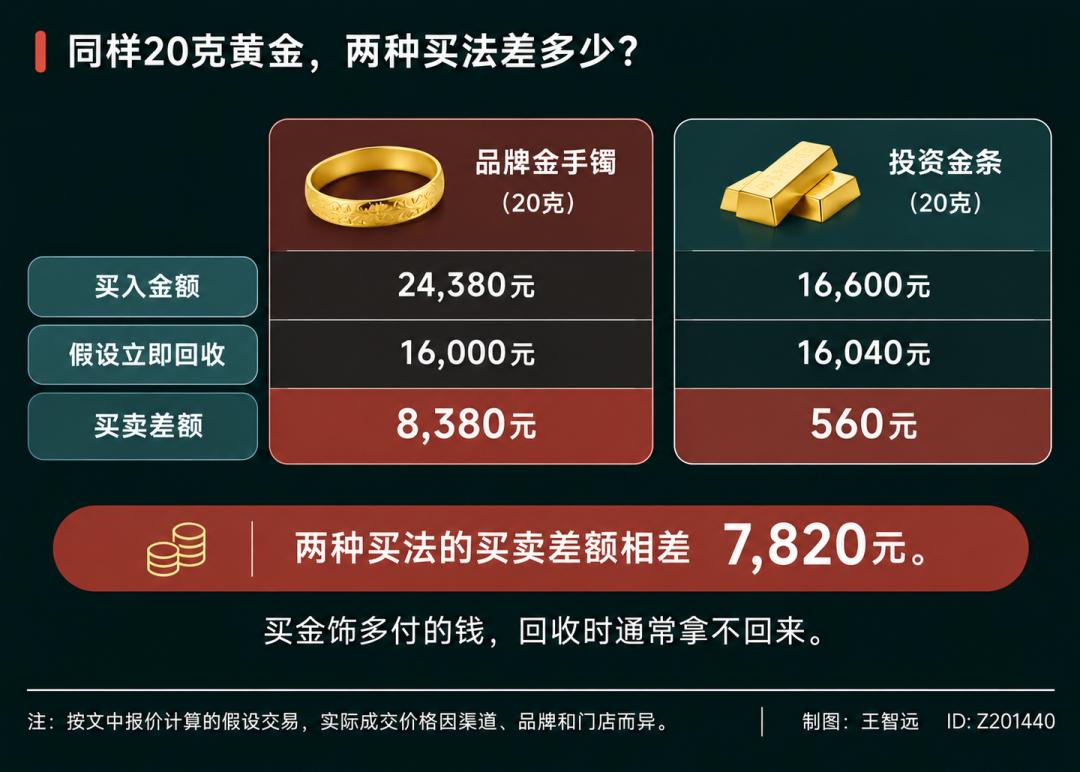
Take 20 grams as an example. A branded bracelet, calculated at 1169 yuan per gram plus a processing fee of 50 yuan per gram, costs 24380 yuan in total. If you recycle it immediately at 800 yuan per gram, you can only get 16000 yuan back, with a gap of 8380 yuan in between.
For the same 20 grams of gold, the investment gold bar costs 16600 yuan when bought at 830 yuan per gram; when recycled at 802 yuan per gram, you can get 16040 yuan back, with a gap of 560 yuan.
This is only a hypothesis based on two sets of quotations. The actual transaction and recycling prices depend on specific stores. It can illustrate one point: the extra money you paid when buying gold jewelry will not come back in full when you recycle it.
Third, calculate whether the extra money you spend is worth it.
Gold funds also have costs. For example, the ICBC gold ETF has a management fee of 0.15% and a custody fee of 0.05%; bank accumulated gold has bid-ask spreads and related fees, and the redemption rate of some ICBC products is 0.5%.
There are also bid-ask spreads for investment gold bar transactions, while the situation of branded gold jewelry is more complicated: in addition to the gold price, you also need to pay processing fees, brand premiums and store-related fees.
You are buying gold in all these scenarios, but some products charge you annual management fees, some charge you spreads when you trade, and some require you to pay the extra money the moment you get the gold jewelry.
Of course, the extra part of the cost for gold jewelry has its own value.
You can wear the bracelet, choose your favorite style, and get after-sales support if there is any problem. But the money you pay for these services is for the value brought by the jewelry, not all of it counts as the value of the gold itself.
Some people have started to change their purchasing methods. On November 18, the listed price of Laomiao was 1141 yuan, and the actual price after the activity was 1041 yuan, a difference of 100 yuan per gram.
There is another purchasing method at Tianya Jewelry City:
The shop assistant introduced that the gold jewelry costs 977 yuan per gram, or you can buy the raw gold material at 850 yuan per gram, and pay an extra 20-yuan processing fee to the store for custom processing. By changing the purchasing method, you can save more than 100 yuan per gram.
The same is true in Shuibei. In mid-November, gold jewelry was priced at around 980 to 990 yuan per gram, and gold bars at 860 to 870 yuan per gram. Some people also use old gold to exchange for new products, only paying the processing fee and price difference, without having to repurchase the original gold at full price.
These methods are not necessarily suitable for everyone, and you need to check the craftsmanship, gold purity, repurchase conditions and after-sales service separately. But everyone is actually calculating the same account: since the weight of gold is the same, is it necessary to pay extra for the intermediate links?
This also explains the contrast at Caibai's counter: 10-gram gold bars have a low total price, and the bid-ask spread is relatively easy to calculate; 200-gram gold bars may not be more expensive per gram, but you have to pay hundreds of thousands of yuan at one time.
As for gold jewelry, buyers also need to consider whether they like wearing it and whether they want to sell it later. If you mainly focus on the fluctuation of gold prices, you need to calculate the bid-ask spread carefully; if you buy it for wearing, craftsmanship, style and service are also valid reasons for you to pay the money.
The worst case is that you pay the price for jewelry when buying, but expect the return of an investment product when selling.
……
People buying gold have started to calculate more carefully, and people selling gold also need to recalculate their accounts.
In the first three quarters of 2026, the national gold consumption in China reached 684.62 tons, a slight year-on-year increase of 0.28%. Among them, jewelry consumption decreased by more than 91 tons, while gold bar and gold coin consumption increased by more than 92 tons.
This does not prove that all people who used to buy gold jewelry have turned to buy gold bars, nor can it be attributed to this round of gold price drop in November, but at least it shows that the spending direction of people buying gold is changing. The jewelry sector is weakening, while the gold bar and gold coin sector is strengthening.
When this change falls on gold stores, troubles come.
Large brands have ways to cope with part of the gold price fluctuation. For example, Chow Tai Seng disclosed its gold leasing arrangement in February this year.
Simply put, it means borrowing gold from banks, processing it into jewelry and selling it, then buying back the same weight of gold to return to the bank when it expires. The limit disclosed by the company does not exceed 80% of the total gold-related inventory.
In this way, when the gold price falls, although the gold in the inventory may depreciate, the gold you buy back to return to the bank in the future may also be cheaper, and the two parts can offset part of the loss.
Lao Fengxiang also uses gold leasing, with a lease term of generally one year, pays the agreed rent, and returns the gold or settles in the agreed way when it expires.
However, this method can only help enterprises cope with part of the gold price fluctuation. If there are no customers at the counter, the rent and labor costs still need to be paid, and the capital chain may still face pressure.
Lao Fengxiang's net cash flow from operating activities in the first three quarters was -1.414 billion yuan, compared with 2.366 billion yuan in the same period of last year. Even with these hedging tools, the company may still face tight capital flow.
The situation of franchised stores is more complicated.
Many stores purchase goods through the buyout method, paying for the goods themselves and bearing the inventory pressure themselves. If they purchased the goods at a high price before, and now have to promote sales at reduced prices, their capital turnover will be tight.
Stores with sufficient capital and stable channels may survive, but those that only have one store and rely on daily sales to maintain operations usually face greater pressure.
As a result, some stores have started to exit the market.
In the first half of 2026, the number of franchised stores of 9 major gold and jewelry companies decreased by 2643 on a net basis. Chow Tai Seng saw a net decrease of 473 stores in the first half of the year, 454 of which were franchised stores.
Lao Fengxiang closed 537 underperforming stores in third- and fourth-tier cities in the first three quarters, accounting for more than 70% of its total closed franchised stores, and opened 90 new stores in first- and second-tier cities in the same period.
Of course, store closures are not all caused by gold prices. Site selection, rent and the company's own adjustments are all contributing factors. At least from the perspective of the number of stores, some gold brands are indeed contracting.
The financial reports also reflect the pressure.
Lao Fengxiang's revenue in the first three quarters was 26.611 billion yuan, down 44.56% year-on-year. It recorded a loss of 124 million yuan in the third quarter alone, with a gross profit margin of 5.22% in that quarter. Its inventory still stood at 8.596 billion yuan, almost no less than at the beginning of the year.
Chow Tai Seng's franchised business revenue in the third quarter was 369 million yuan, down 59.9% year-on-year.
The company raised its per-gram brand usage fee from 12 yuan to 24 yuan, but the corresponding revenue only increased by 9.08%.
The fee doubled, but the revenue only increased by 10%. If other conditions remain basically unchanged, it indicates that the shipment volume corresponding to the per-gram charging rule has probably dropped significantly.
What do these figures have to do with people buying gold? They are actually closely related.
Part of the extra money you pay when buying gold jewelry supports the operation of physical stores, so that you can get guidance when purchasing, adjust the jewelry if it does not fit, and find a place to exchange