Phones are becoming increasingly expensive. Why should consumers pay for the sky-high patent fees?
This year during the Double 11 Shopping Festival, a phenomenon has emerged that the final purchase price of discounted smartphones after big promotions is still higher than that of models at the same level last year.
For example, even with platform subsidies of 500 yuan, many flagship phones have seen a price increase of nearly 1,000 yuan this year compared to last year. The long-standing rule in the smartphone circle that "buy early to enjoy early, buy later to enjoy discounts" has completely failed, and consumers who have been waiting for price cuts have been hit hard by the soaring mobile phone prices.
Even more, due to the drastic price surge, some flagship phones have lost their eligibility for state subsidies as their total price exceeds 6,000 yuan, leading netizens to complain that waiting for a later purchase not only fails to get a discount, but also brings a "super double price increase".
Why are mobile phones getting more and more expensive?
One important reason comes from storage chips. As the AI boom drives a sharp increase in demand for storage chips, memory prices have risen accordingly. Kwak Noh-Jung, CEO of SK Hynix, believes that "the shortage of storage chips may last until after 2030".
To make matters worse, the rise in storage prices will also significantly push up the patent fee called "Standard Essential Patent"[1], and consumers will also bear this hidden cost of purchasing mobile phones. What is more worthy of vigilance is that a considerable part of the price increase of patent fees in this "hidden cost" lacks reasonable basis. Facing this kind of unreasonable price hike, the industry and consumers should clearly say "no" and firmly refuse it — because once acquiesced, it is not just the price of mobile phones that will rise, but also the threshold for each of us to access data and use the Internet.
Some people may wonder, what is the relationship between the rise in memory prices and the cost of "Standard Essential Patents"?
What are "Standard Essential Patents"
Different from ordinary patents, "Standard Essential Patents", in simple terms, are patents that cannot be bypassed if a technology is to meet a certain industry standard.
Take mobile phones as an example. Mobile phones of different brands can all access 4G and 5G networks because they follow the same set of communication standards and speak the same "technical language". The patents necessary to implement these standards are communication standard essential patents, referred to as communication SEPs.
To produce mobile phones with 4G and 5G communication functions, mobile phone manufacturers usually need to obtain relevant patent licenses and pay a certain patent fee to the patent holders.
But the problem is, since this money is paid for communication technology, why may the communication patent fee also rise when memory prices go up?
Memory Price Hike
May Drive Two Consecutive Rises in Communication Patent Fees
SEP patent fees, also known by some as patent tax, can be simplified to a primary school multiplication problem just like tax calculation: SEP patent fee per mobile phone = billing base × royalty rate.
First of all, the billing base. Normally, the component that uses the patented technology should be used as the reference for billing — whoever uses it pays for it. Counterintuitively, the reference object of the billing base is often not the communication component itself, but the price of the entire mobile phone.
This can be clearly seen through a simple math problem: assuming that the original selling price of a mobile phone is 2000 yuan, and now it is sold for 3000 yuan due to the rise in memory price. Calculated at a royalty rate of 5%, the SEP patent fee per mobile phone will increase from 100 yuan to 150 yuan, with a growth rate of 50% (see the table below). However, the quality of 5G communication technology used by consumers has not changed, yet they have to pay an extra 50 yuan for no reason.
This is the first round of patent fee increase.
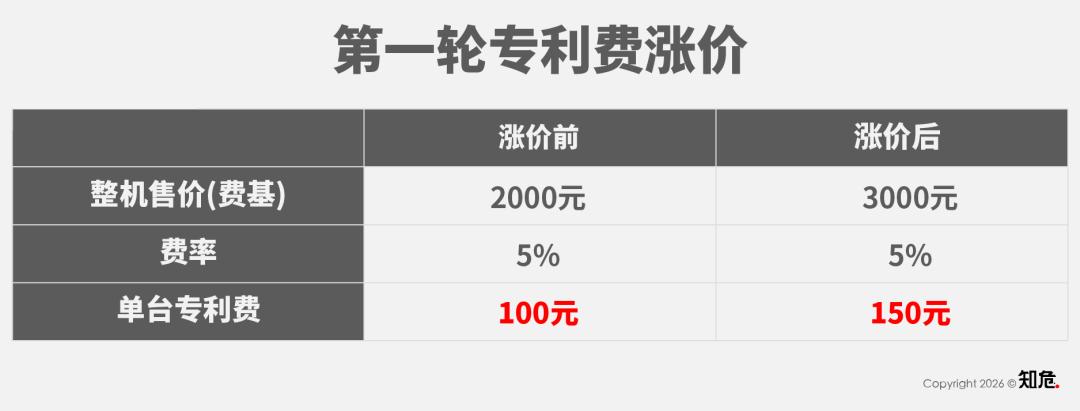
Note: The above is only for simplified illustration.
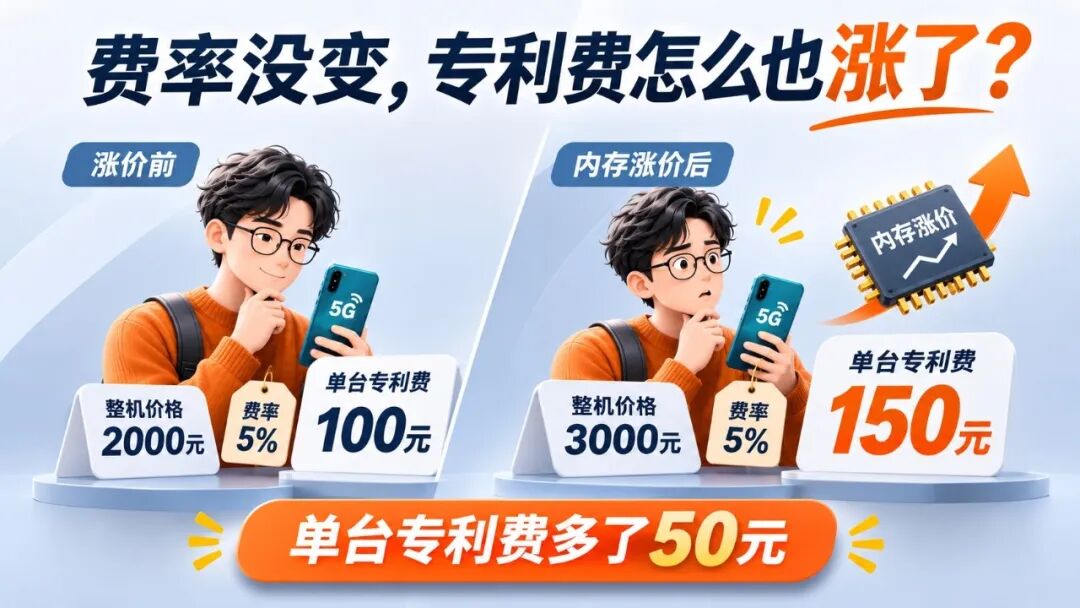
Note: The image is AI-generated, for illustration only.
In addition to the billing base, the rise in the overall mobile phone price caused by the memory price hike will also lead to a substantial increase in the royalty rate. Usually, when calculating the royalty rate, courts will compare the prices of mobile phones of different communication generations (such as 4G phones and 5G phones) to determine the value of communication SEPs. If the impact of price increases of memory or other non-communication SEP components is not fully excluded, the price increase brought by these components may be mistakenly counted as the value created by communication technology, which will eventually push up the SEP patent royalty rate.
This is the second round of patent fee increase.
Take the 5G royalty rate as an example. The relevant patent royalty rate was about 4% in a judicial precedent a few years ago, and a few years later, the royalty rate given by another judicial precedent is close to 8%, almost doubling. Such a large change in the royalty rate calculation result does not mean that the 5G communication technology itself has undergone an equivalent upgrade. For the 5G mobile phones in consumers' hands, the communication function has not changed, and the user experience will not automatically improve just because the patent royalty rate increases.
Going back to the previous math problem, if we consider the impact of the royalty rate brought by the rise in memory value, calculated at an 8% royalty rate, the SEP patent fee per mobile phone will increase from 100 yuan to 240 yuan, a rise of 140 yuan.
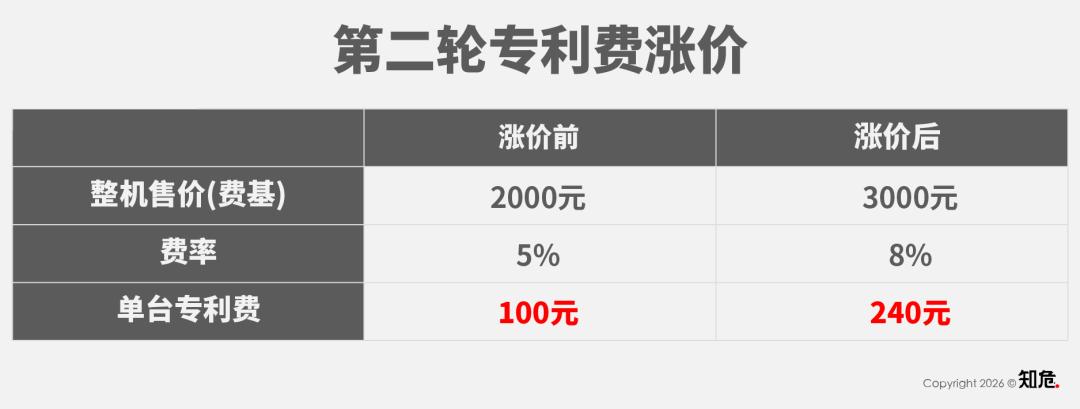
Note: The above is only for simplified illustration.
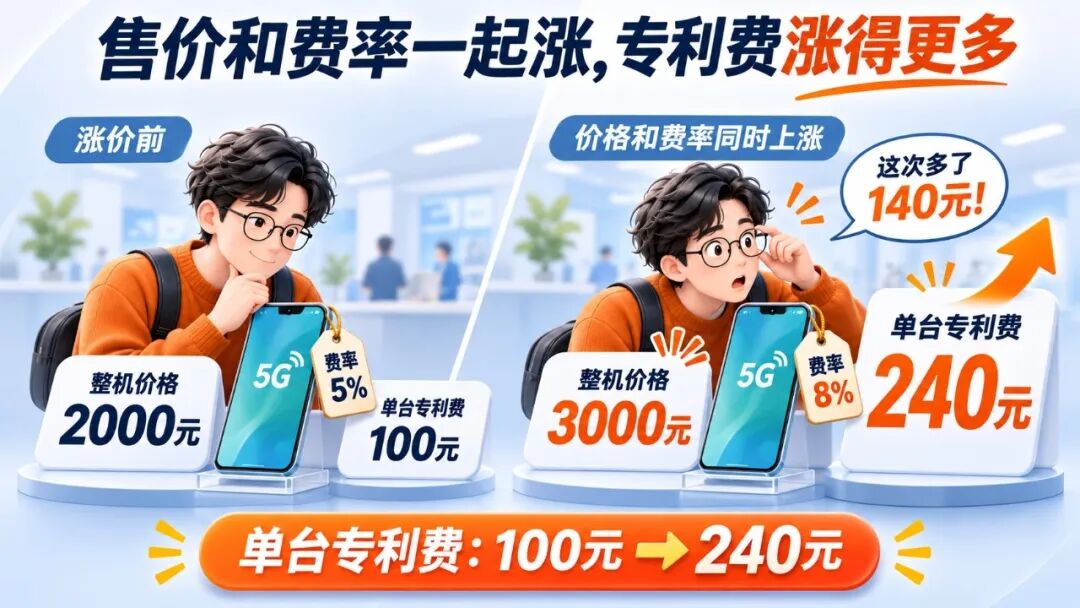
Note: The image is AI-generated, for illustration only.
This 140 yuan is a heavy cost for manufacturers, and a real extra expense for consumers — it may be the savings of a student who works part-time for several days, the utility bills of a family for two months, or the money saved by carefully comparing prices, waiting for the promotion seasons of 618 and Double 11, and stacking platform discounts and trade-in subsidies when buying a mobile phone. However, this 140-yuan rise in patent fees easily offsets all the discounts that consumers have tried their best to get — the money saved is not as much as the extra money spent.
Eventually, this cost will not disappear in the manufacturers' accounts, but will go directly into every consumer's shopping cart intact: you have to pay an extra 140 yuan for the same mobile phone, and the promotion season that consumers who wait for price cuts have been looking forward to has become a helpless situation where "buy later, pay more".
Will High Cost-Effective Mobile Phones in China Become Fewer and Fewer?
In contrast, mid- and low-end mobile phone manufacturers with limited profit margins are under much greater pressure from rising costs. According to Counterpoint data, the average net profit margin of mainstream domestic mobile phone manufacturers in 2025 was only 3.2%, less than 60% of the global average level. For these manufacturers, their already thin profit margins leave little room for further compression.
This round of memory price hike has a particularly obvious impact on mid- and low-end mobile phones. According to Omdia data, in the first quarter of 2026, the proportion of memory cost in the bill of materials cost of mobile phones priced below 400 US dollars is close to 60%, and even exceeds 64% in models priced below 99 US dollars.
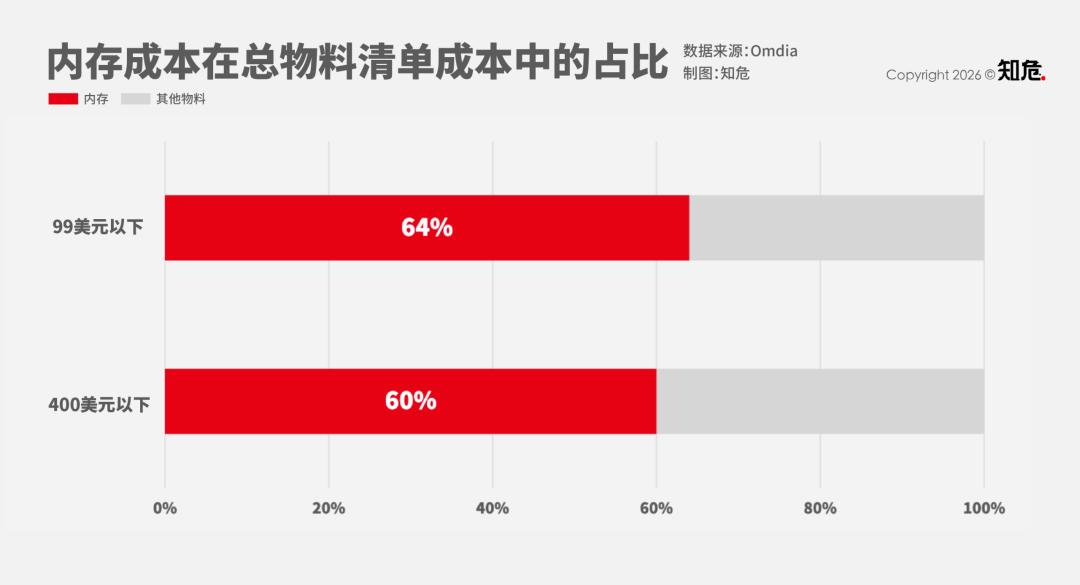
Figure: Proportion of memory cost in total bill of materials (BOM) cost (Q1 2026)
Mobile phone manufacturers, especially domestic brands such as OPPO, vivo, Honor and Xiaomi, have been pushed to the "critical line" by high costs. For these brands, low-end models already have very slim profit margins. When the costs of hardware such as chips and screens keep rising, and patent fees further increase, it becomes more and more difficult to continue selling at low prices. To ensure profitability, manufacturers may have to adjust their product structure and invest more resources in the mid-to-high-end market with larger profit margins.
Signs of this change have already emerged. According to Counterpoint data, the shipment share of mobile phone models priced below 1000 yuan in the Chinese market has dropped from 15% in 2024 to less than 3% in the second quarter of 2026.
However, the mobile phone market does not only have consumers who pursue high performance and new technologies. For many people, a mobile phone that can make calls, use WeChat and mobile payment is already enough. They do not need the most advanced imaging system, nor do they pursue complex AI functions, but only hope to buy a stable and durable mobile phone at an affordable price.
From a broader perspective, mobile phones are never just "tools for making calls". They are the first gateway for the vast majority of people to access the Internet, obtain data and services, and also the entry point for countless people to work, study, seek medical treatment and handle public affairs. When unreasonable patent fees continue to push up terminal prices and force manufacturers to shrink their low-end product lines, what is raised is not just the cost of purchasing mobile phones, but the ability of ordinary people to access the data world and the Internet itself. Charging reasonable returns for real innovation is an incentive for innovation; allowing unreasonable patent fee hikes to go unchallenged is unknowingly setting up "toll stations" for digital life.
How to make patent fees more reasonable has become an unavoidable problem for the market.
The industry has long called for a solution called the "minimum salable unit" approach. In simple terms, it means that the billing base no longer uses the price of the whole mobile phone, but is calculated based on the component that uses the patented technology as much as possible. For example, the price of the communication module is used as the billing base for communication SEP patent fees, to reduce the impact of other factors such as memory, screens and cameras on communication SEP patent fees. To put it another way, even if the price of the whole mobile phone is still used as the billing base, the prices of components unrelated to communication functions such as memory, screens and cameras should be excluded in the calculation process, to avoid these factors pushing up the billing base and royalty rate respectively, resulting in "two consecutive rises" in communication patent fees, and eventually making consumers pay for extra costs.
Say No to Unreasonable Patent Fees
As mobile phones are getting more and more expensive, consumers have the right to ask: what value exactly does the extra money paid correspond to?
The rise in memory prices does not mean that the technical contribution of communication patents has increased accordingly. Consumers have already paid once for more expensive memory, and paying an extra communication patent fee for the same price hike is obviously unreasonable. Cost increases unrelated to the contribution of communication technology should not be the reason for communication patent fees to rise.
Similarly, the patent royalty rate formed in the industry for a long time should not be taken as a standard that can be generally and significantly raised just based on a single case judgment. There should be sufficient evidence and verifiable explanations for why the royalty rate rises, on what grounds it rises, and whether the increase is commensurate with the technical contribution. While protecting patent rights, judicial judgments should also carefully consider the impact of royalty rate changes on the industry and consumers, and should not allow the high royalty rate in a single case to become the basis for the whole industry to compete to raise prices.
Unreasonable patent fee hikes should be firmly resisted. Because this is never just a patent fee dispute between enterprises — every unreasonable patent fee will eventually be passed on to the terminal price, raising the cost for ordinary people layer by layer. In the long run, what will be weakened is the ability of every consumer to access data and use the Internet. If we acquiesce in an unreasonable price hike today, some people may be blocked from the digital world by the price threshold tomorrow.
Rejecting an unreasonable patent fee protects not only consumers' wallets, but also everyone's equal right to access data and the Internet.
Notes:
[1] For the convenience of reading, this article uniformly uses the expression "patent fee". Unless otherwise specified, it refers to the communication standard essential patent licensing fee, that is, the technical usage fee paid by mobile phone manufacturers to relevant patent holders for implementing communication technical standards such as 4G and 5G.
This article is from the WeChat official account "Wei Zhi", author: De Dong, editor: Da Bing, published with authorization from 36Kr.