DeepSeek's 105 billion yuan financing has been officially closed. Liang Wenfeng is highly selective in choosing investors: Tencent and CATL have squeezed into the top tier, some investors were rejected even when they came with sufficient capital, while others voluntarily gave up the investment opportunity.
National Business Daily has learned that DeepSeek's second round of financing has made the latest progress.
Tianyancha shows that on November 17, Hangzhou DeepSeek Artificial Intelligence Basic Technology Research Co., Ltd., the industrial and commercial entity of DeepSeek, completed the change of investors, adding Hangzhou Chengyan Enterprise Management Consulting Partnership (Limited Partnership, hereinafter referred to as Hangzhou Chengyan). The registered capital also increased from the previous 16.447496 million yuan to 19.918707 million yuan.
Further penetrating upward, Hangzhou Chengyan completed the industrial and commercial change in the same period: Liang Wenfeng himself withdrew, 31 new partners were added, and the registered capital contribution increased from the previous 6,000 yuan to the latest 34.39 billion yuan. These new partners are exactly the external shareholders that the industry has been paying attention to for a long time and participated in DeepSeek's second round of financing. Previously, an investor revealed to reporters that the financing amount of this round reached more than 105 billion yuan.
In the past, in the venture capital circle, investors picked projects; this time, projects pick investors. Institutions are scrambling for shares, but they have to accept strict penetration review and a long capital lock-up period, and the vast majority of funds can only indirectly hold shares through the SPV controlled by founder Liang Wenfeng. On the one hand, the market is surging with FOMO (fear of missing out) sentiment, regarding this investment as an "industry business card"; on the other hand, the enterprise voluntarily removes non-compliant investors and gives priority to strategic investors with industrial resources.
DeepSeek's two rounds of financing are far more than just an AI company raising funds to expand production. It represents the underlying changes taking place in China's hard technology primary market: the core is no longer "asking for money", but "selecting the people who give money".
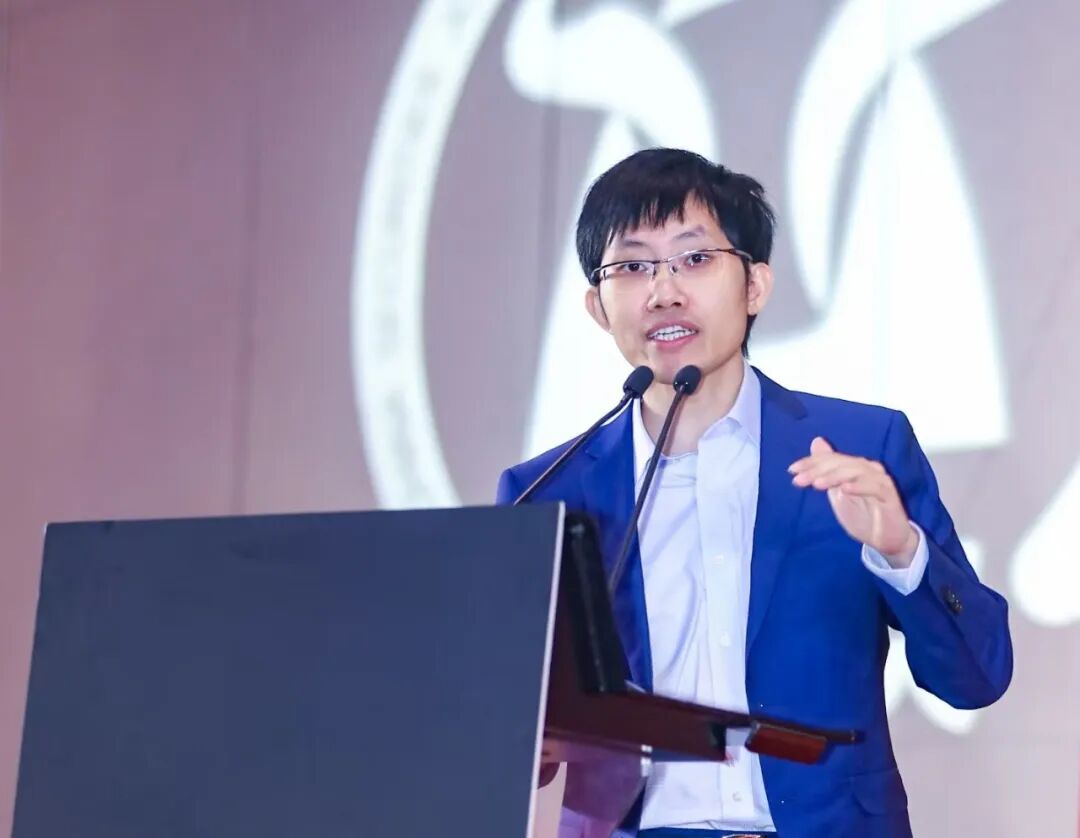
Liang Wenfeng, Image source: Visual China
Pre-IPO financing is settled, bringing a new round of ammunition
First, let's take a look at the list of 31 contributing entities in this round of DeepSeek's financing.
Except for Hangzhou Chengce Business Consulting Co., Ltd., the executing partner, the situation of the remaining 31 partners of Hangzhou Chengyan is as follows:
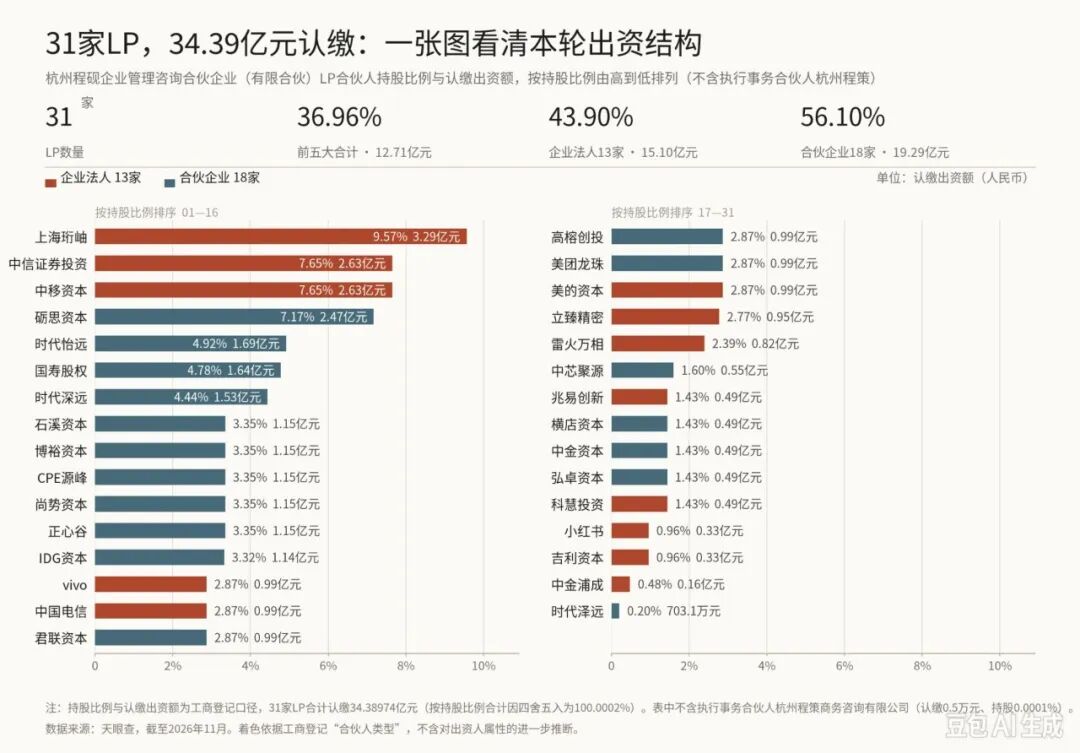
Looking from the highest to the lowest shareholding ratio, first of all, Shanghai Yanxiu Commercial Management Co., Ltd., which is associated with Tencent, ranks first with a 9.5653% shareholding ratio and a capital contribution of 329 million yuan.
The CATL system contributed through three funds: Xiamen Shidai Yiyuan, Xiamen Shidai Shenyuan, and Fujian Shidai Zeyuan, with a total shareholding ratio of 9.5653%, and the subscribed amount is 329 million yuan, tied with Shanghai Yanxiu as the largest external contributor.
The second echelon is China Mobile Investment Holdings under China Mobile and CITIC Securities Investment Co., Ltd., both with a capital contribution ratio of 7.6522% and a subscribed amount of 263 million yuan each; Tianjin Lisi Xingshen associated with Lisi Capital accounts for 7.1740% with 247 million yuan; Qingdao Chengxin Zhida associated with China Life Equity accounts for 4.7826% with 164 million yuan.
Going further down, Hangzhou Shixi Zhaoyi No.1 associated with Stony Creek Capital, Boyu Xiaohe (Tianjin) associated with Boyu Capital, Hangzhou Yuanfeng Panrui associated with CPE Yuanfeng, Shixiang Shangshi (Tianjin), and Ningbo Zhixing Yueheng associated with Zhen Fund all account for 3.3479%, with a subscribed amount of 115 million yuan each; Tianjin Yuncheng Venture Capital associated with IDG accounts for 3.3236% with 114 million yuan.
The entities with a 2.87% shareholding ratio are the most numerous, totaling 6: China Telecom, Vivo Mobile Communication, Midea Investment, Fuzhou Huizhu (Meituan Longzhu), Hangzhou Junlian Jiatu, and Tianjin Gaorong Changying, each subscribing 98.684 million yuan. The background of this echelon is also the most diversified: China Telecom, Vivo, Midea, and Meituan Longzhu have industrial or central enterprise backgrounds, while Junlian Capital and Gaorong Venture Capital are professional primary market investment institutions.
Continuing downward, the share shrinks rapidly. Lichun Precision Intelligent Manufacturing accounts for 2.7739% of the shares and subscribes 95.395 million yuan; Hangzhou Leihuo Wanxiang accounts for 2.3913% with 82.237 million yuan; Jiaxing Juyuan Yaohui associated with SMIC CEC Source accounts for 1.5974% with 54.934 million yuan; GigaDevice, Shanghai Kehui, Hengdian Baihui associated with Hengdian Capital, Jiaxing Hongzhuo Keqing associated with Hongzhuo Capital, and CICC Hegang (the entity associated with CICC Capital) each account for 1.4348% with 49.342 million yuan; Xingyin Information Technology (Xiaohongshu) and Zhejiang Geely Industrial Investment each account for 0.9565% and subscribe 32.894 million yuan; CICC Pucheng, a wholly-owned subsidiary of CICC, accounts for 0.4783% with 164.47 million yuan.
However, providing funds is only the basic condition for entry. Many interviewed institutions told reporters that DeepSeek's evaluation criteria for primary investors in this round have shifted. The industry reputation of institutions and the industrial resources they can output weigh far more than pure financial strength, and the strategic investment attribute overrides the demand for financial investment.
If the above partners are reclassified according to the type of contributing entities, a clearer capital structure can be seen: the participating entities cover three camps, namely industrial capital in the fields of internet platforms, new energy terminal manufacturing, and semiconductor material chains, state-owned and central enterprise background institutions, and the largest number of market-oriented financial institutions with relatively scattered individual shares.
The setting of the lock-up period is also long enough: a VC said that the capital lock-up period is seven years, and an additional five-year lock-up period will be added after the completion of the listing. What the enterprise needs is not hot money that comes in and out quickly, but capital that can be deposited for a long time, and it expects investors to bring tangible industrial synergy such as computing power, scenarios, and orders.
Compliance review in advance:
Differences between new and old financing and closing constraints
At the governance level, the reporter noticed a detail: Hangzhou Chengce, which acts as the executing partner, is mainly controlled by Liang Wenfeng (holding 99% of the shares), and he himself is not in the list of direct partners of Hangzhou Chengyan. More than 3 billion yuan of funds are split into 31 LP shares and all put into a platform where the founder side acts as GP. The design of this structure is actually not unexpected.
For DeepSeek, this may be the final round before sprinting for IPO, and it is destined to be a different kind of financing.
From April to June 2026, DeepSeek's first round of 51 billion yuan of financing was completed, setting a single-round financing record for China's AI industry at that time. Liang Wenfeng personally led the investment of 20 billion yuan, and a number of institutions such as the Tencent, CATL system, NetEase, JD.com, and IDG entered the market. At that time, many funds completed their capital contribution through multi-layer fund nesting, and the number of underlying LPs was huge, which also contributed to the tightening of the review standards in this round.
Different from the common "getting money first" in the primary market, this round puts compliance review directly at the forefront. Zhang Xin (pseudonym), a partner of a VC in South China, introduced that DeepSeek requires all GPs to fully report the list of underlying investors, penetrate and verify each layer of LPs downward, and strictly filter non-qualified investors. After all reviews are passed, institutions can enter the signing and payment process.
Chen Shi (pseudonym), the head of an institution in Shanghai, also said: "This round should be better, not as complicated as the first round."
To implement compliance, DeepSeek has also set up a clear rectification mechanism. It is reported that once non-compliant LPs are identified during the closing process, they will be given time to sort out and clean up by themselves; if the rectification cannot be completed after the expiration, the corresponding entire share will be directly recovered.
Role reversal: Investors no longer hold the initiative in negotiations
In the traditional venture capital narrative, entrepreneurs come to the door with projects, and investors hold money to select teams. But this narrative completely failed in DeepSeek's this round of financing.
Zhang Xin has deep feelings about this: "In the past, entrepreneurs had dreams but no money in their pockets; investors had money and helped entrepreneurs realize their dreams. Now entrepreneurs not only have dreams, but also have money in their hands." He confessed that DeepSeek's case "has almost no precedent in China's primary market".
What is more notable is that except for the National Artificial Intelligence Large Fund, all other institutions must complete their shareholding through the SPV controlled by the founder. An institution revealed that the explanation given by the enterprise side is that if there are too many shareholders before the IPO, all aspects may be affected. Through the SPV structure, the founder can control specific decisions and progress.
This also reflects the new reality of A-share hard technology investment: for major strategic track projects, it is not only about financial indicators, technical barriers and industrial strategic value are also important scales for pricing. Chen Shi analyzed that this is why even though the valuation is not low, there are still a large number of institutions willing to compete for entry qualifications. In his view, for national strategic tracks such as large models, chips, and commercial aerospace, the market investment logic has changed significantly, and the traditional evaluation framework for financial investment cannot be completely followed.
Of course, not all institutions are enthusiastic about this capital carnival. A well-known dual-currency fund finally chose to abandon participation in DeepSeek's this round of financing after completing communication and evaluation.
The investor of this fund told reporters that participating in DeepSeek's financing is more like getting an industry "financing business card". In the asset portfolio of the entire fund, this investment is difficult to provide differentiated allocation value. "From a financial point of view, there is no hard injury, but we need to combine the attributes of the fund and how to explain it to our own LPs."
The deeper concern comes from industry judgment. The investor believes that the current domestic large models as a whole are in a competitive state of "stepping on the left foot with the right foot", each can obtain phased advantages, but the gap between each other is not as big as imagined. There are not many new investment windows in the basic large model track, and they have shifted their focus to the application layer on top of the models, while applications are constrained by the boundary of model capabilities and productization landing capabilities.
In his view, DeepSeek's this round of financing is not entirely due to lack of money. Relying on the industry reputation and research capabilities accumulated through open source, a larger part of the role of financing is to consolidate market influence. When selecting investors, in addition to compliance, funds, and industrial resources, enterprises also take many personalized matching considerations into account.
Fanatical entry is not the only answer, and maintaining wait-and-see is also a choice.
IPO countdown: After the financing ammunition
The real competition has just begun
In September this year, some media reported that DeepSeek has commissioned CITIC Securities to prepare for the Science and Technology Innovation Board IPO.
In Zhang Xin's view, the industry's reference frame is the overseas AI giant Anthropic. The domestic market also urgently needs a benchmark large model company to land on the A-share market, and DeepSeek is regarded as the most suitable local target to benchmark OpenAI and Anthropic.
However, where exactly the funds raised by DeepSeek in this round will be spent is still unclear. Even institutions that have already entered the market can hardly get a complete plan. What can be confirmed is that some of the directions include the expansion of computing power infrastructure and the recruitment of top talents; at the same time, DeepSeek is also building an ecological territory through investment and mergers and acquisitions.
It is worth mentioning that Anthropic is expected to be listed on NASDAQ tonight (November 19), with the IPO issue price set at $83 per share. Some institutions calculated accordingly that Anthropic's listing will become one of the largest IPOs in global history, and it is also the first IPO of a major cutting-edge AI model developer, with a fully diluted valuation of about 1.5 trillion US dollars. After listing, it will become an important window to observe the profitability of US stocks.
Chen Shi pointed out that leaving aside the financing story, the final competition of the large model track falls on two things.
The first is the money-burning competition for basic R&D. The cost of computing power remains high, and the competition for talents has escalated from ordinary scientists to the global competition for genius-level researchers. DeepSeek itself is also recruiting top talents on a global scale. These financings are not an exaggerated figure in the scale of investment in global large models.
The second is commercial landing. No matter how strong the model capability is, it is necessary to find real payment scenarios in the end. DeepSeek has gained a firm foothold in the programming track, but the whole industry is still looking for more scalable monetization paths. Financing is only ammunition. Whether the ammunition can be converted into products and revenue is the real test.
In the middle of this wave, the mentality of the entering institutions is also full of contradictions. As the investor said: "We have to coexist with FOMO, keep calm and rational, and not be afraid of risks and stay still. Making money may not be our ability, and failing to meet expectations is also the norm of high-risk investment."
This article is from the WeChat Official Account "Meijing Toutiao", Author: Li Lei, Editors: He Xiaotao, Ye Feng, Yi Qijiang, published with authorization from 36Kr.