Alibaba's net profit surged 213%, Wu Yongming laid out the clear AI strategy, and the relevant annualized revenue has exceeded 70 billion yuan.
On November 19, Alibaba released its financial report for Q2 of fiscal year 2027 (corresponding to the natural year from July 1 to September 30, 2026). Alibaba's revenue for this quarter reached 271.519 billion yuan, up 9.57% year over year; its net profit stood at 64.420 billion yuan, up 213% year over year, which was mainly driven by the increase in net investment income and operating profit; its adjusted net profit was 19.909 billion yuan, up 92% year over year.
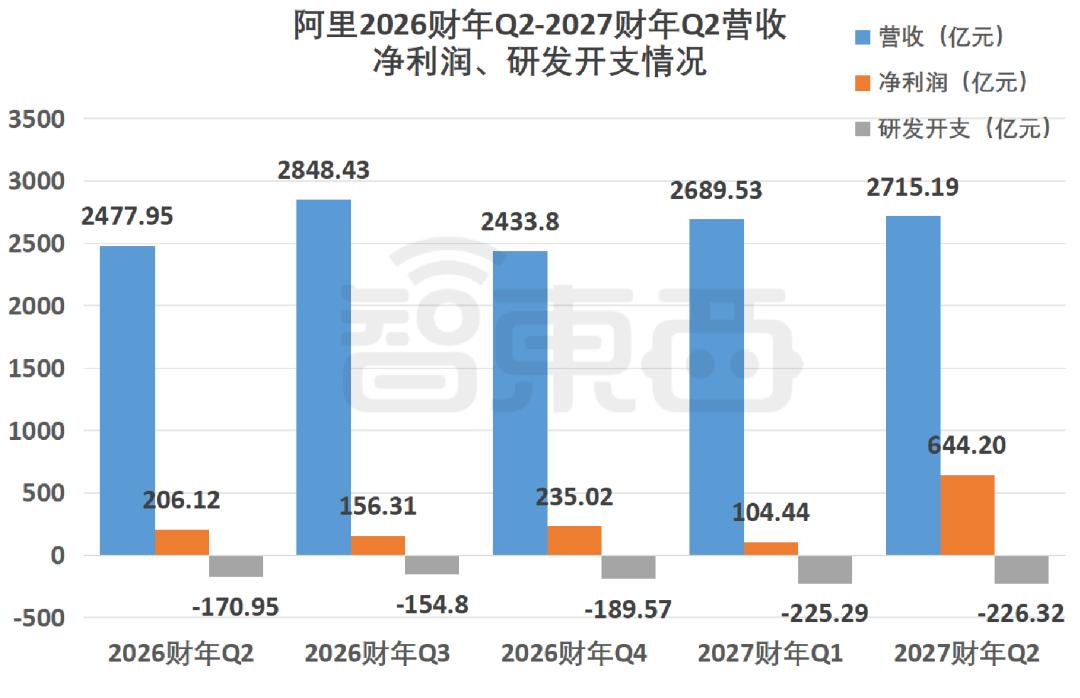
▲ Alibaba's revenue, net profit and R&D expenditure from Q2 FY2026 to Q2 FY2027 (Chart by Zhidx)
In the second quarter of fiscal year 2027, Alibaba's revenue from AI Cloud and computing power services reached 60.973 billion yuan, up 53% year over year, of which revenue from external customers increased by 64% year over year, and revenue from AI-related products hit 17.918 billion yuan, marking the 13th consecutive quarter of triple-digit year-over-year growth. Converted based on this quarter's revenue, the annualized revenue of AI-related products is about 71.7 billion yuan, exceeding 10 billion U.S. dollars.
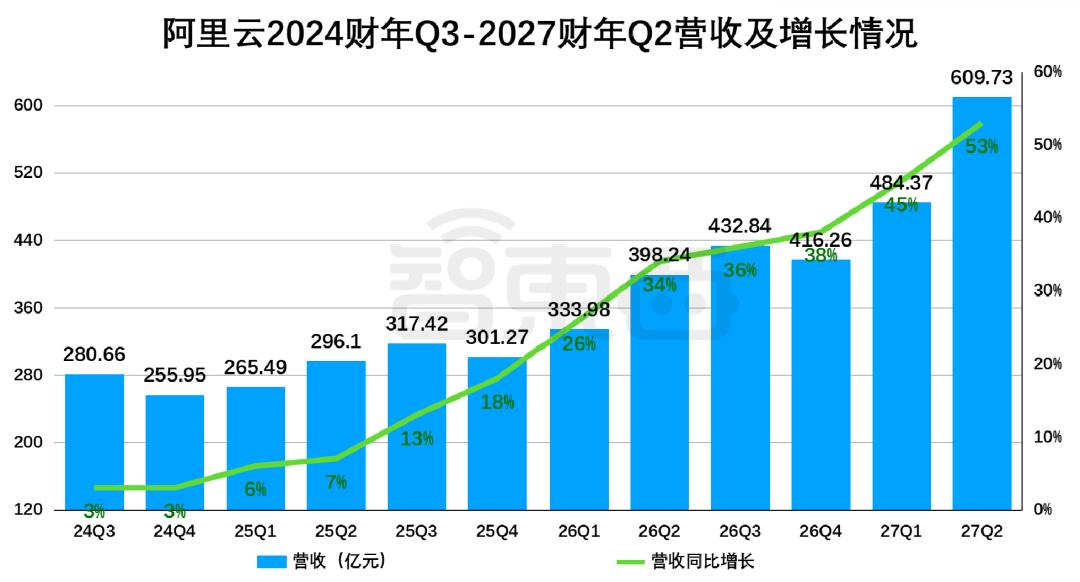
▲ Alibaba Cloud's revenue and growth in the past three years (Chart by Zhidx)
While the cloud business is accelerating its growth, Alibaba's quarterly capital expenditure reached 50.477 billion yuan, up 60% year over year, but lower than the 67.68 billion yuan of the previous quarter. Alibaba stated that the year-over-year increase in expenditure is mainly related to the accelerated expansion of computing power, rising prices of chip components, preparations in advance for CPU computing power demand brought by AI agents, and fluctuations in procurement cycles.
When talking about the impact of new export restrictions on computing power on model iteration, Wu Yongming, CEO of Alibaba Group, said at the earnings call that Alibaba is still evaluating its specific impact on products and finances. Qwen has been training the next-generation model on domestic T-Head chips, and Bailian has provided model inference services based on domestic chips. In the future, the vast majority of models, whether for Alibaba, its partners or customers, will rely entirely on domestic chips for training.
When talking about the Model-as-a-Service (MaaS) business of Bailian, Wu Yongming said that this business mainly depends on the release of new models. In the past two months in China, the release progress of new models from Alibaba and its partners was slightly lower than expected. With the launch of Qwen4-Max and the upcoming release of the next-generation video model in the near future, Alibaba maintains its target of achieving an annualized recurring revenue of 30 billion yuan for the MaaS business by the end of fiscal year 2027.
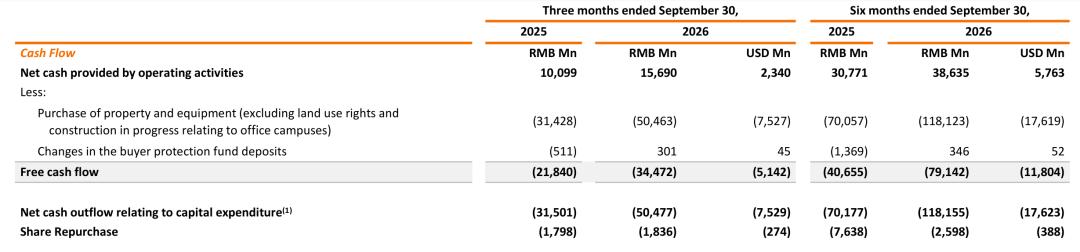
In this quarter, the net cash flow generated from Alibaba's operating activities was 15.690 billion yuan, up 55% year over year. In the same period, the net outflow of free cash flow expanded from 21.840 billion yuan to 34.472 billion yuan. Alibaba said the main reason is the increase in cloud infrastructure expenditure, and factors such as the increase in prepayments from cloud service customers offset part of the impact.
As of the close of trading on November 18, US Eastern Time, Alibaba's US stock price fell 2.63% to $84.37 per share (equivalent to about 562.47 yuan per share), with a total market value of 2098.91 billion US dollars (equivalent to about 1.40 trillion yuan). As of 8:55 on November 19, US Eastern Time, in the pre-market trading stage, Alibaba's stock price fell 1.88% compared with the previous trading day to $82.78 per share (equivalent to about 551.87 yuan per share).
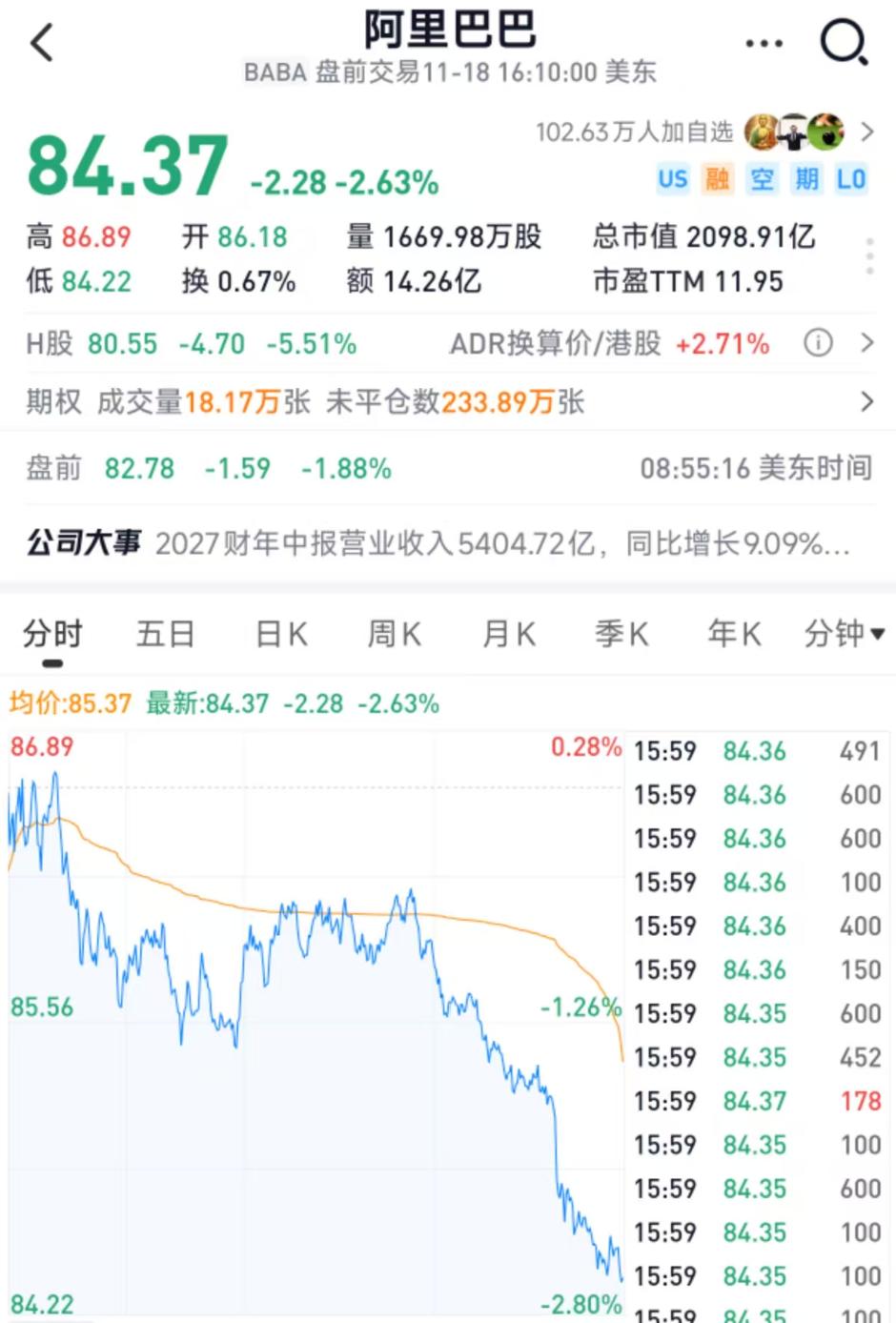
▲ Alibaba's US stock price (Source: Xueqiu)
01.
AI Cloud and Computing Power Revenue Exceeds 60 Billion Yuan
Revenue from External Customers Grows by 64%
Starting from the first quarter of fiscal year 2027, Alibaba adjusted the segment disclosure caliber of its financial reports. The Cloud Intelligence Group and T-Head are merged into the "AI Cloud and Computing Power Services" segment. The AI model laboratory, Qwen Consumer Business Group and Qwen Office, which were previously classified under "All Others", are integrated into the "AI Laboratory and Applications" segment.
In this quarter, Alibaba E-Commerce Group remains the segment with the largest revenue scale, with revenue of 197.237 billion yuan. The year-over-year revenue growth rate of both AI segments exceeded 50%, with AI Cloud and Computing Power Services posting revenue of 60.973 billion yuan, up 53% year over year, and AI Laboratory and Applications generating revenue of 4.435 billion yuan, up 51% year over year.
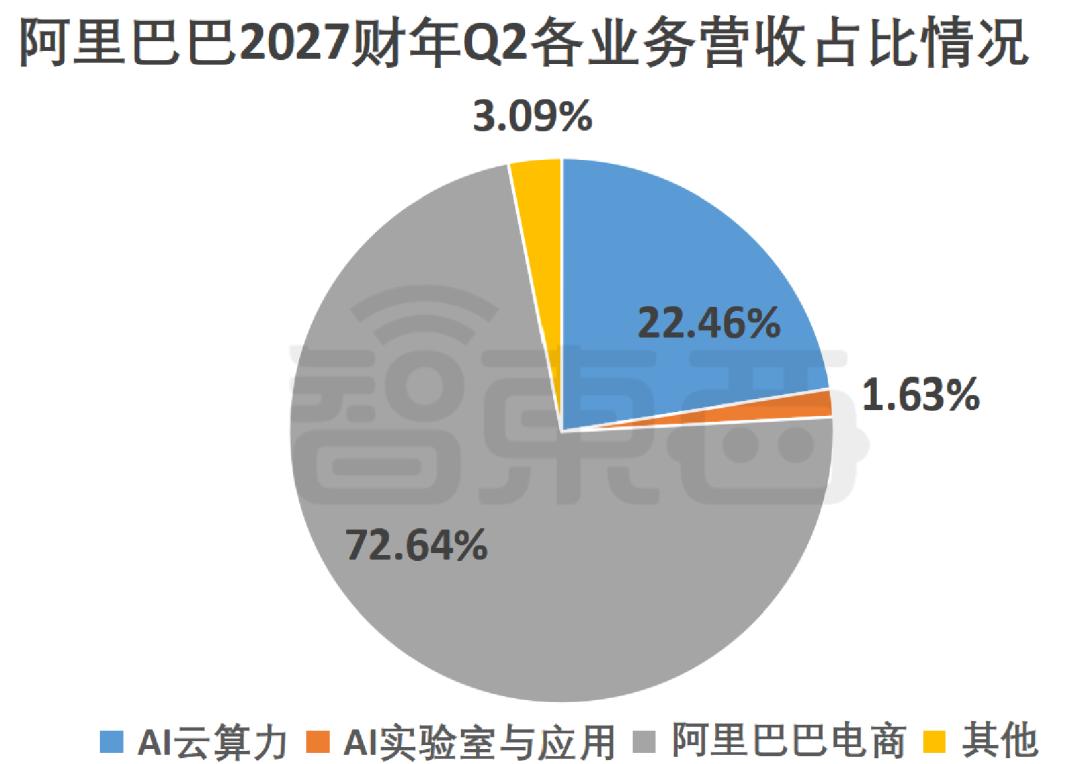
▲ Revenue proportion of each business of Alibaba in Q2 FY2027 (Chart by Zhidx)
1. AI Cloud and Computing Power: Revenue from External Customers is About 47 Billion Yuan
Alibaba's AI Cloud and Computing Power Services include the Cloud Intelligence Group and T-Head. In this quarter, the revenue of this business reached 60.973 billion yuan, of which revenue from external customers was about 47 billion yuan, up 64% year over year. Excluding computing power equipment solutions, recurring revenue from external customers increased by 67% year over year. Alibaba said that this is largely due to customers' wider adoption of AI-related products.
In this quarter, revenue from AI-related products reached 17.918 billion yuan, marking the 13th consecutive quarter of triple-digit year-over-year growth.
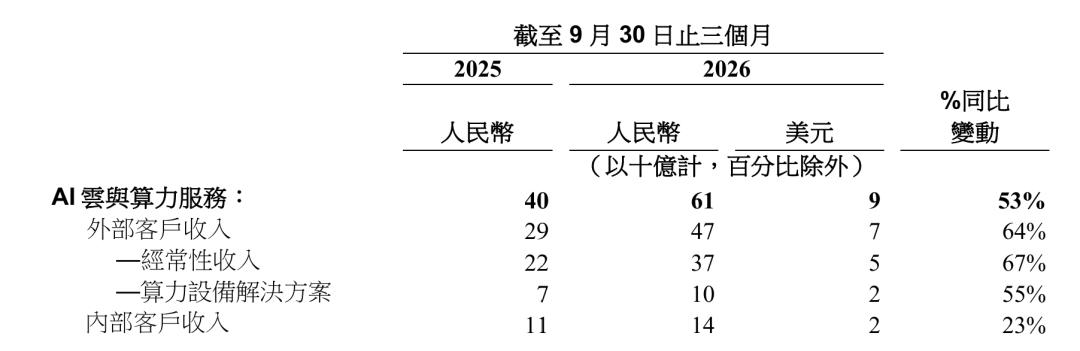
The profitability of AI Cloud and Computing Power Services is also improving. In this quarter, the adjusted earnings before interest, taxes and amortization (EBITA) of this business was 8.838 billion yuan, up 121% year over year, and the adjusted EBITA margin rose to 14.5%.
In terms of chips, T-Head released the new generation of training and inference integrated AI chip Zhenwu V900 at the Yunqi Conference in September, which is scheduled to be launched in the first quarter of 2027. Alibaba said that V900 adopts a self-developed parallel computing architecture, and its performance is significantly improved compared with the previous generation Zhenwu M890. T-Head also open sourced the Zhenwu chip software stack SAIL to simplify application migration and enhance compatibility with mainstream AI frameworks.
Wu Yongming said at the earnings call that starting from 2027, most of Alibaba's new AI chips will come from T-Head. Alibaba will prioritize using self-developed flagship chips to ensure its own model iteration, while taking into account the large model training needs of key partners.
In terms of super nodes, T-Head launched a super node instance based on Zhenwu M890 in August. Alibaba said that this instance can support model inference with more than 2 trillion parameters. The next-generation super node will integrate Zhenwu V900 as well as self-developed interconnection, network and storage chips, which is also scheduled to be launched in the first quarter of 2027.
Wu Yongming said that Alibaba initially expects the cloud revenue growth target for the next fiscal year to be 30% to 45%. With the continuous release of domestic computing power, Alibaba expects the cloud revenue growth rate in natural year 2028 to return to more than 50%.
2. Models and Applications: Revenue Grows by 51%, Adjusted EBITA Loss Narrowed Quarter-on-Quarter
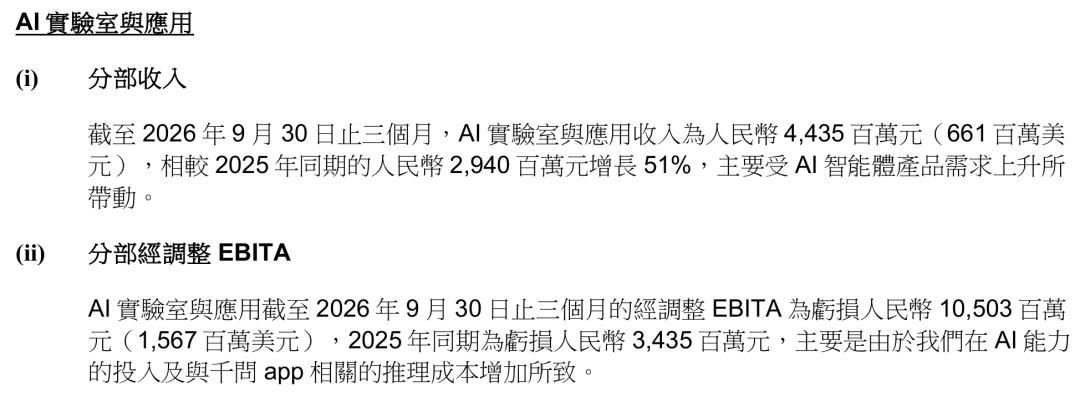
In this quarter, Alibaba's AI Laboratory and Applications segment posted revenue of 4.435 billion yuan, up 51% year over year, with adjusted EBITA loss of 10.503 billion yuan, narrowing by about 24% compared with the 13.861 billion yuan loss in the previous quarter.
In terms of models, Alibaba recently released Qwen4-Max. This model adopts a new Mixture-of-Experts architecture, has 2.4 trillion parameters, and has native visual capabilities. Alibaba said that the new model improves Token usage efficiency and has stronger long-cycle task execution capabilities in scenarios such as manufacturing, game development, medical care and cutting-edge scientific research.
In terms of personal applications, the Qwen App has covered more than 20 service fields, including shopping, local services, travel, office, learning, personal finance and health. In October, Alibaba launched the cloud-based personal agent Qwen Go! in the Qwen App, which can perform multi-step tasks across platforms and retain context and user preferences for a long time.
In terms of enterprise applications, Qwen Office launched the "Enterprise Context" function at the Yunqi Conference in September. It can continuously organize and update information from enterprise documents, meeting minutes and internal communications, allowing agents to perform tasks based on enterprise knowledge and work processes.
When asked whether the value of AI business will fall more on models or applications, Wu Yongming said that the two need to iterate together. If similar applications all use the same underlying model, the product is easier to be replaced and it is more difficult to retain users. At this stage, Alibaba will focus on improving product capabilities and remain restrained in large-scale promotion and user subsidies.
3. E-Commerce Revenue Grows by 2%, Reduced Loss of Instant Retail Drives Profitability Improvement
Alibaba E-Commerce Group posted revenue of 197.237 billion yuan in this quarter, up 2% year over year, and adjusted EBITA was 38.851 billion yuan, up 243% year over year. Alibaba said that the improvement in profitability is mainly due to the significant loss reduction of the instant retail business.
By business segment, China's instant retail revenue increased by 22% year over year to 58.757 billion yuan, mainly driven by the growth of Hema's online and offline channels. China's e-commerce customer management revenue decreased by 5% year over year. Excluding the impact of revenue write-downs from the new marketing development plan, the revenue increased by 1% year over year on the same caliber.
AI has also begun to enter the daily operation process of merchants. Alibaba revealed at the earnings call that the Qwen Office e-commerce version launched in October can help merchants automatically perform multi-step cross-platform work. Wu Yongming said that among the paying users of Qwen Office, the proportion of e-commerce users is increasing.
02.
Alibaba's Net Profit Grows by 213%
Both Investment Income and Operating Profit Increase
Alibaba's net profit for this quarter was 64.420 billion yuan, up 213% year over year. Among them, interest income and net investment income were 73.305 billion yuan, up about 265% year over year, which was mainly driven by the increase in net income brought by changes in the fair value of equity investment. The operating profit in this quarter was 29.116 billion yuan, up 443% year over year.
Alibaba said that the improved operating performance of Taobao Flash Purchase and cloud business, as well as the improved operating efficiency of multiple businesses, drove the growth of the group's adjusted EBITA. After excluding investment gains and losses, equity incentives and other items, Alibaba's adjusted net profit was 19.909 billion yuan, up 92% year over year.
R&D and computing power investment are still growing. In this quarter, Alibaba's product development expenses were 22.632 billion yuan, up about 32% year over year, accounting for 8.3% of the group's revenue. Capital expenditure was 50.477 billion yuan, up 60% year over year. Affected by the increase in cloud infrastructure expenditure, the net outflow of free cash flow expanded from 21.840 billion yuan in the same period of the previous year to 34.472 billion yuan.
03.
Alibaba Confirms 5 Billion Yuan of Investment Income from Ant Group
Ant Group Accelerates the Promotion of AI Applications
Alibaba disclosed in its financial report that the net income from changes in the fair value of equity investment increased in this quarter, but did not specify which invested enterprises are involved and their respective contribution amounts.
In the six months ended September 30, 2026, Alibaba confirmed that the investment income from Ant Group was 5.023 billion yuan, up about 17% year over year. Alibaba holds about 33% of the equity of Ant Group on a fully diluted basis, and recognizes relevant income with a one-quarter lag. Based on a rough estimate, Ant Group's profit in the first half of 2026 is about