The fastest-ever trillion-yuan IPO has just been born.
The sound of the turning page of the era is coming from afar.
On the evening of November 19, Beijing time, Anthropic officially landed on the Nasdaq, and the Amodei siblings showed up at the bell-ringing ceremony. The issue price was set at $83 per share, the opening reference price rose by more than 20%, corresponding to a market cap approaching $2 trillion, exceeding 10 trillion RMB.
What has been realized accordingly is an enormous windfall: each of the seven co-founders has seen their net worth rise to about $20 billion, totaling over $140 billion, collectively ranking high on the Bloomberg Billionaires Index. Early employees and investors have also ushered in the realization window, some reaped returns while others left with regrets — even Masayoshi Son sighed on the eve of the listing: "I really wish I had invested back then."
It is hard to imagine that the starting point of this trillion-dollar empire was nothing more than a falling-out six years ago. Back then, the Amodei siblings left OpenAI due to ideological differences, were turned away by almost every party they approached for a time, and finally pried open the door with Claude Code.
The echo of the bell crossed the ocean. Tonight, Chinese AI companies are also watching this scene: to a certain extent, it is the coordinate for their future.
Six years after leaving Baidu, the former employee led the team to create a trillion-dollar market cap
The Amodei siblings' departure from OpenAI was quite dramatic.
It was December 2020, when OpenAI held an all-hands video meeting. After Sam Altman reported the research progress, Dario took the floor and announced that he would resign together with his sister Daniela and five other colleagues to start a new business. Shortly after, the seven were removed from the meeting, and their work emails and computers were deactivated.
At that time, ChatGPT had not yet been launched.
The older brother Dario once had a stint at Baidu: after obtaining a doctorate in biophysics from Princeton University, he joined Baidu for his first job to participate in the R&D of the speech recognition system Deep Speech 2, working under Andrew Ng. He was not particularly prominent at that time, and eventually joined OpenAI to lead the R&D of GPT-3. The younger sister Daniela studied English literature at the University of California, Santa Cruz, and was in charge of safety and policy after joining OpenAI. They criticized that OpenAI was moving too fast on commercialization, while its attention to safety did not keep pace accordingly.
Thus in 2021, the siblings and their partners co-founded Anthropic, which means "related to human beings". After the first version of Claude was developed, the team was not confident about the safety of the model, so the release was delayed for about half a year. When Claude made its public debut in March 2023, ChatGPT had already seized all the limelight.
The turning point came in an accident.
An engineer casually asked Claude what song was playing on the computer, unexpectedly the model wrote a script on its own to find out the song title, using a language that the engineer was not even familiar with. Eventually, this internal experiment evolved into Claude Code. Developers can directly assign tasks on the command line, allowing the model to read, modify and test codes.
The once hard-to-cover massive computing power investment has thus found a rapidly expanding business.
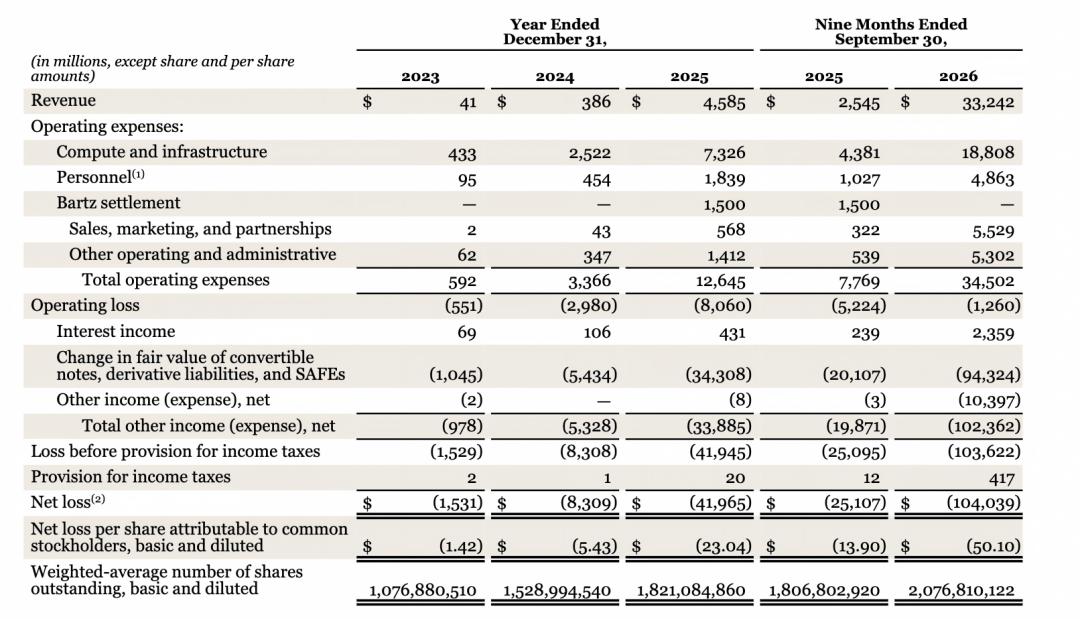
The prospectus has unveiled the business model of this company. In 2023, Anthropic's full-year revenue was only $41 million. It jumped to $4.6 billion in 2025, and in the first three quarters of 2026, this figure has soared to $332.4 billion, of which the third quarter alone brought in $169.6 billion.
What is surprising is the quality of its customers. By cutting into programming and workflow scenarios, Anthropic has firmly captured the enterprise market with the strongest willingness to pay. As of the end of September this year, the number of its customers with annual payment exceeding $100,000 has exceeded 11,900, and the net dollar retention rate (NRR) of existing customers is as high as 900%.
The profit outline is emerging, but its appetite for computing power is equally astonishing. The prospectus has disclosed an astronomical bill: to support model iteration, the company has signed long-term computing power and infrastructure procurement commitments totaling more than $9 trillion, of which the expenditure in the next year will be as high as $707 billion.
The trend of history is often somewhat ironic. Those who left out of concern about excessive commercialization have built a larger enterprise in less than six years. Such a speed has never been seen in human commercial history.
Rejected by 21 VCs
Ushered in Super Returns
The tide of wealth is astonishing.
Calculated at the issue price of $83 per share, each of the seven co-founders of Anthropic holds shares worth about $20 billion, totaling more than $140 billion, ranking high on the Bloomberg Billionaires Index.
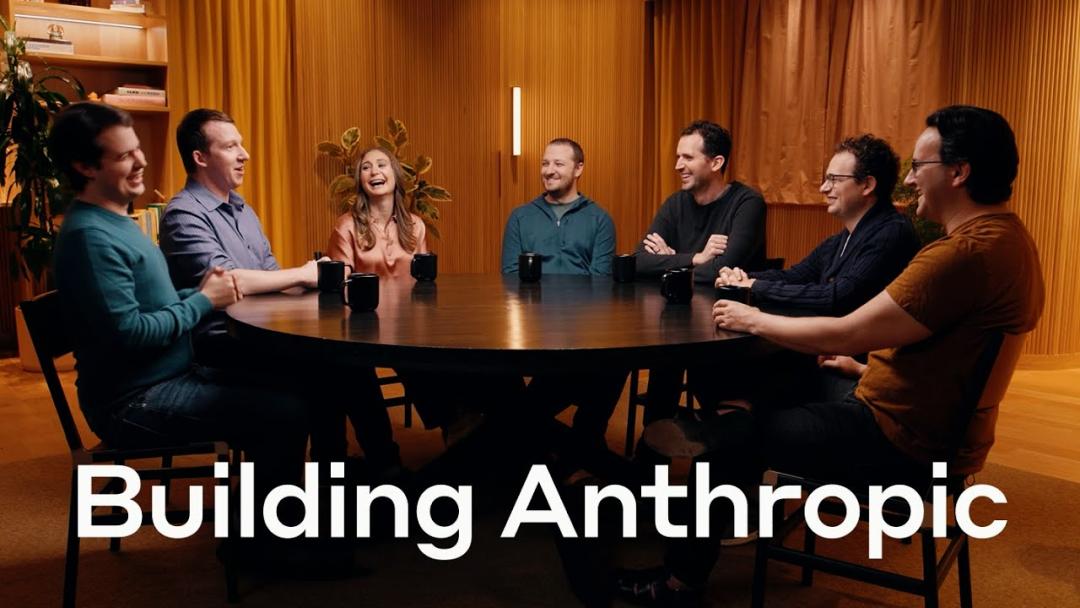
Employees have also ushered in the window of wealth realization. Now more than 5,000 employees of Anthropic will gain more than $200 billion in the IPO. Among the first 100 employees who joined the company, more than three-quarters are still working there. A career choice made a few years ago now has the power to change lives.
The earliest investors have reaped hundredfold returns.
Back in 2021, less than half a year after Anthropic was founded, Jaan Tallinn, co-founder of Skype, led the Series A round, with former Google CEO Eric Schmidt and others participating, and the whole round invested about $125 million. Calculated at the issue price of $83, this batch of shares is worth about $403 billion, with a return of more than 300 times.
There is also an investment from Hollywood. Sound Ventures was co-founded by Guy Oseary, Madonna's agent, and actor Ashton Kutcher. At that time, they had already invested in OpenAI, and only after obtaining the consent of both Altman and the Amodei siblings did they invest about $35 million in Anthropic. They kept increasing their holdings afterwards, with a total investment of about $435 million. Based on the disclosed shareholding scale before the listing, roughly estimated at the issue price, their shares are worth about $75 billion, which is about 17 times of the total investment.
Spark Capital also has an impressive track record — as the only venture capital firm named in the prospectus, it has invested a total of $777 million, and the market value of its positions has soared to about $14 billion, with an overall return of about 18 times; among them, the initial first investment of $75 million has a potential return of nearly 80 times. Menlo Ventures has invested a total of about $1 billion, in exchange for a position of about $21 billion, with a return of about 22 times.
Turning the clock back a few years, behind every early investment there was full of embarrassment of being ignored. Investor Anjney Midha still remembers clearly that back then, in order to help Anthropic raise funds, he contacted 22 VCs in a row and was rejected 21 times.
That is why those institutions that caught up later are even more bittersweet. ICONIQ, now the largest financial investment shareholder, once gave up the opportunity, and did not lead the Series F round at a high valuation of $18.3 trillion until 2025, then continued to increase its holdings, with a total investment of more than $6 billion, corresponding to a shareholding of about $300 billion; HSG once hesitated because it bet on OpenAI. Although it finally appeared in the list of shareholders of Anthropic's Series G and Series H rounds this year, the entry cost is completely different from before.
Amazon and Google have gained even larger returns. Calculated separately, the two have invested about $130 billion and $136 billion respectively, and the estimated value of their shareholdings has exceeded one trillion US dollars.
Behind the bustle, some people missed the entire golden mountain.
SBF, founder of FTX, once invested $500 million in Anthropic through Alameda Research. After the company went bankrupt, it sold off all relevant shares in two batches in 2024 to pay off creditors, recovering about $13.4 billion. Institutions such as Jane Street, HOF Capital and Fidelity's funds took over part of these shares. If they had held them until this IPO, the value would have been about $370 billion according to calculation.
Masayoshi Son, founder of SoftBank, also missed the golden opportunity.
"I really wish I had invested back then." On the eve of the listing, Masayoshi Son sighed with great emotion. Recalling the meeting with Dario, he appreciated this founder very much. SoftBank also once discussed taking a stake in Anthropic, but at that time it had already started investing in OpenAI, and Masayoshi Son thought it was inappropriate to bet on the opponent of its partner.
In just over five years, Anthropic has grown from being ignored to a trillion-dollar market cap. Some people have cashed in their chips while sticking to their choices, while others have missed the era in hesitation. However, the bell-ringing is never the end of the story.
Watershed
The Major Exam for AI Has Just Begun
"Never let the company's valuation exceed its real value, not even one dollar." Before the listing, Dario mentioned that he hopes Anthropic will continue this habit in the capital market: promise less, deliver more.
Facing the trillion-dollar IPO, this sentence is particularly thought-provoking.
In the past few years, large model companies have lived in the greenhouse of the primary market. As long as the technology curve is steep enough and the vision is grand enough, VCs are willing to keep increasing their bets for the possibility of the future. But after stepping into the secondary market, the rules have changed. Computing power bills, business retention and profit paths all have to undergo ruthless inspection.
The current sentiment is the most direct footnote. Since the beginning of November, the market value of the Nasdaq 100 Index has evaporated by nearly $2 trillion, and the market's patience with high AI valuations and sky-high capital expenditures is running out. It is in this atmosphere of panic that Anthropic stood on the bell-ringing stage against the trend.
No one can give an answer in advance. As a trillion-dollar large model company stepping onto the ice, every K-line of Anthropic after listing is testing the ice thickness for the entire industry.
It is not only Wall Street that is holding its breath and watching the market, the most nervous one is probably OpenAI. In June this year, the company has secretly submitted its IPO application, and Altman personally promoted the restructuring of the organizational structure, targeting a 2027 listing. With a valuation of $1.25 trillion, it can be said that it needs Anthropic to stabilize its position in the secondary market more than anyone else.
Chinese large model companies across the ocean are also closely watching this major exam.
In terms of IPO progress, the Chinese team has taken earlier steps. In January this year, Zhipu and MiniMax successively landed on the main board of the Hong Kong Stock Exchange; in June, the Shanghai Stock Exchange issued audit guidelines, clarifying that large model enterprises are applicable to the fifth set of listing standards of the Sci-Tech Innovation Board, opening the door for high-quality technology enterprises that have not yet formed large-scale revenue.
Subsequently, news came out that DeepSeek was preparing for a Sci-Tech Innovation Board IPO, and had hired CITIC Securities. In the past few months, DeepSeek's two rounds of financing and IPO preparation have been advanced one after another. The market even began to vaguely expect that if its market cap stands at one trillion yuan in the future, the founder Liang Wenfeng's book wealth may rewrite the ranking of China's rich list.
The team preparing for Hong Kong IPO is still expanding. Earlier, investment media exclusively learned that Moonshot AI behind Kimi has sent a notice of organizational restructuring to investors, preparing for a Hong Kong IPO. StepFun, Kling AI and other companies have successively spread news of listing plans.
Perhaps this night is exactly the historical watershed of the AI era.
The pain of stock price fluctuations is inevitable, but it is not necessarily a bad thing for the industry. The bubbles propped up by concepts will eventually clear out, and technologies that can truly change the era are never afraid of stepping out of the greenhouse. Only by standing up to the most critical scrutiny of the public market can they take root truly.
Detaching the sight from short-term fluctuations, the bell-ringing itself conveys a clear result: devoting youth and energy to the hardest underlying technologies is no longer just a poor idealism, but can also bring decent and generous returns.
For China's technology industry at present, such a return model is worth looking forward to. Technological innovation is in itself a long and lonely process of trial and error. The new names on the rich list not only change the fate of a few people, but also form silent road signs, becoming the confidence for latecomers to persist. The new generation of industrial advantages may be bred in these choices.
As Liang Wenfeng once said: "When this society allows people who engage in hard-core innovation to achieve fame and success, the collective mindset will change."
This article is from the WeChat Official Account "Pedaily" (ID: pedaily2012), written by Wang Lu, authorized for release by 36Kr.