Who is building OpenAI's first AI hardware? The design and R&D are undertaken by a team of Apple veterans, and Apple's supply chain is responsible for manufacturing.
OpenAI has indeed tapped deep into Apple's core supply chain ecosystem.
As early as the morning of November 19, Securities Times cited supply chain sources pointing out that FIH Mobile Limited (FIH), a subsidiary of Foxconn, has secured the order for OpenAI's mobile phone project and will participate in the full assembly of related products. In fact, the National Business Daily also cited supply chain insiders the previous night stating that Luxshare Precision is currently in comprehensive cooperation with OpenAI on multiple products, and "it did not take on the mobile phone assembly business possibly due to overall consideration of resource allocation."
Both of them are long-term partners of Apple. However, it is almost certain that OpenAI's first AI hardware product will not be a mobile phone.
As early as August this year, Luxshare Precision revealed some information in its "Investor Relations Activity Record". Li Bin, Chief Operating Officer of the company, stated at that time, "The customized product development for overseas model companies is advancing very efficiently, which will bring significant performance contributions to the company starting next year."
Although OpenAI was not named directly, combined with today's supply chain reports and previously disclosed information from media outlets such as Bloomberg and The Information, the outline of OpenAI's first AI hardware product has gradually become clear:
This is a screen-free AI device expected to be delivered to consumers in 2027, and Luxshare Precision will be its core manufacturer.
However, as the company behind ChatGPT, OpenAI is obviously not satisfied with launching just one product. What exactly does it want to build in terms of hardware, and which teams and suppliers has it recruited? Lei Tech (ID: leitech) conducted an in-depth investigation.
OpenAI's first AI hardware product is not a mobile phone, but a "donut"
Since OpenAI announced the acquisition of io Products in 2025, various rumors around its AI hardware plans have never stopped. Mobile phones, glasses, headphones, even smart desk lamps, AI pins and recording devices have all been reported as products under development.
Among them, the mobile phone project has received particularly high attention. In April this year, Ming-Chi Kuo, analyst at Tianfeng International Securities, first disclosed that OpenAI is cooperating with MediaTek and Qualcomm to develop mobile phone processors, and Luxshare Precision is the exclusive system co-design and manufacturing partner, with mass production expected in 2028. Although the latest news indicates that FIH will undertake the full device assembly, it further confirms that OpenAI's mobile phone plan has entered the stage of supply chain cooperation.
Smart glasses are also on the planning roadmap. In February this year, OpenAI was exposed to be developing a series of AI hardware including smart glasses, but the glasses are not expected to be ready for mass production until 2028.
As for headphones, news about an AI headphone codenamed "Sweetpea" leaked earlier this year, which is reportedly designed differently from traditional TWS headphones. In fact, Tang Tan, Head of Hardware at OpenAI, explicitly stated in 2025 court documents that the first prototype product mentioned to the public at that time was not an in-ear or wearable device.
Therefore, OpenAI's first consumer-facing AI hardware product is most likely neither a mobile phone, nor glasses or headphones.
In the middle of this year, Bloomberg journalist Mark Gurman successively disclosed that OpenAI plans to first launch a portable, screen-free AI device, with a size close to a ice hockey (standard diameter of 7.62cm) and an appearance similar to a "donut". According to current information, this product will be equipped with a microphone, speaker, camera and environmental sensors, interact with users through voice, and also use indicator lights and movable mechanical structures to make the device's feedback more vivid.
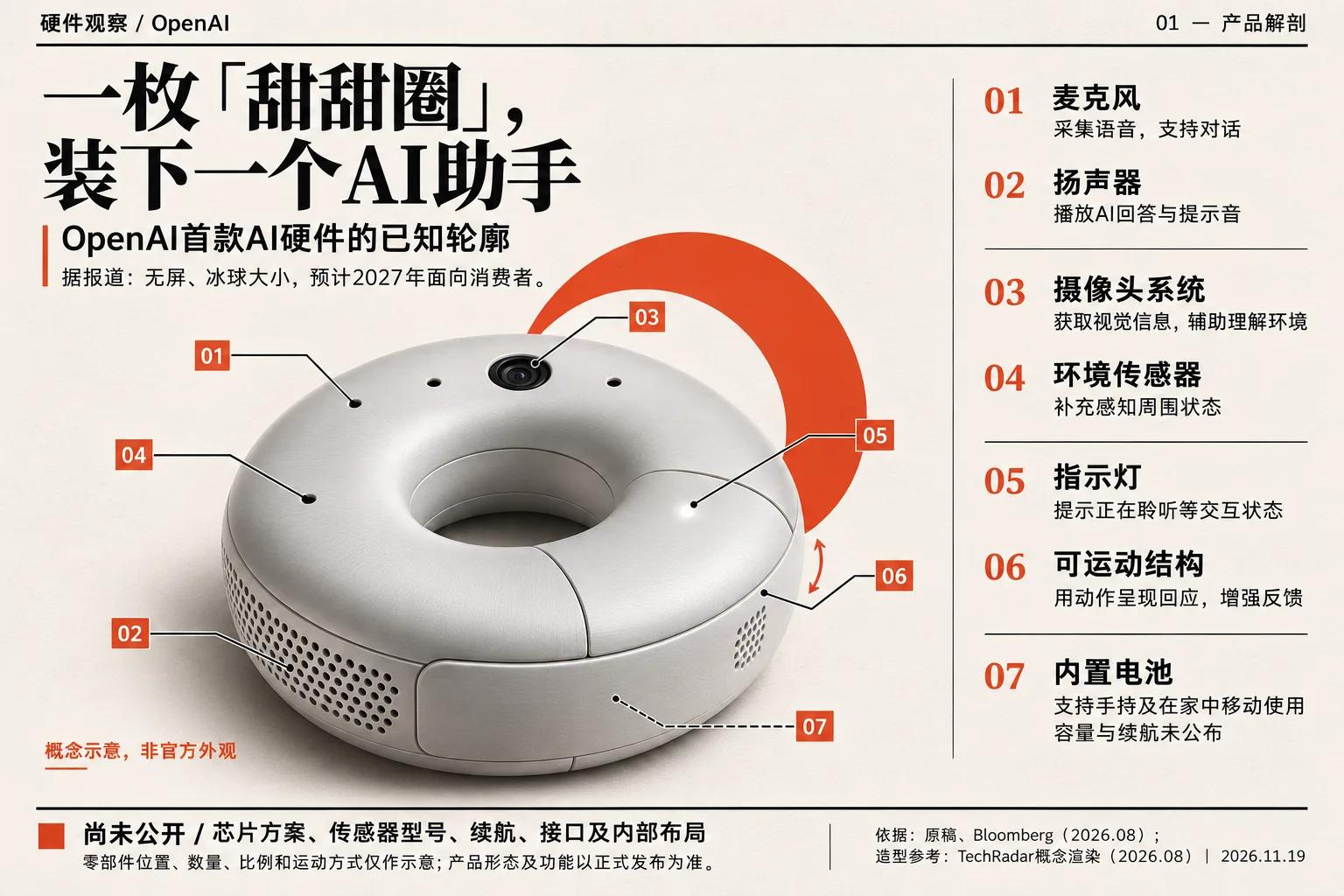
Image source: Lei Tech @GPT
To put it simply, it is somewhat similar to a portable smart speaker, but OpenAI hopes to endow it with stronger environmental perception and active interaction capabilities.
For example, users do not need to explicitly describe their problems through voice commands every time. The device can combine the environmental information obtained from cameras and sensors to understand what the user is doing and what is happening around, and then decide how to respond or provide assistance.
Previously, OpenAI CEO Sam Altman described the device they are building as calmer and simpler than smartphones.
This line of thinking is not hard to understand. Over the past decade, smartphones have almost monopolized the main entry point for people to interact with the digital world, but OpenAI obviously hopes that AI can break away from the restrictions of screens and apps, and become an assistant that can be used at any time in daily life.
Of course, whether this interaction method is really more convenient than using a mobile phone can only be judged after the product is launched. At least according to current news, OpenAI has already found teams and manufacturers willing to invest resources in this idea.
Luxshare is responsible for manufacturing, Goertek may provide speakers
If we have to pick the most important company from OpenAI's hardware product supply chain, it is undoubtedly Luxshare Precision at present.
Luxshare's advantages are easy to understand. As an important manufacturer in Apple's supply chain, Luxshare has accumulated rich experience in the manufacturing of products such as iPhone and AirPods. More importantly, it is not only responsible for assembling the purchased components.
In recent years, Luxshare has also strengthened its vertical integration capabilities from precision components and modules to complete devices. In the investor exchange mentioned earlier, Luxshare also specially emphasized that by integrating ODM business and R&D teams, the company has strengthened its capabilities in complete machine product development, design and underlying R&D.
This point is particularly important for OpenAI.
After all, the device OpenAI hopes to manufacture is not a conventional smart speaker. According to previous reports, this device needs to integrate cameras, sensors, acoustic systems and mechanical movement structures in a space the size of an ice hockey, while taking into account battery life, heat dissipation and overall device reliability.
For OpenAI, which is developing consumer electronic products for the first time, a manufacturer with mature system design and mass production experience can reduce a lot of troubles.
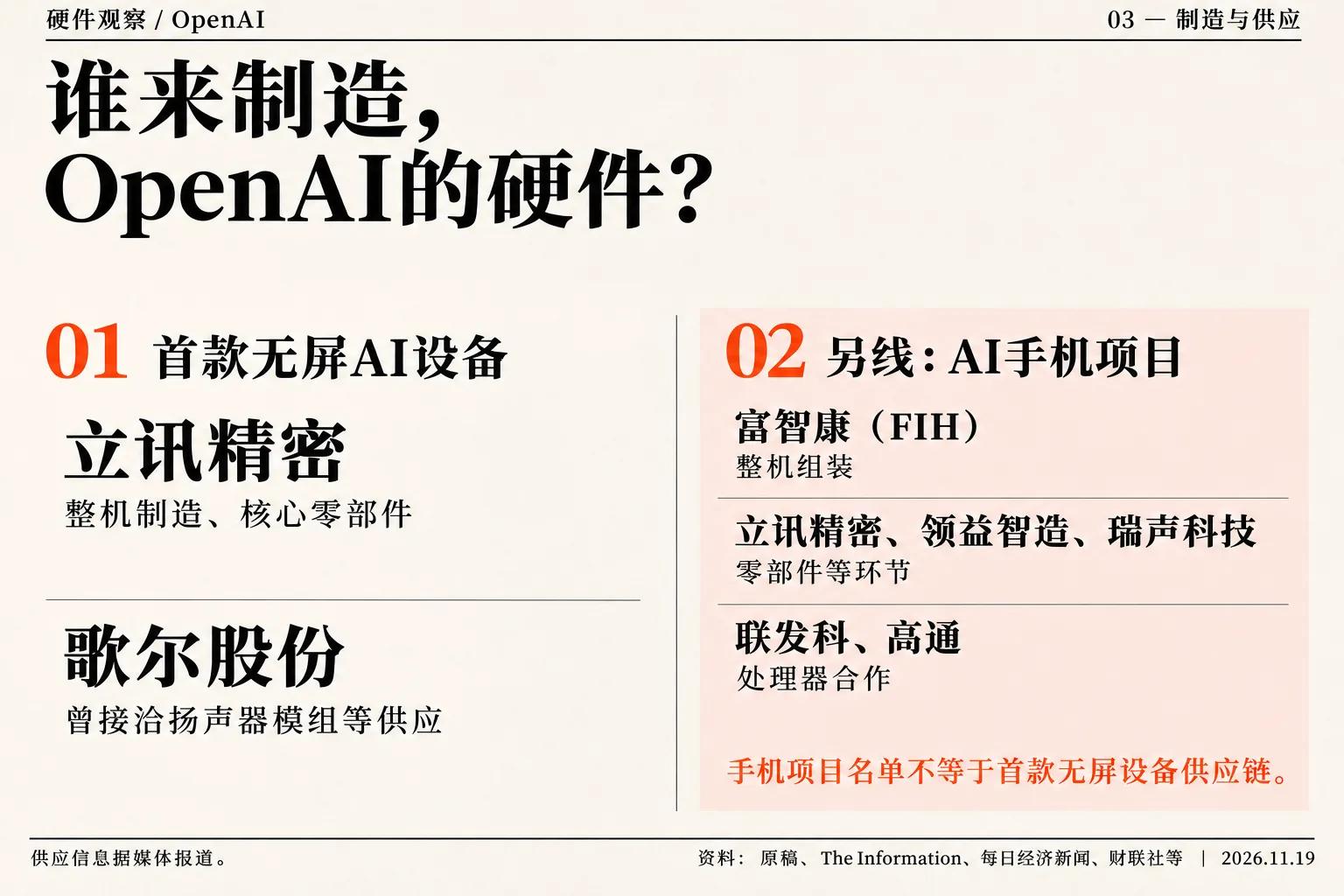
Image source: Lei Tech @GPT
In addition to Luxshare, another noteworthy Chinese manufacturer is Goertek Co., Ltd.
As early as 2025, The Information disclosed that OpenAI was in contact with Goertek, hoping that it would provide components such as speaker modules for future hardware products.
Goertek has long been involved in the manufacturing of Apple products such as AirPods and HomePod, and has very deep accumulation in micro-acoustics and complete machine integration. For an AI device with voice as the core interaction method, acoustics is naturally an unavoidable key point. However, what can be confirmed at present is only that the two sides have had supply negotiations, and there is no public reliable evidence that Goertek has finally obtained the designated and mass production orders.
As for traditional Apple supply chain manufacturers such as AAC Technologies and Lingyi iTech, as well as the cooperation with Qualcomm and MediaTek, they are mainly related to OpenAI's mobile phone project.
Half of the former Apple hardware team is involved in R&D and design
Compared with the component supply chain that still needs further confirmation, the composition of OpenAI's hardware R&D and design team is much clearer now.
The story starts with Jony Ive.
This former Apple Chief Design Officer, who once led the design of iMac, iPod, iPhone and Apple Watch, founded the independent design company LoveFrom after leaving Apple in 2019. According to the press release released by OpenAI in 2025, Sam Altman, Jony Ive and the LoveFrom team started cooperation as early as 2023 to explore new hardware products in the AI era.
Subsequently, Jony Ive co-founded io Products with three old colleagues, namely Scott Cannon, Evans Hankey and Tang Tan.
The backgrounds of these four people almost cover the key links of consumer electronics hardware from design to manufacturing.
Tang Tan worked at Apple for about 25 years, was responsible for product design of iPhone and Apple Watch, and now serves as OpenAI's Chief Hardware Officer, being one of the most important technical leaders of the entire hardware project.
Evans Hankey was the head of industrial design after Jony Ive left Apple, and once directly took over part of Ive's responsibilities at Apple. After joining io, she continued to be responsible for the industrial design of hardware, and assumed corresponding responsibilities after the team was merged into OpenAI.
Scott Cannon's role in this team is more focused on manufacturing and supply chain. According to a report from The Information in February this year, he is currently responsible for the supply chain work of OpenAI's device project.
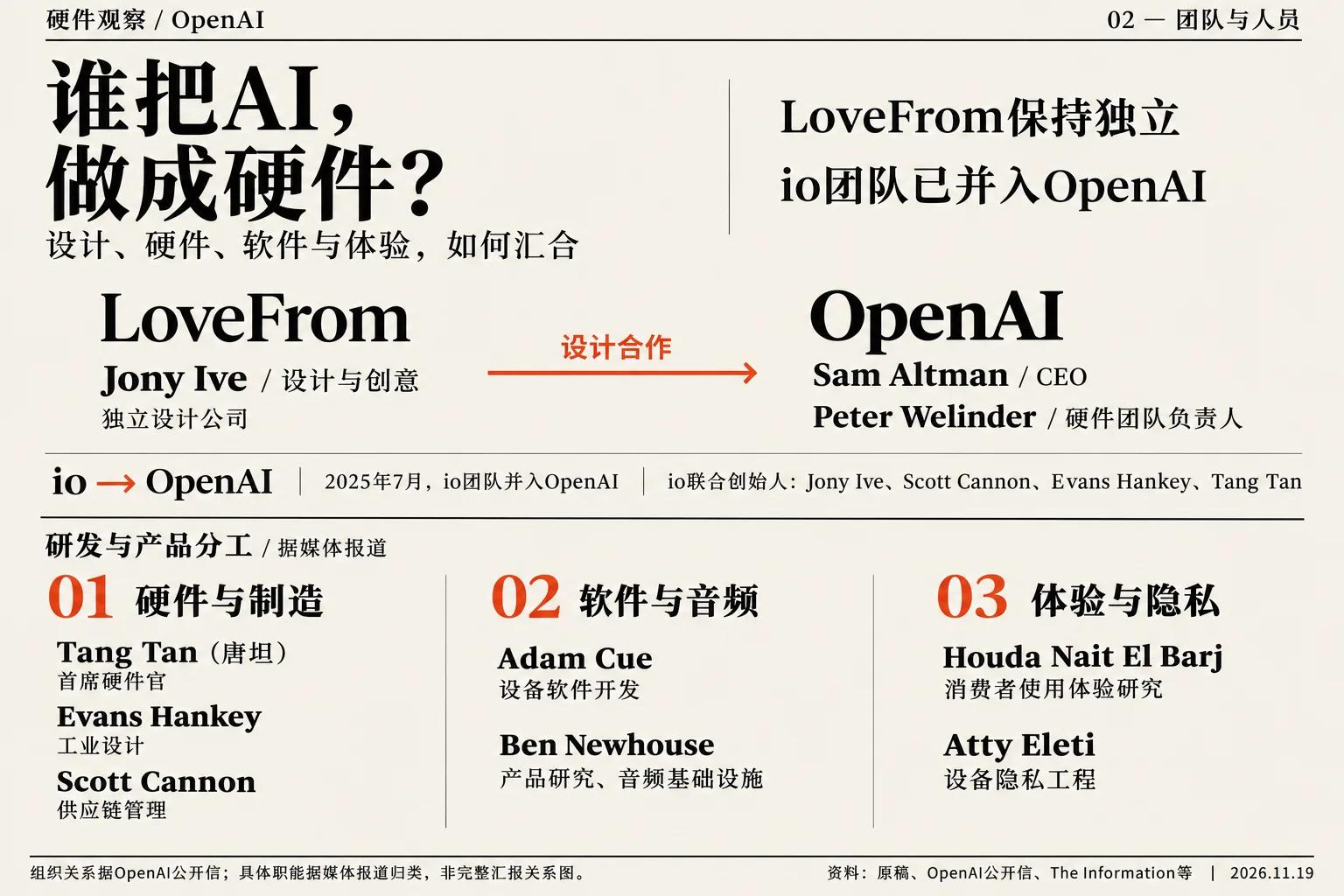
Image source: Lei Tech @GPT
In May 2025, OpenAI announced the acquisition of io Products for approximately 6.5 billion US dollars, and completed the team integration in July. According to the open letter, the io team officially became part of OpenAI and continued to be responsible for hardware R&D and product implementation; Jony Ive and LoveFrom are deeply involved in the design and creative work of OpenAI's products.
According to current information, although Jony Ive is not a formal employee of OpenAI, he has great decision-making power in hardware design, and the vast majority of design choices are ultimately approved by him.
In other words, OpenAI has introduced Apple's former core hardware talents, design capabilities, and part of the mature development experience into the company. And this $6.5 billion acquisition bought far more than just dozens of engineers.
Relying only on Apple veterans cannot complete a brand new AI device. From the perspective of organizational structure, OpenAI has actually assigned the hardware project to a relatively independent team.
At present, this team is led by Peter Welinder. He was previously responsible for OpenAI's new product exploration business, and jointly promotes product development with hardware experts from io such as Tang Tan. In addition:
Adam Cue, son of Eddy Cue, head of Apple's services business, also joined OpenAI through io and is responsible for software development of future hardware;
Ben Newhouse co-founded the computer vision company Bubbli (later acquired by Dropbox) and participated in OpenAI's Operator project. He is currently responsible for product research, participating in the transformation of the original text-biased AI infrastructure into a system suitable for audio interaction;
Houda Nait El Barj has a background in economics and behavioral research, has engaged in related research at Stanford University, and also participated in OpenAI's Operator project. She is currently responsible for studying how consumers will use these AI devices;
Atty Eleti once worked as a software engineer at Stripe. After joining OpenAI, he served as co-head of the GPT-4 API, participated in the privacy protection engineering of AI devices, and later was responsible for ChatGPT Voice related product work.
The staffing arrangement actually reflects OpenAI's idea for AI hardware, especially its first product. If it is just a speaker that can call ChatGPT, the design and development are not as complicated as imagined. But to make the device continuously perceive the environment, participate in conversations naturally, and even take the initiative to provide assistance, the audio model, environmental understanding, interaction design and privacy protection need to work together.
Especially without a screen, it is difficult for users to confirm what information the device is obtaining and what operations it is performing at any time, as they would when using a mobile phone.
This is also a problem that OpenAI must personally participate in solving.
As the project continues to advance, the scale of the hardware team is also expanding. According to a report from Fortune magazine in July, OpenAI's hardware team has exceeded 400 people, mainly working in Jackson Square, San Francisco, not far from the LoveFrom studio.
Just on November 16, the San Francisco Chronicle disclosed that OpenAI and Jony Ive's hardware project have rented a new office space of about 115,000 square feet in downtown San Francisco to prepare for subsequent team expansion.
Compared with the scale of about 55 people when io was first acquired, OpenAI has now obviously built a truly meaningful consumer hardware R&D team.
But the connection between this team and Apple has become more and more complicated. In July this year, Apple filed a lawsuit against OpenAI and some of its former employees, accusing them of improper acquisition and use of trade secrets and supply chain confidential information. From another perspective, this lawsuit also reflects that OpenAI and Apple have formed direct competition in multiple fields such as hardware talents, technology and supply chain.
Conclusion
According to current information, the team and manufacturing system behind OpenAI's first AI hardware product have taken a general shape.
Jony Ive and LoveFrom are responsible for design creativity, the hardware team composed of former Apple executives such as Tang Tan undertakes R&D and product implementation, OpenAI's own model, software and product research teams participate in the interactive experience, and Chinese manufacturers such as Luxshare Precision turn these ideas into mass-producible devices.
This is a hardware development system with a strong Apple style.
Interestingly, OpenAI is trying to break the human-computer interaction method dominated by smartphones, and may even launch its own AI mobile phone in the future, but its first hardware product still cannot do without the talents and supply chain that Apple has cultivated over the past few decades.
Of course, the fact that the supply chain is ready only represents that OpenAI has taken the first step in its hardware business. Next year, when this oddly shaped screen-free device is really placed in front of consumers, will people be willing to buy a new AI device, or continue to use ChatGPT on their mobile phones?
For OpenAI and everyone involved, this is the more important question.
This article is from "Lei Tech", authorized for release by 36Kr.