Hi everyone at UBTECH, please wait a little longer before you enter your homes.
At the 2026 APEC, one of the representative figures in the embodied intelligence field participating in the thematic seminar is Wang Xingxing, founder and CEO of Unitree, and the other is Zhou Jian, founder, chairman of the board and CEO of UBTech.
Headquartered in Shenzhen, UBTech is a listed company focusing on full-size humanoid robots, serving as a critical platform to demonstrate the level of China's robotics industry.
According to Zhou Jian, the large-scale industrialization of humanoid robots "still requires opening up the full chain connecting R&D, mass production and practical application."
This remark hits the nail on the head.
Against the current landscape of China's embodied intelligence sector, a structural contradiction lies in the fact that while single-point capabilities are advancing rapidly, a mutually driving positive cycle has not yet taken shape among R&D, mass production and application.
Just a few days ago, UBTech successively secured large orders, taking a solid step forward towards this closed loop.
Still Far From Entering Household Scenarios
As the year is drawing to a close, UBTech has landed another large order.
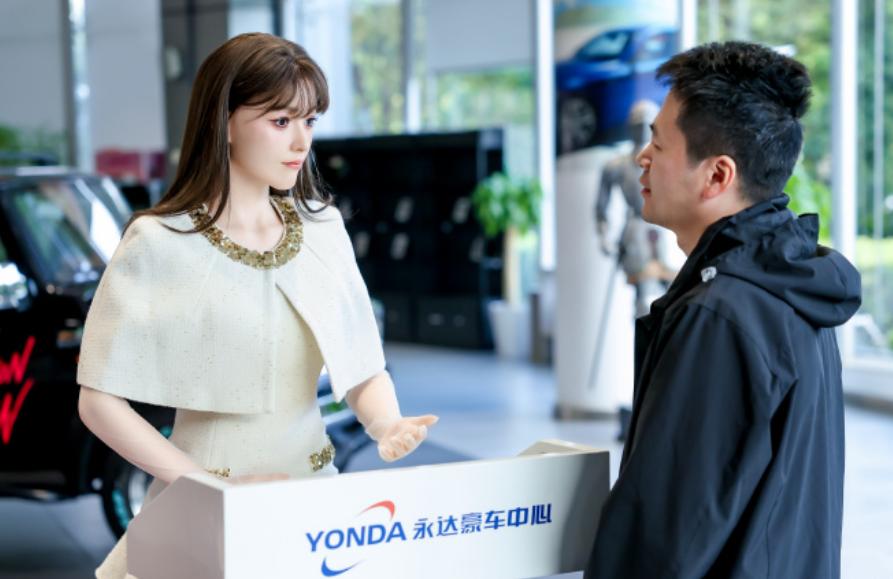
On November 11, UBTech announced on its official WeChat account that Yongda Auto, a leading domestic luxury car dealer, will purchase 400 units of UBTech's ultra-realistic humanoid robot U1 Pro, and UBTech plans to deliver all the units within this year.
This is the first large-scale bulk commercial order for the U1 series since its release in June, marking that bionic robots have moved from exhibition items to large-scale B-end procurement.
What do car dealers need robots for? Judging from the attached pictures, the robots are deployed to provide shopping guide services.
UBTech's market cap rose slightly on the day of the announcement, but all the gains were erased the next day, followed by a continuous decline. As of November 19, UBTech's market cap stood at around 33.1 billion Hong Kong dollars. Compared with Unitree, the two companies posted comparable revenue in the first half of this year, while UBTech's market cap is only 14% of the latter's.
It is clear that the market does not regard this as an exciting piece of news. After all, this order still follows the old path — relying on distribution channels and targeting the B-end market.
UBTech already ran a similar cooperation with Boshi Group, a strategic partner of Mercedes-Benz in China, back on July 15 this year, placing U1 robots as exhibits in 4S stores to provide simple shopping guide services. In addition, on November 9, UBTech just signed a three-year sales cooperation agreement for 100,000 units with China Telecom E-surfing Terminal. To boost robot sales, UBTech has closely aligned itself with channel partners.
A relevant person in charge of UBTech explained the logic to AI Lan Media: "The deployment of U1 robots in car dealer stores and robot parks also helps consumers get in touch with and experience the products in real scenarios, which will be converted into household purchase decisions in the future."
However, that was not what UBTech said at the launch event. When it released the U1 series of bionic robots in June this year, UBTech positioned it as a "family emotional companion robot", and announced that the all-channel orders for the U1 series had exceeded 13,361 units. Zhou Jian also stated on site that "delivery of 10,000 units is guaranteed this year".
This immediately drew nationwide attention, and people were curious: is it possible to fall in love with a robot so soon?
The subsequent development was not as sci-fi and sweet as people expected. At the earnings call at the end of August, Zhang Ju, CFO of UBTech, gave a new forecast: the actual deliverable volume of the U1 series this year will be around 1,500 to 2,000 units. The performance was cut by 80 percent overnight.
For this huge gap, UBTech attributed the problem to production capacity.
The head of the U1 robot needs to integrate 19 degrees of freedom and two to three thousand components in a limited space to realize more than 30 micro-expressions; the yield rate of the bionic silicone skin is not high, eyebrows and eyelashes need to be implanted manually, the micro servo actuator is a non-standard part, and the supply chain has not been fully optimized. Zhou Jian also admitted on the earnings call that the commissioning of the Guangxi factory was delayed by two to three months due to natural factors, which "was not fully anticipated in advance", and the company has thus urgently arranged supplementary production capacity in Shenzhen.
But even if the production capacity problem is solved, can the closed-loop business model be achieved?
The answer is no, because this series of orders only verifies that "humanoid robots reach end users through mature distribution systems", rather than "humanoid robots have begun to enter households".
This can also be seen from the product definition and details. U1 Pro itself is not a robot designed for practical work: it is equipped with bionic silicone skin, 88 degrees of freedom and more than 30 micro-expressions, but does not support autonomous walking, has no housework functions, and only has a 2 to 4 hours of battery life for companion chat after a single charge. It is far from practical, and its high price of 169,800 yuan is unaffordable for ordinary families.
At the ongoing APEC in recent days, Zhou Jian said: "General-purpose humanoid robots with extremely strong generalization capabilities still require more time to develop under current hardware and large model conditions."
He gave a specific description of this "time" earlier this year — it will take at least 3 to 5 years to achieve household emotional companionship, and it may take 7 to 10 years for robots to perform tasks such as housework.
This predicament is not a problem exclusive to UBTech.
Currently, the robots that have entered households, such as Qiyuan's Q1 and T1, and Songyan Dynamics' Xiaobumi, are mainly positioned as companions that provide emotional value for family members.
When AI Lan Media conducted in-depth experience tests on mainstream small-sized household humanoid robots on the market, passersby would come over to take a close look and ask: "What on earth can it do?" After experiencing the functions of "singing, dancing and chatting", they would always say with regret: "It's just a big toy..."
Yes, it will still take some time before robots can perform practical work in household scenarios.
Regarding the delivery ratio of U1 robots in commercial and household scenarios, the relevant person in charge of UBTech did not disclose the data to AI Lan Media on the grounds that it involves financial information.
The Significance of U1 Goes Far Beyond Profit
At present, the scenario that supports UBTech's revenue is still the industrial sector. Industrial scenarios feature clear demand, strong payment capacity, and relatively single requirements for robot forms, making it the most realistic commercialization path at this stage.
Therefore, Zhou Jian has established this development logic: first polish technologies, accumulate data and set standards in industrial scenarios, and then gradually expand to commercial and household scenarios.
The main product at this stage is the Walker series humanoid robots, which have been deployed in multiple automobile factories in the first half of the year to perform tasks such as handling, quality inspection and assembly.
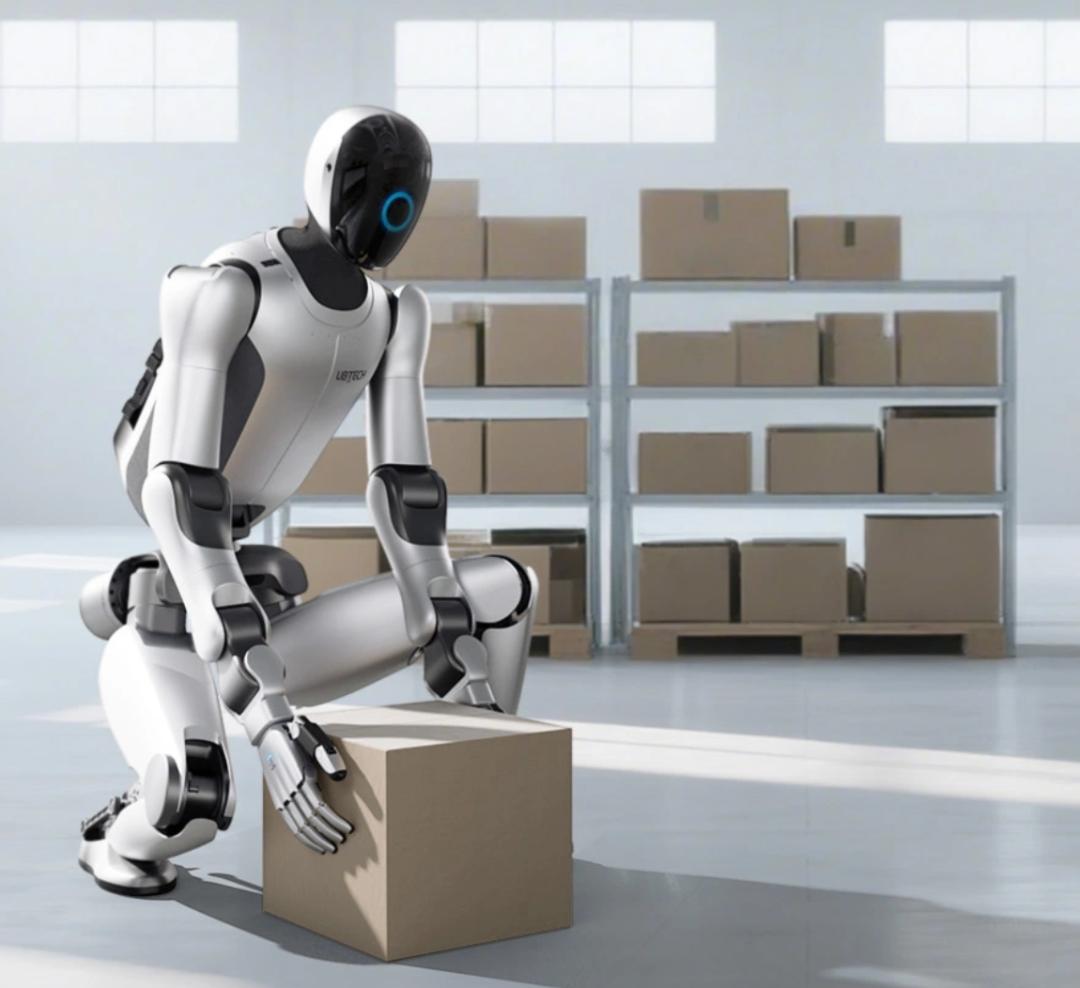
However, different from the general concept of embodied intelligence, UBTech's projects are highly customized.
The financial report data confirms this point. In the first half of 2026, UBTech's total revenue reached 1.269 billion yuan, of which the revenue from full-size embodied intelligent humanoid robots was 590 million yuan. Out of the 590 million yuan, about 569 million yuan came from the business of "customized intelligent robots and solutions for other industries", which are industry-specific customized projects from manufacturing enterprises including Airbus, BYD, Geely and Foxconn.
The fact that UBTech's robots have entered Airbus's supply chain and secured orders from leading automobile manufacturers fully proves its outstanding technical strength. However, the nature of industrial business also determines that it generates slow returns, with low replicability, long negotiation cycles and slow revenue recognition.
If UBTech relies on this business model for a long time, it will only be defined as a project-based system integrator, and it will be difficult to obtain a high-premium market valuation.
The real vast blue ocean lies in the C-end market, which is a huge market covering hundreds of millions of households with enormous imagination space.
Although UBTech's U1 series for household consumers has not achieved considerable scale so far, its strategic significance is more far-reaching than selling a few more industrial robots in the short term.
The U1 series has opened up a brand new track for UBTech — consumer-grade humanoid robots. Different from Unitree and Agibot, UBTech's full-size bionic route is highly distinctive.
In the competitive landscape, UBTech has seized the right to define this product category. Although the products it launched may not be the optimal solution, they have occupied consumers' mindshare. Later entrants have to benchmark their own products against U1 when making product explanations.
The premium the market gives to Unitree is not based on the sales volume of its quadruped robots, but on the high expectations behind general embodied intelligence. Although U1 is not profitable, as long as it exists, UBTech still has the right to tell stories about household scenarios, emotional companionship and general-purpose intelligence.
Of course, the next step is to enter households as soon as possible. The main obstacle to this goal is the generalization capability of the robot, in short, whether the embodied brain is smart enough, and when the robot can obtain stronger autonomous learning and decision-making capabilities.
UBTech's layout on the embodied brain is mostly oriented to industrial scenarios.
UBTech has independently developed and open-sourced Thinker, an embodied intelligence large model with hundreds of billions of parameters, which ranks first in 9 authoritative international benchmarks according to the official statement. The supporting Thinker-VLA, a vision-language-action model with closed-loop feedback, realizes millimeter-level material loading, generalized grasping and dual-arm collaborative box handling. It also launched Thinker-WM, a world model for industrial scenarios.
UBTech is obviously not fully prepared for household scenarios. According to Zhou Jian's vision, UBTech still has 3 to 5 years of development time, and people are looking forward to the day when it completes its transformation from industrial scenarios.
This article is from the WeChat official account "AI Lan Media", written by Feng Hua, edited by Wei Xiao, and published with authorization from 36Kr.