The investors who fled before Jensen Huang resigned
Capitol Hill is never short of "stock market gods".
The most renowned one is former US House Speaker Nancy Pelosi. Over her 38-year career in Congress, she has recorded a cumulative return of around 16930%, 7 times higher than the Dow Jones Index in the same period. This year, however, Democratic Congressman from California Ro Khanna completed a transaction that even Pelosi would envy.
On September 4 and October 7, the trust associated with Khanna's wife sold Nvidia shares twice. Coincidentally, Nvidia's share price just hit a record high on October 6. More than a month later, the AI bubble was finally punctured by niche literary content, Jensen Huang resigned as CEO, and Nvidia's share price plummeted by 35%.
The Khannas also sold two lots of Nvidia shares near the price peak in May, and bought them back in the third quarter, showing extremely skilled band operation. Since the beginning of this year, Khanna has disclosed 4578 transactions, and generated 112.1% excess return over the S&P 500 from January to April alone.
However, as the person with the highest turnover rate on Capitol Hill, Khanna has actively pushed for banning members of Congress from trading stocks.
But this is not realistic. The annual salary of ordinary members of Congress is only 174,000 US dollars, and it has not increased for 17 years[1], not to mention that even the President himself is a skilled trader.
After Trump returned to the White House, he traded Nvidia a total of 103 times, involving an amount ranging from 27 million to 97.5 million US dollars. In January 2025, Nvidia's share price plunged under the impact of DeepSeek. Just two days before Jensen Huang's first visit to the White House, Trump's account quietly bought 1-5 million US dollars worth of Nvidia shares.
The latest operation took place in August, when he bought 1.6 million US dollars of Nvidia shares and sold 1 million US dollars at the same time. As an ally of Jensen Huang, Nvidia has always been one of Trump's heavyweight positions.
In contrast, Khanna is not only the congressman representing the district where Nvidia's headquarters is located, but also the chief Democratic member of the Select Committee on U.S.-China Strategic Competition, directly participating in discussions on chip export policies. With such an accurate selling timing, his special identity inevitably makes people speculate a lot.
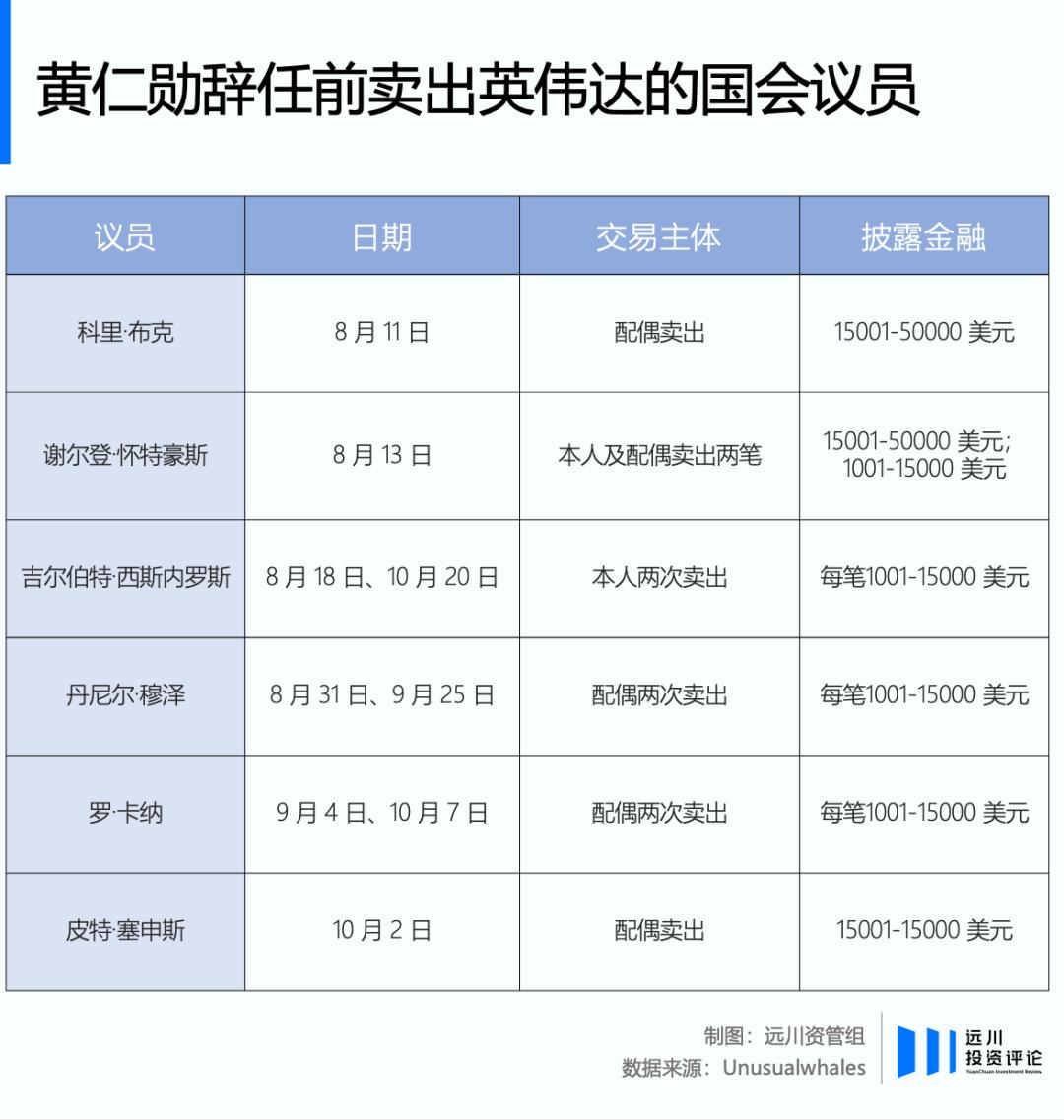
In addition to the Khannas, top asset management giants such as Soros Family Office, Blue Crown Capital, Bridgewater, Sixth Street, and Capital Group reduced their Nvidia positions in the third quarter, while Renaissance Technologies almost liquidated all its holdings.
From Capitol Hill to Wall Street, a group of people best at dealing with information have sold Nvidia shares one after another. What danger did they smell before Jensen Huang stepped down?
Ripples
Anyone who has watched *Ming Dynasty 1566* knows that the two most effective labels to get rid of hostile forces are "lewd behavior" and "colluding with Japanese pirates".
No one expected that hundreds of years later, this combination of tactics would be used on Jensen Huang.
The first institution that targeted Jensen Huang's private misconduct was a short-selling agency named Culper Research.
The two most viral financial articles worldwide this year are one, the field note of the No.3 analyst at Citrini Research who went deep into the Strait of Hormuz, and the other, Culper's cross-border tracking of Nvidia's business in China. These two little-known small institutions have revived non-fiction writing in the financial circle.
Culper was founded in 2019, with its office located in an apartment in Brooklyn. The team has only four members: founder Lamarco, two analysts, plus a Shiba Inu[2].
The name Culper is taken from the Culper Ring, a spy network established by George Washington during the American Revolutionary War.
In his view, there is a certain similarity between short-selling research and espionage: collecting hard-to-obtain clues and piecing scattered information into a complete map. Just like the "Mosaic Theory" believed in by Citrini founder James Citrin, real wealth is not in public financial statements, but in many small information fragments that are costly to obtain and may be ignored by mainstream institutions.

Christian Lamarco Daisy Korpics/WSJ, Bloomberg
In its short-selling report, Culper's core view is that Nvidia ostensibly withdrew from the Chinese market, but a large number of GPUs continue to serve Chinese customers through Southeast Asian intermediaries. China still contributes 20% of Nvidia's computing power revenue, which will deal a huge financial blow to Nvidia along with export restrictions and domestic substitution in China.
Interestingly, Culper found that Jensen Huang has a close relationship with Huang Le. Huang Le once bragged at a party that he could get Jensen Huang to come over, and the latter actually showed up soon. Some employees broke the news that Huang Le is the behind-the-scenes owner of Megaspeed, one of Nvidia's largest chip buyers in Southeast Asia.
Culper even analyzed the video of the two leaving a noodle shop frame by frame, and froze the frame at 3 minutes and 27 seconds: when Huang Le saw the reporter outside the door, he stopped abruptly, turned back to ask for the opinion of the woman in gray, and continued to move forward after getting the signal.
On May 13, 2026, Lamarco stayed up all night, finished a bagel, smoked a cigarette, and released this 40-page short-selling report, stating at the beginning that he holds a short position in Nvidia. At this time, Jensen Huang was arriving in Beijing aboard Trump's Air Force One.
The next day, Nvidia's share price hit a record high.
Six months ago, few people paid attention to this short-selling report. Nvidia's share price kept rising, and the long report that Lamarco had worked so hard to write ended up being a dud.
However, in the second quarter, the long positions in Nvidia began to loosen. Point72 reduced its holdings by 94.2%, and Third Point and Greenwoods Asset Management Hong Kong almost liquidated all their positions. In May, the Khannas quietly sold two lots of Nvidia shares, and the genius teenager Leopold held put options with a nominal value of about 1.57 billion US dollars, laying the groundwork for the subsequent blow-up.
It was not until October 29 that *The New York Times* exposed the spy suspicion, and Jensen Huang was then subjected to intensive public scrutiny.
This is where the Blue faction mouthpieces are more vicious than Culper: sex scandals can only bring down local officials, but spy narratives can topple senior politicians.
With both approaches applied, even if Nvidia's fundamentals are extremely strong, its share price can be pushed down. Since October 6, short sellers have realized nearly 24 billion US dollars of book profits in just 40 days.
People began to re-read Culper's report, and even Muddy Waters was inspired to target the private relationships of another senior executive at Nvidia.
Cracks
Nowadays, the mastermind behind Jensen Huang's resignation has gradually become clear.
There has been a serious split within the Republican Party. The hawks represented by Rubio and Besent, who oppose selling chips to competitors, and the populists represented by Bannon and Hawley, who oppose the rapid development of AI that takes away jobs of MAGA supporters, jointly suppress the expansionist faction represented by Trump and Lutnick. Coupled with the Blue faction media with severely declining standards fanning the flames, Jensen Huang has become the target of various political forces.
But in the third quarter, before the House of Cards-style political drama unfolded in Washington, the top Wall Street capitals mentioned at the beginning had already accelerated their exit.
Top domestic capitals took the opposite operation: GY Capital International completely liquidated its Nvidia holdings in the third quarter, while Greenwoods Asset Management Hong Kong liquidated its positions in the second quarter but bought them back in the third quarter, just like Point72 and Third Point.
Compared with TSMC, Greenwoods' position in Nvidia is more like a tentative layout, with a small and very flexible position. Point72's operation is similar: even after buying back in the third quarter, it has cut 77% of its common stock position compared with the first quarter.
Daniel Loeb of Third Point has a more clever operation. He just liquidated all Nvidia positions in the second quarter, and bought back 1.5 million shares in one go in the third quarter, directly making Nvidia his third largest heavyweight position. On November 3, however, he announced in a letter to investors that he had significantly reduced his holdings in chips and data centers, worrying that trillions of dollars in AI capital expenditure might not be able to earn back the costs.
To sum up, Wall Street's bearish views on Nvidia are based on no more than three points: Do customers still have money to buy chips? Do the chips they bought have enough power to run? Even if they have money and power, will customers definitely buy Nvidia chips in the future?
First of all, the script of circular financing is almost unsustainable.
Insurance companies were originally the main source of funds for chip financing, providing loans at an interest rate of 5%-6.5%. However, as financing for tech giants such as Microsoft and Nvidia touches the single-client concentration limit of insurance companies, borrowers have to find capital sources with higher costs.
In Daniel Loeb's quarterly report, the US credit market has gone crazy. The yield of high-yield bonds and leveraged loans for multiple data centers has reached double digits; top-tier data center ABS priced below 5% in January now has a yield close to 7%; the price of credit default swaps for Oracle, Meta and Nvidia hit a record high in late October.
As interest rates get higher and higher, the return on investment of data centers gets thinner and thinner, and Nvidia has gradually changed from a chip seller to a financier that provides funding to chip buyers.
Then, AI computing power construction has hit a power wall.
Alan Waxman, who once ran Goldman Sachs' largest proprietary investment department and now founded the $1400 billion alternative asset management giant Sixth Street, recently estimated that about 200 billion US dollars worth of chips are still lying in warehouses, waiting for the yet-to-be-completed data centers to be powered on.
Rising financing costs threaten Nvidia's orders, and power bottlenecks slow down the order fulfillment speed. But what is more fatal is that Nvidia's big customers are studying how to buy fewer of its chips.
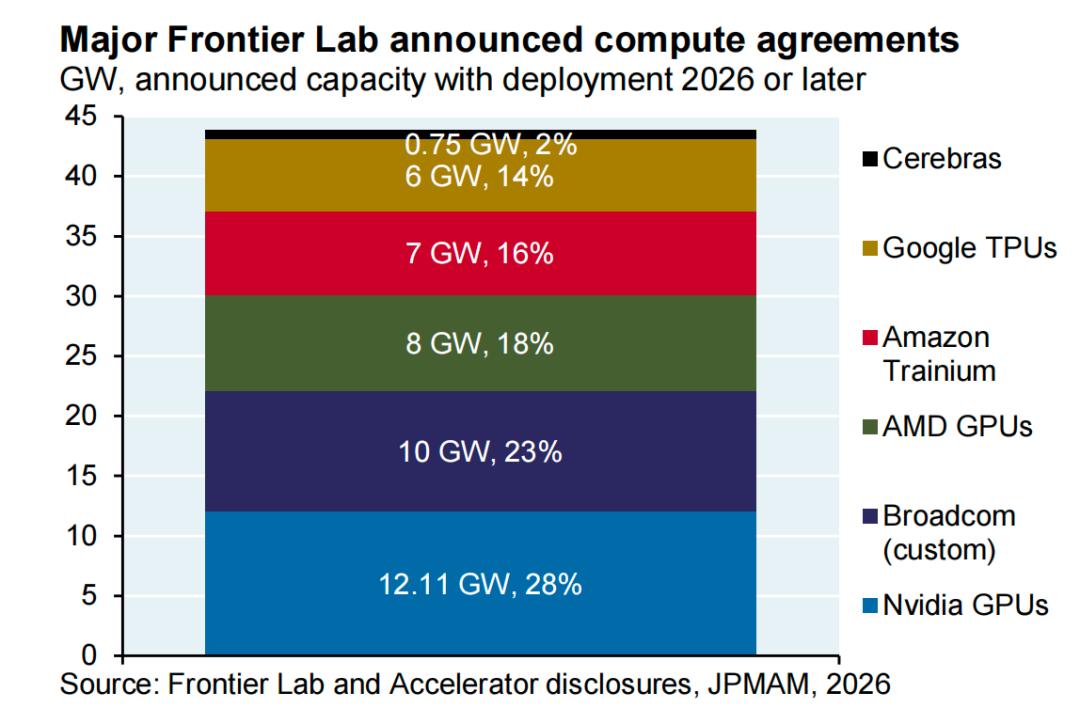
A recent report by JPMorgan Chase points out that CUDA's moat is collapsing. According to their statistics, the computing power distribution deployed by cutting-edge labs after 2026 is: Broadcom 23%, AMD 18%, Amazon Trainium 16%, Google TPU 14%, Cerebras 2%, and Nvidia only accounts for 28%.
Michael Burry, who has been shorting Nvidia for a year, also noticed this change, and recently shorted the VanEck Semiconductor ETF, avoiding the iShares Semiconductor ETF which has higher weightings of AMD and Broadcom.
Back in 2024, Peter Thiel said a disappointing sentence at the All-In Summit: Nvidia is making so much money that everyone will try their best to replicate its success in the chip sector.
Two years later, Silicon Valley giants are fulfilling Thiel's prediction.
Stay or Go
After Jensen Huang stepped down, a core question emerged: Is the departure of a company's legendary founder a reason for Long Only funds to sell?
Duan Yongping is neither bearish nor adding positions. He believes that it will not affect Nvidia's business in the short term, and in a few years, it will depend on whether they can find a good CEO. Jensen Huang is a very hardworking person with great vision for the prospects of AI, and it is very difficult to find someone like him.
Matthew Witheiler, an investment manager at Wellington, Nvidia's major shareholder, believes that Nvidia's product roadmap for the next two to three years has been determined, and the CUDA ecosystem, R&D team and customer relationships will not disappear overnight with Jensen Huang's departure. No matter who takes the helm, Nvidia will remain the leading supplier in the AI computing power market.
Bond fund managers at Wellington even believe that changing to a new CEO may not be a bad thing, as the successor's tolerance for risk taking is likely to be lower than Jensen Huang's[2].
In a sense, Jensen Huang is not only Nvidia's CEO, but also the central bank governor of the AI computing power market.
While selling GPUs to customers, he channeled funds to downstream computing power companies through equity investment, financing support and procurement commitments. The entire AI industry has experienced rounds of credit expansion driven by him.
For the market that is used to credit expansion, Wall Street knows better than anyone what will happen if a Volcker-style governor suddenly takes office.
References
[1]Legislative Branch Appropriations: Frequently Asked Questions
[2]The 31-Year-Old Trader Who Called Out Jensen Huang's 'China Problem'—and Shorted Nvidia,wsj
[3]Nvidia turmoil marks the end of easy money for the AI trade
This article is from the WeChat Official Account "Yuanchuan Investment Review" (ID: caituandzd), written by Shen Hui, authorized for release by 36Kr.