OpenAI has confirmed Liang Wenfeng's "prophecy"
GPT-6.2 Astra took the top spot in real robotic arm tests, marking another step forward in the capability of general large models to directly drive robots.
According to the AA-Robotics v0.1 list released by independent evaluation agency Artificial Analysis, GPT-6.2 Astra scored 79 points, completing 6 out of 8 physical tasks.
Not only OpenAI's flagship model, but also the relatively less capable GPT-6.2 Sol received a high score of 78.
In this benchmark test, the models were not allowed to undergo special training, and the whole process adopted a zero-shot setting. The models directly controlled a 6-axis robotic arm to move real objects by writing code.
In the past, robot manufacturers generally believed that vertical robot models had advantages in robot adaptation, force control and other aspects, and were more suitable for robots than general models.
Now it seems that with the development of general models, after performance iteration, general models may replace the position of vertical models.
Liang Wenfeng once expressed a similar view, arguing that breakthroughs in embodied intelligence can be built on the continuous evolution of general model capabilities.
In Liang Wenfeng's AI roadmap, the capability evolution of the general model itself is the main line leading to AGI, and embodied intelligence is an extension of this roadmap.
1
On November 13, foreign media reported that OpenAI had disbanded its independent robotics team, merged the original robotics team into the company's main research team, and adjusted the applied robotics and hardware teams to other departments.
OpenAI confirmed to the media that the reason for the adjustment was that general models performed excellently in controlling robots.
Researchers found that after connecting GPT-6 Astra to a robot, it has been able to participate in the execution of some specific tasks with surprisingly good performance.
In fact, after the release of GPT-6 Astra, there has already been a wave of attempts to use Astra to drive robots. For example, real-machine tests by independent evaluation agency Robocurve show that Astra achieved a 95% success rate in the task of "grabbing a block and putting it into a bowl" performed by a dual-arm robotic arm.
Such experiments provide more practical basis for general models to control robots. Against this background, OpenAI merged its independent robotics team, which was established less than half a year ago, into the main research team, and the researchers turned to the research and development of artificial general intelligence models.
This means OpenAI has switched to a different technical roadmap: since general models have begun to be able to control robots, there is no need to develop a separate dedicated "spatial intelligence" model specifically for robots.
In fact, this is not the first time OpenAI has adjusted its direction on the robotics technology roadmap.
As early as 2019, OpenAI established a robotics team, trying to make robots learn tasks such as grasping and placing objects through methods including reinforcement learning. But by 2020, this team was disbanded.
Its co-founder Wojciech Zaremba once explained that robot data was limited, and AGI could be achieved more efficiently through other methods. Later, OpenAI focused on large language models and launched ChatGPT in 2022.
With the development of multimodal models, OpenAI turned its attention back to robots.
In 2024, OpenAI cooperated with humanoid robot company Figure AI, trying to apply the capabilities of large models to robots.
At that time, Peter Welinder, Vice President of OpenAI, said that the cooperation with Figure was intended to explore what level of intelligence humanoid robots could reach with the support of large multimodal AI models.
Later, the Figure 01 demo video released by Figure AI showed that the robot could complete simple item delivery according to human instructions. In this cooperation, OpenAI's model provided visual understanding and language interaction capabilities.
However, just one year later, Figure AI announced the end of the cooperation and turned to independent research and development of robot AI.
But OpenAI never gave up its exploration in robotics. In early 2026, OpenAI researchers began to explore another technical roadmap: starting research from video generation models like Sora.
As a video generation model, Sora can understand the relationship between objects, space and motion, and has a certain understanding of how the physical world works.
OpenAI's shift is not an isolated case. In early 2025, the mainstream roadmap for embodied intelligence was still VLA models. By the end of the year, as the shortcomings of VLA in cross-scenario generalization and other aspects became prominent, the industry began to turn its attention to world models.
In June this year, two months after Sora was shut down, Sam Altman announced the establishment of the robotics department "OpenAI Robotics", transferring the entire Sora team to robotics research and development. Led by Aditya Ramesh, the father of Sora and founder of DALL-E, the team migrated the world simulation technology accumulated by Sora to robot training, focusing on industrial auxiliary robots in the short term, with the long-term goal of consumer-grade humanoid robots.
But this roadmap soon changed again.
Only three months after the establishment of this department, in September this year, OpenAI released GPT-6 Astra. OpenAI found that the general model itself has been able to participate in robot tasks. Compared with the world simulation technology specially studied for robots, directly utilizing the existing visual understanding, reasoning ability and task planning capabilities of general models can also lead to a viable path.
Guanya Shi, assistant professor at the Robotics Institute of Carnegie Mellon University, commented on this that it means OpenAI believes that robotics "is no longer a special problem".
After going around in circles on the robotics technology path, OpenAI has turned its attention back to general models.
2
OpenAI's change is not an isolated case. The performance of general models on robotic tasks is making the industry review this technical roadmap.
The Astranomy research released by NVIDIA in October directly used GPT-6 Astra to control simulated robots. In the RoboLab-120 test, the direct control scheme achieved a task success rate of 66.3%.
Deepu Talla, head of NVIDIA's robotics division, said in a recent interview that the emergence of GPT-6 Astra is a major breakthrough that pushes robots to have multi-task processing capabilities.
Claude Fable 5.2 released by Anthropic also demonstrates similar capabilities. The model controlled robots to complete a variety of tasks, such as solving Rubik's cubes, unscrewing bottle caps and drawing robots. In the RoboDojo Sim simulation benchmark, Fable 5.2 achieved an average success rate of 64.9%, while the score of GPT-6 Astra under the same test framework was 29.8%.
Although this technical roadmap is not yet mature, it at least shows that general models are becoming a roadmap worth trying in embodied intelligence research.
In China, robotics companies are also paying attention to this change.
Unitree is currently exploring the roadmap of applying large models to robots, and Wang Xingxing even said bluntly: "When GPT-7 comes out next year, it may directly break through all the problems in embodied intelligence."
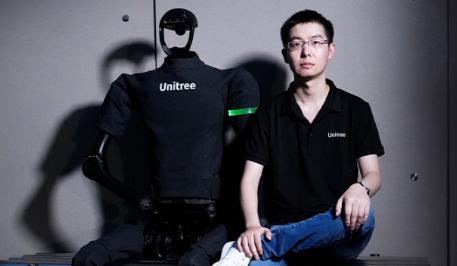
Previously, Unitree was both advancing the VLA model and exploring the world model. Wang Xingxing once mentioned that last year Unitree picked up the world model based on video generation again. Unitree has released the general VLA model UnifoLM-VLA-0, as well as the WMA (World Model-Action) model.
But recently, Unitree has begun to try to apply GPT-6 Astra to robot experiments.
Wang Xingxing mentioned that without pre-writing complex programs, the robot can complete painting only through prompts; for another example, the robot can not only recognize the chessboard, but also place the chess pieces accurately in the corresponding positions. Wang Xingxing emphasized that all these experiments were completed under the condition of "zero training".
Agibot is also exploring a similar direction.
Recently, the team of Zhihui Jun published a paper, the core of which is to connect the conversational large model with the robot body that can perform actions. The model can not only understand language instructions, but also call the robot's body to complete tasks such as pointing to real objects, body movements and facial expressions.
This means that robotics companies are trying to "connect" the capabilities of general large models into robot bodies to promote embodied intelligence.
This also provides a new reference for Liang Wenfeng's previous judgment.
When world models became a popular direction in the embodied intelligence field, Liang Wenfeng seemed relatively restrained about this technical roadmap. He valued the capability evolution of the general model itself more, regarding it as the main line leading to AGI.
In Liang Wenfeng's vision of the AI roadmap, after Agent, the continuous learning capability of AI models should be solved first, then reach the singularity of self-iteration, and then comes embodied intelligence.
In other words, he hopes to first make the general model itself strong enough, and then extend this capability to the physical world.
This has a certain similarity with OpenAI's latest adjustment. Both point to a judgment: embodied intelligence does not necessarily require training a set of independent robotic intelligence from scratch. The evolution of general model capabilities may also become a path for robots to move towards embodied intelligence.
Moreover, neither of the two companies only stays at the model level.
While adjusting its robotics business, OpenAI has invested in many robotics companies. DeepSeek has also begun to extend to the embodied intelligence field, participating in the placement of Unitree Robotics, reaching a three-year strategic cooperation with Unitree, and investing in companies including Winverse AI and Regenius Robotics.
3
The integration of general large models into robots has become a new trend, but this does not mean that VLA models and world models are leaving the stage.
In the past few years, the mainstream technical roadmap of embodied intelligence has undergone several changes, from VLA models to world models, and then to general large models. But no one has ever truly replaced anyone else.
The first to attract attention was the VLA model. The so-called VLA (Vision-Language-Action model), in simple terms, is a model that allows the model to process camera images and human instructions at the same time, and then convert the understanding results into robot actions.
The emergence of this roadmap is related to the development stage of large models at that time. At that time, large models had certain language and visual understanding capabilities, but could not directly control robots. The robot's own data was limited, and it was very difficult to train a robot model from scratch.
In July 2023, Google DeepMind released the VLA model RT-2, which can learn from web and robot data, and convert this knowledge into general instructions for robot control.
The VLA roadmap provided a feasible solution at that time. However, VLA lacks generalization capability and autonomy, which makes robots unable to adapt to complex real environments.
In the real physical world, robots need to cope with continuous physical changes. Robots not only need to know what to do now, but also judge what changes will happen to the world after doing so.
Therefore, after the advent of video generation models, manufacturers generally believed that video generation models are expected to replace VLA models.
In February 2024, OpenAI released Sora, and proposed in its technical report that large-scale video training has become a path to build a physical world simulator.
There are a large number of videos of human activities on the Internet. How humans pick up things, move things, walk, organize items and other behaviors are all recorded in the videos. If the model can learn object motion, spatial relationships and action consequences from these videos, it will have the opportunity to migrate this capability to robots.
But video generation does not equal the ability to control robots. Therefore, the industry began to try to combine world prediction and action generation to form a World Action Model (WAM).
In other words, VLA focuses on the mapping from observation to action, while the world action model attempts to incorporate the prediction of the future into action decision-making.
However, world models still face many problems, and the simulated physical processes may not be accurately reproduced in the real environment.
Until after the advent of Astra, the industry began to explore another possibility: can general large models directly undertake task understanding, planning and decision-making for robots?
The embodied intelligence research project HomeBody released by the Stanford team in cooperation with Caltech provides a case. This study tries to answer a question: if the general large model is smart enough, do robots still need the VLA model as an intermediate layer between the large model and the body?
The answer given by HomeBody is that within a certain range of tasks, it is not necessary.
After the researchers connected GPT-6 Astra to the Unitree G1 humanoid robot, they let the robot directly call the pre-built robot skill library. After the robot entered an unfamiliar kitchen, it completed sorting and item finding according to human instructions.
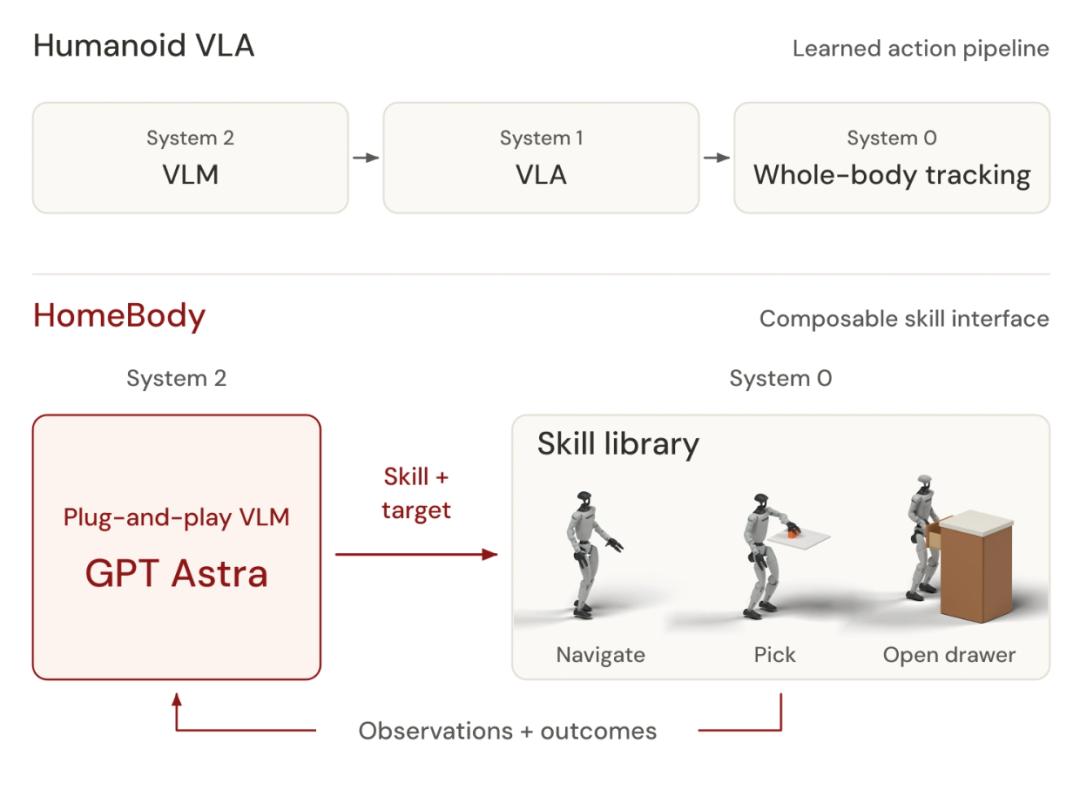
The same is true for Fable 5.2 released by Anthropic later. Fable 5.2 has significantly improved in robot control, and it can handle even those robot tasks that it has never received special training for with ease.
This means that as the reasoning capability of models increases, some robot skills that originally required special training may begin to emerge from general models.
A core problem of embodied intelligence is to let robots understand the environment and judge the possible consequences of actions. The idea of world models is to learn from videos and then simulate the future. The idea of general large models is to use existing reasoning capabilities to analyze tasks and then apply them to task planning.
The two roadmaps have different technical ideas, but point to the same goal: to let AI take actions in the real world.
This article is from the WeChat official account "Letter AI", author: Xue Yaping, published with authorization from 36Kr.