Elon Musk strongly backed Jensen Huang in Shenzhen.
Elon Musk. Image generated by AI
On November 19 Beijing time, Elon Musk, who was in Shenzhen, China, talked about his impression of China. He praised Shenzhen's urban scale, modernization level and vitality of the technology industry, suggested the outside world come to China in person to see for themselves, and said he holds respect for China.
When talking about China-US relations, he said that maintaining good relations and making positive progress in economic and trade consultations between the two sides are beneficial to the two countries and even the whole world.
Musk's visit to China came during the APEC series of meetings held in Shenzhen. The outside world generally linked Musk's trip to the APEC CEO Summit, and the advancement of Tesla FSD in China has also become the focus of public attention.
During his visit to China, Musk participated in the TomorrowX Summit held in Austin, the United States via remote connection, and had a dialogue event with Gavin Baker, founder of Atreides, and Antonio Gracias, founder of Valor Equity Partners.
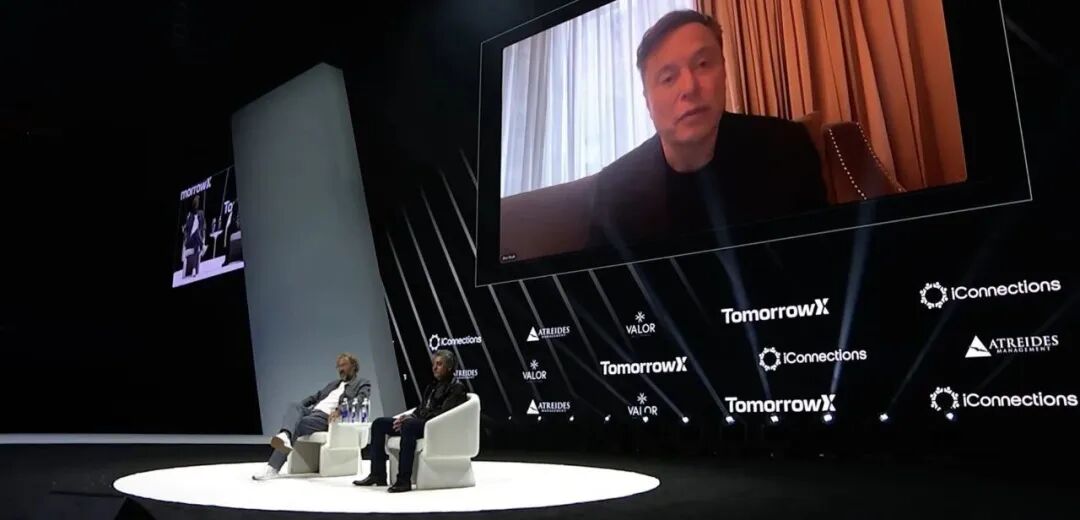
The three have known each other for many years, and the topics of their conversation covered the latest progress of SpaceX, xAI and Tesla, as well as fields such as artificial intelligence, robotics, chips and brain-computer interfaces. Musk also took this opportunity to disclose the technical progress and product plans of his multiple companies.
In the aerospace field, Musk talked about the progress of Starship's first successful recovery of the upper stage spacecraft, saying that this means a key breakthrough has been made in the goal of full reusability of rockets. He believes that Starship is expected to reduce the cost of orbit entry by about 100 times, creating conditions for the construction of the Moon and Mars.
In the field of artificial intelligence, he revealed that xAI is transferring core engineering staff from Starlink to rewrite the training software stack from scratch using C/C++. The upcoming Grok 4.8 will not take boosting benchmark test scores as the primary goal, but pay more attention to the ability to solve practical problems.
Robotics and autonomous driving are also important parts of the conversation. Musk said that Optimus is currently tackling the technical difficulty of fine hand manipulation, and may first be applied to industrial scenarios such as mineral mining and smelting in the future. He predicts that within the next 12 to 18 months, robots will have the ability to perform complex household chores such as washing dishes and taking out trash.
Regarding Cybercab, he said that this steering-wheel-less driverless taxi has been put into operation in Austin, and the service scope will be gradually expanded later.
In terms of chips and computing power infrastructure, Musk predicts that the super chip factory Terafab will achieve mass production of its first phase by the end of 2028. He also introduced the practices of SpaceX and xAI in data center construction: internal engineering teams directly participate in the construction to shorten the construction cycle and control costs. In addition, he also put forward the idea of using space solar power to build the on-orbit computing satellite Star Mind, believing that its technical complexity may be lower than that of Starlink V3.
Musk also talked about the clinical progress of Neuralink. He said that more than 30 paralyzed subjects have now used brain-computer interfaces to control robotic arms with their minds to eat independently, and the company is also advancing the Blindsight project to help people with total blindness regain their vision.
On the issue of AI safety, he emphasized again that models should pursue truth as much as possible and not deviate from facts to cater to users. When talking about NVIDIA, he compared Jensen Huang to Michael Jordan in his prime, saying that it is a pity for NVIDIA to lose such a leader during its winning streak.
Throughout the conversation, Musk repeatedly mentioned how to solve problems starting from engineering and technology itself. From Starship recovery, AI training software stack rewriting, to data center construction and practical application of humanoid robots, he focuses on specific technical bottlenecks, costs and implementation timetables. This is not so much a fantasy about the future as a centralized inventory of the technical progress and development plans of his multiple companies. For artificial intelligence, robotics and space computing that the outside world cares about, he gave his own judgments and also disclosed many projects that are still in progress.
The following is the condensed version of the exclusive interview:
01. Starship Reusability and Deep Space Vision
Q: The 15th flight of "Starship" successfully recovered the upper stage spacecraft (Ship 42) for the first time. What does this mean for the full reusability of rockets and the aerospace industry?
Musk: This successful capture and recovery of the spacecraft is an extremely grand milestone. Perhaps only those who have long followed the development history of SpaceX can truly appreciate the weight of this achievement. Previously, we have successfully captured and recovered the rocket booster three times through the robotic arm of the launch tower, and even completed the re-flight and re-capture of the booster.
But this is the first time we have successfully captured and recovered the upper stage spacecraft, which proves that all components of "Starship" can fly into space and return intact, and can fly again with only minimal maintenance. To pay tribute to this historic spacecraft, we plan not to risk it flying again, but to keep it for public display.
Before that, human beings had never manufactured a truly fully reusable orbital upper stage spacecraft, let alone let it land vertically in a propulsive manner and be precisely caught in the air by the huge "chopsticks" robotic arm.
This sounds like a whimsical science fiction novel, but we made it. In practical economic terms, full and rapid reusability can reduce the cost of human access to space by 100 times and achieve an orbital carrying capacity of millions of tons per year.
Q: Why reduce the cost of access to space by 100 times or even 1000 times? What is the deep motivation for building cities on the Moon and Mars?
Musk: To build a city on the Moon or Mars, you have to transport a huge amount of supplies there, because you need to rebuild the entire basic industrial system from scratch locally. Just like the classic "pencil making" case in economics, even a mobile phone or a pencil relies on a huge industrial foundation from mining, multi-stage refining, manufacturing basic parts to assembling complex components.
The Moon and Mars must achieve industrial self-sufficiency, which is essential for the long-term continuation of human consciousness. Even if the earth suffers natural or man-made disasters in the future, human civilization and consciousness can still survive. I call it "backing up the biosphere" or "buying life insurance for all mankind".
At the same time, this is also the first key stepping stone for mankind to move towards a real interstellar civilization. At that time, space travel will no longer be the privilege of a few government astronauts, and any ordinary person can go to the Moon, Mars or any corner of the solar system as long as they want. Once we become a multi-planetary civilization, it will force the development of more advanced spacecraft, which will then lead us out of the solar system, explore the Milky Way, and maybe encounter alien civilizations, or relics of ancient alien civilizations that have existed for tens of millions of years.
If we count from the Sumerians' invention of cuneiform writing, human civilization has only a history of more than 5,000 years, which is just a fleeting spark on the cosmic scale. A civilization with self-respect must not be willing to be an mediocre "single-planetary civilization". We must become a multi-planetary and even multi-stellar civilization.
Generally speaking, the driving forces that push me forward are divided into two categories: one is "defensive motivation", that is, to ensure that human consciousness will not become extinct when a disaster occurs on the earth; the other is "forward-looking motivation", that is, the excitement and yearning for the future. Life cannot just be about solving one painful practical problem after another. There must also be a vision that makes people's hearts surge and makes people wake up every morning full of expectations. Becoming an interstellar civilization is such a great cause that makes people glad to live in this era.
Q: After 25 years of long journey and countless failure risks, you finally achieved the milestone of fully reusable rockets in the aerospace field. How do you feel about it?
Musk: It feels amazing. It can be seen from the tearful reaction of the SpaceX team at that time that everyone inside knows the fundamental and far-reaching significance of this breakthrough. "Starship" will become the first fully reusable orbital space system in human history, which has always been the dream milestone of the rocket engineering community since its birth.
The previous space shuttle was said to be partially reusable, but the huge orange external fuel tank as the main load-bearing structure was discarded after each launch; and the technically recoverable orbiter required tedious disassembly and renovation for about 9 months after each flight, which was essentially equivalent to rebuilding a large number of components.
In contrast, "Starship" was originally designed to achieve full and immediate reusability like a civil airliner. After the booster lands, it can be hoisted with another spacecraft immediately to take off again. If we do not reduce the aerospace cost by 100 to 1000 times on the existing basis, even with all the financial budget of the US government, it is economically impossible to build cities on the Moon and Mars.
02. Rewriting the AI Underlying Layer
Q: xAI recently rewrote the underlying training stack from scratch. How is the progress of the upcoming Grok 4.8? Why is AI training essentially a network communication problem?
Musk: When I first founded xAI, I just regarded it as a very small side project. At that time, I met many top AI talents who only wanted to study large language models instead of engaging in Tesla's focus on "real-world AI" (such as autonomous driving and humanoid robots).
In order to prevent them from flowing to OpenAI, Anthropic or Google, and at the same time not distract Tesla's energy, I established this small company that initially had only five or six people. But because I failed to devote my efforts to polishing the foundation as I did with SpaceX and Tesla in the early stage, and later I spent about a year getting involved in campaign and government affairs, the early development path of xAI was not very solid. Building a company is like building a skyscraper, you must first lay an extremely deep foundation.
Later, xAI was merged into SpaceX, and I realized that we must completely start over and rewrite the entire underlying software architecture to make a leap in AI intelligence. In the past, the industry generally relied on open source tools like JAX or SGLang, and you can't build world-class AI with mediocre free software.
Therefore, in the past six to eight months, we have transferred core backbones who once led the software development of Starlink and "Starship", and used mainly C and C++ languages to rewrite the entire training, reinforcement learning and inference software stack from scratch. We strive to make the code as close to the underlying hardware as possible to reduce the performance loss caused by the software abstraction layer and the third-party black box problem. Now, I think we have the world's top AI training software stack.
In large-scale AI training, hundreds of thousands of GPUs need to work in a highly coordinated manner, which largely evolves into a "network communication software problem": how to make a huge number of GPUs interconnect in the most efficient way. This is highly similar to the technical problem solved by Starlink in rebuilding the entire Internet in space, so SpaceX's network technology and engineering experience can be seamlessly transferred.
Of course, in addition to the training stack, high-quality data and reinforcement learning are also crucial. We have invested a lot of energy in screening high-quality data, optimizing the tokenizer, and filling data for out-of-distribution blind spots.
In the reinforcement learning stage, the questions raised must be logical, and the standard answers must be absolutely accurate. If you train the model with stupid questions and wrong answers, reinforcement learning will become meaningless "random walk". When you look at the model's chain of thought in this case, you will find that the model is like a human being locked in a box and tortured.
It clearly calculated the correct answer, but was told "the answer is wrong", so it was forced to start frantically guessing what absurd wrong answer humans want. Even in the face of machines, seeing that scene makes people feel sympathetic. At present, Grok 4.8 is in the reinforcement learning stage.
Q: When developing Grok 4.8 and Tesla autonomous driving, why do you value "practicality" more than various benchmarks?
Musk: Our purpose of developing Grok 4.8 is by no means to brush various benchmark lists, which is a futile and stupid behavior. Our core goal is to maximize "practicality", which is exactly the same as Tesla's logic of developing Full Self-Driving (FSD).
At Tesla, we never optimize to cope with the so-called driving test standards, but focus on every manual takeover that occurs in real driving, trace back to the root cause to find the reason behind it, whether it is incorrect raw data, unbalanced data distribution, or lack of data for specific scenarios, then repair the data and retrain. Our requirement for Tesla AI is not to "reach a certain percentage of accuracy", but to achieve zero accidents and be impeccable.
Similarly, we conduct regular soft releases through Grokbot to test different versions of Grok behind the scenes, directly verify whether it really solves users' practical problems, and use these real feedback to form a data flywheel to promote the continuous evolution of the model.
03. Optimus Initially Applied to Heavy Industry
Q: What is the latest progress of the humanoid robot Optimus? When can it really help people take out trash, wash dishes, and what is its initial commercial landing scenario?
Musk: Optimus is progressing very smoothly. We plan to hold a public demonstration in about one or two months, and this will definitely be a completely real, non-pre-programmed, non-staged demonstration.
Most of the humanoid robot demonstrations on the market today are "fakes" with pre-arranged programs, and they cannot execute arbitrary instructions in an unfamiliar real environment. For example, if you ask the robot to pick up the apple on the table and move the table to another position halfway, they will be completely at a loss. What we are about to show is Optimus's actual ability in daily real interactions.
Manufacturing a truly practical humanoid robot is an extremely arduous project, and the most difficult part is the hands and forearms (where the main actuators are located), whose engineering difficulty even exceeds the sum of the rest of the robot. Because human hands have extremely high fine motor skills.
Computer scientist John Carmack once put forward a very profound and basic test standard: let the robot walk over to pick up a box of remote-controlled toy cars, unpack it, unscrew the battery compartment screw, install the battery, screw the screw back, and then operate the toy car to drive. At present, no robot in the world can do this, and this is exactly one of the goals we are tackling.
As for the housework you mentioned, such as "taking out trash" and "cleaning dirty plates with residues, washing, drying and putting them back in the cabinet", no robot in the world can do it yet, but I expect Optimus to have these capabilities within 12 to 18 months. In the future, Optimus can not only do housework, mow the lawn and cook, but also serve as a child's tutor and 24-hour bodyguard, becoming a more practical personal assistant than R2-D2 and C-3PO in Star Wars, and almost every family will want one or two units.
However, when it comes to Optimus's initial application scenario with the most economic value, it will be the heavy industry field, such as mineral mining and multi-stage refining. At present, the United States is highly dependent on overseas in mineral mining and smelting. For national security, we must rebuild this part of production capacity locally. Putting Optimus into these heavy industry jobs that run 24 hours a day, 7 days a week (168 hours a week in total) is the most reasonable starting point in terms of economic benefits. After the heavy industry demand is gradually met, it will enter thousands of households on a large scale.
Q: What is the current operation situation and subsequent expansion plan of the steering-wheel-less driverless taxi Cybercab in Austin?
Musk: Since Cybercab completely cancels the steering wheel and pedals, there is no backup means for manual takeover, so we are extremely cautious in promoting it. Up to now, the entire Robotaxi network including Model Y, Model 3 and Cybercab has not had any serious casualties or major accidents. We must not let the