Chinese home appliances are making aggressive inroads into overseas markets.
More and more overseas consumers choose Chinese home appliances not because of low prices, but because their real user demands are fully satisfied.
Against the backdrop of the continuous slump in China's A-share market, an enterprise has bucked the trend in the past two days, repeatedly refreshing its all-time high market capitalization record.
This enterprise is Midea Group, the leading player in China's home appliance industry. Its stock price recently broke the previous historical high set on February 10, 2021, marking a new record since its listing. The total market capitalization of the company's A+H shares once exceeded 720 billion yuan, also hitting a new all-time high.
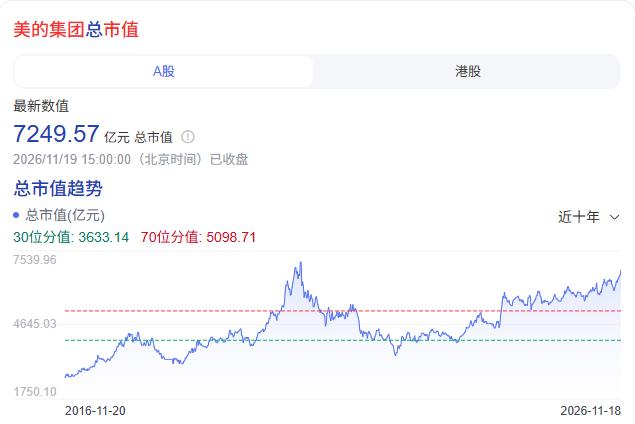
It has been a full five years since Midea Group's market capitalization last exceeded the 700 billion yuan mark, but China's home appliance industry has long passed the stage of rapid growth. According to monitoring data from AVC, from January to September this year, the total retail sales of China's domestic home appliance market (excluding 3C products) reached 6.041 trillion yuan, down 10% year on year; by quarter, the figure dropped by 6% in the first quarter, 12.4% in the second quarter, and 10.1% in the third quarter.
The stimulating effect of e-commerce promotional events on home appliance sales has continued to decline. During this year's "Double 11" shopping festival, the online sales of home appliances fell by about 14% year on year.
Under the overall environment of slowing growth in China's domestic home appliance industry, the stock prices of leading home appliance enterprises have repeatedly hit new highs, which actually indicates that the growth logic of domestic home appliance brands has changed.
The same trend has also occurred in the two leading TV brands Hisense and TCL. According to a report from RUNTO, the total shipment of branded complete TV sets in China's TV market in 2026 is expected to reach 30.36 million units, down 7.7% year on year, hitting the lowest market size in at least 17 years.
Domestic TVs are facing sluggish sales in the local market, but TV manufacturers have achieved stronger profitability. In the first three quarters of this year, TCL Electronics recorded a revenue of HK$95.793 billion, up 15.7% year on year; its net profit attributable to owners of the parent company reached HK$2.104 billion, surging 43.6% year on year. Hisense Visual Technology posted a revenue of 44.417 billion yuan, up 3.7% year on year; its net profit attributable to owners of the parent company stood at 1.844 billion yuan, also registering a 13.23% year-on-year increase.
From Midea to Hisense and TCL, the only answer to why Chinese home appliance brands are collectively achieving growth against the trend is going global.
Chinese Home Appliances Are Selling Hot Worldwide
At this year's September performance briefing, Fang Hongbo, Chairman and President of Midea Group, disclosed a set of overseas operation data of Midea: overseas sales account for more than 40% of the company's total sales, its products have been exported to more than 200 countries and regions around the world, a complete online and offline sales network has been established in most overseas markets, with about 5,500 after-sales service outlets; more than 25,000 overseas retailers have accessed Midea's overseas sales platform; as of June 2026, Midea has nearly 50,000 overseas employees.
On the R&D side, Midea has set up 29 R&D centers in 11 overseas countries, which can integrate global R&D resources to form a complementary global technology R&D system. Among the 68 major production bases around the world, 45 are located overseas, which can realize localized production and delivery, and better capture the growth opportunities in overseas markets.
According to Midea's financial report, the most eye-catching growth engine in its overseas business is the rise of its self-owned brands. In the third quarter of this year, Midea's overseas OBM revenue increased by more than 20% year on year, and OBM has accounted for more than half of its overseas revenue.
Especially under the record-breaking high temperature in Europe this summer, Midea's PortaSplit mobile air conditioner was in short supply in the European market, further boosting the brand's popularity overseas.
This product, designed to solve the pain point that holes cannot be drilled to install external units in European apartments, has been completely sold out and is "hard to get one unit" through online and offline channels in many European countries, and even its second-hand market price has soared all the way. Since June, the new orders of the PortaSplit split mobile air conditioner have exceeded 160,000 units.

In the same period, Midea's two air conditioner production bases in Wuhu and Guangzhou received a total of 200,000 new European orders within one month. In July, Midea Air Conditioning officially announced that it would urgently ship 200,000 air conditioners to the European market to meet the surging demand.
While Midea's air conditioners are selling hot in Europe, Hisense and TCL's TV products have also captured a large share of the overseas market.
According to the latest TV industry research from TrendForce, the global shipments of Hisense and TCL in the third quarter of 2026 reached 7.48 million units and 7.45 million units respectively, ranking steadily second and third, almost squeezing the top-ranked Samsung into a corner.
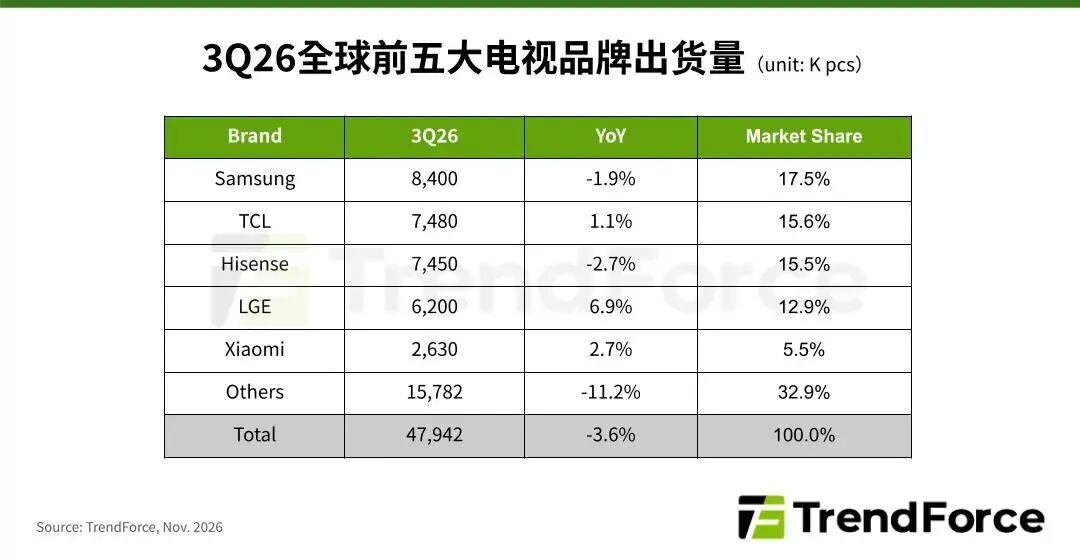
Different from the inherent impression, the hot sales of domestic color TVs overseas are not only due to price advantages. Jia Shaoqian, Chairman of Hisense Group, once revealed that in the past, when Chinese home appliances entered overseas markets, a selling price of 500 US dollars was an astronomical figure, but today Hisense's products, especially its Mini LED products, are priced as high as 25,000 US dollars overseas, and still win market recognition.
Hisense's sales data shows that from January to September this year, the sales volume of Hisense's TV products in the global 100-inch and above large-screen market and high-end Mini LED TV market increased by 77.37% and 75.53% year on year respectively. Among them, in high-end European markets such as Germany, the United Kingdom and France, the sales volume of products priced above 3,000 US dollars increased by 110%, 83% and 40% respectively.
TCL has also gained a firm foothold in the overseas high-end market. In the first three quarters of this year, the international market contributed nearly three quarters of the revenue of TCL's TV business. Among them, the average selling price of TCL's overseas TV products increased by 17.8% year on year, the shipment of Mini LED TVs in the international market increased by 94.5%, and the gross profit margin of TCL's overseas TV business also rose from 14.6% in the same period last year to 19%.
Going Global Is No Longer an Option, But a Must
Chinese home appliance brands started their globalization journey very early, but based on the huge domestic market demand, the overseas incremental revenue in the early years was only an added bonus, far from being able to support the overall development blueprint of the entire brand and group.
However, as the demand in China's domestic home appliance market has peaked, the importance of overseas markets has become increasingly prominent. Today, going global has become a mandatory task for all leading home appliance brands.
Among white goods groups, in addition to Midea, Haier has long built its fundamental market overseas.
According to financial report data, Haier's overseas revenue has accounted for more than 50% of its total revenue in the second quarter of this year. Haier's overseas expansion follows a long-term sustainable path: on the one hand, it builds consumer trust by acquiring brands such as Sanyo Home Appliances and GE Appliances; on the other hand, it offsets tariffs and geopolitical risks by building overseas factories, hiring local workers and paying taxes locally.

Among small home appliance brands, Chinese emerging smart home appliance brands represented by sweeping robot manufacturers have long achieved fruitful results overseas. The two leading brands, Roborock and Ecovacs, have basically formed a business structure where the majority of their revenue comes from overseas markets.
Specifically, Roborock recorded an overseas revenue of 6.073 billion yuan in the first half of 2026, accounting for 60.22% of its total revenue. Ecovacs' overseas revenue proportion reached 51% for the first time in the second quarter of 2026, exceeding its domestic market revenue. Its overall overseas revenue proportion in the first half of the year stood at 49%, and the proportion of overseas revenue in the first three quarters has steadily exceeded 50%.
Whether it is traditional large home appliances such as refrigerators, color TVs and air conditioners, or emerging small home appliances such as sweeping robots and projectors, Chinese brands and Chinese manufacturing have become the common choice of global consumers, not including some foreign brands that are originally OEM-produced by Chinese factories.
From the perspective of product features, more and more overseas consumers choose Chinese home appliances not because of low prices, but because their real user demands are fully satisfied.
For example, the Midea PortaSplit mobile air conditioner mentioned above, with its split mobile design and no-drilling installation feature, perfectly fits the installation environment of most houses in Europe.
In Pakistan, local people are used to wearing large robes, and large families have a huge laundry volume, so Haier launched a 15kg large-capacity washing machine that can wash the robes of the whole family in one go.
In Vietnam, where thunderstorms are frequent, TCL developed color TVs with better lightning protection and stronger signal receiving capability, which were well received by local consumers once launched. In 2025, TCL's market share in Vietnam's TV market has entered the top three.
But such success did not come overnight, and it is even valuable experience summed up from many painful lessons. Just over a year ago, Midea voluntarily recalled about 1.7 million U-shaped and U+ window-type air conditioners sold in the US and Canadian markets, because the U-shaped design of this product was not well adapted to the high humidity environment in North America, leading to the retention of condensed water and the growth of mold.
The huge space of overseas markets means that usage environments and user demands vary from region to region. Only by tapping local real demands and developing customized solutions through proactive R&D can brands obtain premium pricing and long-term growth space.
Lessons from Mobile Phone Manufacturers
The current success of Chinese home appliances overseas easily reminds people of the vigorous overseas expansion journey of domestic mobile phones. Brands such as Xiaomi, OPPO, vivo and Transsion are typical representatives of Chinese mobile phone brands going global. Among them, Xiaomi's global shipment steadily ranks among the top three, Transsion's market share in Africa is close to 50%, and OPPO and vivo have delivered outstanding performance in high-end markets in Southeast Asia and Europe.
From the perspective of overseas expansion paths, there are similarities between home appliance brands and mobile phone brands: both are driven by saturated domestic markets that force them to expand overseas, and both adopt the strategy of first opening up emerging markets with cost-effectiveness and channel efficiency, then penetrating into mature markets.
As the "senior" that went global earlier and built brand awareness overseas, the development history of mobile phone manufacturers in overseas markets is well worth learning for home appliance manufacturers.
The first point is the early warning of legal risks in different regions, and relevant arrangements must be made before entering the market, instead of "getting on the bus first and buying the ticket later".
For example, patent litigation is a pitfall that many domestic mobile phone manufacturers have stepped into overseas. Enterprises such as Xiaomi, OPPO and Transsion have encountered dense and prolonged litigation battles overseas. Although some litigations ended with the victory of Chinese enterprises, the time and energy spent and the damage to the brand are far beyond what a judgment can make up for.
Similar cases have also occurred in the home appliance industry. For example, well-known home appliance brand Whirlpool has repeatedly used intellectual property rights and trade barriers to protect its market in the United States. It launched an anti-dumping investigation against large Chinese household washing machines in 2016, and filed a dual-track lawsuit of "ITC + local court" against enterprises including Midea and Haier last November, targeting specific low-profile microwave-hood combination products.
The second point is the unpredictable geopolitical risks. Of course, as enterprises, they cannot eliminate such risks unilaterally by "doing everything right", and can only hedge them through structural diversification.
Previously, Chinese mobile phone enterprises such as Xiaomi, OPPO and vivo suffered huge losses in the Indian market. Even if they built local factories, hired local employees and operated in compliance with regulations, their assets could still be frozen for non-commercial reasons, and their equity could still be forcibly diluted.
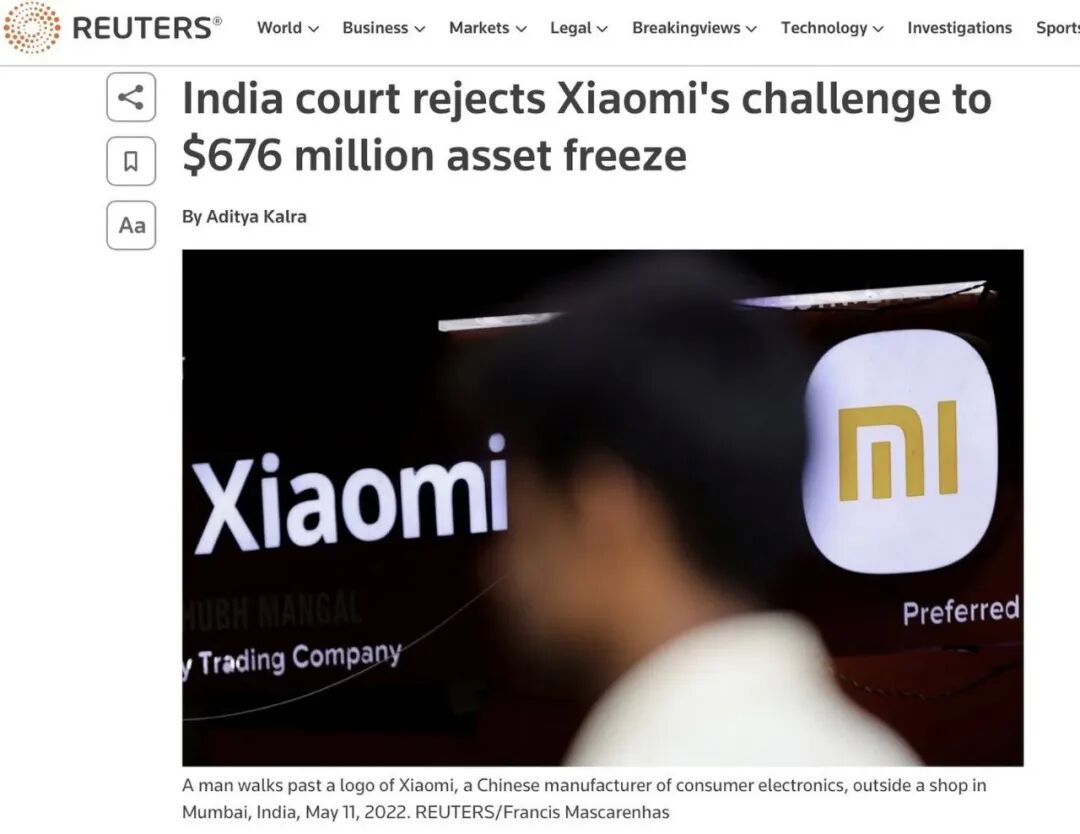
"Do not put all your eggs in one basket", and avoid accumulating too much immovable assets in a single market, which remains a proven and brilliant business philosophy in overseas markets.
However, there is a clear difference between home appliance products and mobile phones: mobile phones have a short iteration cycle and high replacement frequency, while the replacement cycle of home appliances is usually calculated in years.
This also means that once brand trust is damaged, the repair cycle for home appliance brands will be much longer.
Mobile phone brands can "make a comeback" with the next generation of products, but once consumers lose confidence in a home appliance brand, it will be much more difficult to win back market share. Especially as "outsiders", home appliance brands have narrower fault tolerance space in terms of patents, compliance and local relations than mobile phone brands. From this perspective, the overseas expansion journey of Chinese home appliance brands is bound to be more cautious than that of Chinese mobile phone brands.
This article is from the WeChat official account "Spiral Lab", written by Zhuiming, and published with authorization from 36Kr.