PC shipments plummeted by 20%, but the leading vendors are earning increasingly more profits instead.
At the Baidu World Conference held some time ago, Robin Li asked Yang Yuanqing, who was present at the event, a question: Has the sales volume and utilization rate of Lenovo PCs increased because of AI? Yang Yuanqing responded with an ambiguous "hmm" and quickly steered clear of this topic.
Robin Li's line of thinking is logically sound: the best current use case for AI is on PCs rather than mobile phones, which is bound to drive certain growth in the PC sector.
But in fact, the answer may be highly counterintuitive.
The latest data released by IDC shows that in the third quarter of 2026, global PC shipments reached 62.7 million units, down 20.1% year on year. None of the top five vendors, namely Lenovo, HP, Dell, Apple and ASUS, recorded growth. Lenovo's shipments fell 22.6% year on year, HP's shipments dropped 30.9% year on year, and even Apple's Mac shipments declined by 11.3%.
The "AI-driven PC shipment growth theory" frequently mentioned by industry leaders appears particularly powerless in the face of these dismal sets of data.
What is even more counterintuitive is that although AI has not actually driven up PC shipments, the financial performance of several leading vendors is highly commendable.
Take Lenovo as an example, its performance in the third fiscal quarter of the 2025/26 fiscal year shows that the group's revenue reached 157.5 billion RMB, up 18% year on year; net profit increased by 36% year on year, with the profit growth rate twice as high as the revenue growth rate.
Apple's Mac revenue hit 10.79 billion USD, up 23.7% year on year; Dell's cumulative stock price increase to its highest point this year once reached as high as 259%.
AI has not driven up PC shipments, but it has boosted the "wallets" of vendors. Whether leading vendors should continue to obsess over shipment figures is a question. But what is more worth exploring behind this question is whether the logic of this mass hardware business, the PC industry, has quietly changed.
How much profit has AI actually brought?
Why can vendors still make money even when sales are declining?
A small part of the reason is that under the pressure of rising memory prices, the average selling price of PCs worldwide is increasing.
Jeff Clarke, Chief Operating Officer of Dell, described at the May performance meeting that price adjustments are so frequent that "it feels like we are re-pricing every day". Since the beginning of this year, PC vendors including Lenovo, HP, Dell, ASUS and Acer have all adjusted their prices multiple times, with some models seeing price increases ranging from 15% to 30%.
IDC predicts that the global average selling price of PCs will rise by 20% in 2026.
Naturally, profits brought by high pricing will be higher. For example, Apple continues to raise the prices of multiple Mac and iPad models, among which the 512GB version of MacBook Air has increased from 1099 USD to 1299 USD. In the quarter ending in June, Mac's revenue reached 10.35 billion USD, up 29%.
Of course, price increases are not the fundamental reason why PC vendors make money, after all, price increases have also suppressed the shipment willingness of the consumer market. In the final analysis, it is still AI that truly supports the financial performance of leading vendors: on one end is the AI infrastructure business, and on the other end are high-end AI PCs priced at tens of thousands of yuan per unit.
Take Dell as an example, in its report for the second fiscal quarter of the 2027 fiscal year, Dell's revenue reached 46.971 billion USD, up 58% year on year. Among this, the AI server business performed prominently, with order value reaching 60.9 billion USD and recognized revenue hitting 16.4 billion USD, which has exceeded the revenue of the entire PC-related business.
Coincidentally, in the quarter ending at the end of June, Lenovo's ISG business (including traditional servers, AI servers and storage) recorded a 98% year-on-year revenue growth, with operating profit reaching 777 million USD. The reserved AI server project value reached 54 billion USD, up 157% in a single quarter.
AI PCs, which became popular as early as 2024, have taken on the mission of product structure upgrading on the consumer side.
As early as the third quarter of 2024, data released by Canalys showed that global AI PC shipments reached 13.3 million units in that year, accounting for 20% of total PC shipments in that quarter. Since then, with the accelerated development of the AI era, leading vendors have continuously increased the proportion of AI PC products.
Take Lenovo as an example, statistics show that the number of Lenovo's AI PC product models increased from 17 in the first fiscal quarter of 24/25 to 28 in the second fiscal quarter. By 2026, during IFA 2026, Lenovo released a number of new AI PC products for both the consumer side and the commercial side.
It is not just Lenovo.
According to reports from The Wall Street Journal, all vendors hope to mitigate the impact of the overall shrinking PC market by increasing the proportion of AI PC products, that is, increasing the number of PC products that can perform AI computing locally on end devices. ASUS ProArt P16, Dell XPS 16 Creator Edition, HP OmniBook Ultra 16, and MSI Prestige N16 Flip AI+ have all opened for pre-order.
If the first-generation AI PCs that became popular in 2024 were more of a marketing gimmick for "traditional PCs", with functions mainly focused on lightweight local reasoning, speech transcription and copy polishing, bringing weak consumer perception and limited premium space, and did not truly break the profit ceiling of the PC industry.
By 2026, NVIDIA entered the PC sector, and AI PCs have further evolved towards the ultra-high-end and Agent-oriented direction, making the pricing logic break away from the framework of consumer electronics. For example, the top-spec barebone version of Microsoft's Surface Laptop Ultra is priced at nearly 50,000 yuan; the high-spec version of Lenovo AI PC (YOGA Pro 15 RTX Spark) is marked at 42,999 yuan.
This is undoubtedly one of the biggest supports for vendors' profitability.
At the same time, even though overall market shipments are declining, consumers are very willing to pay for AI PCs.
The high-spec version of Lenovo YOGA Pro 15 RTX Spark was sold out within half an hour. As of the evening of October 18, JD still showed "out of stock". On the second-hand trading platform Xianyu, some sellers even listed the high-spec version at a price of 50,000 yuan, about 7,000 yuan higher than the official suggested retail price.
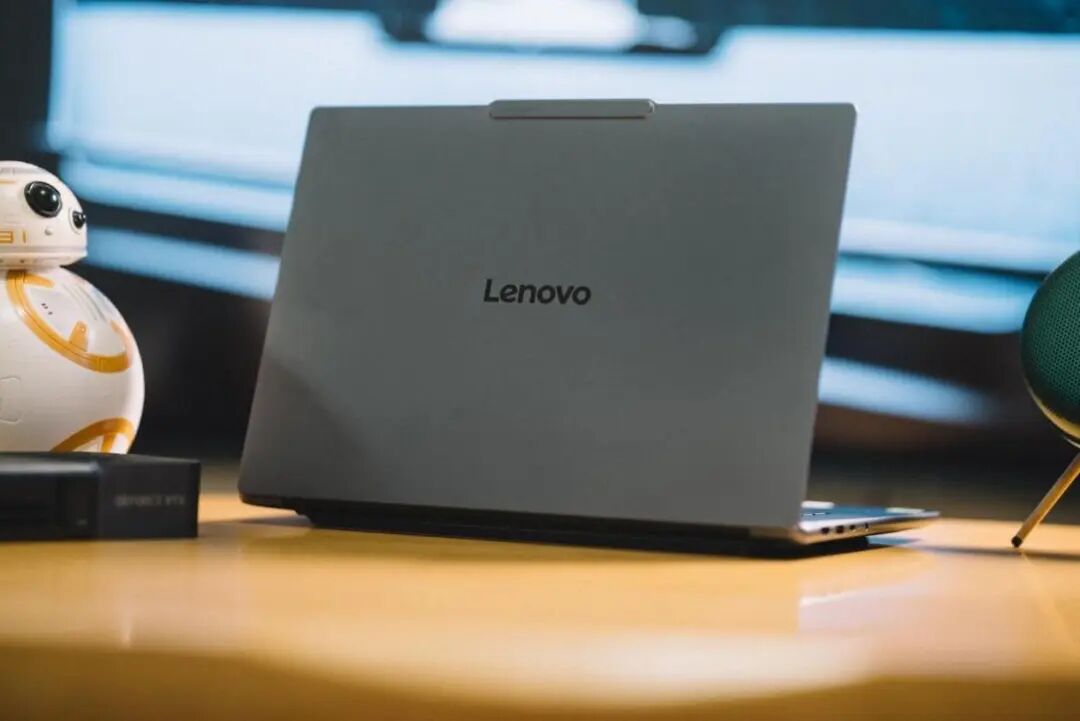
So how much money can AI PCs actually make for vendors?
Still taking Lenovo as an example, according to Morgan Stanley's caliber, the global average price of Lenovo's ordinary PCs is about 800 USD (equivalent to about 5,400 RMB), the gross profit margin of conventional PCs is about 15.5%, while the gross profit margin of ultra-high-end AI workstation models like RTX Spark can reach around 22%.
Reflected in revenue and profit:
Reporters from *Economic Journal* calculated that assuming the shipments of Lenovo YOGA Pro 15 reach 2 million units (accounting for about 3% of Lenovo's annual PC shipments), it will bring about 75.2 billion yuan in incremental revenue and 17.2 billion yuan in incremental gross profit for IDG, with a single-unit incremental gross profit margin of about 23%, pushing up IDG's gross profit margin by about 0.9 to 1.3 percentage points and operating profit margin by about 0.8 to 1.3 percentage points.
The thought-provoking part of this set of data is that ultra-high-end models that only account for 3% of shipments can leverage nearly 1 percentage point of profit margin for the PC business of a leading vendor. The more accurately this business account is calculated, the more distant the golden age of the PC industry, which judged heroes by "shipment volume", seems to be.
The unresolved "variable" from NVIDIA
At present, major institutions are very optimistic about AI PCs.
A report released by Omdia shows that AI PCs are expected to account for 60% of global PC shipments in 2027, and further rise to 79% by 2030. Goldman Sachs predicts that AI PC shipments will reach 150 million units in 2026, up 39% year on year, accounting for 59% of all PCs. By 2028, shipments will be close to 200 million units, with a market penetration rate of 82%.
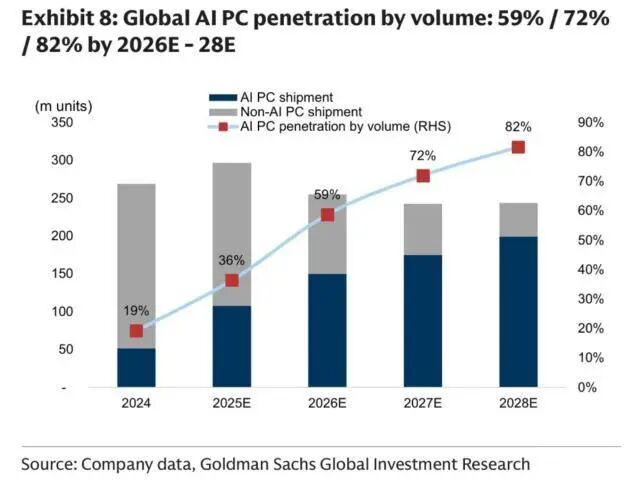
The grand occasion of first-launch sell-out and second-hand price increase in the consumer market seems to have further boosted the trend of AI PCs accelerating to replace traditional PCs.
However, how many people will replace their computers for AI functions?
According to a survey by Omdia, 69% of PC office users are willing to pay a higher price for local AI processing capabilities, but only 9% of users will replace their computers because of AI functions. More importantly, 2025 survey data from LeadLeo Research Institute shows that NPU, the core hardware of AI PCs, is not effectively invoked in many mainstream software.
This means that after consumers pay the hardware premium, they do not get a corresponding improvement in AI experience.
In June 2026, NVIDIA announced the launch of RTX Spark, officially entering the PC chip sector, which immediately caused a carnival among PC vendors. Microsoft, Dell, HP, ASUS, Lenovo and MSI will successively launch new Windows all-in-one machines equipped with this chip, such as Lenovo YOGA Pro 15 RTX Spark and ASUS ProArt P16.
Have the new generation of AI PCs made progress compared with the past?
Judging from the current evaluations by major tech bloggers, RTX Spark notebooks have significant advantages in GPU performance, local large model reasoning, and large-capacity unified memory, especially suitable for developers and creators who need to run large models locally. However, actual tests have also exposed many problems:
The Windows on Arm architecture has shortcomings in software compatibility, with poor performance in some games and professional applications.
The performance in terms of battery life, heat generation and fan noise under high-load scenarios is not satisfactory. In addition, the local Agent experience that NVIDIA focused on promoting is not good: generating a news brief using Hermes Agent and the local Qwen model takes about 10 minutes, consumes 10% of the battery, and the final effect is not as good as cloud-based Claude.
Admittedly, the shortcomings in the experience level are not irreparable hard injuries, and they will most likely be gradually remedied with future technical iterations.
What needs to be worried is that shortly after several RTX Spark notebooks were released, NVIDIA encountered the "incident" related to Jensen Huang.
Jensen Huang is the core operator of NVIDIA's entry into the PC market, and he personally promoted the entire process of RTX Spark from architecture definition, ecological cooperation to implementation rhythm. TrendForce estimates that shipments of RTX Spark-related products will be within 200,000 units in 2026; as the ecosystem matures, the number is expected to rise to 1 million units in 2027.
Now that Jensen Huang has stepped down, many media at home and abroad have begun to worry: Will NVIDIA continue to increase investment in consumer-level projects in the future?
Among them, the fate of RTX Spark has aroused predictions from several media. For example, Kieren Jessop, PC analyst at Omdia, said bluntly: Consumers will not feel much change in the short term, but the next two or three years are worth alerting.
After all, the commercial return of the consumer-level business is far less than that of the AI data center, and it requires continuous investment.
On November 18, NVIDIA released its financial report for the third fiscal quarter of the 2027 fiscal year (ending on October 25, 2026), with revenue reaching 115.8 billion USD, up 103% year on year and 20% quarter on quarter; net profit hit 65.3 billion USD, up 105% year on year and 9% quarter on quarter.
The new generation of Lenovo AI PCs equipped with RTX Spark has started shipments, and NVIDIA has included this progress in its edge computing business.
In this quarter, this business achieved revenue of 8.2 billion USD. In contrast, the data center business reached a record high revenue of 107.6 billion USD, exceeding 100 billion USD for the first time, with a revenue proportion of about 93%, up 110% year on year and 21% quarter on quarter.
Cress, who temporarily took over as CEO, has a CFO background, and every subsequent investment and revenue of NVIDIA will probably be calculated more strictly.
The mood of PC vendors has become particularly ironic at this moment.
This is probably the inescapable fate of the PC industry: for decades, it has never truly mastered its own narrative power. In the early years, it was pushed to iterate by Intel's Moore's Law, then later driven to replace devices by Microsoft's system upgrades. Now that it hits the AI wave, it still has to rely on the strategic tilt of chip giants to get a share of the growth dividend.
The PC industry, trapped in the stock market dilemma, is about to fall into confusion again with the departure of one person.
This also illustrates a cruel reality of the PC industry: when the narrative power is in the hands of others, the imagination space for growth may shrink at any time. Now that the incremental dividend brought by AI is becoming uncertain, cost reduction has become a more controllable starting point for PC vendors, and a round of readjustment around production capacity has actually already begun.
The "zero-sum game" of production capacity reshoring
In the future, what kind of computers will consumers pay for?
Senior analysts at Counterpoint pointed out that AI computers, high-end displays and differentiated products still have opportunities, but the enterprises that eventually win must have four capabilities at the same time: innovation capability, competitive prices, strict supply chain management, and product value that is attractive to consumers and enterprises, none of which can be missing.
Among them, price and supply chain management are particularly important in this era when PC material costs and end selling prices are getting higher and higher. In the first quarter of 2025, the three core components of CPU, DRAM and SSD accounted for 45% of the total machine material cost; by the third quarter of 2026, this proportion has reached 68%.
At present, major PC vendors seem to only have two main tasks left: save money, make money.
This has also led to upcoming new changes in the production lines of global PC vendors. In the past, China was one of the largest OEM production regions for the global electronics industry, and gave birth to leading Taiwan-based enterprises such as Foxconn, Quanta Computer, Compal Electronics and Pegatron, as well as mainland-based leading enterprises such as Huaqin Technology and Luxshare Precision.
Later, due to the rise in domestic OEM costs, PC vendors began to move production lines to cheaper Thailand and Vietnam. It is reported that HP even plans to move up to 70% of its production capacity out of China.
Now, as PC material costs keep rising, the problem of insufficient supporting facilities in Thai and Vietnamese bases has been amplified. The superposition of logistics cycles and inventory costs has gradually eroded the original advantage of low labor costs. TrendForce points out that PC vendors are re-evaluating the logistics, procurement and supply chain management costs of emerging production bases.
In contrast, China has mature manufacturing talents, low production costs and a complete electronic industry chain.
On October 28, Nikkei Asia cited sources saying that global PC vendors including HP, ASUS and Acer are moving part of their production lines