Against the backdrop of an 89.4% growth rate, what path should domestic chips follow? Wei Shaojun has put forward five suggestions.
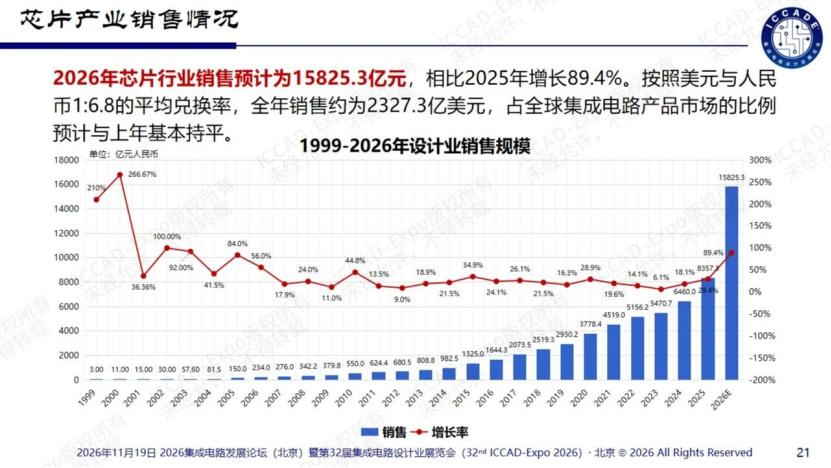
$1.6 trillion. This is the scale that the global semiconductor market will most likely reach this year, representing a year-on-year increase of 101.1%. The sales revenue of China's chip industry is expected to hit 1582.53 billion yuan, up 89.4% year on year. Both figures are impressive, but Wei Shaojun, Director of the IC Design Branch of China Semiconductor Industry Association, issued a far from relaxed reminder for this performance report at the 32nd ICCAD-Expo: under certain circumstances, supply chain security is more important than technological advancement.
The Intelligent Revolution is the Final Missing Piece
Wei Shaojun is reluctant to define the current era as the "Fourth Industrial Revolution". He prefers to call it the highest stage of the people-centered technological revolution.
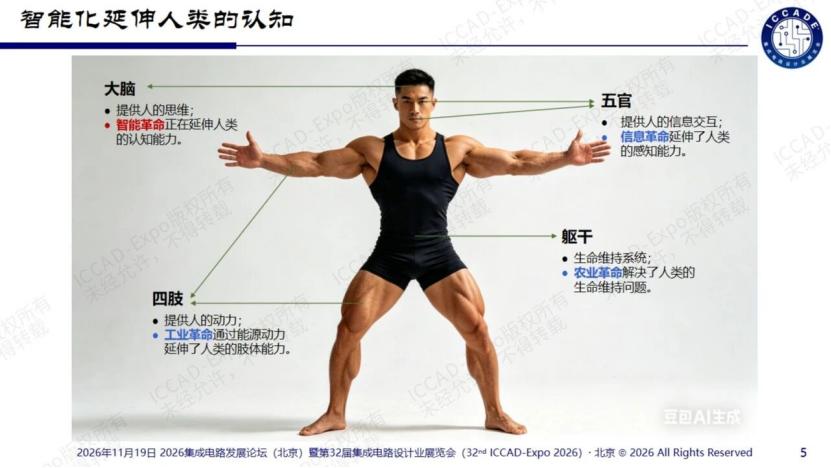
He used a picture of the human body as an example: the torso is the life support system, the limbs provide mobility, the five sense organs are responsible for perception, and the brain is in charge of cognition. The agricultural revolution solved the food problem with planting and animal husbandry technologies, supporting the human torso; the industrial revolution extended human limbs with energy and power, with cars, high-speed railways, airplanes and ships all serving as its footnotes; the information revolution extended human five sense organs with computers and the Internet, making satellite remote sensing and transoceanic communications easily accessible even from afar; and today's intelligent revolution represented by artificial intelligence and semiconductors is extending the human brain.
From this perspective, the four puzzle pieces are all in place. The intelligent revolution is the first time that all parts of the human body have obtained technological support. Wei Shaojun believes that this does not mean the end of the technological revolution, and future breakthroughs will emerge in ways that cannot be imagined today, such as replacing fossil fuels and nuclear energy with new energy sources, and replacing silicon technology with biotechnology, but they are all iterations and upgrades based on the existing foundation.
The outcome of this wave is already in front of us. In 2015, DeepMind performed 10 times better than human professional players in Atari games; for image recognition of 20,000 categories, machines have surpassed humans; AlphaGo's victory over Ke Jie made Chinese people widely perceive artificial intelligence for the first time; the word error rate of Chinese speech recognition has dropped to 5.9%; the accuracy of lip reading recognition has reached 93.4%. Wei Shaojun judges that in the next ten years, breakthroughs in artificial intelligence will profoundly change production and lifestyles, and will also be the core commanding height of major country competition.
Semiconductors and Artificial Intelligence Are Inseparable From Each Other
The term artificial intelligence has been tied to machines since its birth, and the machine here refers to computers. The birth of semiconductors also originated from computers, and in turn supported every leap of computers. From transistors to integrated circuits, and then to microprocessors, the two development lines have been advancing side by side all the way.
Every time the form of computers changes, semiconductors will move up a level. Personal computing in the 1980s, network computing in the 1990s, cloud computing in the new century, and intelligent computing today, each round has brought an order-of-magnitude increase in the scale of the semiconductor market.
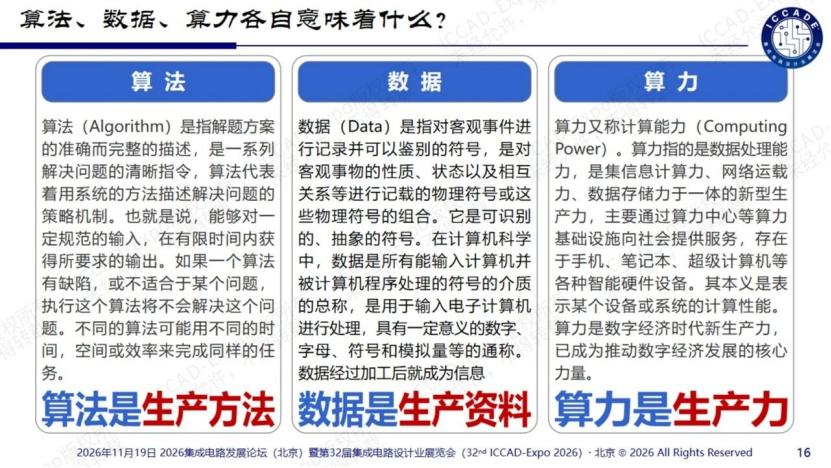
Wei Shaojun believes that algorithms are production methods, data are means of production, and computing power is productive force. Among the three, computing power completely relies on semiconductor technology, and no other technology today can replace silicon-based semiconductors to provide computing power. The reason does not lie in whether a certain discipline can achieve breakthroughs, but behind silicon-based technology is an industrial ecosystem that has cost tens of trillions of dollars and been built over more than half a century.
Training, Derivation, Inference: Three Types of Chips With Three Different Development Paths
For chip designers, training, derivation and inference are not three abstract concepts, but three distinct product specifications.
Training corresponds to the learning process, which requires stable output of large computing power for a long time. The greater the computing power, the shorter the training time, the more data that can be fed into the model, and the higher the model accuracy. Therefore, the basic requirements for training chips are large computing power, large storage, and large communication bandwidth. Derivation corresponds to the thinking process, which needs to refine the raw data and see through the appearance to get the essence based on existing experience, requiring sufficient computing power and storage to give relatively accurate and fast conclusions. Inference corresponds to the knowledge that has reached a consensus, and the chip must output results immediately, where low latency is the top priority.
In the past ten years, the architecture of AI chips has followed a clear development path. In the early stage, there were no dedicated chips, and people used existing devices such as CPU, GPU, FPGA and DSP to verify algorithms, which had low performance and poor scalability. Then people turned to application-specific integrated circuits, namely ASIC, which improved performance by several orders of magnitude, but flexibility became a new shortcoming. As algorithms iterated rapidly, chips could not keep up, so new architectures with high flexibility and real-time reconfigurability became the mainstream. In the large model stage, computing power has become the main contradiction, and the storage capacity has expanded along with trillions of parameters.
Where Does the 89.4% Growth Come From
Statistics from the IC Design Branch of China Semiconductor Industry Association show the 2026 performance report. The annual chip sales revenue is expected to reach 1582.53 billion yuan, up 89.4% year on year, covering 20 cities and about 4324 enterprises. This statistical caliber has excluded the mobile phone sector. Wei Shaojun said frankly that considering there is still some time before the end of the year, this figure is relatively conservative, and it may underestimate the revenue by 100 to 200 billion yuan.
Regional differentiation is very obvious. The Yangtze River Delta region reached about 970.2 billion yuan, up 109% year on year; the Guangdong-Hong Kong-Macao Greater Bay Area reached 304.4 billion yuan, up 28% year on year; the Beijing-Tianjin-Bohai Rim region reached 216.8 billion yuan, up 38.5% year on year; the central and western regions reached 270.3 billion yuan, up 86.6% year on year. All 20 cities achieved positive growth, and the top four in the growth rate list are Hefei with 2546.7%, Wuhan with 218.2%, Chongqing with 66.7%, and Beijing with 45.1%. The explosive growth of Hefei and Wuhan has directly driven the strong growth of the memory industry. Ten years ago, China's memory industry was still in its infancy, but now its sales scale may have exceeded 500 billion yuan, close to 600 billion yuan.
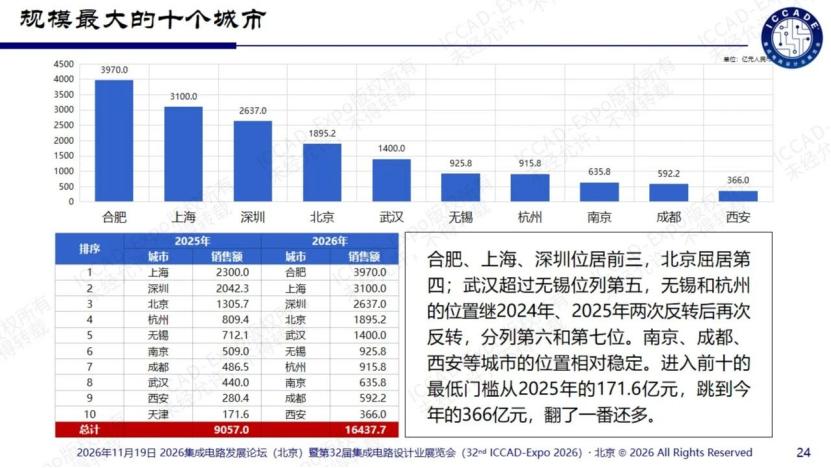
The city ranking is also being reshuffled. Hefei, Shanghai and Shenzhen rank top three, Beijing ranks fourth, Wuhan surpasses Wuxi to rise to fifth, and Wuxi and Hangzhou have swapped positions again after two reversals in 2024 and 2025. The total sales revenue of the top ten cities is 1.64 trillion yuan, accounting for 93.3% of the national total revenue. The threshold for entering the top ten has jumped from 17.16 billion yuan in 2025 to 36.6 billion yuan, more than doubling.
The concentration at the enterprise level is more obvious. The threshold for entering the list of top ten advanced chip enterprises has risen from 8.4 billion yuan in 2025 to 14.5 billion yuan. The total sales revenue of the top ten enterprises is close to 800 billion yuan, up 218% year on year, far higher than the average growth rate of 89.4% of the whole industry. The number of enterprises with sales revenue exceeding 100 million yuan reached 947, an increase of 116 compared with 831 in the previous year.
Five Suggestions and One Reminder
Facing this surging wave of artificial intelligence, Wei Shaojun put forward five suggestions on how China can stand at the forefront of the trend, seize development opportunities, and win the competition in the process of development.
First, we should have confidence in artificial intelligence, but also maintain a sense of awe. He repeatedly emphasized that artificial intelligence cannot be simply regarded as a single technology, because any technology will evolve, and if you only look at it from a technical perspective, you will easily lose confidence when encountering difficulties. Intelligence is a new stage of human social development, and artificial intelligence is just the beginning, which will last for many years. He specifically called on the investment community to be bolder and more aggressive in investing in artificial intelligence. As long as the direction is clear, the team is reliable, and the technology has unique features, it has the basic prerequisites for investment. You reap what you sow. Without today's investment, there will be no gains tomorrow.
Second, study the objective laws down-to-earth. AI chips are one of the most complex chips in the industry, which need to push all capabilities of the manufacturing process to the limit. Large computing power chips not only require advanced processes, but also need to obtain performance at the highest possible energy efficiency, and hope that the area is large enough to carry more computing resources. Geopolitical factors will slow down the development of domestic advanced process nodes, but this does not mean that the development is completely blocked. In the past two years, domestic enterprises have used various methods to break through process restrictions, and have been able to achieve results comparable to chips made with advanced processes under existing conditions.
Third, have the courage to innovate and shift from chip-centric thinking to system-centric thinking. In the era of artificial intelligence, the industrial focus has extended from a single chip to the system level. The challenges are no longer limited to the chip itself, but also involve multi-chip collaboration and software collaboration. Chip engineers need to transform into system engineers. Large computing power chip manufacturers should not only focus on the theoretical computing power of chips, because the communication overhead brought by multi-chip interconnection will cause system performance loss, which can reach 30% to 40% in large-scale interconnection scenarios. The communication problem between computing power chips cannot be completely solved by traditional communication theories and solutions. The bit error in traditional point-to-point communication can be compensated by retransmission, with limited delay impact. But in large-scale computing power integrated systems, the delay caused by bit errors will trigger the waiting of multi-chips and even the whole system, resulting in global performance loss. Such new problems have reshaped the industry competition pattern. Enterprises that had advantages in the past may not be able to maintain their advantages, which also creates new opportunities for the industry.
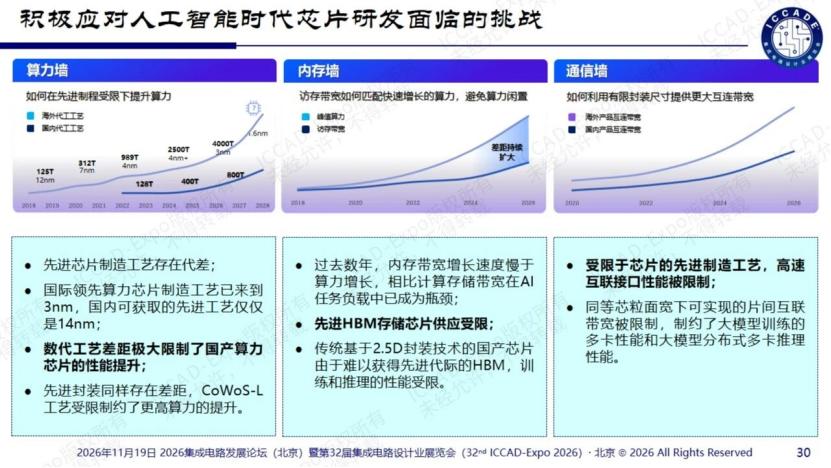
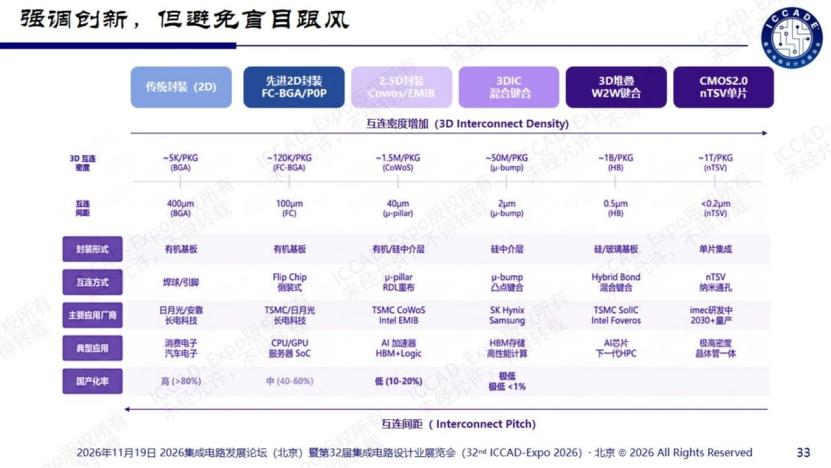
Fourth, find solutions to practical difficulties. The current process evolution has indeed deviated from the expected path, but we cannot simply conclude that Moore's Law has failed. Its underlying logic is still valid in the long run. Advanced processes can still achieve higher performance, lower power consumption and better unit cost, but the difficulty of reaching the expected indicators continues to increase. The current industry is exploring design solutions that do not rely on advanced process nodes, relying on advanced packaging to complete integration, which is expected to blaze a localized development path and expand strategic space. The industry is trying to achieve product performance close to that of advanced process nodes relying on mature processes, improve chip computing efficiency and inter-chip communication bandwidth through innovation, and reduce system overhead with software and engineering optimization, so as to ease the constraints at the advanced manufacturing level. At the same time, AI is reshaping the methods and paradigms of chip design. We need to use AI to accelerate chip R&D, improve design quality, and explore new chip architectures, which also brings new challenges and opportunities to traditional EDA.
Fifth, stay sober-minded and do not follow trends blindly. Most of the domestic enterprises' innovations are based on specific background conditions. Before adopting a new technology, we must carefully study the logic and boundary conditions behind it, otherwise it will easily cause waste of resources and miss market opportunities.
After finishing the five suggestions, Wei Shaojun turned the topic to ecosystem. A single flower does not make spring, while a hundred flowers in full bloom bring spring to the garden. It is almost impossible for a single enterprise to cover the whole semiconductor chip industry, which requires a complete, rich and prosperous supply chain and ecosystem. He said the most important sentence in the whole speech: under certain circumstances, supply chain security is more important than technological advancement.
Assess the Situation and Accumulate Strength for Takeoff
Finally, Wei Shaojun quoted two ancient Chinese texts. One is from a couplet in the Wuhou Temple in Chengdu: "If you can attack the mind of the opponent, the rebellious forces will eliminate themselves; since ancient times, those who know military affairs are not bellicose. If you cannot assess the situation, both leniency and strictness will lead to mistakes, and later governors of Shu must think deeply about this". The other sentence is from "Discussion on Moving the Capital and Establishing Vassals II" written by Chen Danran in the Qing Dynasty: "Since ancient times, those who do not plan for the long-term future cannot plan for the immediate present, and those who do not plan for the overall situation cannot plan for a single region". These two paragraphs tell us that we must assess the situation and focus on the big picture to do small things well. What Wei Shaojun wants to express is that the current domestic semiconductor industry is booming, and we should not only see the breakthroughs, but also realize that the industry needs to accumulate strength for long-term development after the hype fades away. By seizing the opportunity of artificial intelligence and actively embracing this wave, China's chip industry can move from one victory to another.
This article is from the WeChat official account "Semiconductor Industry Review" (ID: ICViews), author: ICVIEWS Editorial Department, published with authorization from 36