Performance report of Hainan Free Trade Port in its first year of customs closure operation: the number of newly added foreign-funded enterprises increased by more than 30%, and the offshore duty-free sales exceeded 27 billion yuan.
Hainan Free Trade Port is facing its first annual assessment after customs closure.
On December 18, 2025, Hainan Free Trade Port launched island-wide customs closure operation. The island covering more than 30,000 square kilometers has officially entered a brand-new operation stage of "liberalizing the first line while exercising control over the second line".
This is the first time that China has placed an entire provincial-level administrative region into a high-level opening-up pressure chamber. There is no ready-made model in the world, and since its launch, it has been an open examination paper with no standard answers.
Approaching the first anniversary of customs closure, this experiment has ushered in a phased grading.
Hainan Daily states that the policy effects of the free trade port have entered a "stage that can be observed and verified". Central media including People's Daily, CCTV, and Economic Daily have focused on its legal guarantee, bonded maintenance, and the "one-person army" entrepreneurship model, with outstanding performance shown in the assessment.
The higher-standard grading comes from the Standing Committee of the National People's Congress.
On November 3, the 25th meeting of the 14th Standing Committee of the National People's Congress heard the report on the inspection of the implementation of the *Hainan Free Trade Port Law of the People's Republic of China*. The law enforcement inspection team went deep into 8 cities and counties across the island, visited more than 30 enterprises, hospitals and schools to collect opinions and suggestions.
The achievements are written into the report item by item, and the shortcomings are also annotated one by one. With the answer sheet and annotations placed on the table at the same time, how can Hainan Free Trade Port blaze a new path of opening-up that balances vitality and resilience in the next step?
Offshore Duty-free Sales Hit 27.52 Billion Yuan
Many experts and scholars told the Times Weekly reporter that there is hardly any equivalent reference sample for Hainan's customs closure.
Su Jian, Professor at the School of Economics of Peking University and Director of the National Economic Research Center, pointed out that Hong Kong of China and Singapore are city-type free ports, while the port areas of Dubai and Panama are point-type free zones. Hainan, by contrast, implements customs closure for an entire provincial-level administrative region, while taking into account multiple objectives including the unified national large market, national fiscal and taxation system, people's livelihood, and national territorial security. Its complexity far exceeds existing international samples.
Li Shijie, President of Hainan Open Economy Research Association, mentioned that in the first two to three decades of reform and opening up, there were mature reference objects such as the "Four Asian Tigers" for domestic development. Now, however, international economic and trade rules are being reshuffled, and many traditional free trade logics are being marginalized. Hainan's opening-up needs to align with internationally prevailing economic and trade rules, and also explore an independent path amid the complex and changing international environment.
Looking across the globe, there is no similar model; looking back at history, there is no identical precedent. There is no standard answer to be found, but after the answer sheet is submitted, there is its own evaluation criterion.
Since the customs closure, as of September 30 this year, the "zero-tariff" policy for imported goods has accumulated a total import value of 4.29 billion yuan, with 720 million yuan of taxes exempted.
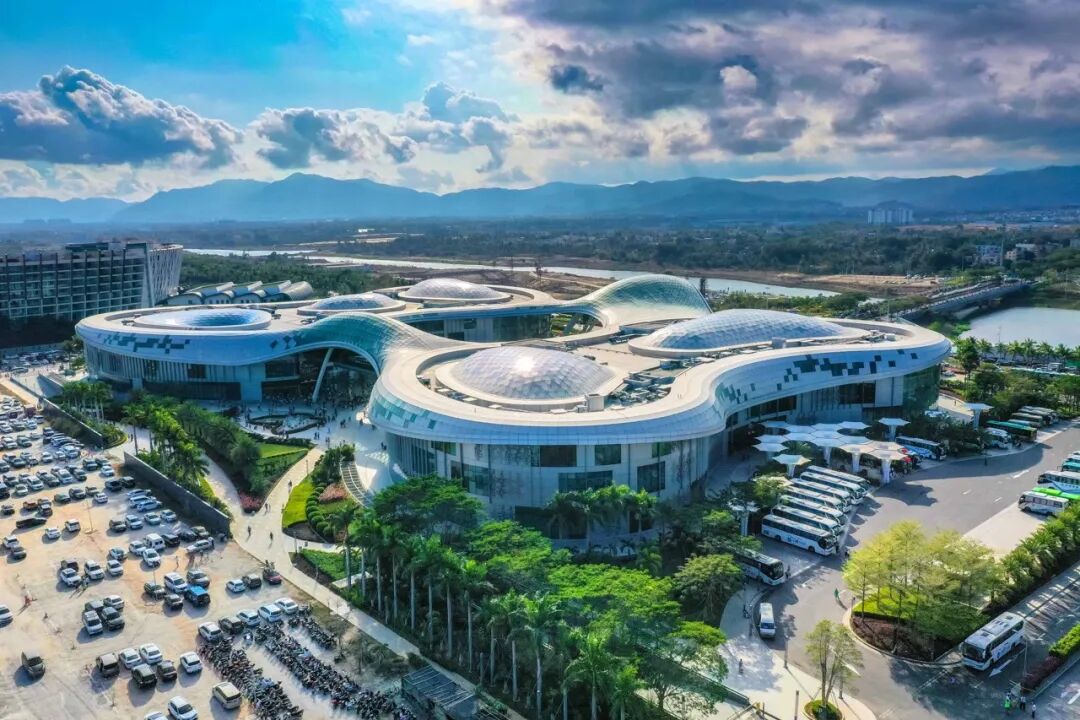
△ Sanya International Duty Free City Source: Tuchong
In addition, Hainan has completed the construction of 8 high-standard opening-up ports and 10 "second-line ports". The total value of import and export goods at all opening-up ports reached 138.6 billion yuan, up 9.2% year on year, and the number of inbound and outbound passengers reached 2.245 million, up 23.6% year on year.
Market vitality has also been continuously enhanced. As of September 30 this year, 242,000 new business entities have been registered, up 29.2% year on year. The number of newly added foreign-funded enterprises and customs-filed foreign trade enterprises increased by 31.1% and 47.4% respectively, and the duty-free shopping sales of off-island passengers reached 27.52 billion yuan.
The eye-catching data outlines the opening-up effects in the first year after customs closure, while the quality of free trade port construction still needs to be observed and evaluated from more dimensions.
Chen Yajie, Economist at the Institute of Public Diplomacy and Hainan Opening-up of the China South China Sea Institute, put forward four evaluation dimensions to the Times Weekly reporter: whether opening-up is expanded, whether risks are well prevented and controlled, whether high-quality industrial development is promoted, and whether the sense of gain of residents and enterprises is improved.
These four criteria have also become the core coordinate system for observing the effects of Hainan's first year after customs closure.
Seeking a Balance Between Delegation of Power and Regulation
The first two items of the scoring criteria, expanding opening-up and risk prevention and control, are always in a subtle tension.
When opening up widely, people worry about failing to exercise proper control; when exercising strict control, it is easy to restrict vitality.
In this regard, Li Shijie focused on the EF account, namely the multi-functional free trade account of Hainan Free Trade Port.
There used to be a vivid metaphor in the industry: most cross-border capital channels in domestic regions have many checkpoints and long approval chains. The EF account is equivalent to a capital "expressway" with fewer checkpoints, making capital flow more convenient.
Relying on this mechanism, the time consumed for cross-border capital transfer has been reduced from "calculated by days" to "minute level".
As of the end of June this year, a total of nearly 1,300 EF accounts have been opened by 13 banks across Hainan. In the first six months of 2026, the transaction volume of EF accounts exceeded 300 billion yuan.
The scale is not small. But in Li Shijie's view, this channel is far from being fully utilized.
He made a comparison: there are millions of business entities in Hainan, but the proportion of enterprises that have opened EF accounts is relatively low, which is due to the overly strict audit standards.
However, at the stage when China's cross-border penetrating supervision capacity for capital is not yet perfect, tightening the front-end access is also a realistic choice.
In the group deliberation of the Standing Committee of the National People's Congress, Committee Member Sun Jusheng's judgment echoed this point. He proposed that Hainan still has insufficient tasks to undertake the national high-level opening-up pressure test, and suggested expanding the coverage of EF accounts and enriching application scenarios.
The dilemma of EF account expansion is exactly the epitome of this pressure test. Li Shijie also pointed out several other directions to be broken through: visa exemption for overseas technical personnel, sales tax reform, etc.
In Chen Yajie's view, opening-up and supervision are not opposites. In the past, more emphasis was placed on "only when you can manage well can you open up", making supervision a precondition for opening-up. Hainan's practice further proves that the real flow of trade, logistics, capital and personnel will continuously generate business data, which in turn helps enterprises establish more accurate credit files and force the iteration and upgrading of supervision capabilities.
Chen Yajie judged that the current 8 "first-line" ports and 10 "second-line" ports are operating smoothly, and customs clearance efficiency is steadily improving, indicating that this institutional framework has withstood the initial operation test.
Over the past year, between "flexible operation" and "effective control", Hainan has not adopted a one-step solution, but followed a gradual, controllable, trial-and-adjust route.
Examining the Actual Gap in the Implementation of Policy Dividends
The last two items of the scoring criteria, high-quality industrial development and the sense of gain of market entities and residents, measure the gap between policy design and actual perception.
If the policies are in full swing while the perception of enterprises and residents is relatively cold, this answer sheet is not considered complete.
Chen Yajie analyzed that for residents, the zero-tariff policy for daily consumer goods and off-island duty-free shopping have allowed consumers to directly reap the dividends of opening-up, but residents' more stable and lasting sense of gain will ultimately be reflected in employment opportunities and income growth.
Data from Hainan Provincial Bureau of Statistics shows that in the first three quarters of 2026, the province's gross domestic product reached 581.255 billion yuan, representing a year-on-year increase of 1.2% at constant prices. The per capita disposable income of provincial residents was 28,167 yuan, representing a nominal year-on-year increase of 4.6%.
The other end of the gap is connected to the government's fiscal accounts. Su Jian believes that the customs closure operation is the first time in China that the cost of institutional opening-up is "clearly priced", with supervision cost, fiscal cost and social cost all becoming explicit. In the past, the dividends of opening-up were visible while the costs were implicit, but now all costs are placed on the table.
Li Shijie mentioned that enterprises have uneven perceptions of the policy. Enterprises that can open EF accounts and adapt to the free trade port policies enjoy significantly more conveniences than other entities.
Only when business operations continue to improve can the scale of employment be expanded, which translates into local employment and income growth.
Chen Yajie said that there is a time lag in the transmission of policy dividends itself. Policies such as zero tariff, low tax rate, and value-added processing tariff exemption can directly reduce the operating costs of enterprises and enhance their ability to allocate international resources. However, many new policies are matched with brand-new business models, which require relying on specific business pilots to accumulate experience, improve rules, and then gradually expand the scope of application to allow more enterprises to share the policy dividends.
Hainan Experiment Paves the Way for High-level Opening-up
The first anniversary of customs closure is not the end point. The real significance of this first-year assessment never lies only in the gains and losses of Hainan as an island.
Su Jian said that the nearly one-year customs closure operation can be regarded as a "pressure test" for institutional opening-up. External tariff shocks, real estate adjustment, smuggling through purchasing on behalf of others and other issues are all existing pressures in actual operation.
Among them, the challenges at the supervision level are particularly long-term: shifting from "physical enclosure" to "information enclosure", the current smooth operation of the customs clearance system is achieved through high investment, and effective governance precisely indicates that risks are long-term stocks that require continuous investment.
"In addition, the reliance on tourism and real estate has not been fundamentally reversed, and problems such as the ebb of land finance, low fiscal self-sufficiency rate, and high dependence on transfer payments remain to be solved." Su Jian said.
Transformation cannot be achieved overnight. Chen Yajie believes that Hainan's industrial structure is in the process of continuous adjustment. The construction of the free trade port itself is a long-term undertaking that requires sustained efforts.
One of Chen Yajie's key work priorities is the research on institutional innovation and expanded opening-up of the service industry in Hainan Free Trade Port, focusing on analyzing how Hainan can further expand opening-up in fields such as medical care, finance, digital economy, and professional services, and promote the recognition of overseas professional qualifications, cross-border practice of professional talents, and facilitation of trade in services.
"If Hainan cannot give a good answer to this examination paper, no other place can do it well." Li Shijie's expectation is very specific: turn the free trade port policies into the "shopping cart" of local residents, shape the policies into the "livelihood" of innovators and entrepreneurs in Hainan, and make Hainan an "island gathering talents from all over the world".
The value of this experiment never lies only in Hainan.
Su Jian analyzed that the physical boundary and legal authorization system on which Hainan's customs closure is based are non-replicable, but the governance experience accumulated in the experiment has universal reference significance. For example, the combined model of smart supervision and credit supervision, the governance paradigm against smuggling and purchasing on behalf of others, the practical toolbox for fiscal transformation from "land finance" to "industrial finance", and the engineering promotion method for optimizing the business environment can all provide references for the opening-up exploration of other regions.
"The essence of the Hainan experiment is to explore a Chinese-style high-level opening-up paradigm. On the premise of maintaining the unified national large market, macroeconomic regulation sovereignty, and fiscal and taxation sovereignty unchanged, we will partially build a high-standard opening-up institutional cluster to blaze a trail for China's deeper reform and opening-up." Su Jian said.
This article is from the WeChat Official Account "Times Weekly" (ID: timeweekly), written by Wang Chenyuan, and authorized for release by 36Kr.