Anthropic IPO wealth creation: seven founders have a net worth of tens of billions, and thousands of employees are set to become millionaires
Anthropic is about to embark on its wealth-creation journey. The AI company that rose to fame with its Claude large language model is set to list on the Nasdaq on November 19 local time, under the ticker symbol ANT.
The day prior, Anthropic priced its IPO Class A common shares at $83 per share, a price above the company's previous estimate. Anthropic stated that the offering consists of 980,000,000 Class A common shares, of which 956,351,354 are being sold by Anthropic and 23,648,646 are being sold by certain selling shareholders.
Calculated based on the above offering price, the company's fully diluted valuation reaches approximately $1.5 trillion. Its public offering fundraising size is about $813 billion, coupled with the concurrent $260 billion private placement, the total fundraising amount exceeds $1.07 trillion, setting a new global IPO record, surpassing SpaceX's previous base transaction size of $750 billion.
A large number of wealthy individuals will also be born as a result. First are the seven co-founders of Anthropic, each of whom will have a paper net worth exceeding $10 billion after the IPO. Each of them holds approximately 1.4% of the shares (on a fully diluted total share capital basis), and no one holds absolute controlling stake.
The seven are respectively CEO Dario Amodei, President Daniela Amodei, Chief Computing Officer Tom Brown, Head of Public Interest Jack Clark, Chief Science Officer Jared Kaplan, Chief Architect Sam McCandlish, and Head of Interpretability Research Chris Olah. They are exactly the core team that left OpenAI.
CEO Dario Amodei holds a PhD in computational neuroscience from Princeton University, previously worked at Google Brain, and later served as Vice President of Research at OpenAI, leading the R&D of GPT-2 and GPT-3. He leads Anthropic's overall research direction, technical roadmap and corporate strategy, and is the core person in charge of the Claude model.
Dario's sister Daniela previously served as Vice President of Safety and Policy at OpenAI. She is responsible for the company's operations, AI safety system, policy, business and compliance affairs.
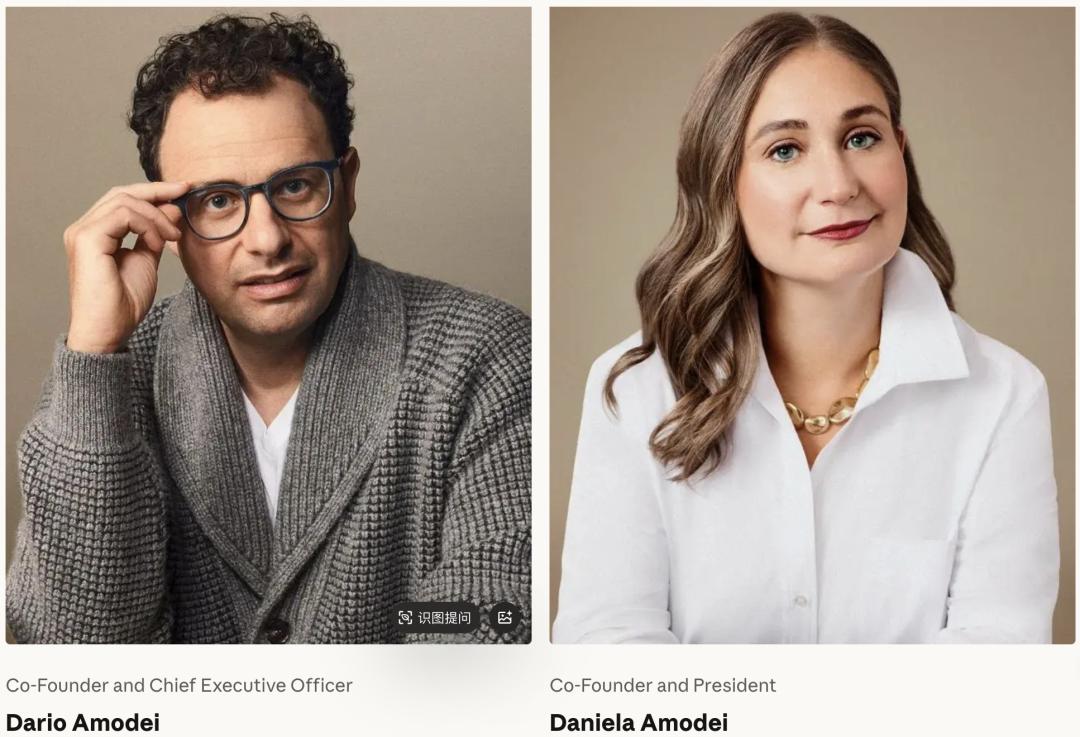
Image source: Anthropic official website
During his time at OpenAI, Tom Brown was responsible for computing power and large-scale training infrastructure. After joining Anthropic, he takes full charge of the acquisition, expansion and scheduling of computing power resources required by Claude, and is a key figure guaranteeing the large model training resources. Jack Clark was a technology journalist in his early years, joined OpenAI to be in charge of AI policy, and now leads the Anthropic Institute think tank. Jared Kaplan, a theoretical physicist by background, is responsible for the company's basic technology research.
In addition, Sam McCandlish was an early AI safety researcher at OpenAI and participated in the R&D of Codex, and now is the person in charge of the company's large-scale model training architecture. Chris Olah, a Thiel Fellow, previously focused on model interpretability at Google Brain and OpenAI, and is a well-known researcher in the field of AI safety.
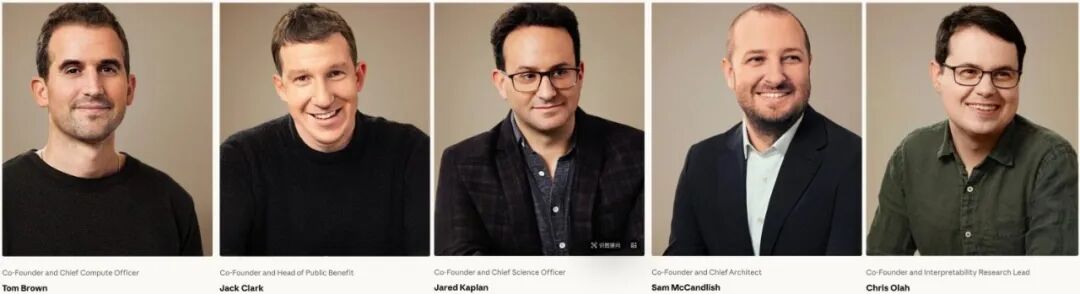
Image source: Anthropic official website
The prospectus shows that the company adopts a special Class F shareholding structure, under which the seven founders lock in 50.1% of the voting rights through one Class F share held jointly. Even if they continue to reduce their personal Class A shares in the future, as long as they retain the minimum shareholding, they will still hold the dominant power in corporate governance.
The seven founders also promised to donate 80% of their personal equity to charities, and the company will additionally allocate 5% of its shares to the public interest trust.
Anthropic's employees are also about to enjoy the wealth carnival. According to estimates by private market research institution Sacra, based on the valuation benchmark of $1.35 trillion, the pre-tax vested equity held by about 2,800 current and former employees of Anthropic may be worth at least $1 million. Hill, a private company equity trading platform, further calculates that after the completion of this IPO, 598 non-founder employees will hold equity with a book value of more than $100 million.
A large number of options and restricted shares of the company are open to employees, with a weighted average exercise price of options of only $2.91 per share. The extremely low exercise cost has greatly expanded the room for book returns on employee equity. This also makes Anthropic one of the most prominent cases of employee wealth creation among listed companies in Silicon Valley in recent years.
In addition to the founding team and ordinary employees, a group of strategic investors and early VC institutions are also beneficiaries of this IPO. Amazon and Google are the two most important strategic shareholders, holding a large number of non-voting Class N shares in total. Industry chain enterprises including NVIDIA, Microsoft, TSMC, and AMD participated in the $260 billion private placement. Established venture capital institutions such as Bessemer, Menlo, and Accel, as early investors, have ushered in the exit window after years of betting.
Different from many IPO projects where old shareholders cash out intensively, many early VC institutions have chosen to subscribe for additional shares. Market news shows that existing Anthropic investors including HSG, Iconiq, Lightspeed Venture Partners, Accel and Altimeter Capital Management plan to subscribe for billions of dollars worth of shares in the company's IPO.
According to the estimate of Brad Gerstner, CEO of Altimeter Capital, the over-subscription multiple of Anthropic's IPO reached 10 to 20 times. His institution submitted a subscription intention of $5 billion, which is the largest new share subscription order in the 20-year history of the institution.
Behind the bustling subscription market, some well-known investors have regrets. Masayoshi Son, founder of SoftBank, recently publicly stated that he admitted that not investing in Anthropic was a mistake he made. He explained that SoftBank had already heavily invested in OpenAI at that time, and did not want to bet on two horses in the same AI race, so it put aside the investment negotiations with Anthropic.
"I had a face-to-face conversation with Dario Amodei, CEO of Anthropic. I think he is excellent, and I really wish I had invested in Anthropic," said Masayoshi Son.
On November 19, Huatai Securities stated in a research report that after Anthropic goes public, it will become an important window to observe the profitability of US stocks: the speed of the company's revenue growth affects the scale of new upstream orders; the rise and fall of its stock price affects the non-operating gains and losses of investors such as Amazon and Google.
The market is also worried that the large-scale IPO may become an inflection point for the trend of US stocks. Huatai Securities believes that simple analogy is not applicable. The IPO itself is not the focus of this issue, and the core lies in the level of profit growth rate. Compared with 2000, this round of IPOs is concentrated in a small number of leading enterprises, the issuers have a good revenue base, and their valuations have been revised down in advance. Compared with the "rigidly following old precedents" worry about IPOs, earnings and valuations are more important issues. Since the current US stock valuation has not provided a sufficient margin of safety, Huatai Securities is relatively cautious in the short term. When the valuation falls back to a reasonable level, it believes that profit growth can still provide medium and long-term support for US stocks.
This article is from the WeChat official account "Jiemian News", written by Song Jiannan, authorized for release by 36Kr.