eBay is on the wane
The glory of eBay is fading, and its influence among Chinese seller groups has been on the wane.
More than a decade ago, eBay was one of the preferred sales platforms for Chinese cross-border e-commerce sellers. A group of sellers including Aukey, Sailvan Times, and Aosom once achieved the 0-to-1 breakthrough through eBay and quickly accumulated their first pot of gold.
In 2005, Lu Haichuan, the founder of Aukey, registered a company in Germany, taking eBay as the main channel to sell products such as car DVD players and home furnishings; In 2007, brothers Chen Wenping and Chen Wenhui, founders of Sailvan Times, started selling 3C digital products, oil paintings and other products on eBay, earning their first pot of gold in entrepreneurship, while Song Chuan, founder of Aosom, also entered the German market through eBay in his early years, mainly operating home furnishing products.
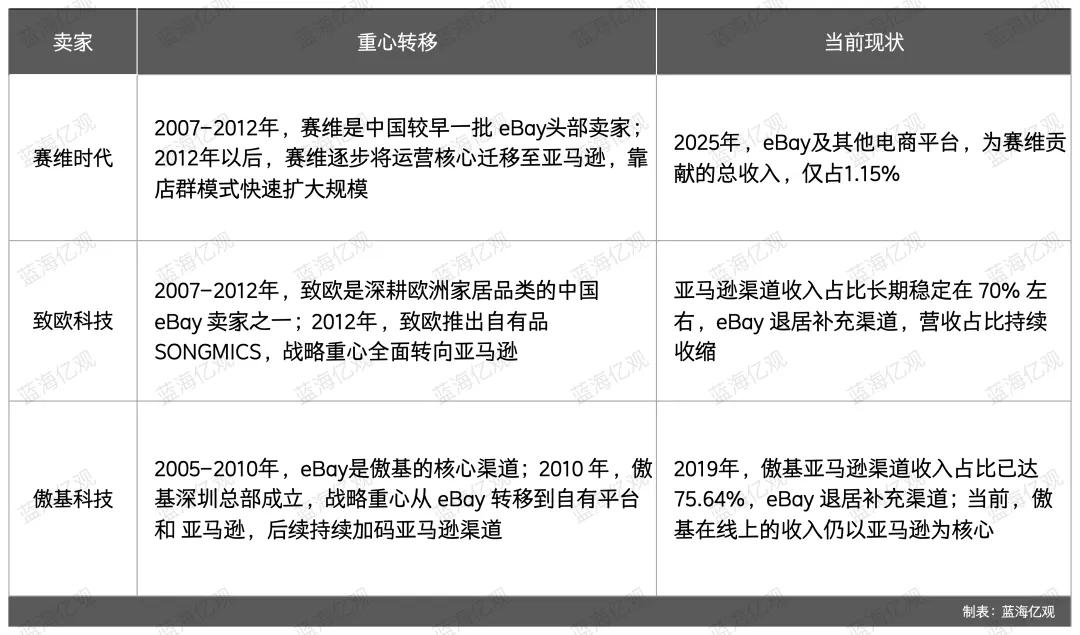
These companies were once the benchmark sellers on eBay, and later all grew into listed companies.
However, with the growth of eBay's traffic flattening out, the continuous solidification of its seniority-based weight system, and the increasingly diversified outbound platforms, the importance of eBay in the business territory of Chinese sellers is constantly being diluted.
For many sellers, eBay is transforming from a "core channel" to a "complementary channel". Even for eBay benchmark sellers such as Sailvan Times, Aukey and Aosom, they have gradually shifted their business focus to platforms such as Amazon, independent sites, TikTok and Temu.
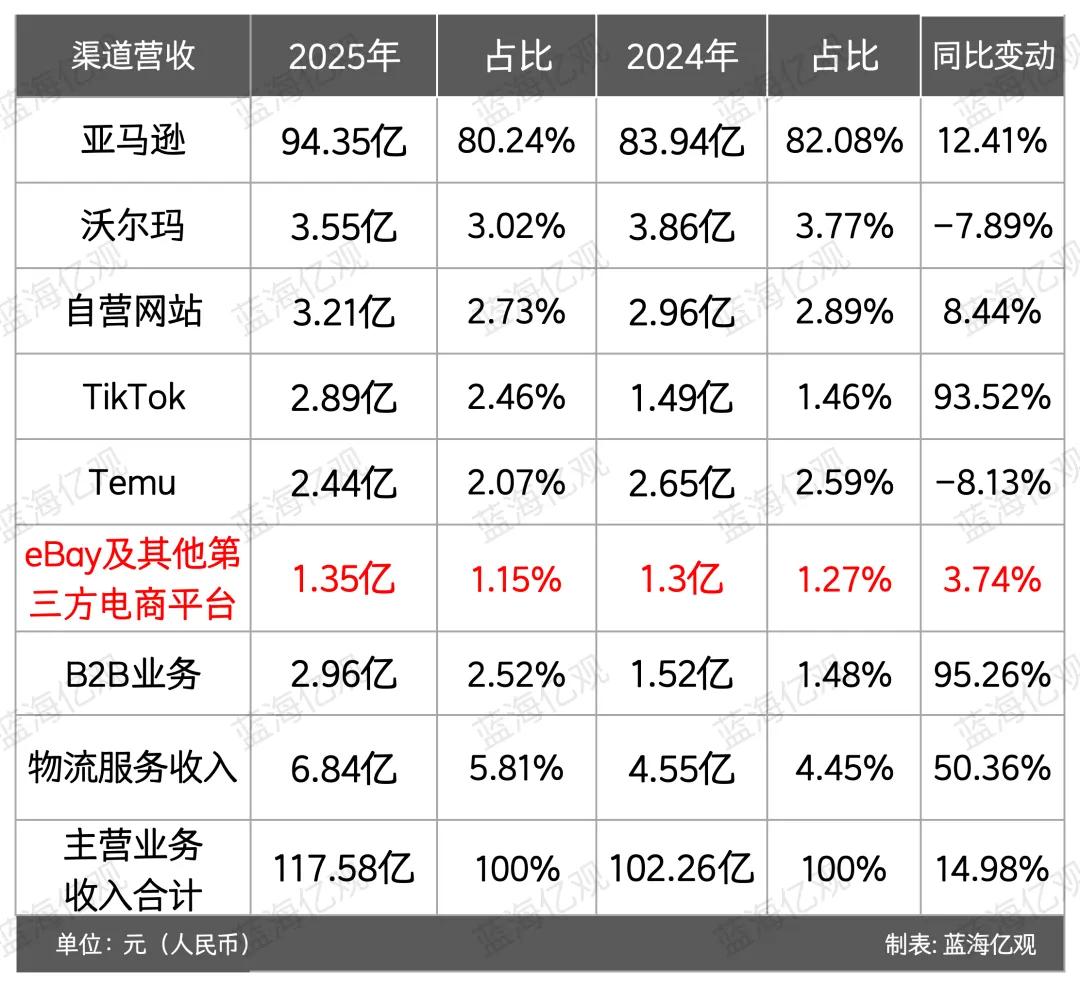
Taking Sailvan Times as an example, in 2025, Amazon took the lead, contributing 80.24% of Sailvan's revenue (9.435 billion yuan), while the total revenue from eBay and other e-commerce platforms only accounted for 1.15% of its total revenue, lower than the revenue from platforms such as Walmart, self-operated websites, TikTok and Temu.
As a number of Chinese sellers fade out of eBay, eBay continues to downsize its team, and in the recent round of large-scale layoffs, the China team has been listed as a key target.
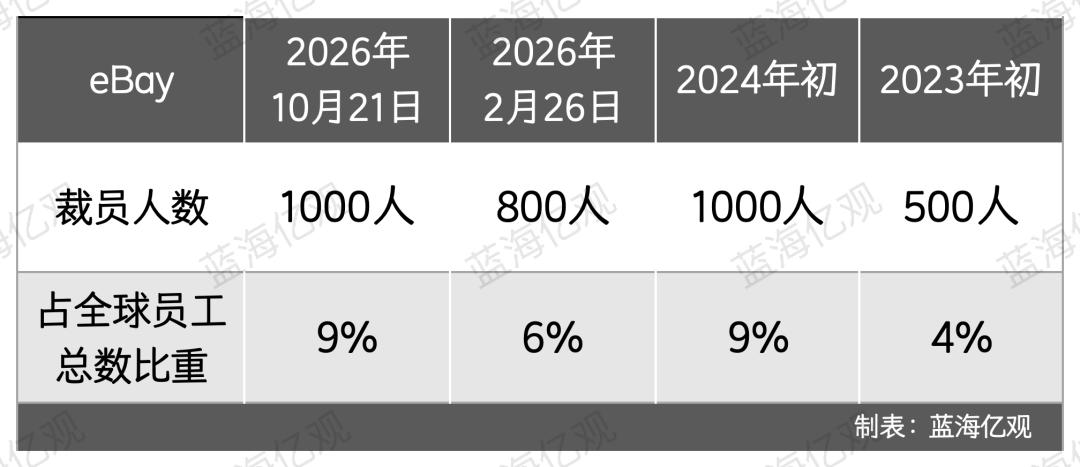
On October 21, eBay CEO Jamie Iannone announced that 9% of jobs will be cut, involving about 1,000 to 1,100 positions. This is eBay's fourth layoff in nearly three years.
In February this year, eBay just laid off about 800 employees (accounting for 6%), and from 2023 to 2024, eBay laid off about 1,500 people in a row.
According to "Workplace Bonus" news, the new round of personnel adjustments recently launched by eBay China involves major office locations such as Shanghai. According to disclosures from multiple independent sources, the layoff ratio in the China region may have reached 80%, "many eBay employees have started looking for opportunities on social recruitment software."
eBay's drastic move against the China team this round has made many Chinese sellers worry about whether it will affect their daily operations, including links such as manual customer service response time, appeal processing cycle and product review. Some sellers tried to contact their dedicated eBay account manager, but after half a day, they still did not get a reply. At present, there is no evidence that such situations are directly caused by this round of layoffs.
Behind eBay's consecutive layoffs, it is inseparable from its slow growth rate.
An eBay spokesperson admitted that the growth of employee size was faster than business development, and the company's cost pressure increased accordingly. This layoff is to invest more resources in core businesses.
eBay started with C2C auctions, and its asset-light model of "seller self-delivery + marketplace platform" gained advantages in the early years.
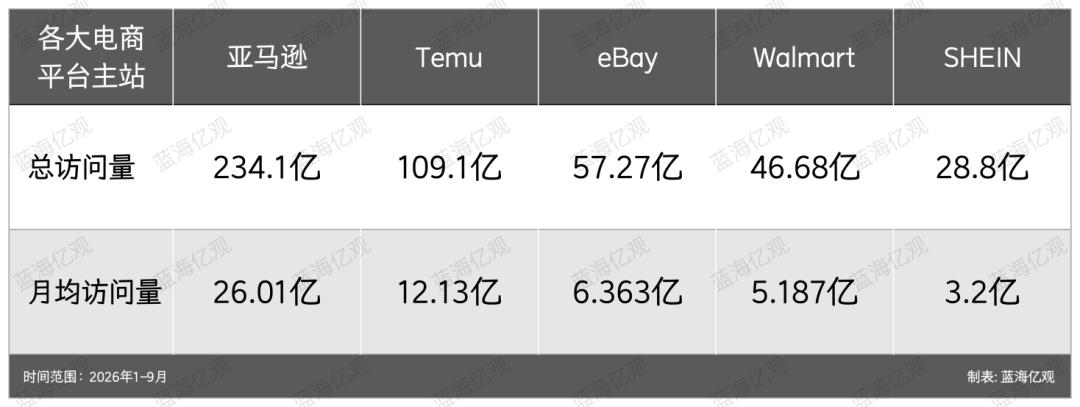
However, the situation has changed dramatically in recent years. When Amazon (self-operated logistics network + efficient delivery), Temu (full-hosting + ultra-low price), TikTok Shop (content marketing + impulsive consumption), SHEIN (small batch fast response + personalized design) have taken a large number of orders for standard products, fast-moving consumer goods, home furnishings, fashion and other categories, eBay has been caught up by rising stars such as Temu, SHEIN and TikTok Shop in terms of in-site traffic, GMV and seller scale.
When the profit of low-price stocking of standard products is squeezed to the limit, eBay, which once relied on stocking sellers to support its scale, is caught in a dilemma, and can only adopt the "shrinkage + defense" strategy, cutting off most of the investment promotion, R&D, localization and other teams targeting Chinese stocking sellers, and instead stick to its good tracks of non-standard products, niche hobby products and professional accessories.
The new opportunities that eBay can provide to sellers, especially new sellers, are getting fewer and fewer, so a group of sellers have chosen to vote with their feet.
Chinese Sellers Can Hardly Make It to the eBay Top List
In recent years, the "presence" of Chinese cross-border sellers on eBay has gradually declined.
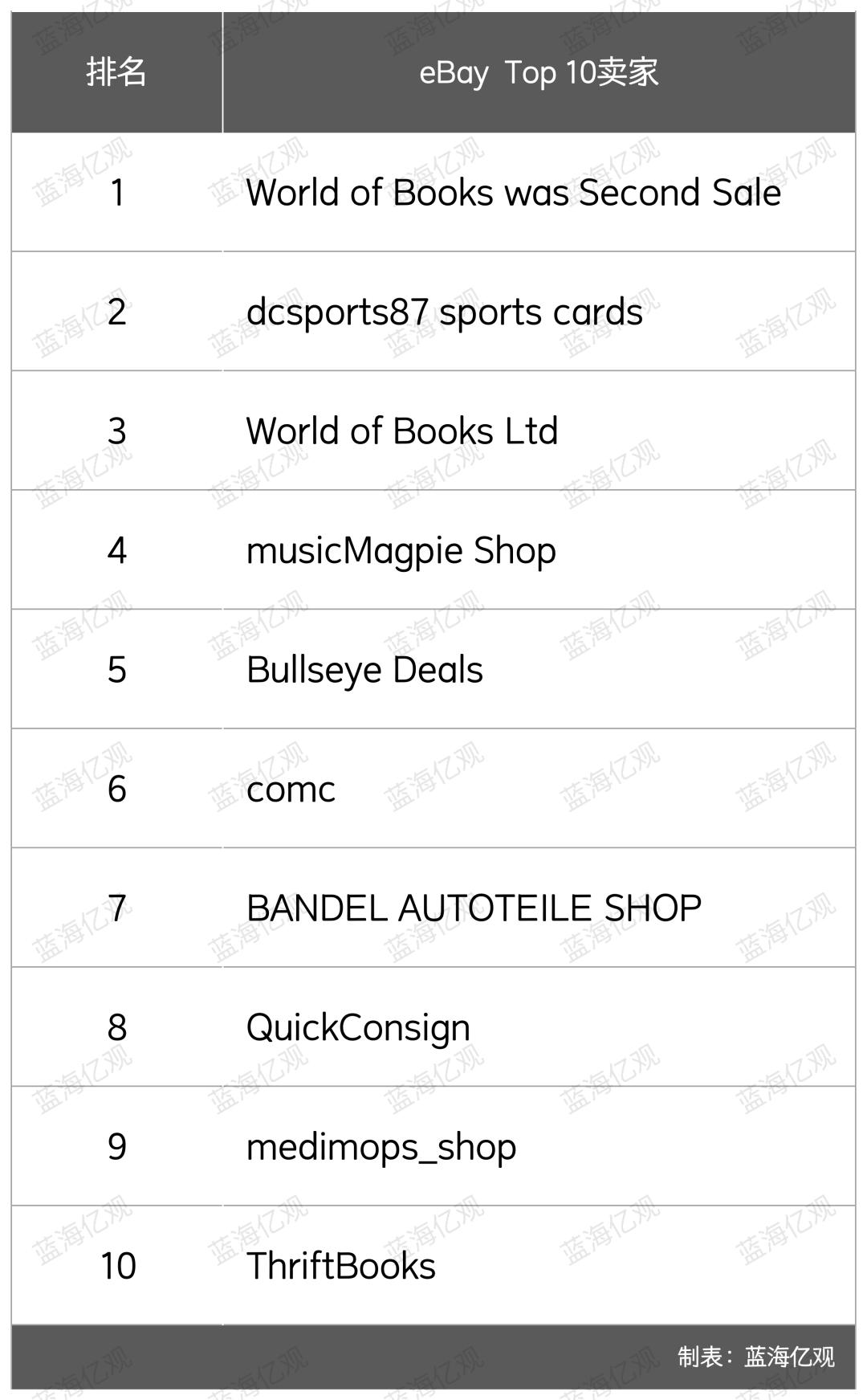
Data from Marketplace Pulse shows that in the eBay Top 100 seller list, European and American sellers occupy an absolute dominant position, while the presence of Chinese (cross-border) sellers is insufficient, among which American sellers alone account for 50 seats, while British and German sellers have 24 and 18 seats respectively.
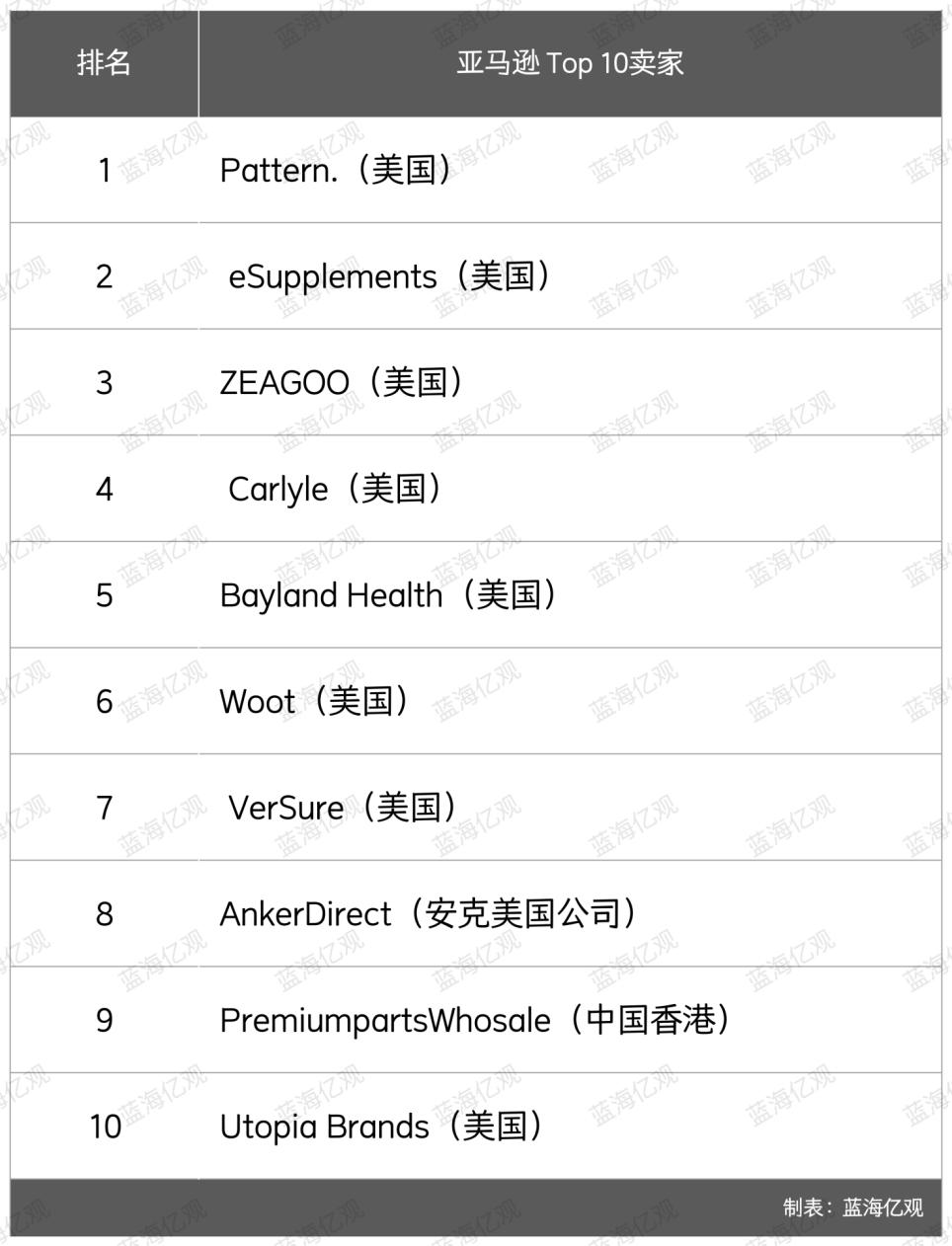
In contrast, in the Amazon North America site Top 100 list, Chinese sellers hold important positions, accounting for 15 seats in total, and if Anker's US company is included, there are 16 seats in total, forming a sharp contrast with eBay's Top 100 list.
Why have Chinese sellers faded out of eBay in recent years?
One of the important reasons is that eBay's total site traffic has peaked and grown slowly in recent years, while product supply and online SKUs are increasing, making a large number of sellers fall into the competition for stock resources, including traffic, advertising positions and buyer attention.
For veteran sellers who have been operating for many years, if they want to continue to expand their business scale on eBay, they may not get the same return as in the past. At the same time, the continuously rising operating costs such as logistics and commissions are also squeezing the profit margin of most sellers.
Against this background, some veteran sellers no longer regard eBay as an "incremental platform", and begin to gradually reduce their investment on eBay, only seeking to keep their existing stores, while devoting more energy and budget to emerging platforms such as Amazon, Temu, SHEIN and TikTok Shop to achieve business growth faster.
In recent years, the decline of store sales and traffic has become a problem repeatedly mentioned by many eBay sellers.
Many sellers feedback that even if they continue to increase their advertising budget and increase promotion efforts, it is difficult for their eBay store sales to improve significantly. In contrast, the same products, with the same or even less budget, often sell better on other platforms, and the sales of some products are even several times that on eBay.
Recently, a seller who has been operating on eBay for 16 years feedback that his store sales have declined for several consecutive months, and the latest month even dropped by 80%.
On Reddit, a US women's clothing seller who has been operating for nearly 5 years said that since May, the traffic and sales of his store have declined significantly, even after increasing the promotion of products and selling half of the products at 50% off, the sales are still sluggish. However, the sales of the same products on Poshmark reached 3 times that of eBay.
In the context of reduced opportunities, the growth rate of eBay sellers in recent years has slowed down significantly.
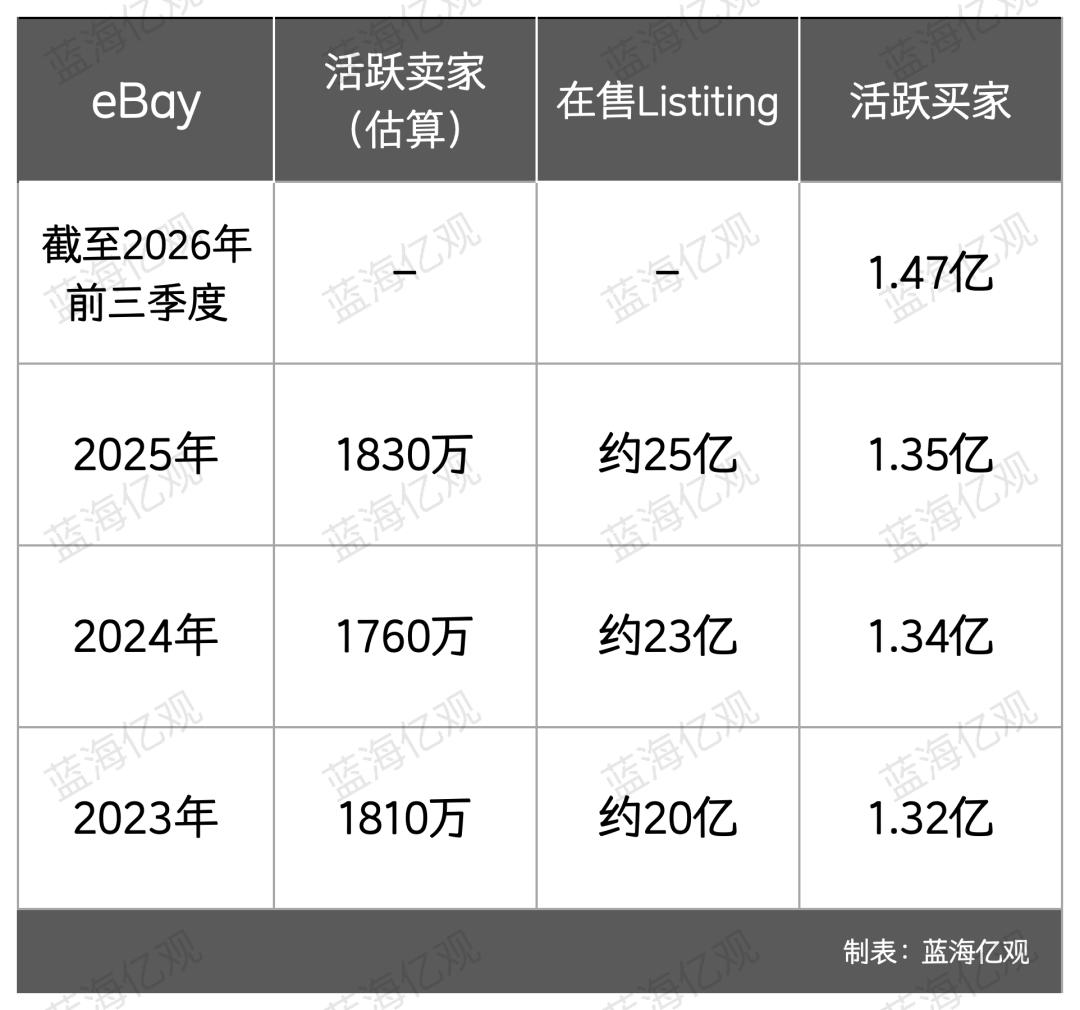
From 2023 to 2025, the estimated number of active sellers on eBay increased from 18.1 million to 18.3 million, an increase of only 200,000 in three years; at the same time, its number of active buyers grew slowly from 132 million to 147 million as of the first three quarters of 2026.
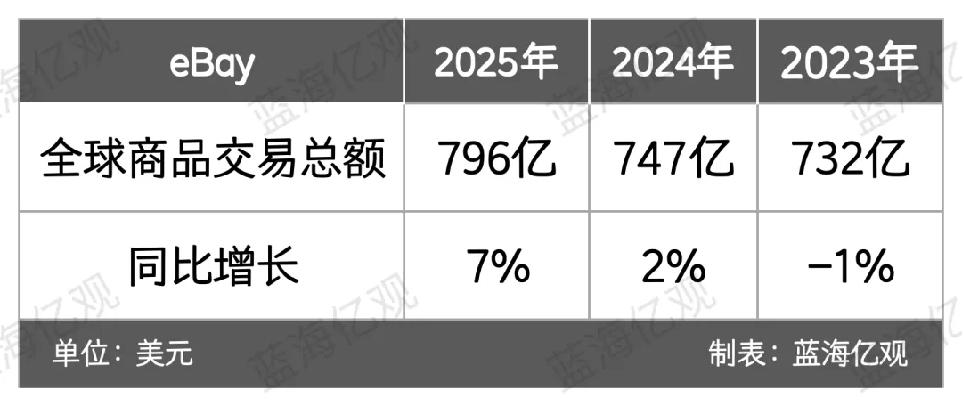
The growth dilemma of sellers has also been transmitted to eBay's GMV. In recent years, eBay's GMV has grown slowly, advancing at a growth rate of tens of billions of dollars per year.
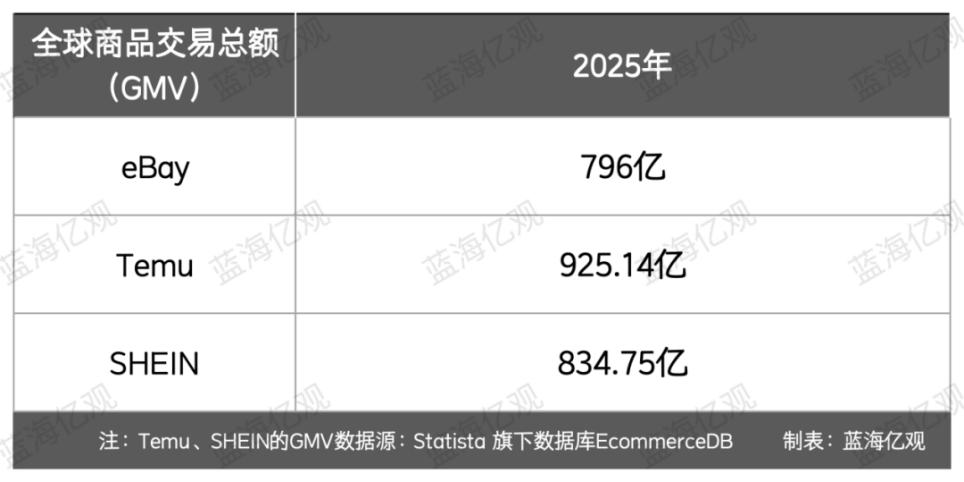
From 2023 to 2025, eBay's GMV only increased by 6.4 billion US dollars. In 2025, eBay's GMV reached 79.6 billion US dollars, which has been overtaken by latecomers Temu (92.514 billion US dollars) and SHEIN (83.475 billion US dollars).
Having said that, although eBay is trapped in the dilemma of slowing growth, it still has a solid foundation.
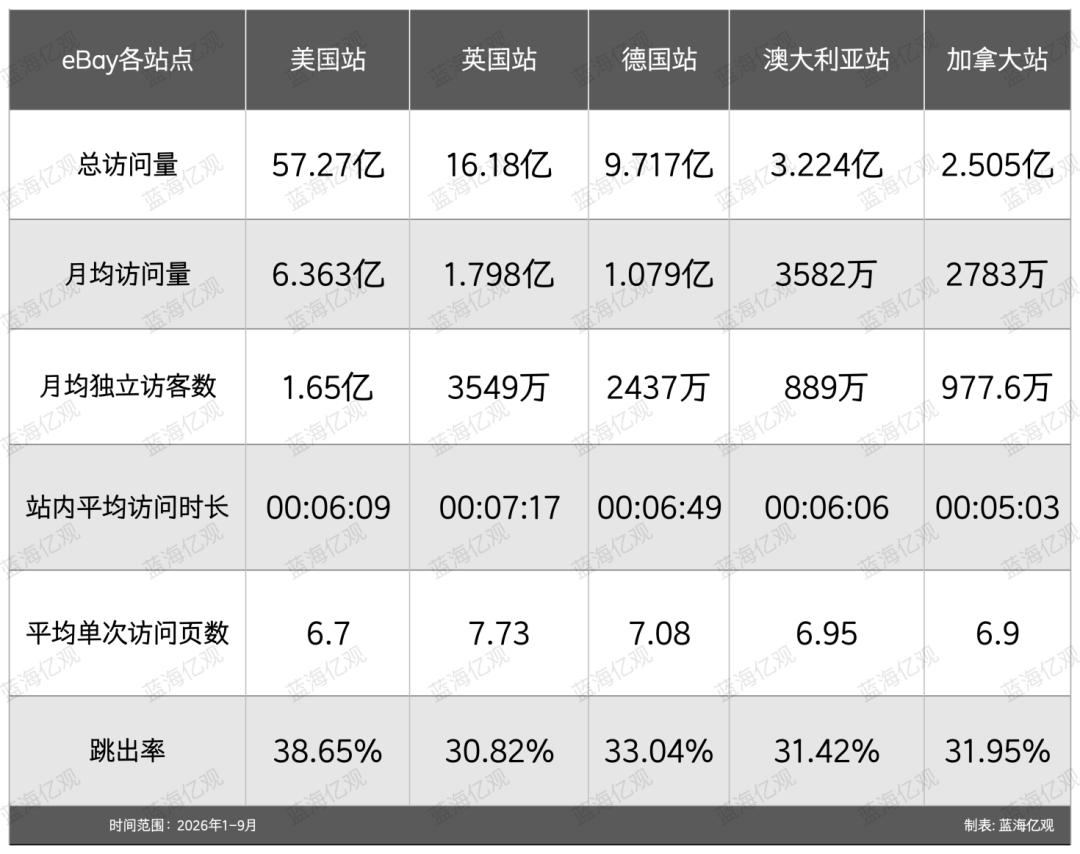
Relying on the traffic foundation and supply chain resources accumulated in mature markets such as the United States, the United Kingdom, Germany, Australia and Canada, eBay still "stabilizes" a group of long-term operating sellers.
From January to September 2026, the total visits of eBay US site reached 5.727 billion, while the UK site and German site reached 1.618 billion and 971.7 million respectively.
On the whole, eBay is not failing, but the new opportunities it provides to sellers are reduced. The entire eBay platform has entered the stage of "stock competition".
Among the top 100 sellers in eBay sales, nearly 50% are sellers who have opened stores for more than 10 years. For this group of sellers who opened stores around 2007, a number of veteran sellers firmly occupy the best positions, enjoying a "retirement life" with stable traffic and no worries about orders, while even if new sellers want to burn ads to boost their business, it will not help.
This situation makes a group of "sub-new sellers" and "new sellers" sigh in despair, and then choose to fade out or even completely withdraw from eBay in disappointment.
eBay Does Not Want to Fight a Fierce Price War, But Also Does Not Want to Lie Flat
eBay clearly understands that there is no chance of winning by fighting a fierce price war with Amazon, Temu, SHEIN and other platforms on low-price standard products. However, this does not mean that eBay wants to lie flat.
While laying off staff, eBay is also placing bets, concentrating resources on core category operation and AI tool iteration.
First of all, eBay is increasing its layout in core advantageous categories such as card collectibles, refurbished electronics, second-hand vintage products, auto parts, fashion, and second-hand transaction business. Secondly, it is devoting greater efforts to AI, introducing AI into links such as product listing, in-site search and recommendation.
For eBay, categories such as trading cards, auto parts, and second-hand vintage products have strong buyer stickiness and high premium, and are not easy to be crushed by full-hosting low-price platforms such as Temu, so eBay has poured more resources into these advantageous categories.
In the third quarter of 2026, eBay's key categories, C2C and second-hand commodity transactions have accounted for more than 72% of its GMV (excluding Depop).
Among them, the GMV of eBay's key categories increased by