AI needs a "call button"
In 2026, the AI industry is stuck in a counterintuitive awkward period.
On one hand, current AI demand is skyrocketing. According to OpenRouter data, the volume of Token processing scheduled on its platform has increased by approximately 250 times within 20 months, reaching 128.4 trillion; the computing power rental market has also risen accordingly, with the rental price of H200 increasing by 160% and B200 by 120% within the year.
However, the profits that end up in pockets are exceptionally bleak. Data from the same OpenRouter shows that open-source weight models processed 72% of Tokens in the second week of September, but only received 27% of the platform's total expenditure.
Not only can platforms not get their share of revenue, model companies themselves are bleeding cash. Take Zhipu AI as an example, its adjusted net loss in the first half of 2026 is nearly 2 billion yuan; and OpenAI across the ocean also recorded an operating loss rate as high as 122% in the first quarter.
The surging demand has failed to drive up the profits of model companies. This makes people ponder deeply: what exactly is blocking AI from reaping profits?
01. Replaced Old Tasks and Unclear New Accounts
When AI enters the market, the first to be impacted are those highly standardized dedicated tools.
For example, services that used to require separate purchases such as translation, basic customer service, and code completion are now being fully taken over by large AI models.
According to Anthropic's report, the task automation coverage for computer programmers has reached 74.5%, and for customer service representatives 70.1%; the translation field is even more extreme, as previous research from Microsoft shows that AI is already competent for 98% of the content in interpretation and translation work.
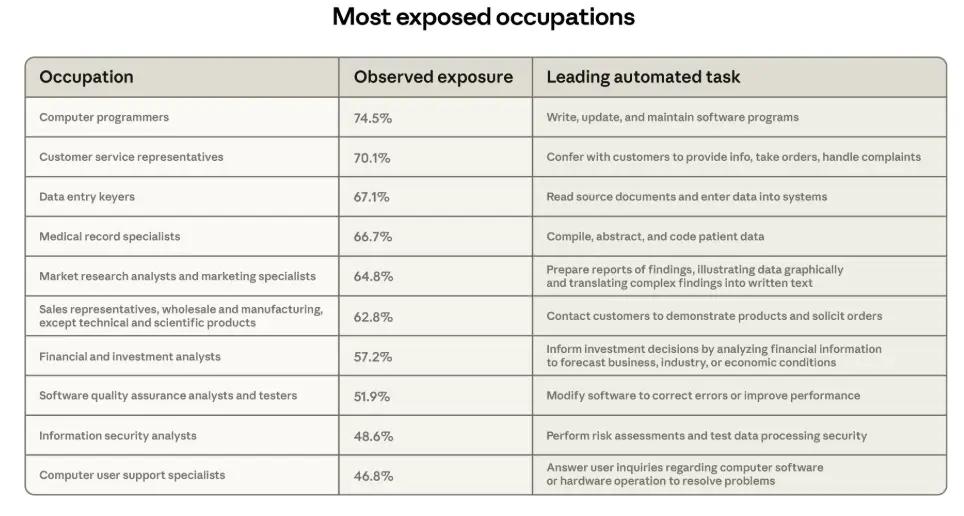
(Image source: Anthropic)
AI has directly taken away these old tasks that were originally supported by a large number of small and medium-sized service providers. The original old market is real, and people's demand for AI is naturally real as well.
But while the demand is met, the accounting model has not been inherited along with it.
In the traditional dedicated market, what people buy is the "result".
For example, you pay for translation by the thousand characters, and get quoted for programming by the project. This kind of transaction is just like buying clearly priced goods in a supermarket: customers know exactly how much they pay and what they get in advance.
But now most mainstream large model companies have adopted a different model, similar to utilities like water, electricity and gas, using a "pay per consumption" strategy, with the pricing unit changed to Token.
This leads to the situation where customers are faced with a cost account that is completely unclear in advance.
The first problem is that Token consumption is not visible.
When users use AI to complete tasks, they cannot predict how many Tokens will be consumed in advance. For a seemingly simple task, the underlying call chain may be very long. This "invisibility" is very likely to cause users to generate a large number of calls unconsciously, and when the bill comes out, the cost often far exceeds expectations.
For example, according to Axios citing real revelations from AI consultants, an enterprise opened Claude access to all its employees without setting a budget cap. Since no tool can accurately estimate the Token consumption behind each conversation and each call chain, the company simply did not and could not measure the approximate cost level in advance.
As a result, when the monthly bill came out, it directly created a staggering $500 million deficit. For many listed companies, $500 million is enough to wipe out their full-year net profit, and this is only one month's cost, which can be called a sudden financial disaster for any enterprise.
Similarly, after Uber deployed Claude Code, due to insufficient estimation of call volume, it only took four short months to exhaust its full-year AI budget.
This experience of "cannot calculate in advance, and get shocked after the fact" will likely make customers more cautious in usage, for example, imposing usage restrictions on permissions, budgets, and call scopes.
A survey by Cloudera once pointed out that due to the difficulty of cost estimation, 89% of respondents said their enterprises were forced to reduce or redesign their AI plans this year.
Not only that, this opacity also deprives users of the basis for price comparison.
When you buy a bottle of water, it costs about 2 yuan, everyone knows that clearly, and the cost-effectiveness is obvious at a glance. But when facing AI billed by Token, since the consumption of each task is different, users may not be able to judge whether it is more cost-effective to use AI for this task or to go through traditional channels.
Even if users grit their teeth and accept this billing method, or see clearly every bill, Token consumption may not bring equivalent commercial value to users.
Data aggregated by Entelligence AI shows that for every 1 US dollar invested in Tokens, only 18 cents generate actual value, 44 cents are used for bug fixing, and 27 cents go to rework. A survey by Accenture also shows that less than 20% of Token expenditures can be linked to quantifiable business outcomes.
In other words, enterprises spend a lot of money on AI, but most of their budget is spent paying for its "immaturity" and "mistakes". With such input-output ratio, enterprises that originally expected to "lie flat" with the help of AI end up "subsidizing" it instead.
This imbalance may not only directly drive away old customers and reduce repurchase rate, but also scare off new customers and limit future expansion.
It can be seen that although AI has taken over the market share of the old market, the unclear pricing and lack of equivalent value make users reluctant to pay. As a result, the profits of the traditional market have not been passed on to large model companies.
02. The "Result" That Cannot Be Written Into Contracts
Selling by consumption cannot generate revenue, so the logical "solution" seems to be to go back and inherit the "pay by result" model of traditional dedicated tools, but this path is also blocked for AI.
In traditional tools, results are tangible. Translation agencies deliver translated manuscripts, customer service staff close work orders, and code completion generates a segment of program. These results have clear boundaries, can be accepted after inspection, and can be priced.
But AI breaks the boundary of capabilities. It can not only write poems, but also write codes, and even analyze financial reports conveniently. This makes it very difficult to use a standard contract to stipulate "what counts as completing the task" and "what is the value of so many tasks completed together", which is the so-called "attribution" dilemma.
The reason why attribution is difficult is that a real business result is usually achieved by multiple links working together.
For example, an enterprise launched AI marketing, and the conversion rate increased by 20% in that quarter. But how much of this 20% is attributed to AI's capabilities, how much to the help of manual operation, and how much to the possible cyclical recovery of the market?
UCloud, a cloud service provider, put it very directly: a business result is usually the product of the joint action of multiple links, and it is difficult to simply attribute the final effect to a single call of a certain model. That is to say, when multiple factors such as AI, machines, manpower, and environment work together, value segmentation becomes a deadlock in AI billing.
Stripe has specially released guidelines for outcome-based payment, which clearly reminds that if the attribution standard is not clearly defined in the contract in advance, disputes may arise between customers and vendors over "who the outcome belongs to".
Without a unified judgment standard, result-based billing is impossible to implement.
Even if there are vendors that implement result-based billing in the market, they are limited to single closed-loop scenario fields. To put it simply, they usually only let AI do one type of work, and charge only when AI is doing the work.
For example, Salesforce, which does CRM overseas, its Agentforce in the customer service scenario only charges when AI independently completes the closed-loop without transferring to human agents; domestic Bairong Intelligence also settles in the customer service scenario based on "work orders successfully completed without transferring to human agents".
AI has been applied and generated value, and a single application may be a solution, but it also restricts AI's capabilities to one scenario, turning it back into a dedicated tool.
Thus it can be seen that results are difficult to define and attribution is difficult to split. When general large models sell "results", they still cannot fully provide the market with an operation model that can not only retain AI's "all-capable" features, but also make accounts clear.
Therefore, if general large models want to break this deadlock, they may need to find a new solution that can truly land value.
03. Establish Anchor Points First, Then Build Entries
When the two tactical billing models of selling "consumption" and selling "results" both fail, the key of the problem points to a strategic "absence".
Large model companies have been trying to enter the market through multiple paths with AI's general capabilities, using AI's cross-domain capabilities to achieve "grand unification" of the originally scattered dedicated markets.
Although AI's general capabilities can indeed swallow the demand of a large number of dedicated markets like a black hole, it is precisely because it "can do everything" that it appears to lack irreplaceability in specific business scenarios.
In fact, this dilemma of "how general tools take root in the market" is not unique to AI. Looking back at the evolution history of technology products, those general tools that eventually grew into behemoths are usually very specific at the starting point.
Take mobile phones as an example. It is a general device integrated with multiple functions, and now people can use it to do many things on the Internet. But in the early stage, its way to enter the market was very direct, using a physical hardware to bring people the convenience of "making phone calls anytime, anywhere".
Take Nokia 1100 as an example. From its launch in 2003 to its discontinuation in 2009, it sold more than 250 million units in total, becoming the best-selling mobile phone in history.
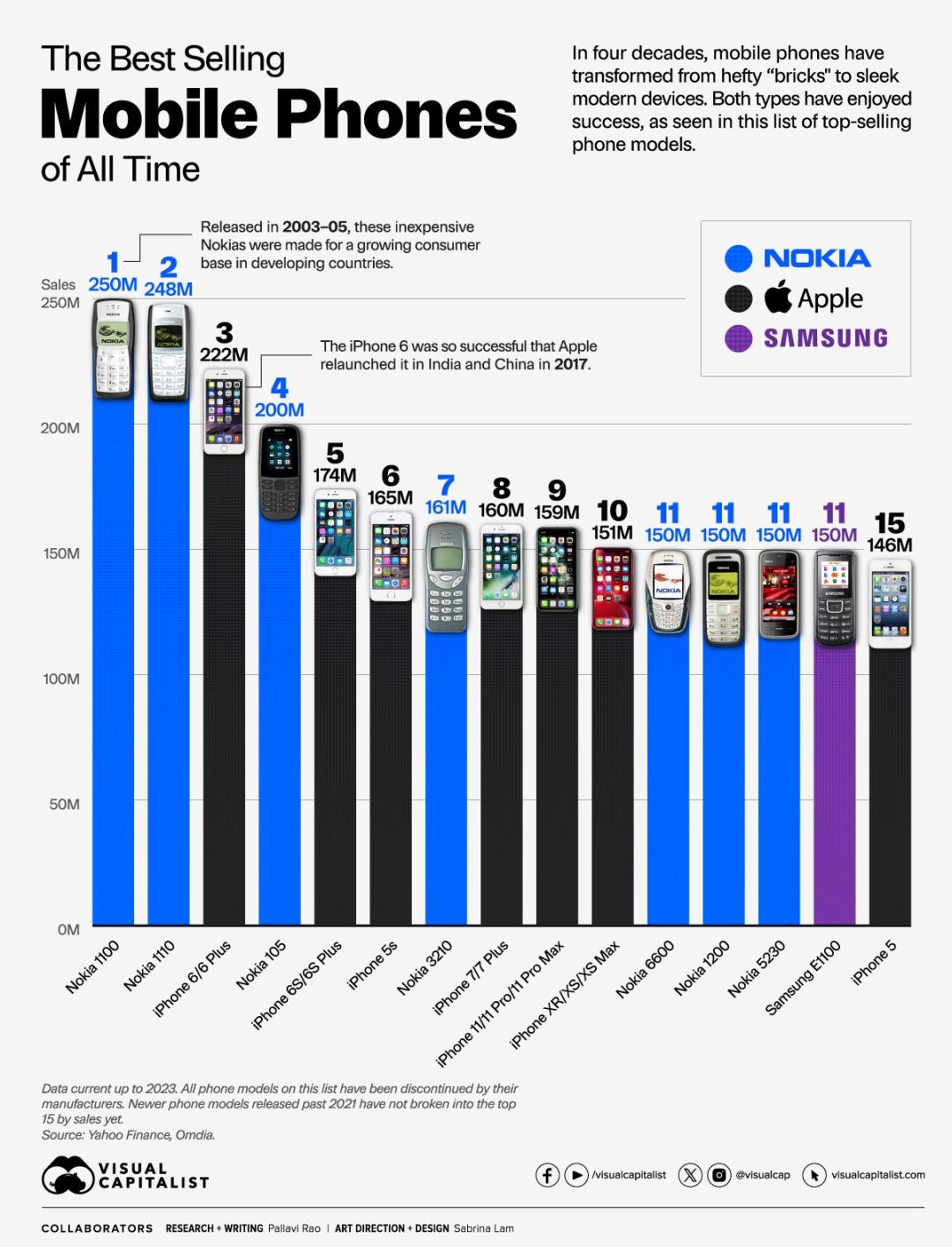
From today's perspective, the functions of this mobile phone are even more rudimentary than the small smart watch on a primary school student's wrist. It has no camera and no application ecosystem. Its 400-hour standby time and anti-slip, dustproof shell are completely designed to ensure the single demand of "making a call anytime".
Functions such as checking the time, checking the calendar, and playing Snake were all added after the call entry was firmly established, or in other words, these are Nokia's associated functions rather than core selling points. Users will not buy it separately just to check the time or calendar, but they are willing to pay for the convenient transmission of information.
Later, Nokia was eliminated by smartphones, which is the result of the replacement of hardware forms in technological iteration, not the mistake of this strategy itself. If we set aside the rise and fall of the product itself, the revelation it leaves for AI is still valid, that is, to gain a firm foothold in the market, AI must first rely on a high-frequency, rigid-demand anchor point.
In other words, current AI is like a super smartphone stuffed with various APPs, capable of writing poems, drawing pictures, and writing codes, but it also needs to find its own "call button".
Admittedly, AI is not like Nokia that can become a "small cuboid" held in users' hands, but AI can be "embedded". No matter this "embedded" node is in B-end enterprises' financial reimbursement, equipment maintenance, or in C-end users' AI search, travel planning.
When AI is embedded as a node, its output becomes a deliverable that can be clearly recorded by the process. You don't need to see how much credit AI takes, you only need to see whether the efficiency of this node itself has improved.
For example, Lenovo's financial Agent directly covers 32 core financial processes, increasing invoice processing efficiency by 50%. Dongfeng eπ's intelligent agent "Equipment Master" shortened the machine fault response time from 10 minutes to 4 minutes, directly reducing enterprise losses...

(Image source: Feishu)
It can be seen that when AI is embedded into a specific task node, it obtains a container that can clearly show the delivered value. Only on this basis can large model companies rebuild a charging structure that makes people willing to pay.
As for what this charging structure is, it is still unknown now. In the future, it may be a fixed system subscription fee, a commission drawn from the saved costs, or some dynamic pricing model that evolves.
But no matter which choice is made, if the AI business wants to make real profits, it must make AI value "calculable" and "visible". Otherwise, no matter how perfect the billing model is, it is just a dead letter.
After all, in the business world, value comes first, then payment. If you haven't found a stable value anchor point yet and rush to settle accounts with customers, it is destined to be just a cruel one-sided "unrequited love".
* Images are from the Internet, please contact us for deletion in case of infringement
This article is from WeChat Official Account "Deep Gaze Finance" (ID: chutou0325), written by Xia Qi, published with authorization from 36Kr.